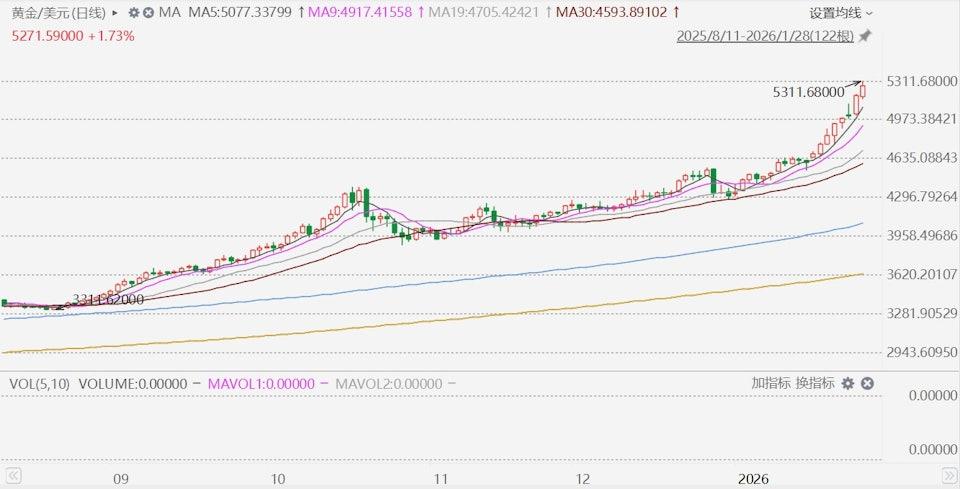
Gold prices continued to strengthen against the backdrop of the Federal Reserve keeping interest rates unchanged. Spot gold broke through the $5,500 per ounce mark for the first time during the session, last trading at $5,484. Over the past year, gold prices have risen by more than 80%. Despite the remarkable gains, mainstream Wall Street institutions remain generally optimistic about the medium- to long-term prospects of gold.
Article author: Gelonghui
Source: Hong Kong 01
Gold prices continued to strengthen against the backdrop of the Federal Reserve keeping interest rates unchanged. Spot gold broke through the $5,500 per ounce mark for the first time during the session, last trading at $5,484. Over the past year, gold prices have risen by more than 80%. Despite the remarkable gains, mainstream Wall Street institutions remain generally optimistic about the medium- to long-term prospects of gold.
Goldman Sachs: The Dual Engines of Fear and Wealth
Core forecast: We raise our December 2026 price target to $5,400/oz, with a potential target of $6,000/oz in the spring.
Core logic: Goldman Sachs' bullish judgment is based on its "fear and wealth" model.
- The "Wealth" Effect (Emerging Market Central Banks): Since geopolitical events in 2022 led to the freezing of foreign exchange reserves in some countries, there has been a structural shift in the confidence of central banks globally, especially in emerging markets, in the safety of dollar assets. Goldman Sachs predicts that monthly central bank gold purchases will remain at a historical high of approximately 60 tons until 2026. This diversification driven by "national wealth" provides a solid physical demand floor for gold prices, making them less sensitive to high-interest-rate environments.
- The "fear" effect (private investors): The continued expansion of the US fiscal deficit and rising uncertainty surrounding tariff policy have reignited safe-haven demand among Western private investors. ETF fund flows show that funds are shifting from US Treasuries to gold to hedge against global policy risks. Goldman Sachs believes that this demand is unlikely to subside until there is a significant improvement in US fiscal discipline.
- Structural Revaluation: Goldman Sachs points out that, without considering large-scale liquidation by private investors, the central price of gold has been permanently raised. Gold is listed as the top commodity asset in 2026 and is expected to outperform energy and industrial metals.
JPMorgan Chase: De-dollarization and a Structural Bull Market
Core forecast: Average price of $5,055/oz in Q4 2026, with a target of $5,400/oz in 2027.
Core logic:
- Central bank demand lacks price elasticity: Analysts believe that central bank gold purchases are not highly sensitive to price. Even if gold prices break through $5,000, central banks will continue to increase their gold holdings to "de-risk" their foreign exchange reserves. The report also points out that Chinese demand and new allocation demand related to crypto assets constitute a significant incremental factor.
- Debt expansion and currency devaluation: In an environment of continuous expansion of global debt, "currency devaluation trading" has become the main theme, and gold, as an asset without counterparty risk, is expected to see its premium continue to rise.
- Long-term bullish outlook: JPMorgan believes that gold price pullbacks should be seen as buying opportunities, as the rise is supported by long-term balance sheet restructuring needs, rather than short-term speculation.
Bank of America: "Forget $5,000," aim for $6,000.
Core expectation: Target price of $6,000/ounce in spring 2026.
Core logic:
- Historical Bull Market Retrospective: Looking back at the past four major gold bull markets, gold prices have risen by an average of 300% over approximately 43 months. If the current market trend follows a similar pattern, $6,000 is not an aggressive target.
- Supply-side constraints: Production from major North American gold miners is projected to decline by approximately 2% in 2026, while the all-in sustaining cost (AISC) is expected to rise to $1,600 per ounce. Declining production and rising costs will limit the downside potential for gold prices from the supply side.
- Preferred hedging tool: Bank of America clearly views gold as a primary hedging tool and potential source of alpha in its portfolio for 2026, and recommends maintaining an overweight position.
Citigroup: Tactical Bullishness and Strategic Divergence
Core expectations: Short-term (0–3 months) target of $5,000/oz; neutral in the baseline scenario, and up to $6,000/oz in the bull market scenario.
Core logic:
- Baseline scenario (50% probability): If tariff concerns ease and the global economy achieves a soft landing, gold prices may experience neutral fluctuations or a slow decline.
- Bull Market Scenario (30% Probability): If the US experiences stagflation, or if the Federal Reserve significantly cuts interest rates, causing the dollar to weaken, gold prices may hit $6,000 in 2027.
- Relative value judgment: In terms of commodity allocation, Citi is relatively more optimistic about copper and aluminum, believing that their supply and demand fundamentals are becoming more strained due to the energy transition and the construction of AI data centers.
Deutsche Bank: "Super Bull" in Extreme Scenario
Core forecast: $6,000/oz in 2026, and potentially $6,900/oz in an alternative scenario.
Core logic:
- Safe-haven funds inflow: Increased geopolitical and economic uncertainty has triggered a concentrated inflow of funds into safe-haven assets, exceeding the expectations of traditional models.
- Gold-silver ratio correction: Silver's rebound is expected to be supported by the correction of the gold-silver ratio, which in turn will support gold's high level. At the same time, Chinese demand will provide overall support for the precious metals sector.
Société Générale: Target Achieved, Aiming for New Highs
Core expectation: Year-end target price of $6,000/ounce.
Core logic:
After the $5,000 target was quickly surpassed, Societe Generale believes its previous assessment was too conservative. Expectations of a Fed rate cut, policy uncertainty, and continued investment demand are the three main drivers of rising gold prices. If inflation picks up again, $6,000 may only be a temporary target.
UBS: Core Assets for Structured Allocation
Core expectation: Prices will remain around $5,000/oz in the first three quarters of 2026, and may rise to $5,400/oz if risks intensify.
Core logic:
- Driven by two engines: simultaneous increases in holdings by official departments and private investors, with central banks expected to purchase approximately 950 tons of gold in 2026, locking up a significant proportion of global supply.
- Assets outside the credit system: With declining real interest rates and the normalization of fiscal deficits, gold, as an asset outside the credit system, has a historically high strategic allocation value.
Morgan Stanley: Accelerated Upside in a Bull Market Scenario
Core expectations: Baseline scenario: $4,500/oz; Bullish scenario: $5,700/oz.
Core logic:
- Risk barometer: Gold is considered a core indicator for measuring multiple risks.
- A weaker dollar is expected: As monetary policy shifts towards easing, a weaker dollar will become a significant driver of gold prices.
Wells Fargo: Upholding its Value Store of Interest
Core expectation: $4,500–$4,700 per ounce.
Core logic: In an environment of sticky inflation, high government debt, and geopolitical tensions, gold remains a reliable long-term store of value.
Barclays Bank: The Resonance of Industrial and Monetary Attributes
Core expectation: $4,550/ounce, with a bullish outlook on silver.
Core logic: Historical data shows that rises in precious metals are often accompanied by strength in industrial commodities. Silver, driven by both industrial demand from sectors like photovoltaics and electronics, and its monetary attributes, exhibits greater elasticity.
TD Securities: Significant Overall Revaluation
Core forecast: Average price of $4,831/oz in 2026, with a high of $5,400/oz in the first half of the year.
Core logic: TD believes that the precious metals sector is undergoing a systematic revaluation, with the overall pricing center of safe-haven assets shifting upward, benefiting gold, silver, and platinum.