On-chain evidence suggests that a single entity systematically hoarded up to 10% of the total LINK supply (approximately 100 million tokens) during and after the "10.10 market crash".
Written by: LinkBoi
Compiled by: AididiaoJP, Foresight News
Based on in-depth on-chain data analysis, I discovered an unusual pattern while studying the top 100 wallets in terms of LINK holdings.
Multiple wallets held almost identical amounts of LINK, approximately 2 million each, and held no other assets. Initially, I identified 8 to 9 similar wallets, but further investigation revealed that these were just the tip of the iceberg.
Ultimately, I found a total of 48 wallets with almost identical LINK balances and highly consistent transaction patterns. Based on this consistency, I believe they belong to the same controlling party.
In other words, between August 2025 and January 2026, a certain entity acquired approximately 100 million LINK tokens, representing 10% of its total supply.
It is clear that this entity is making every effort to remain anonymous. Its accumulation strategy is carefully designed to avoid attracting attention or affecting market prices.
Why are these wallets determined to belong to the same entity?
Several key pieces of evidence support this:
- Each wallet holds approximately 2 million LINK.
- All wallets were created between August and November 2025.
- All purchases were made from the same Coinbase hot wallet address: 0xA9D1e08C7793af67e9d92fe308d5697FB81d3E43.
The most convincing evidence comes from the comparison of transaction heatmaps. The heatmaps of these wallets are strikingly similar, all executing a similar number of LINK transactions on the same dates and following the same accumulation rhythm.
There are slight differences in timing: wallets created later tend to have larger initial purchases, while those created earlier are more gradual. However, after the initial phase, all wallets begin to make continuous purchases on the same day each month.
For example, observing wallets 54, 55, and 56, the August data differs slightly, but the transaction behavior from September to January is almost completely synchronized. This pattern repeats across all 48 wallets, as if operating on the same timetable.
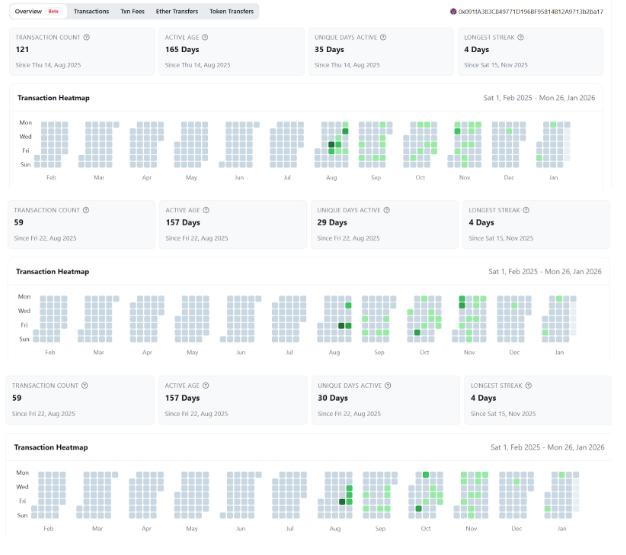
The link displays these 48 wallets and their transaction heatmaps, allowing readers to verify them themselves.
Why is the market not reacting to a 10% increase in supply?
The answer is simple: the entity is doing everything it can to avoid disrupting the market.
They used anonymous wallets without publicly disclosed institutional affiliations and purchased LINK in structured, phased batches to avoid sudden surges in demand. Their objective was clear: to quietly accumulate LINK without triggering market speculation or bandwagon effects.
To this end, they took advantage of a rare market event.
The market crash on October 10
According to Raoul Pal, market makers were unable to access the API at the time, causing a severe imbalance in the crypto market. Simultaneously, tariff concerns triggered panic selling, flooding the order book with sell orders. Due to a lack of buyers, the market experienced a freefall.
To prevent a complete collapse, exchanges were forced to intervene, placing a large number of buy orders to absorb selling pressure, thus accumulating a large amount of crypto asset inventory.
In the weeks following the crash, these assets were gradually released back into the market in October and November, creating sustained selling pressure and unusually abundant liquidity.
This is the perfect time for covert accumulation.
The entities behind these wallets took advantage of the liquidity window to absorb large amounts of LINK while avoiding price inflation. Notably, 39 out of the 48 wallets were created during October and November, when liquidity was at its peak.
Two possible motivations
First, it presented an opportunity to accelerate accumulation. The entity viewed the market crash as a rare opportunity to speed up its accumulation process, which might otherwise have taken several more months.
Second, there's the issue of emergency strategic reserves. This entity may urgently need to acquire LINK and quietly build its position using the liquidity generated by the price crash, thus avoiding further price volatility. Whether this urgency stems from strategic needs or external pressure remains unclear.
Impact on exchange balance
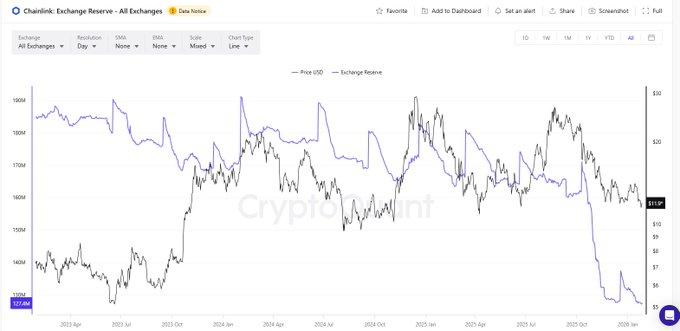
The surge in new wallet purchases coincides closely with CryptoQuant data showing a sharp drop in LINK balances on exchanges from October to November.
This drop corresponds to the creation of 39 new wallets, each accumulating approximately 2 million LINK during this period.
Who could be the entity behind it all?
The potential range for accumulating 10% of the LINK supply has been greatly narrowed.
Chainlink Labs
The likelihood is low. Chainlink officially holds approximately 300 million LINK tokens as non-circulating supply, which is publicly disclosed and included in its plans. Furthermore, Chainlink has publicly announced that it will repurchase $1 million worth of LINK every week. If it were to secretly hoard nearly $1 billion worth of LINK at the same time, it would contradict its public stance.
However, the timing is noteworthy: the accumulation begins on August 11, 2025, exactly four days after Chainlink's reserve mechanism was announced, which may be sending a long-term positive signal to the outside world.
BlackRock
This is one of the more reasonable speculations. BlackRock, with $14 trillion in assets under management, has repeatedly stated that tokenization is the future of financial markets. Its BUIDL fund, with over $3 billion in assets, is highly dependent on Chainlink's CCIP, proof-of-reserve, and data services.
Holding 100 million LINK tokens would help it secure a strategic position in the tokenization infrastructure. While the allocation is relatively small relative to its size, it is significant. Secret accumulation is also logical; a large-scale, premature public purchase would inevitably drive up the price.
JPMorgan Chase
It is also a possibility. This trillion-dollar bank is rapidly expanding its blockchain division (Kinexys, formerly Onyx) and has become one of the most active traditional institutions in the field of tokenized assets and cross-chain finance.
Its tokenized money market, funding projects, and multiple public chain settlements in 2025 all rely on Chainlink's CCIP, runtime environment, and oracle data streams. Holding 100 million LINK will help establish interoperability between its permissioned chains and public chains and its strategic position in the oracle infrastructure, ensuring priority access, staking rewards, and reducing dependency risks.
Interestingly, JPMorgan Chase's actions before and after the October 10th crash are noteworthy. Just days before the plunge, the bank released a bearish report highlighting the vulnerability of crypto-related stocks to geopolitical risks. Although the crash was primarily triggered by external factors, the consecutive bearish reports and liquidity vacuums have led to speculation that large institutions may have been quietly building positions.
Financial infrastructure institutions (such as DTCC and SWIFT)
The likelihood is low. Such institutions typically do not hold strategic token reserves. More importantly, if Chainlink becomes part of its future core infrastructure, DTCC or SWIFT are unlikely to tolerate an unknown entity controlling 10% of the LINK supply—this would pose an unacceptable systemic risk.
Another detail worth noting:
All 48 wallets were created between August and November 2025, with the last one created on November 20 – just two days before SWIFT adopted the new ISO 20022 standard, and Chainlink is a participant in the project.
While the timing of these coincidences doesn't constitute causal evidence, it's difficult to ignore. If LINK is to play a significant role in future financial communications, settlement, or interoperability infrastructure, building strategic reserves beforehand is undoubtedly a reasonable long-term strategy.
For institutions aiming for long-term consolidation rather than short-term speculation, locking in supply in advance can reduce execution risk, mitigate price shocks, and reduce reliance on future liquidity.
High-net-worth individuals
The likelihood is extremely low. 100 million LINK tokens are worth more than $1 billion, and very few people can mobilize such a large amount of funds. It is even rarer to concentrate such funds in a single crypto asset without a clear strategic purpose.
My opinion
I believe this is almost certainly the work of a large institution. Without deep market knowledge and institutional-level execution capabilities, it would be impossible to accumulate 10% of the supply without shaking prices.
The increased buying during the period of ample liquidity following the October 10th crash, particularly from institutional investors, suggests they understand that high liquidity allows for frequent buying without driving up prices. This level of coordination far exceeds the capabilities of the average individual investor.
It is also worth noting that the accumulated amount is exactly 100 million LINK, which is exactly one-tenth of the total supply. This shows that its size was intentionally set, rather than accumulated randomly, reflecting a long-term strategic intent for the project.
Accumulating 100 million LINK tokens is unlikely to be purely speculative. This suggests that the token may have practical applications in the future. The entity appears to be preparing for the future of Chainlink supporting critical financial infrastructure and is building reserves accordingly.
Uncertainty remains until the entity's identity is revealed. However, the very fact that a single entity could accumulate 10% of the LINK supply for future use carries a significant bullish implication.
What will happen next?
If the buyer is a large institution, the subsequent impact could be very positive. Other asset management companies and infrastructure providers may rush to build their own LINK reserves, but replicating this slow, covert accumulation process is virtually impossible. Latecomers may be forced to bid high prices, thus significantly driving up prices.
At the same time, the risks associated with concentration cannot be ignored. Controlling 10% of the supply implies significant influence, and given the entity's unclear intentions, its future actions remain a key variable.
The following points are clear:
- This accumulation is real.
- Its strategy is highly sophisticated.
- The scale involved is extraordinary.
Whether this is an early move by a large institution or something else, it is one of the most noteworthy on-chain models in LINK's history.