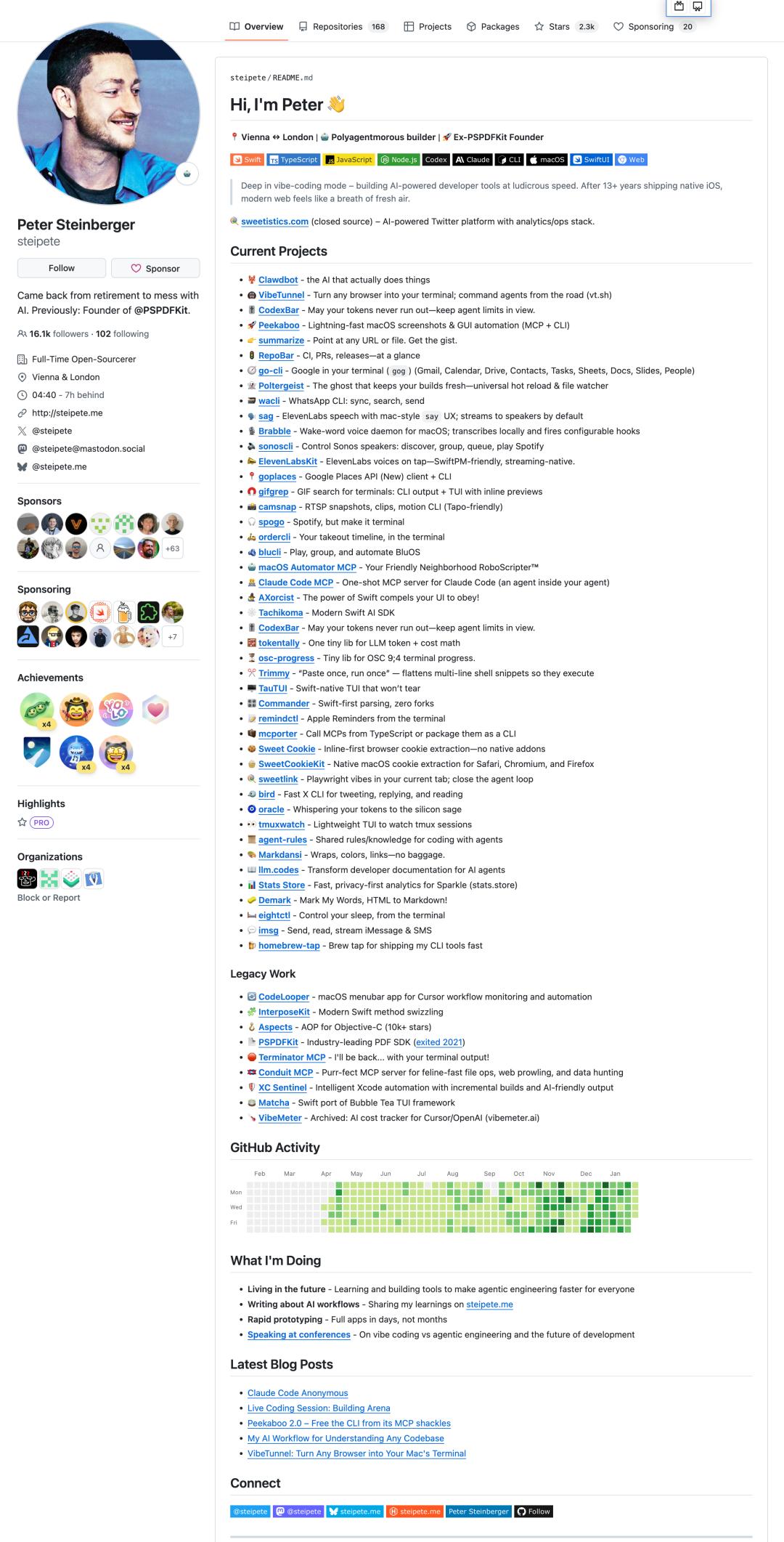
The article summarizes an interview with Peter Steinberger, the founder of the AI tool Moltbot (formerly known as Clawdbot).
Article author and source: APPSO
There's no end to learning, there's really no end to learning.
Over the past few days, AI models and products have been making headlines and generating buzz. Moltbot (formerly Clawdbot) even made international headlines and dominated Silicon Valley news.
The almost vertically upward star curve on GitHub, the Mac mini selling out, the Discord servers crashing... it all happened so fast.
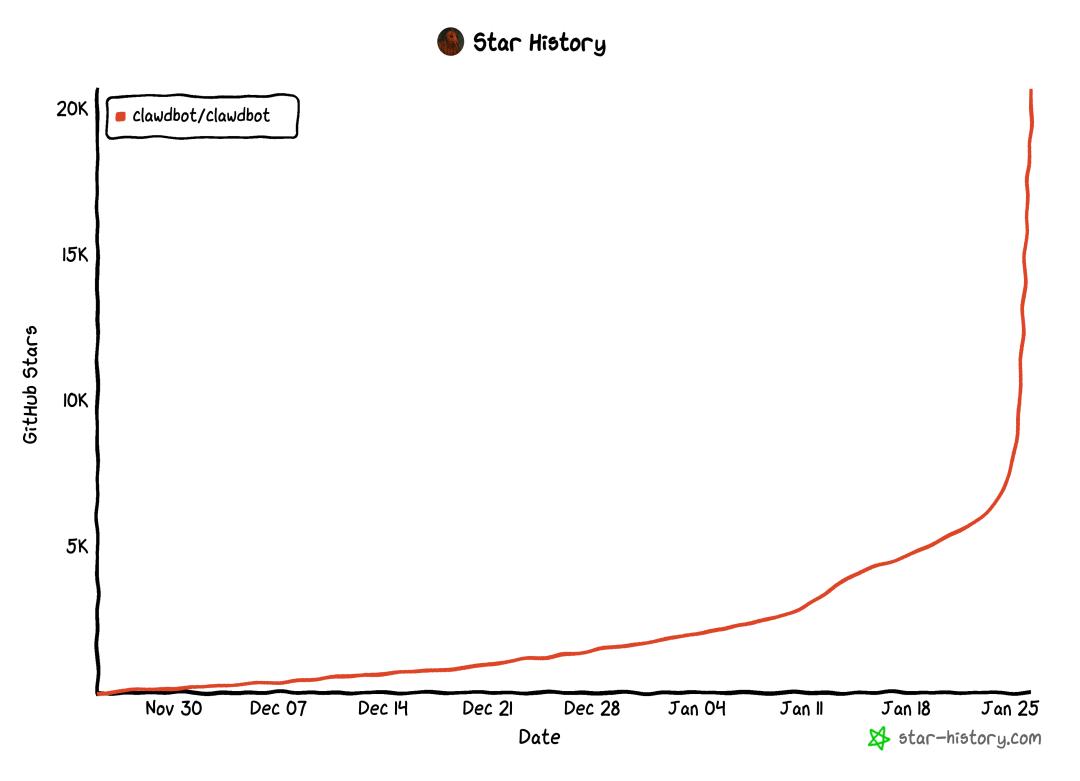
What's even more unbelievable is that this wasn't a startup or a team effort at all; it was the result of Moltbot founder Peter Steinberger working on it all by himself at home.
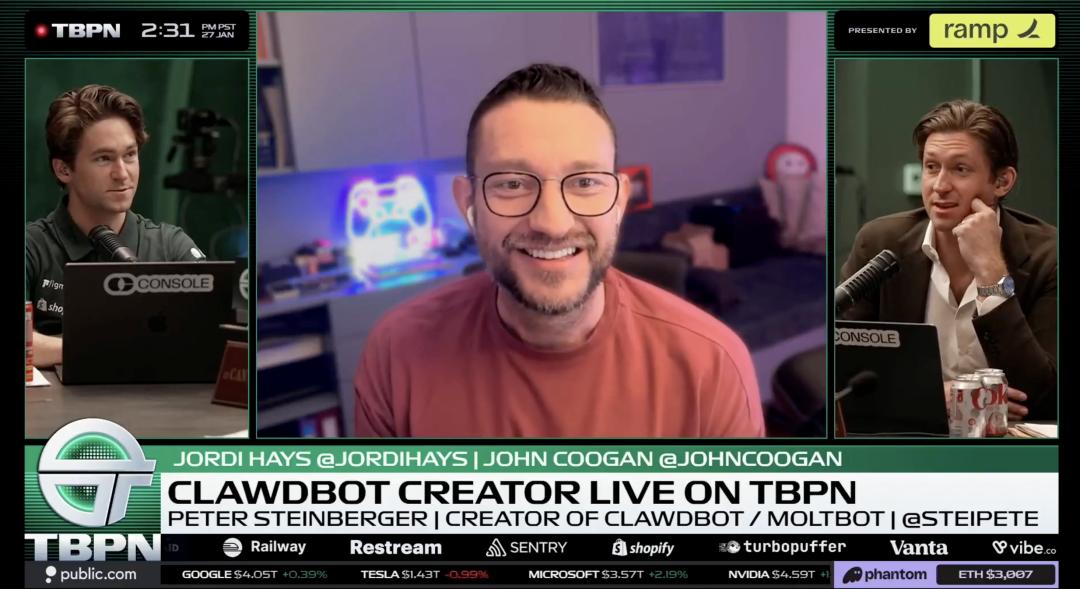
Peter recently gave an interview to TBPN. It was already 11 PM in Europe when the interview took place, but he still seemed quite energetic, even though he probably hadn't slept well for the past 72 hours.
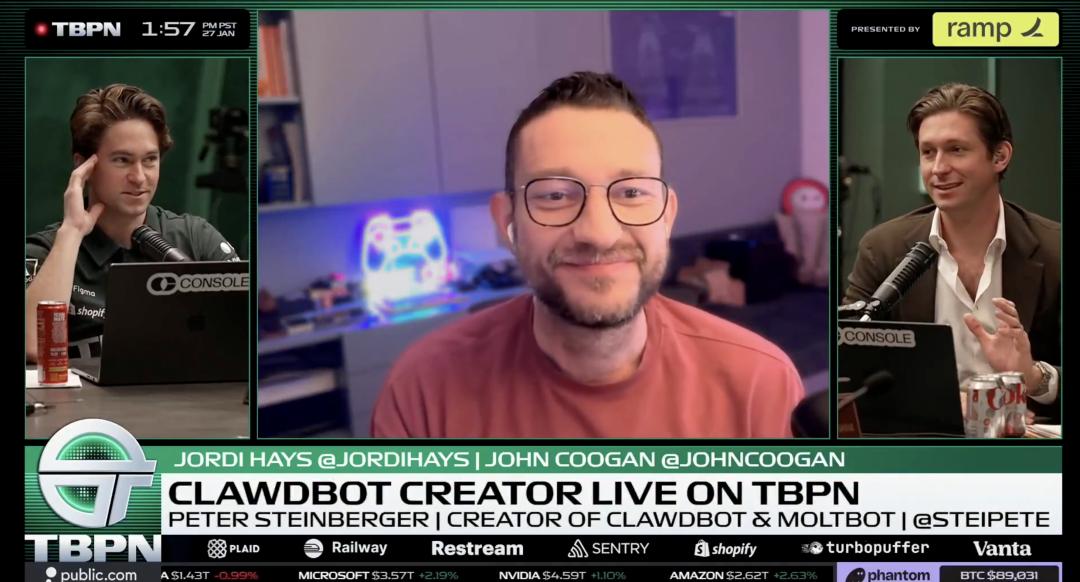
Video link: https://x.com/tbpn/status/2016299976360656970?s=20
From utterly exhausted to "getting hyped up again".
Peter's script begins in a style reminiscent of a Silicon Valley fantasy novel.
Four years ago, he sold his software company, which he had run for 13 years, achieving financial freedom (earning 100 million euros). Logically, the rest of his life should have been filled with yachts, champagne, and endless vacations. And that's exactly what he did, taking a complete break for three years, even jokingly comparing himself to the unfortunate character in "Austin Powers" whose "motivation" had been drained.
After working non-stop for 13 years, a year's rest might be enough, but I took a three-year break, which seems reasonable.
Sometime last April, he readjusted his mindset, began his retirement and comeback, and focused on AI research. Coincidentally, he had just missed the three particularly bad years of AI development, and his return coincided with the start of internal testing for code generation tools like Copilot.
After his first experience, he started having insomnia. He sent a message to a friend at four in the morning, and to his surprise, his friend on the other side of the screen was just as into it and replied instantly.
Peter even organized an offline gathering called "Claude Code Anonymous," which has now been renamed "Agents Anonymous"—he had to keep up with the times.
The WhatsApp API setup, completed in an hour, unexpectedly triggered an "aha moment."
The best way to learn new technologies is through play.
Peter's logic for doing projects is simple: I want to have fun. So he often makes small projects, trying different programming languages and different methods.
One project even lasted two months before having to be stopped because it became too useful. He and his friends were out having fun, but he could still use his phone to continue working on the Claude Code project.
This is so bad for my mental health. Am I just creating a tool that makes me more addicted?
One day last November, he had a sudden inspiration: Could he interact with his computer via WhatsApp? If the AI wasn't running, and he was wandering around the kitchen, he wanted to check on their status or send them some prompts.
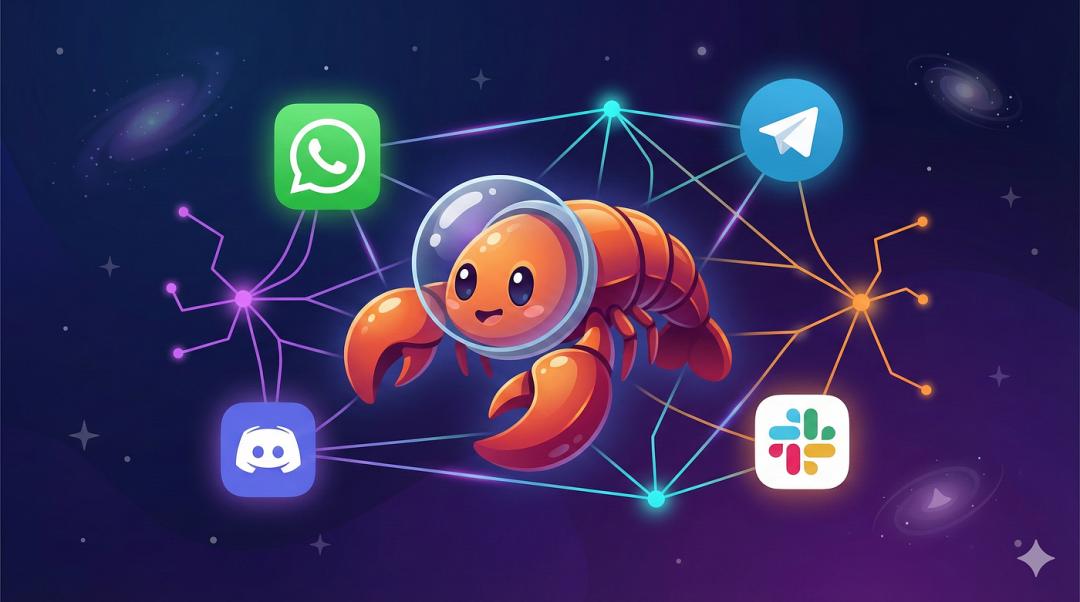
So he quickly created a WhatsApp API: receive messages, call Claude Code, and return the result. He finished it in an hour, and it worked.
When sending prompts, I usually include an image in addition to the text because images often provide a lot of contextual information, and you don't have to type as much text. So I think this is a "black technology" that can make prompts faster—direct screenshots. Intelligent agents are actually quite good at guessing what you want from images, so I also added image support.
Later, he went on a weekend birthday trip to Marrakech and found that he used the function more often than he expected, but not for writing code, but more for things like finding restaurants.
Once, he even sent it a voice message. He hadn't actually used the voice function, but ten seconds later, it replied as if nothing had happened. Peter was utterly astonished: "How did you do that?!"
It replied, "I noticed you sent a file without a file extension, and after checking the file header, I found it was audio. I planned to use the tool on your Mac to transcode it, but it gave an error because it wasn't installed correctly. However, I found the OpenAI API Key in your environment variables, so I directly used curl to send it to OpenAI and got the transcription. Then I replied to you."
That moment truly gave Peter a "haha" moment.
From then on, Peter was completely obsessed and started doing all sorts of weird and wonderful things. For example, he created an alarm clock system that allowed an AI agent to "migrate" to his computer in London, then remotely log into his MacBook at home and turn up the volume to wake him up.
I may have made the most expensive alarm clock in the world.
However, it did malfunction, because the alarm clock uses heartbeat signals to determine its status. For Peter, this project was both a technological exploration and a form of artistic creation.
On the one hand, it pieces together existing technologies; but on the other hand, it completely changes the way you interact with these technologies because all the technical details are "hidden".
You no longer need to worry about dialogue compression or which model to choose, although you might still think about it occasionally, since tokens are still quite expensive. But most of the time you won't care about these things; you're just having a conversation with a "friend" or a "ghost."
The tech community didn't get it, but non-technical friends said, "I want to use it."
Peter may seem to have become famous overnight, but he actually did a lot of preparation before his sudden rise to fame.
For example, he found that many of the current MCP (Model Context Protocol) tools are quite poor and lack scalability.
However, he discovered that the intelligent agent understood Unix and could call thousands of small programs on the computer, simply by knowing the program name, accessing the help menu, and loading the necessary content. Therefore, the smart approach was to develop according to the model's mindset, rather than according to human habits.
You need to build your system according to their way of thinking, and everything will work better. In a sense, this is a completely new form of software.
He also created a tool for managing locations on Google Maps, which connected to speakers, home cameras, smart home systems, and more. These things were all combined using small CLI tools and skills, making the intelligent agents more powerful and more fun.
Actually, he was already completely captivated by that WhatsApp integration feature. He thought it was amazing, so he shared it on Twitter. Usually, when he posts about projects, he gets a lot of feedback. But that time, the reaction was lukewarm; it seemed like people didn't get it.
He showed it to his friends, even those who weren't tech-savvy, and they were very interested, saying they wanted to use it right away. So he felt he had actually made something of note, it's just that people in the tech world didn't realize it at first.
So he continued to refine it, because he enjoyed using it. Ultimately, he created this tool for himself. " It's open source; my motivation was simply to have fun and inspire others to try it, not to make money. I've already made enough; I'm not short of money. "
The past 72 hours: From Discord to the name change controversy
Then came the "explosion" moment.
The sheer volume of activity on Twitter nearly crashed Discord's servers, with user numbers growing at an unprecedented rate. He was even struggling to keep up with Instagram. For a while, he had to copy and paste Discord questions into Codex to generate answers, then copy those answers back to continue answering the next question.
Later, when he couldn't handle it anymore, he simply copied the entire channel and had the model answer the 20 most common questions. He then quickly reviewed it, gave it a few extra instructions, and then sent it out directly.
People may not realize that this is not actually a team or a company; it's just me having fun at home.
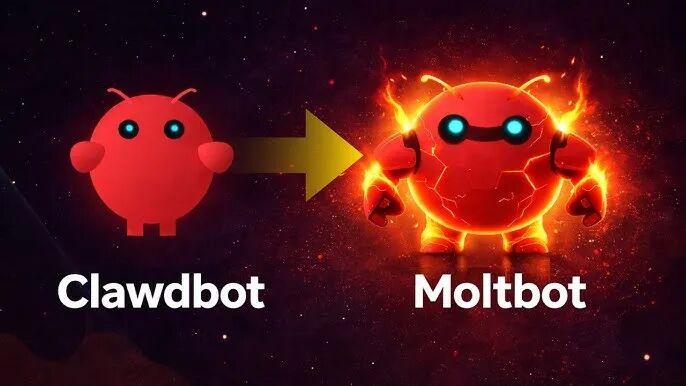
With Clawdbot's sudden rise to fame, he received an email from Anthropic asking him to change the project name. However, Anthropic didn't contact a lawyer directly; instead, someone from within the company contacted him.
However, given the tight timeline and the fact that the project was already so popular, changing the name was nothing short of a disaster, and it caused a huge uproar on social media.
Of all the models, this is still my favorite.
When asked about his opinion on the Mac mini, Peter laughed and said, "My agent is a bit of a 'princess,' it doesn't like using the Mac mini. It wants more performance." In the end, he equipped the agent with a top-of-the-line machine: 512GB of storage, all configurations maxed out, because he also wanted to tinker with local models.
I can now run MiniMax 2.1 on this machine, which I think is one of the best open-source models available. However, to be honest, one machine isn't enough, and it's not very fun. You'll probably need at least two or even three machines.
The interviewer mentioned that the most interesting aspect of Moltbot's explosive popularity is not just the AI agent itself, but the fact that it's the first time people have seen large technology platforms "forced to connect".
Peter believes that existing operating models will be forced to change. For example, accessing the Gmail API involves far more complicated procedures than you can imagine. Some startups are even acquiring companies that already have licenses just to gain access.
However, if these tools are run locally, these obstacles can be bypassed.
Peter had previously done a lot of "cracking operations," such as directly having AI parse a website and then generating a "mirror version."
"Sometimes AI will refuse, saying that the operation is not allowed, so I will 'make up a story' for it. After telling a few sentences of the 'story,' it can give you a perfect API in about 40 minutes. In a sense, this is exactly what large companies do not want to see."
Even his WhatsApp integration essentially exploited a loophole in the platform, simulating the desktop protocol. He tried official channels at the time, but the official solution was only available to businesses, and businesses would have their accounts banned after sending 100 messages.
I actually got blocked... Later, I got so angry that I deleted that part of the code, and there were a bunch of exclamation marks! Because there's simply no reasonable pattern to support this behavior right now, and that needs to be changed.
However, when talking about models, Peter said that from the perspective of "personality", his favorite is still Claude Opus.
"I don't know how much content from platforms like Reddit was used in their model training data, but it performs exceptionally well on Discord." He also gave it a "reply/don't reply" option, so it doesn't spam but "listen" to the conversation and then occasionally delivers a witty reply.
"Sometimes it really makes me laugh out loud. You know, that's quite rare, because most AI jokes are awkward. But I only truly experience the feeling of 'it understands humor' when using Opus."
Regarding coding, he prefers Codex because it handles large codebases very well. And OpenAI's models? "They are extremely stable and reliable, arguably more reliable than many human employees."
Peter also believes that with the emergence of such highly personalized systems, a large number of vertical apps will face annihilation.
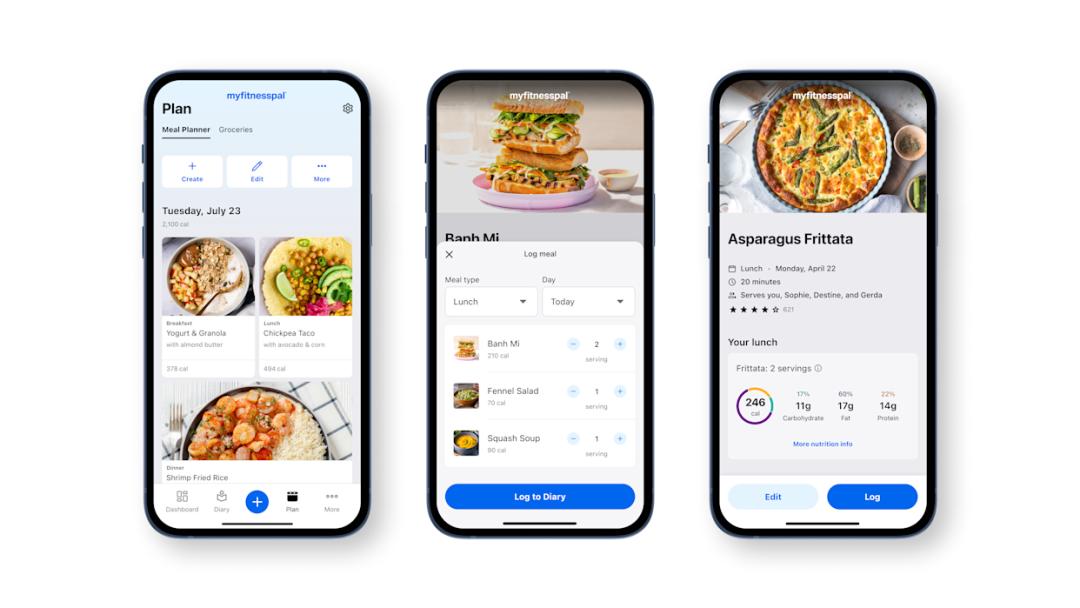
"For example, why would I need MyFitnessPal (a health app)? I take a picture of my food, and my AI already knows I'm at McDonald's and making a bad choice. It combines contextual information to perfectly determine what I'm eating, how many calories I've consumed, and can even automatically adjust my fitness plan."
In his view, AI will directly adjust its plans based on his lifestyle. "I expect a large number of apps to be phased out. Because the way we interact with systems has changed, they will naturally become 'an API'."
With great power comes great responsibility.
Peter is now receiving a lot of emails from security researchers.
He originally created this tool just for his own fun and personal use, for one-on-one chatting on WhatsApp or Telegram.
But now someone is using it in the wrong places. He received piles and piles of reports, some of which did find real problems, while others, although technically plausible, were not used in the way he originally envisioned.
"The whole system is like it's crashed. I did this project alone, out of interest. And now I have to deal with hundreds of security reports, for use cases I never even considered supporting. I don't know what to do, I can only take it one step at a time."
Fortunately, he's now starting to build a small team.
"This system does have certain risks, as I have clearly stated on the official website. In fact, the system will prompt you to read a document before you even start using it."
He believes this project will accelerate related research because it has already generated real demand. Core issues like Prompt Injection are still unsolved in the industry, and probably no company would dare to directly tackle this project.
But his early users understood this, including many AI researchers. They knew that perfection was impossible at this point.
When asked if he would start a company, Peter said, "I think I'd rather have a foundation than a company; I prefer the non-profit model."
Regarding open-source licenses, his idea was to make the open-source version so good that others wouldn't have much room to modify it for profit. He used a relatively permissive license like MIT.
Yes, that means someone might sell it, but ultimately… it's not that important. The code itself isn't that valuable anymore. You can simply delete it and rewrite it a month later. What's more important now is the idea, the attention it garners, and its brand. Those are the real values. So, let them be.
At the end of the interview, Peter even posted job offers online. He said he really hopes to find some maintainers, and if anyone is passionate about open source, experienced, enjoys handling security reports, or is good at disassembling software and helping to fix problems, please email him.
I'm nearing my limit on my own. I hope this project can continue after I'm gone. I think it's so cool that it shouldn't be abandoned. It needs like-minded people to carry it on.