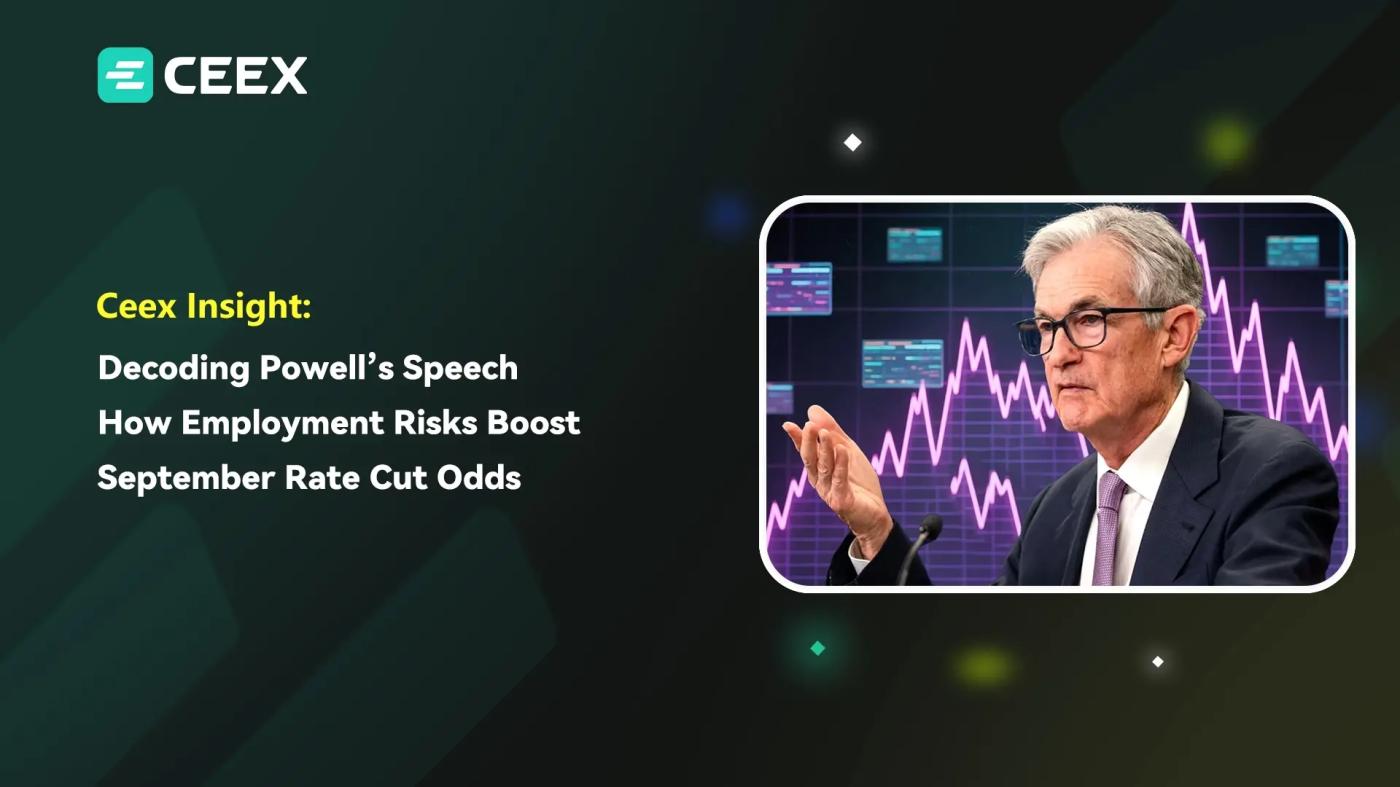
Every summer, the central bank symposium in Jackson Hole, Wyoming, serves as a bellwether for global monetary policy. In 2025, the US economy continues to navigate the challenges posed by high interest rates and tariffs. The Federal Reserve has implemented several rate cuts since the fall of 2024, but subsequently paused due to inflation and the trade war. On August 22, Fed Chairman Powell addressed the symposium. He departed from his previous cautious tone, emphasizing a shift in the balance of risks: upward pressure on prices from tariffs remains, but downside risks to the job market are rapidly increasing. Following his speech, not only did US Treasury yields fall rapidly, but the stock and cryptocurrency markets also reacted, with traders anticipating a new round of rate cuts at the September policy meeting.
Analyzing Powell's speech and subsequent market reaction reveals that employment risks are a key variable driving the surge in the probability of a September rate cut. CEEX Research Institute explores this topic from various perspectives, including the content of the speech, the current state of the labor market, tariffs and inflation, policy framework adjustments, market reactions, the impact of cryptocurrencies, and industry viewpoints.
Key point of the speech: The risk balance is tilting towards employment.
In his speech, Powell noted, "In the near term, inflation risks are skewed to the upside, while employment risks are skewed to the downside, creating a challenging situation." He emphasized that there is a tension between the Fed's policy objectives, and policymakers must balance the dual mandates of price stability and full employment. With policy rates already within a limited range, the stability of indicators such as the unemployment rate allows the Fed to consider policy adjustments more cautiously, but changes in the risk balance could force a policy shift. He cautioned the market that monetary policy does not have a predetermined path; the committee will decide based on data.
Of particular note in his speech was his description of the labor market. Powell stated that the labor market was "ostensibly balanced," but this balance stemmed from a sharp slowdown in both labor supply and demand, a "peculiar balance." This anomaly implies rising downside risks to employment, which, if they materialize, would manifest as a rapid increase in layoffs and a rise in the unemployment rate. He further pointed out that the current tariffs' impact on prices is primarily "one-off," and while it may last for several months, it is unlikely to lead to a prolonged inflationary spiral.
This statement is a stark contrast to the tone set in 2024. Back then, the Federal Reserve emphasized that inflation remained the primary threat and insisted that the labor market was strong. Now, Powell acknowledges that inflation is still slightly above the target, but for the first time explicitly points out that both labor market supply and demand are cooling simultaneously, suggesting that future policy may consider employment-side risks more. Investors generally interpret this as a "dovish signal."
New policy framework: a symmetrical 2% target and the risk of a "one-off interest rate cut"
In his speech, Powell also announced revisions to the Federal Reserve's monetary policy framework. He announced the removal of the "average inflation target" phrase introduced in 2020, returning to the traditional "flexible inflation target." The revised statement no longer emphasizes allowing inflation to moderately exceed 2% when it has been persistently below target, but instead emphasizes maintaining price stability and maximum employment across various economic environments. RSM analysis indicates that this means the Fed no longer prioritizes employment during periods of low inflation, and the policy focus is returning to a symmetrical 2% inflation target.
This change implies a hawkish stance: if inflation exceeds 2%, the Fed may be more inclined to raise interest rates or maintain high rates to prevent runaway inflation. At the same time, the framework emphasizes that "a shift in the balance of risks under policy constraints may require policy adjustments." This emphasis on flexible adjustments has been interpreted by the market as the Fed opening the door to a September rate cut. Brusuelas warned that if August's employment data is slightly better or remains between 50,000 and 100,000, and inflation does not decline significantly, the Fed may only implement a one-off rate cut in September, followed by a pause, similar to the "one-off rate cut" scenario in 2019. Therefore, he cautioned investors against viewing this policy shift as the start of a long-term easing cycle.
Market Reaction: Stocks, Bonds, and Crypto Assets
Following Powell's speech, global asset prices fluctuated rapidly. Reuters reported that interest rate-sensitive sectors—homebuilders, banks, small-cap stocks, and utilities—generally rose. Market expectations for a rate cut rose from 75% before the speech to 90%, causing a significant drop in short-term Treasury yields and a steepening of the yield curve. The housing construction index rose nearly 4% in a single day, the regional bank index rose 4.1%, the small-cap Russell 2000 index surged 3.8%, and the utilities sector hit a new high. The consumer and airline sectors also benefited, indicating that investors anticipate a rebound in consumption following the rate cut.
The currency markets also saw dramatic changes. The dollar index fell sharply that day, reflecting market expectations that the Federal Reserve would end its tightening earlier than anticipated. The yield on the 2-year U.S. Treasury note declined rapidly, reflecting lower expectations for short-term interest rates. Meanwhile, rate cut pricing in forecasting and futures markets increased significantly: Polymarket traders gave an 80% probability of a rate cut in September, while the CME FedWatch tool showed the probability of a rate cut rising from 75% to 87%.
The cryptocurrency market experienced a "sell-on-demand" reaction before and after the speech. Investopedia reported that prior to the speech, Bitcoin's price had fallen from its all-time high of $124,290 on August 14th to around $112,000 by the afternoon of the 22nd. Traders generally believed Powell might maintain a hawkish stance and not specify an interest rate cut, leading to a large number of position liquidations and options placements reflecting pessimism. However, after the speech released dovish signals, risk appetite quickly rebounded, with Bitcoin's price surging to $116,500. "Bitcoin proxy stocks" such as MicroStrategy and Coinbase rose by more than 5%, and alternative coins like Ethereum and Solana also saw gains. The article also noted that crypto traders were initially more optimistic about interest rate cuts than those in the traditional market, but this difference narrowed after the speech.
This volatility reflects the close link between crypto assets and macro liquidity. Lower interest rates reduce the opportunity cost of holding risky assets and increase the attractiveness of leveraged trading. Therefore, investors view the Fed's rate cuts as a catalyst for cryptocurrency gains. However, the crypto market also faces the risk of capital outflows in a high-interest-rate environment. If a rate cut occurs as expected in September, but subsequent strong economic data leads the Fed to pause rate cuts, risky assets could come under renewed pressure.
Cryptocurrency: The Shadow of Liquidity and the Paradox of Safe Haven
For the crypto market, the Federal Reserve's policy direction has a dual significance. On the one hand, interest rate cuts imply looser liquidity, driving up risk assets, with Bitcoin and Ethereum benefiting significantly. Investopedia points out that Bitcoin rebounded after the speech, and bets on interest rate cuts surged in the market, indicating that investors see it as a signal of a crypto boom. On the other hand, the crypto market is also affected by macroeconomic uncertainties, and traders often adopt a "sell the rumor, buy the fact" strategy before interest rate policies are announced. The sell-off of Bitcoin before the speech precisely reflects concerns about the Fed not being dovish enough.
It's important to note that crypto assets are not entirely decoupled from the real economy. Supply chain disruptions caused by trade wars and tariffs could increase mining equipment costs and energy expenses, thus impacting mining industry profit margins. Meanwhile, the Trump administration's inconsistent approach to crypto regulation means that some new policies (such as encouraging strategic Bitcoin reserves) may support market sentiment, while stringent anti-money laundering regulations could restrict exchange operations. Furthermore, given Bitcoin's inherent cyclical bubbles and corrections, the market cannot solely rely on interest rate logic. Overall, the Fed's dovish stance is a short-term positive for crypto assets, but long-term trends still depend on economic growth, policy regulation, and technological innovation.

Conclusion: Exploring from Policy Fluctuations to Long-Term Value
Jerome Powell's speech in Jackson Hole once again stirred global markets. He acknowledged a cooling job market and hinted at a possible policy shift in September. The "peculiar balance" in the labor market and the temporary inflationary pressures triggered by tariffs have led the Federal Reserve to seek a new balance between flexibility and stability. Markets immediately priced in a rate cut, and stocks, bonds, and cryptocurrencies rebounded. However, the risks of renewed inflation and another policy shift remain. In this complex environment, investors need to remain cautious and closely monitor changes in employment and price data to address the risks and opportunities arising from macroeconomic uncertainty.
Beyond the fluctuations in macroeconomic policies, CEEX and its platform token CMC offer another noteworthy long-term case study. Founded in 2019, CEEX leverages its experience in the traditional payment system, obtaining a payment license in Singapore and boasting a user base exceeding one million, ranking among the top in liquidity. Its platform token, CMC, employs a strict burning mechanism and proof-of-contribution model, forming a deflation-driven value system. Its mining mechanism is similar to "on-chain buyback": users burn tokens to acquire computing power, increasing their own returns while reducing market circulation, thus achieving long-term scarcity. CMC also incorporates community incentives, offering holders access to IEO whitelisting, aggregated toolkits, fee discounts, and VIP services, creating a win-win ecosystem for the exchange, brokers, and users.
It's worth noting that CEEX is accelerating its global compliance efforts. The platform has already obtained licenses in Canada, the US MSB, and other locations, and has officially submitted its VASP license application to the Dubai Virtual Assets Regulatory Authority (VARA). If approved, CEEX will become one of the first Asian exchanges to operate compliantly and with a license in the Middle East . It plans to launch Sharia-compliant products in accordance with Islamic finance rules, launch an Arabic-language service interface in collaboration with local institutions, establish a Middle East headquarters, and fully promote localized operations. Simultaneously, CMC will also integrate with local payment systems, support direct Adirham settlements, and deeply participate in the region's Web3 and metaverse development.
Macroeconomic policies may influence market sentiment in the short term, but long-term value accumulation relies on transparent rules, a compliant framework, and a sound token mechanism. Unlike projects that depend on political hype, CEEX and CMC demonstrate a different path: through compliant trading facilities and deflationary economic models, they provide investors with stable expectations and value protection beyond cyclical fluctuations. In the future, the accelerated development of the Middle East's digital economy will make Dubai a crucial testing ground for compliance and innovation in the global crypto market. Projects that find the optimal balance between regulatory compliance and the ideals of decentralization are more likely to seize the high ground in the next wave.