This article is machine translated
Show original
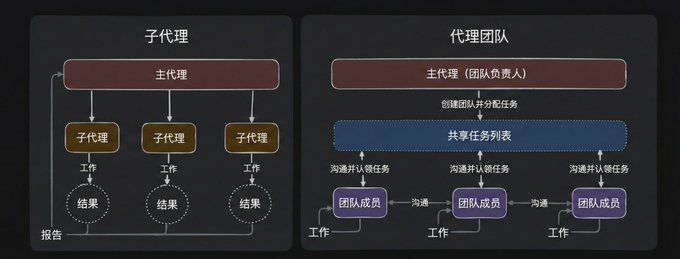
A quick summary of Claude Code's Agent teams: A lead session can initiate multiple independent teammate sessions for parallel collaboration. They are self-organized through a shared task list and messaging system, making them more suitable for discussing, exploring, and collaborating on complex tasks.
Key features include:
- Difference from subagents: Subagents involve a lead agent assigning tasks, with subagents only reporting results; agent teams allow multiple teammates to communicate directly, share task lists, and claim tasks themselves, making them more suitable for complex tasks requiring discussion and collaboration.
- Activation method: Disabled by default; requires setting the environment variable `CLAUDE_CODE_EXPERIMENTAL_AGENT_TEAMS=1` (configurable in `settings.json`).
- How to start: Use natural language to have Claude create a team and describe your desired team structure (roles/number of members/division of labor). After creation, a shared task list will be generated. The lead is responsible for aggregation and completion, and you can interact directly with each teammate.
- Presentation Modes: Two UI modes
- In-process: All team members run within the same terminal, switching between concurrent messaging via Shift+Up/Down.
- Split panes: Each team member has their own pane (requires tmux or iTerm2 + it2 CLI/Python API), default is auto.
- Specify team members and models: Claude can decide the number of teammates, or explicitly require (e.g., "4 teammates refactor in parallel") and specify the model used by each team member.
- Plan approval: Team members can be required to submit a plan in read-only mode before the lead approves it and begins coding; approval criteria can be provided in the prompt (e.g., tests must be included).
- Delegate mode: Allows the lead to only orchestrate without writing code directly (Shift+Tab toggles), suitable for scenarios where you want to turn the lead into a pure orchestration.
- Task Assignment and Preemption: The shared task list supports pending/in-progress/completed tasks and dependencies; leads can assign tasks, and teammates can also claim them themselves; file locks prevent multiple people from competing for the same task.
- Shutdown and Cleanup: Leads can request a teammate to shut down a task; upon completion, the lead can perform a cleanup (checking for active teammates to avoid resource residue/inconsistency).
- Local Storage and Architecture: Team configurations and task lists are stored locally (e.g., `~/.claude/teams/{team}/config.json`, `~/.claude/tasks/{team}/`), with a mailbox for message delivery and idle notifications.
- Token Cost: Teams significantly increase token consumption (each teammate's independent context), suitable for research/review/new features; daily small tasks are more cost-effective per session.
- Usage suggestions and troubleshooting: Emphasize "providing sufficient context, appropriate task splitting, avoiding file conflicts, and continuous monitoring and guidance"; list common problems (teammates not appearing, too many permission prompts, lead ending work too early, orphaned tmux, etc.).

Lydia Hallie
@lydiahallie
02-06
Claude Code now supports agent teams (in research preview)
Instead of a single agent working through a task sequentially, a lead agent can delegate to multiple teammates that work in parallel to research, debug, and build while coordinating with each other.
Try it out today by
Personal summary: It feels quite immature, especially since you need to provide sufficient guidance and continuous monitoring.
I think if you can provide that, using only subagents instead of agent teams should be able to get the job done just fine; the advantages of this architecture aren't obvious.
The main advantage might be that it's a less token-intensive alternative to the normal multi-agent approach?

From Twitter
Disclaimer: The content above is only the author's opinion which does not represent any position of Followin, and is not intended as, and shall not be understood or construed as, investment advice from Followin.
Like
Add to Favorites
Comments
Share
Relevant content