Written by: Lawyer Liu Zhengyao
Introduction
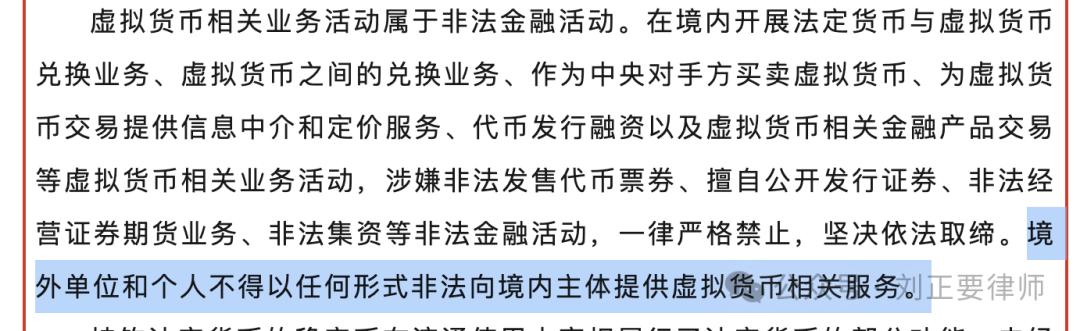
On February 6, 2026, eight departments, including the People's Bank of China, jointly issued the " Notice on Further Preventing and Handling Risks Related to Virtual Currencies " (hereinafter referred to as the "2.6 Notice" or the "New Regulations"). As a legal professional in the crypto industry, Attorney Liu believes that the significance of this document is self-evident, and every cryptocurrency practitioner who wants to comply with regulations must thoroughly read it. In particular, the New Regulations repeatedly mention that " overseas entities and individuals shall not illegally provide virtual currency-related services to domestic entities in any form ," causing concern among many business owners engaged in the judicial disposal of virtual currency cases.
Those familiar with Attorney Liu should know that he has been researching the "judicial disposal of virtual currency cases" since 2023. He is quite familiar with the macro-level regulatory policies and micro-level operational details of this business and knows many practitioners in the industry. Tonight, several business owners have started messaging me privately: Has this industry completely reached its end? Is it still possible to handle judicial disposal cases?
My conclusion is: it's possible, but under the new regulations, all parties involved (the client, the disposing party, the intermediary, the overseas platform, etc.) need to consider how to conduct it more compliantly. A detailed discussion follows:
01 The essence of judicial disposal: Is it "illegal transaction" or "statutory duty"?
First, we need to clarify a basic legal logic. Judicial disposal of virtual currency refers to the process by which judicial organs (public security organs, procuratorates, and courts) or financial departments dispose of virtual currency seized or confiscated in criminal cases or administrative law enforcement, convert it into RMB, and turn it over to the national treasury (in some cases, this is returned to the victims).
The judicial handling of virtual currencies involved in cases is fundamentally different from the speculative trading of cryptocurrencies by ordinary citizens:
First, the legitimacy of the entity. The entity handling the matter is the state judicial organ, and the basis for this action is the provisions of the Criminal Law regarding the confiscation of illegal gains.
Second, the legitimacy of the purpose. The purpose of judicial disposal is to enforce criminal judgments, convert "criminal assets" into "legal tender" and turn them over to the national treasury, thereby safeguarding financial security.
Therefore, even though the new regulations further restrict the financialization of cryptocurrencies, the judicial handling of cryptocurrencies, as part of criminal enforcement, still maintains procedural justice and substantive legitimacy . It is impossible for judicial organs to hold tens of thousands of Bitcoins without being able to turn them over to the national treasury.
02 The "Real Pressure" Brought by the New Regulations in 2026
Since the judicial handling of virtual currencies is legal, why are people panicking? The reason lies in the strict definition of "cross-border services" and "technical assistance" in the new regulations.
(a) The “illegalization” characterization of overseas service providers
The new regulations explicitly state that overseas companies or individuals are prohibited from illegally providing virtual currency-related services to the domestic market. Currently, the vast majority of judicial resolutions in China are completed through a model of "domestic intermediary company + compliant overseas transaction realization."
Under the new regulations, if the overseas entity handling the case does not obtain the "legal and compliant consent" of the relevant domestic departments, the domestic company that provides the connection and undertakes the judicial handling business is very likely to be classified as "providing assistance knowing or should have known that the overseas entity is illegally providing services" and thus violate criminal liability.
(ii) Strict control over "intermediary" and "technology" services
The new regulations stipulate that intermediaries and technology institutions providing services for cross-border related businesses must apply for approval or registration (although this is mainly to regulate RWA business within China, it may be "policy-penetrated" and applied in the judicial process). This means that the past unregulated growth model of "signing a commission agreement and privately finding a money laundering agency or exchange to cash out the coins" will face huge administrative and even criminal penalties.

03 A Further Discussion on Compliance Pathways for Judicial Disposal
Given the current complex regulatory environment, although my country has not officially recognized (or stipulated) a single disposal model, the feasibility of these approaches becomes even more important under the new regulations in 2026:
(a) Shifting from "private commissions" to "official access"
The new regulations repeatedly mention "with the consent of the competent business authority in accordance with laws and regulations" (the same consideration: although this is mainly to regulate domestic RWA business, it may be " policy-penetrated " in the field of judicial disposal). Future judicial disposal must move away from private operations. Disposal companies cannot simply rely on a commission contract from public security, procuratorate, or court and think that everything is fine; they also need to pay attention to their registration or compliance qualifications with financial regulatory authorities (such as the central bank and the China Securities Regulatory Commission), finance departments, tax departments, etc.
(ii) Relying on "specific financial infrastructure"
The new regulations state in the RWA section that "business activities conducted based on specific financial infrastructure are excluded." This actually has some reference value for judicial disposal procedures. For example, in the future, the designation of state-owned banks , licensed exchanges (overseas subsidiaries), or officially designated digital asset management platforms as the corresponding domestic and overseas disposal entities may be taken into consideration by decision-makers.
(III) Transparent Capital Flows and Cross-border Foreign Exchange Settlement
The past pain point lay in how to repatriate the money (USD, offshore RMB) after the disposal and conversion of virtual currencies. The common practice at present was for qualified institutions to use formal foreign exchange management channels to convert the fines and confiscations from foreign currency accounts into RMB and then remit them to the special non-tax revenue account of the Ministry of Finance. The new regulations in 2026 strengthened the State Administration of Foreign Exchange's coordination in the supervision of virtual currencies, which further means that certain "underground bank" style foreign exchange settlements will inevitably be shut down.
04 Industry reshuffle: Only those who comply will survive.
Returning to the original question: Can judicial resolution still be carried out? The answer is: Yes, but the era of "freelancers" and "gray intermediaries" is over.
The new regulations in 2026 are not intended to eliminate judicial proceedings, but rather to eliminate illegal financial activities disguised as judicial proceedings. With the Supreme People's Court and the Supreme People's Procuratorate having already initiated (and possibly completed) research on the judicial proceedings of virtual currencies involved in cases, and with the joint issuance of this new regulation, it is highly likely that a judicial interpretation or operational procedure specifically targeting the "disposal of virtual currencies involved in cases" will be introduced in the future.
A guide to avoiding pitfalls for business owners dealing with cryptocurrency judicial disputes:First, all illegal cross-border matchmaking must cease, especially the operations of small overseas exchanges without licenses or endorsements.
Second, strengthen the technical support attributes. Shift the business focus from "monetization transactions" to "technical assistance (tracking, freezing, seizure, and storage)".
Third, closely follow official guidelines. Pay attention to the detailed implementation rules of the localized handling mechanism by the provincial people's governments.
In 2026, the rules of the crypto have been completely reshaped. The judicial disposal industry is undergoing a painful transition from the "wilderness" back to the "walled" environment. Only teams that truly understand the policy's original intent and possess extremely high compliance expertise will survive this transformation. You are also welcome to contact Attorney Liu to discuss disposal matters.