Mad Men Ultraman, image generated by AI.
On February 10, OpenAI officially announced that it had begun testing advertising features on its ChatGPT platform in the United States.
This test will be rolled out gradually to registered free adult users and ChatGPT Go subscribers who pay $8 per month . Premium subscription plans such as ChatGPT Pro, Business, Enterprise, and Education will not display ads.
In its announcement, OpenAI emphasized that the ads will be labeled as "sponsored content" and visually distinguished from ChatGPT's natural responses, without affecting the AI-generated content.
The company explained that the introduction of advertising was intended to support ongoing infrastructure investment and technology upgrades while maintaining free and low-cost access to the service, thereby enabling a wider range of users to utilize more powerful AI features.
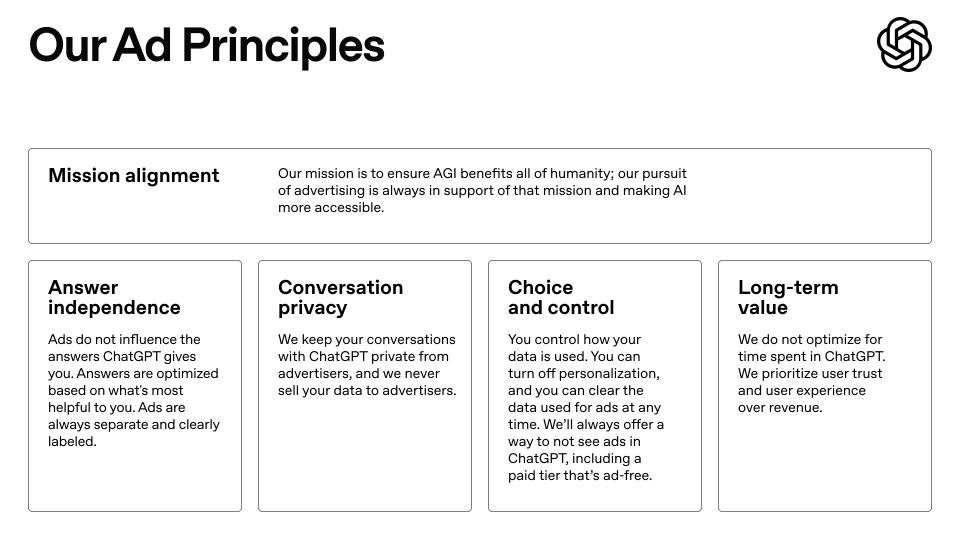
OpenAI announces its advertising principles: ensuring independent responses, maintaining conversational privacy, allowing user control, and prioritizing user experience.
OpenAI has explicitly stated that advertising will not interfere with ChatGPT's answer logic or content generation . All answers will prioritize the questions and needs raised by users, maintaining objectivity and independence. Advertising will only be displayed as supplementary content, ensuring that users can clearly distinguish the source of information.
During the testing phase, ad display will be intelligently matched based on the user's current conversation topic, chat history, and past interactions with ads .
For example, when a user asks for recipes or cooking advice, the system may recommend relevant ingredient delivery or ready-made meal services. OpenAI states that it will prioritize displaying advertising content that is most relevant to the current conversation and potentially most valuable to the user.

Demonstration of interactive advertising effects interspersed in OpenAI dialogue
OpenAI reiterated its commitment to user privacy.
In the advertising system, users' chat content, personal profiles, and related data are not disclosed to advertisers . Advertisers can only obtain aggregated performance data such as ad impressions and clicks, but cannot track or identify the identity of specific users or the details of their conversations.
Furthermore, the platform will not display ads to user accounts under the age of 18 and will avoid inserting advertising content into conversations involving sensitive topics such as health, mental health, and politics. OpenAI stated that these strategies will continue to be optimized as testing progresses and security mechanisms are improved.
Users can manage ad display independently during the testing period , including turning off specific ads, providing feedback on ad content, viewing reasons for ad recommendations, and clearing ad history data with one click. Users can also personalize ad settings according to their preferences.
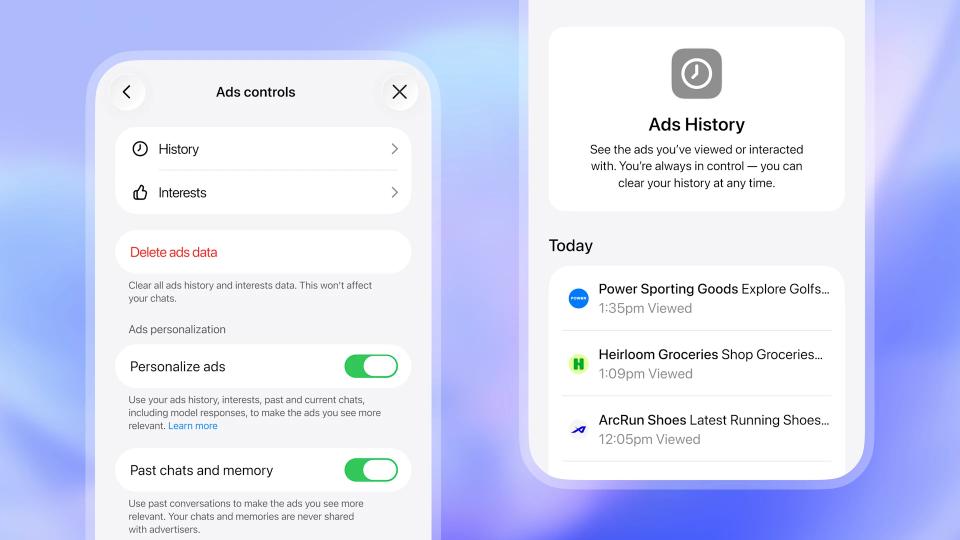
Users will be able to manage their advertising settings independently.
OpenAI believes that in scenarios where users actively use AI for information exploration, solution comparison, or decision support, appropriate and relevant advertising can help users discover the products and services they need more efficiently. OpenAI will continue to optimize its push mechanism based on user feedback and advertising performance, striving to achieve a balance between user experience and commercial value.
For enterprise clients, OpenAI stated that it is building a richer advertising product system and cooperation models, and plans to expand more advertising formats and targeting in the future to help brands conduct valuable interactions with users on the ChatGPT platform.
In its announcement, OpenAI stated that regardless of how the advertising test progresses, ChatGPT's core commitments will remain unchanged: responses will always be independent and objective, user conversations will always be private, and users will always have control over their own experience.
Asad Awan, head of OpenAI’s advertising business, was interviewed on the official OpenAI podcast hosted by Andrew Mayne.
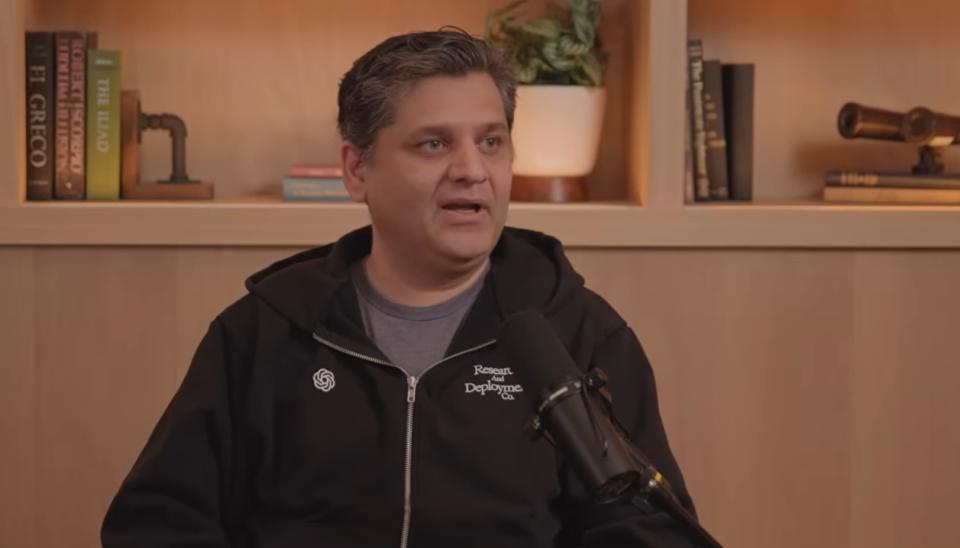
Asad Awan, Head of Advertising at OpenAI
Awan introduced OpenAI's strategic blueprint for introducing advertising into ChatGPT, with the core goal of funding free services through an advertising model to achieve the mission of making AI accessible to all of humanity.
To protect its brand reputation, OpenAI has established the principle of trust over revenue, and explicitly stipulates that the advertising system is completely isolated from model training to ensure that the AI-generated answers remain independent, impartial, and not manipulated by algorithms.
OpenAI is also trying to use AI to lower the marketing barriers for small and medium-sized enterprises, and ultimately build a new business ecosystem based on usefulness rather than clicks.
Attached is a condensed transcript of the podcast conversation:
Andrew: From the user's perspective, why do we need advertising? And why now?
Avan: This stems from our core mission: to bring AGI to all of humanity and benefit them. When your consumer product has over 800 million users, how do you ensure that everyone has access to the best version?
Advertising is one of the most proven and mature business models.
At the same time, it's about how to benefit more people: we want to provide the best models, higher usage limits, and ensure that advertising has real value for both users and businesses. For a company like ours, aiming to democratize top-tier AI, advertising is a natural path.
Andrew: But this is also a contradiction: on the one hand, we can stick to the "high-end route" and refuse ads, but that may limit the experience of free users; on the other hand, embracing ads may bring more resources.
Awan: If the goal is to truly achieve widespread AI adoption, advertising is an effective model. The key lies in setting higher standards to make advertising useful. From the beginning, we've been considering: What core principles should we commit to the world? How do we build truly trustworthy products?
Andrew: You mentioned that "separating answers from ads" is a primary principle. What exactly do you mean by that?
Awan: First, the answers must be independent of the advertisements, whether in visual presentation, model training, or system logic. Users must always be able to trust the answers; the entire ChatGPT product is built on trust.
Second, the conversations are completely private: no ads will appear in sensitive conversations, and the content of the conversations will never be shared with advertisers. Ad matching is done internally, and advertisers cannot see the context.
Andrew: If I ask, "What is this ad saying?", will the model know?
Avan: The model has no idea about the ad content. It will answer "I don't know." But users can actively bring the ad content into the conversation by clicking the "Ask ChatGPT about this ad" button, just like pasting a link to ask a question. We intentionally maintain this separation.
Andrew: In the long run, how can we ensure that this "separation wall" is not eroded? For example, the advertising department may question its necessity ten years from now.
Awan: Our core business is winning users' trust. Whether it's a consumer or enterprise product, trust is everything. If we want to be the best personal assistant for our users, we must treat their data the way they would process information themselves. Our business model is built around trust, which is fundamentally different from many platforms that rely on transactions or content delivery. When incentives prioritize trust, deviations don't exist.
Andrew: How will the ads be distributed among different user groups?
Awan: Ads are only shown to Free and Goier users. Pro, Plus, and Enterprise users will not see any ads. We believe this is reasonable: enterprise scenarios have their own business models; subscribers pay for premium features; and for the vast majority of free users, ads support us in providing higher usage limits and a better experience.
Andrew: How much control do users have over their advertising experience?
Awan: We emphasize transparency and control. Users can see which data is used for ad targeting and choose to clear related data, which is rare in the industry. Users can also turn off personalized settings or choose not to use historical conversations for ad matching. Of course, the most complete control is to upgrade to the ad-free paid version. We believe that users should have complete control, from completely rejecting ads to finely managing data usage.
Andrew: How frequently do the ads appear?
Awan: The top principle is: only show ads that are useful and relevant. If there isn't a suitable match, we'd rather not show it. The number of ads will be small in the initial testing phase because we are carefully learning how to insert ads at the right time. Quality and relevance take precedence over quantity.
Andrew: How do I determine if a conversation is "sensitive" so as to avoid inserting ads?
Avan: This is one of OpenAI's technological advantages. We have a dedicated team that deeply researches and defines "sensitive" categories (such as health, politics, violence, etc.), develops detailed policies, and uses top-notch models for high-precision identification. I have never seen any other product achieve the same level of accuracy as us.
Andrew: How can we prevent ads from appearing in inappropriate contexts? For example, when a user expresses anxiety, an insurance ad might appear.
Awan: We've established two layers of protection: first, a content strategy that clearly defines which contexts are unsuitable for advertising; second, technical execution, where the system automatically filters sensitive conversations and avoids ad matching. Our principle is: ads are only shown when they add value to the conversation. We don't want to harm the user experience, nor do we want advertisers to pay for ineffective exposures.
Andrew: Every time we discuss advertising, someone comments "No ads." What would you like to say to them?
Awan: Users' concerns are reasonable because the industry's past development methods have left many problems. I believe we have a responsibility to rebuild trust with greater transparency and stronger user control. The online advertising industry is only about 20 years old; we are still in the early stages and have the opportunity to establish new standards based on past lessons. Of course, we also respect users who completely reject advertising; they can choose to upgrade to the paid version.
Andrew: Some competitors have questioned your advertising plans.
Awan: Different companies have different missions. Our mission is to bring AI to all of humanity, which means serving diverse scenarios: enterprise, subscription, and hundreds of millions of free users. Advertising is a crucial way to support the free user experience. If we only serve users who can pay, we would be betraying the promise of "AI for all."
Andrew: What benefits can ChatGPT advertising offer to small business owners?
Awan: Today, small businesses often need to hire professional marketers to run ads, which is very costly. Our vision is to make ad placement as simple as an everyday conversation: you just say, "I want to sell more of these shoes in the Midwest," and AI will understand the goal, test strategies, optimize bids, and continuously communicate with you to adjust—it will become your marketing intelligence agent. This will greatly lower the marketing barrier for small businesses.
Andrew: In the longer term, how will AI reshape advertising?
Awan: The next step might be truly conversational advertising, allowing users to gain a deeper understanding of products through interaction with AI. In the more distant future, AI could discover the most suitable products for you behind the scenes, such as recommending vegetarian ramen you've never heard of based on your preferences. Advertising will become smarter and more personalized, while remaining controllable, transparent, and trustworthy. As AI systems themselves develop, the advertising experience will also evolve in tandem.
Jin Lu, a special translator, also contributed to this article.
This article is from the WeChat official account "Tencent Technology" , author: Su Yang, editor: Xu Qingyang, and published with authorization from 36Kr.