In January 2023, a Barcelona fan raised a seemingly simple yet fundamental question on social media: "Who does the $BAR token I bought for 80 euros belong to? FC Barcelona, the Socios platform, or me?" This question sparked a heated debate in the community that lasted for weeks, ultimately failing to reach a consensus. This seemingly technical question actually reveals the most fundamental paradox in the contemporary sports industry's transition to Web3: we are using decentralized technology to build a centralized power structure.
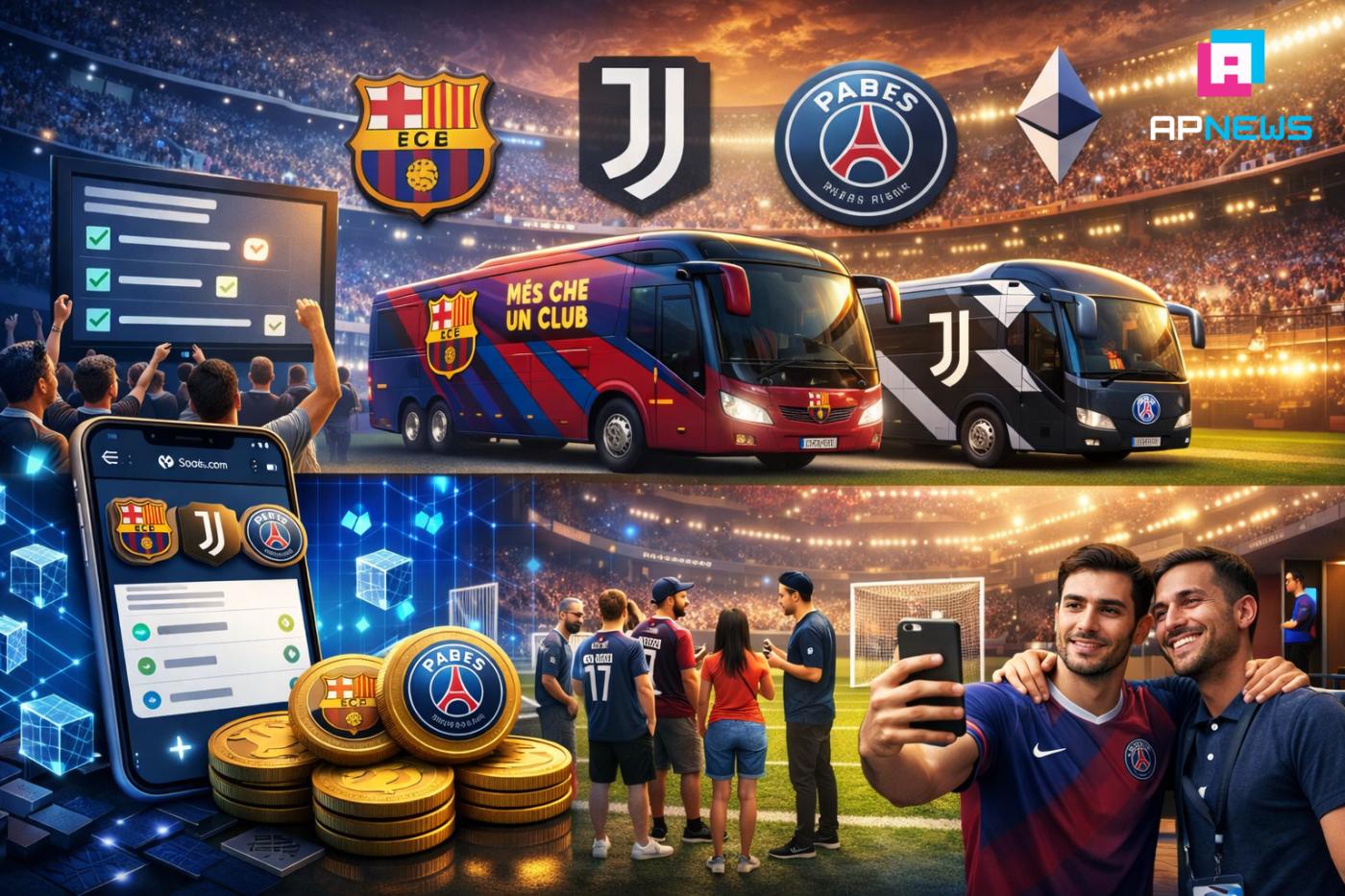
Today, when Juventus fans vote on the team bus color using $JUV tokens, and Paris Saint-Germain holders participate in naming their training grounds with $PSG tokens, a carefully crafted narrative has emerged—blockchain technology grants fans unprecedented "ownership." However, a sober examination of the technical implementation of these fan tokens reveals a disturbing reality: most fans are not purchasing true digital assets, but rather participation credentials existing in a centralized database. These tokens are "imprisoned" within the walled garden of specific platforms, unable to be freely transferred or used in other ecosystems, their voting rights strictly limited to symbolic issues unrelated to the core of the sport.
This article will deconstruct the "asset cage" nature of the current fan token model from the perspective of technical architecture, analyze the business logic and historical inevitability behind this design, and explore possible breakthrough paths. We will see that the evolution from "platform-controlled participation credentials" to "user-autonomous digital identities" is not only about technological choices, but will also determine the fundamental power ownership of sports communities in the Web3 era.
How do centralized platforms define a "decentralized" experience?
The current mainstream fan token ecosystem is built on a sophisticated centralized architecture. Taking the industry-leading Socios platform as an example, its technology stack exhibits a typical three-layer structure: the top-layer user interface provides a smooth voting and interactive experience; the middle-layer business logic servers handle all core computations; and the bottom-layer blockchain serves only as a ledger for recording the final state. In this architecture, true control resides in the middle-layer server cluster, rather than the underlying decentralized network.
The first limitation of this design is the non-portability of the assets. Fan tokens purchased with fiat currency are actually stored in escrow wallets controlled by the platform. Users only gain a database record of "owning the token," not actual control over the private keys. This means fans cannot transfer these assets to their own hardware wallets or use them on other platforms that support the same blockchain. When the platform's partnership with the club terminates, or when the platform itself encounters operational problems, the fate of these digital assets depends entirely on the decisions of the centralized operator.
The second limitation lies in the performative nature of governance. Fan tokens are marketed as "governance tokens," but their governance scope is carefully limited to cultural and marketing issues. Clubs pre-define a list of voteable options through smart contracts, and the platform collects and verifies the voting results through centralized servers. The entire process is technically no different from traditional online surveys, except that the final results are recorded on the blockchain to increase credibility through "immutability." True club governance—transfer strategies, financial allocation, and management appointments—remains entirely in the hands of traditional ownership structures.
The third limitation is the closed nature of the ecosystem. The $JUV token can only function within the Socios ecosystem; it cannot be used to purchase NFT tickets, as collateral in DeFi protocols, or to prove fan identity on other metaverse platforms. This closed nature ensures the platform's commercial monopoly but violates the core spirit of Web3 interoperability. Fans cannot establish connections between fan tokens from different clubs, let alone form a cross-platform fan identity graph.
Why centralization is an inevitable transitional phase
To understand the current state of fan tokens, it is essential to place them within the broader context of the digital transformation of the sports industry. The emergence of centralized platform models is not a technological regression, but rather a rational choice under specific historical conditions.
From the clubs' perspective, partnering with professional platforms like Socios offers a minimally invasive digitalization path. Traditional sports organizations generally lack blockchain technology capabilities, and building and maintaining decentralized systems in-house requires significant technological investment and ongoing operational costs. Professional platforms provide complete solutions: they handle complex technical implementations, ensure compliance with local regulatory requirements, provide user support and community management, and even assume responsibility for market education and promotion. In return, platforms take a substantial cut from token sales and trading, and accumulate valuable user data and industry influence.
From a regulatory adaptability perspective, centralized architectures provide the necessary control nodes. The sports industry faces stringent anti-money laundering (AML), know-your-customer (KYC), and securities regulations. Centralized platforms can perform identity verification, monitor suspicious transactions, and generate compliance reports, much like traditional financial institutions. However, in a fully decentralized system, these compliance requirements would be difficult to meet, potentially exposing clubs to legal risks. The current centralized-decentralized hybrid model is, in effect, a temporary balance between legal compliance and technological innovation.
From a user experience perspective, centralized servers ensure the continuation of traditional internet user habits. Fans expect instant response, zero transaction fees, and a simple, intuitive interface. Fully on-chain voting requires blockchain confirmation, gas fees, and private key management—all of which remain high barriers to entry for the average user. By centrally processing user interactions and only putting the final state on-chain, the platform perfectly hides the complexities of the blockchain, allowing tens of millions of fans without technical backgrounds to participate seamlessly.
This phase can be understood as the "dial-up era" of sports Web3. Just as the internet in the 1990s required access through centralized portals like AOL, today's fans need platforms like Socios to experience new interactive forms enabled by blockchain. Technological immaturity, insufficient market education, and regulatory uncertainty have collectively created the current centralized-dominated landscape. This phase has accumulated valuable user bases, validated business models, and provided operational experience for the industry, but it has also sown the seeds of excessive power concentration.
How open protocols can disrupt closed ecosystems
The technological key to breaking free from the asset cage is being gradually forged. This process is not a revolutionary subversion of existing models, but rather the construction of a parallel and interconnected open ecosystem through incremental protocol innovation.
The evolution of portable asset standards is a crucial first step. Currently, fan tokens are mostly implemented on private blockchains or highly customized public blockchains, but the industry is slowly migrating towards public blockchains and open standards. Ethereum's ERC-1155 standard demonstrates unique advantages, allowing a single contract to manage multiple types of assets—voting tokens, commemorative NFTs, and identity credentials can be issued and managed uniformly. High-throughput chains such as Polygon and Solana are also actively vying for sports asset issuance. This migration will give fans true control over their private keys, the freedom to choose custody options, and the ability to transfer assets between different wallets and applications.
The introduction of decentralized identity (DID) systems will redefine the relationship between fans and clubs. A blockchain-based autonomous identity system allows fans to create a unified digital identity across platforms and clubs. This identity can accumulate reputation data across various dimensions: the length of time a fan has held tokens, their voting history, records of attending offline events, and proof of community contributions. This data can be verified without compromising privacy using zero-knowledge proof technology. When a fan interacts with a new club, they can selectively present proof of their long-time fandom at other clubs to gain corresponding respect or benefits.
The standardization of composable interfaces will unlock the network effects of fan assets. By defining a unified application programming interface (API) and data format, tokens issued by different clubs can be used in applications built by third-party developers. Imagine a metaverse football game where players can wear virtual jerseys of the clubs they own; or a DeFi protocol that accepts mainstream club fan tokens as collateral. This composability will transform fan assets from "closed membership points" into "open financial and cultural mediums."
Gradual decentralized governance experiments may progress from the periphery to the core. Clubs can begin by experimenting with low-risk, non-financial decisions to explore genuine on-chain governance processes. For example, through a decentralized autonomous organization (DAO), token holders could manage the club's charitable fund and decide which community projects to fund; or collectively create and operate a fan media channel. These experiments will accumulate technical experience, build community trust, and lay the foundation for more significant governance participation in the future.
When fan identity becomes an autonomous digital entity
The fan token ecosystem driven by open protocols will exhibit characteristics drastically different from the current centralized model. In this new ecosystem, fan identity will no longer be an appendage defined by the platform, but rather an autonomous, programmable, and composable digital entity.
The core change lies in the complete transfer of ownership. Fans directly control digital assets representing voting rights, access rights, and identity verification through their own wallets. These assets are no longer tied to specific platform accounts, but rather follow the fundamental Web3 principle: "If it's not your private key, it's not your token." Clubs define the economic model and rights rules of these assets through smart contracts, but cannot control their circulation or usage scenarios. This design ensures that even if the relationship between the club and its partner platforms changes, fans' assets and historical records will remain unaffected.
The sophistication and programmability of stakes will reach new heights. Through modular smart contracts, clubs can offer differentiated stake combinations for different types of fans. Long-term holders can automatically receive commemorative NFT airdrops; fans actively involved in governance can receive voting tokens with higher weighting; and fans attending offline events can receive Soul-Bound (SBT) proof of attendance. These stake rules are completely transparent and automatically executed, reducing intermediate management costs and human intervention.
Cross-ecosystem value circulation will become the norm. Fans' reputations and assets can be used across different sports, entertainment platforms, and even business scenarios. A veteran football fan's reputation may help them gain initial trust in a basketball community; their governance experience accumulated with their favorite team can be applied to other decentralized organizations; their fan token collection may become a unique category in the digital art market. This value circulation that breaks down silos will create entirely new network effects and business opportunities.
The substantial evolution of governance will rebalance the relationship between clubs and the community. While core competitive decisions will remain the responsibility of professional management, more operational decisions may gradually be opened to the community. Issues such as the pricing range of season tickets, stadium renovation designs, and the focus of youth team development—community consultation processes on these topics can be achieved through transparent on-chain governance. More importantly, clubs may automatically distribute a portion of their commercial revenue (such as a share of sales revenue from specific merchandise) to token holders via smart contracts, truly achieving economic symbiosis between the community and the club.
The Long Revolution of Fan Sovereignty
The evolution of fan tokens from "asset prisons" to "autonomous identities" is not merely a technological upgrade, but a long revolution concerning fan sovereignty in the digital age. The core contradiction of this revolution lies in the fundamental tension between the traditional highly centralized control model of the sports industry and the decentralized philosophy of Web3.
The current centralized platform model has played a historic transitional role in this contradiction. It lowered the technological barriers, validated market demand, established preliminary business models, and allowed tens of millions of fans to experience the sense of participation of "digital shareholders" for the first time. However, the inherent limitations of this model are becoming increasingly apparent: it creates new centralized power nodes, restricts true ownership of assets, and hinders the innovative vitality of the ecosystem.
The development of open protocols is offering another possibility. Through portable asset standards, decentralized identity systems, and composable interface designs, fans can expect to truly "own" their own digital identities and community benefits. This transformation will not happen overnight; it will be a gradual migration over many years, fraught with technical challenges, business negotiations, and regulatory coordination.
Ultimately, the standard of success is not technological advancement, but the ability to find a sustainable balance between innovation and tradition. Clubs need to maintain professionalism in both competitive performance and business operations while providing appropriate space for community participation; fans need to enjoy their rights while assuming corresponding responsibilities; and developers need to create products that are both valuable and easy to use.
When this balance is achieved, we will witness the birth of a completely new form of sports community: clubs will no longer be brands that unilaterally output content, but rather ecosystems co-built with fans worldwide; fans will no longer be marginalized consumers, but true members of the community with digital identities, economic rights, and participation in governance. From assets in a cage to an autonomous home, this evolutionary path will determine whether Web3 can truly deliver on its fundamental promise of granting users sovereignty, rather than merely repackaging old power structures with new technological shells.