A Busan-based digital asset platform has direct connections to global political and financial networks.
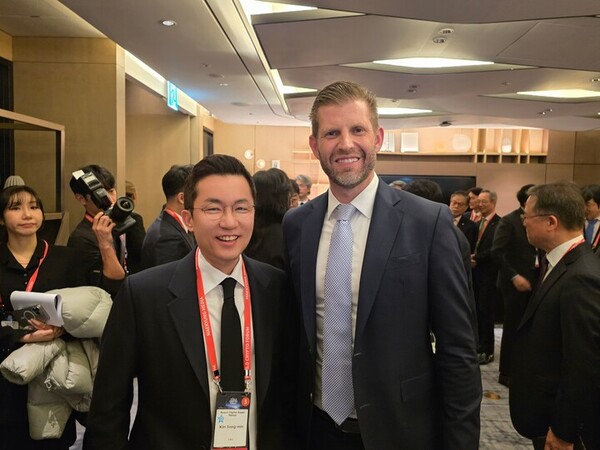
Kim Sang-min, CEO of Busan Digital Asset Exchange, met with Eric Trump, the second son of US President Donald Trump and co-founder of World Liberty Financial (WLFI), to discuss the topic of real asset tokenization (RWA).
This meeting took place at the World Crypto Forum (WCF) VIP event held in Yeouido, Seoul on February 10th. It was highly symbolic, as key figures from Korea and the US directly discussed RWA, amidst the growing integration of digital assets with institutional finance.
Eric Trump identified asset tokenization as a key trend in global digital finance. He emphasized that the structure of placing real-world assets on blockchains could dramatically expand investment accessibility and provide an alternative to the inefficiencies of existing financial infrastructure. He particularly noted that the digitalization of traditional assets such as real estate, raw materials, and gold would facilitate freer capital movement across borders.
CEO Kim Sang-min explained the Busan Digital Asset Exchange's strategy for tokenizing real assets like gold and silver. The exchange aims to leverage blockchain to ensure asset transparency and traceability, while also establishing a standard for the domestic RWA market through a structure that enhances investor protection. He also shared his vision for expanding the platform, based in Busan, to attract global investment funds.
This meeting was significant beyond a mere symbolic encounter, as it demonstrated a point of contact for the Korean RWA market to connect with the global network. WLFI, a digital finance project supported by the Trump family, focuses on expanding the decentralized finance and tokenization ecosystem. The intersection of Korea's real-asset trading infrastructure and US digital finance projects also raises the possibility of future collaboration.
CEO Kim officially invited Eric Trump to the "Blockchain Week in Busan 2026 (BWB 2026)" event, held in Busan this year. It remains to be seen whether Busan can move beyond a simple local event and become a central stage for global digital asset discourse.
Recently, RWAs, along with stablecoins, are considered the fastest-growing sector globally, expanding their reach into institutional settings. In an environment of increasing interest rate volatility and geopolitical risk, asset-backed tokens are emerging as a means of buffering against volatility and a new investment avenue. This meeting serves as a case study demonstrating how Busan-based RWA strategies can connect with the international stage within this dynamic.
The market is focusing on whether Busan can establish itself as a crossroads for global asset tokenization, rather than a testing ground for digital assets.