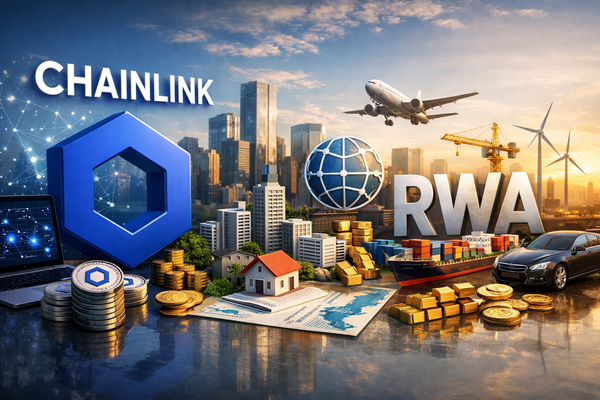
The real-world asset tokenization (RWA) market has grown by over 300% in the past year, according to a recent analysis. Sergey Nazarov, co-founder of blockchain oracle network Chainlink, described this as more than just a fad, but rather a "sign of a structural shift in the market."
He emphasized that tokenization is no longer an experimental process but has entered the process of being integrated into the financial infrastructure. He explained that as traditional assets such as gold, government bonds, real estate, and private equity move onto the blockchain, the boundaries between blockchain and the existing financial system are rapidly collapsing.
An interesting point is the discrepancy between price and fundamentals. While the price of Chainlink's native token, LINK, has recently been showing a downward trend, analysis suggests that network utilization, partnerships, and institutional collaborations are actually increasing. This suggests that token prices do not immediately reflect a project's technological and structural maturity.
The RWA expansion touches on a core area of Chainlink. For tokenized assets to connect with the real-world financial system, infrastructure such as external data reliability, price feeds, and Proof of Reserve is essential. Oracle networks serve as this connecting link. Nazarov pointed out that "for on-chain finance to absorb institutional funds, a verifiable data layer must first be established."
The market interprets this as a sign that Chainlink is moving beyond its "early phase focused on price volatility" and into a "maturity phase." While the past DeFi boom focused on liquidity and token yields, the current RWA phase centers on elements closer to traditional finance, such as regulatory compliance, real-world collateral, and institutional participation.
However, challenges remain. The legal rights structure, jurisdictional issues, liquidation procedures, and accounting practices for tokenized assets still require coordination within each country's regulatory framework. Even with technological advancements, without institutional consistency, large-scale capital inflows will inevitably be limited.
Ultimately, the key isn't LINK's price, but whether Chainlink can establish itself as a "standard data layer" for global financial infrastructure. The 300% growth in RWA is just the beginning. As real assets begin to fully settle on-chain, the role of oracle networks is likely to grow even more.
If the infrastructure is maturing, regardless of the token price, the market may already be moving to the next stage.