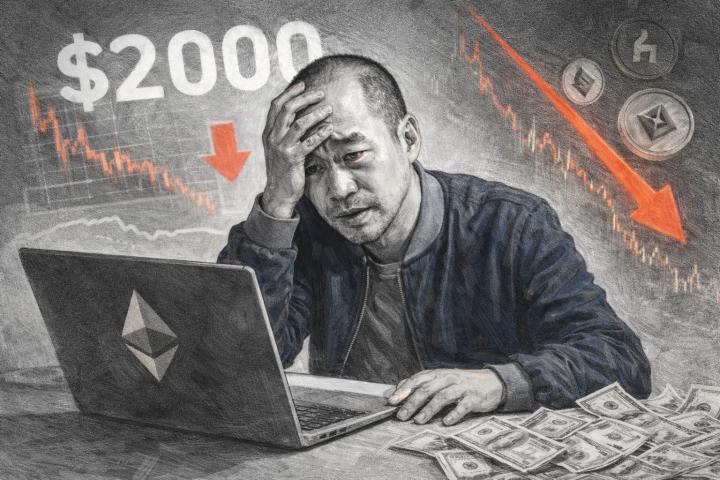
The Fear & Greed Index fell to a record low of 10 while leveraged Longing positions surged, creating a risk divergence that could challenge Ethereum's (ETH) $2,000 mark.
On the chain, many signals indicate "extreme fear" and losses among holders. However, a portion of speculative capital is still betting on a rebound, making the market more sensitive to volatility and the risk of sudden "leverage Dump ".
- The Fear & Greed Index dropped 7 points to a record low of 10, indicating a state of "extreme fear".
- ETH 's MVRV-Z is at -0.42, reflecting that the market is undervaluing the on-chain Capital ; many investors are incurring losses.
- Extreme positive funding and a $122.3 million Longing order using 15x leverage indicate increased leverage, making the $2,000 mark more risky.
Extreme fear is overwhelming market sentiment on Ethereum.
The Fear & Greed Index has dropped to 10, and ETH 's MVRV-Z is in negative territory, indicating that many investors are under pressure from losses, often associated with a period of "capitulation."
The sentiment chart shows that "extreme fear" is weighing heavily on expectations. The Fear & Greed Index just dropped 7 points to a record low of 10, a historically high level often coinciding with periods of investor stop-loss orders and reduced risk appetite.
In the on-chain data layer, Ethereum's MVRV-Z (Market Value to Realized Value) is -0.42. When MVRV-Z is negative, the market Capital is lower than the "realized value," implying that the Medium holder is in a loss.
However, the extreme level is not yet the deepest: ETH 's lowest historical MVRV-Z was -0.76 in 2018. This indicates that the market is under stress, but has not yet reached the deep "surrender" zone seen in the previous cycle.
ETH 's $2,000 mark has become a crucial psychological support level.
With significant corrections and a high percentage of investors currently experiencing losses, $2,000 is XEM a "psychological floor" that needs to be maintained to limit panic and prevent a reversal of FOMO (fear of missing out).
After a correction of around 35%, Ethereum is testing the patience of long-term holders. The core argument is that with many investors in the red, the risk of a sell-off increases sharply whenever the price breaks through key support levels.
The psychological aspect becomes even clearer when nearly 42% of holder are believed to be "underwater." In such a context, the $2,000 mark often Vai as an Peg of expectation: if it holds, it can curb panic; if it falls, volatility can be amplified due to stop-loss orders and liquidation.
Extremely positive ETH funding indicates that leverage is accumulating.
Funding has increased sharply, especially on BitMEX, reflecting a large number of leveraged Longing positions piling up, making the market vulnerable to "leverage Dump " if prices move against expectations.
According to data Chia by CryptoQuant , ETH funding on BitMEX is in an extremely positive state, while Binance has shifted from negative to neutral. The common interpretation is that leverage is increasing as speculative Capital flows into ETH.
A notable example noted by Lookonchain is a trader who opened a $122.3 million Longing ETH position with 15x leverage, bringing the liquidation price down to $1,329. Technically, this position has approximately 50% of its profit unrealized.
However, sentiment and on-chain indicators still lean towards "fear." The market remains in a historically extreme state of fear , coupled with pressure from Capital outflows from ETH ETFs and on-chain metrics suggesting capitulation behavior, creating a divergence from the "profit-seeking" behavior of leveraged investors.
In reality, this divergence means traders are buying based on short-term expectations before on-chain data confirms improvement. If volatility increases or prices fall rapidly, the leveraged accumulation could reverse into a liquidation chain , putting ETH 's $2,000 mark at significant risk.
The divergence between on-chain and trader behavior could cause ETH to become highly volatile.
When on-chain signals tension but leverage continues to rise, the market can easily shift from expectations of a recovery to chain liquidation, especially around psychological milestones like $2,000.
Current indicators suggest that investors are showing signs of deviating from what is reflected on-chain . In other words, "greed" may emerge earlier than the data foundation, making prices fragile if buying pressure is not sustainable enough.
In an environment of extreme fear, any shakeout can trigger defensive behavior such as reducing positions, withdrawing leverage, or selling to preserve Capital. Therefore, the $2,000 level is not only a technical support, but also a test of the resilience of leverage structures in the Derivative market.
Frequently Asked Questions
What does a Fear & Greed Index of 10 mean?
A level of 10 reflects “extreme fear” and historically often coincides with periods when investors cut their losses or surrender. However, this is not a sure sign of a reversal; it simply indicates that sentiment is very negative.
What does Ethereum's MVRV-Z of -0.42 mean?
A negative MVRV-Z indicates that market Capital is lower than the realized value ( on-chain Capital ), implying that the Medium holder is losing money. The -0.42 level shows existing pressure, but it is not as deep as the historical Dip of -0.76 (in 2018).
Why does extreme positive funding increase the risk for ETH?
High funding levels are often accompanied by many leveraged Longing positions. If prices fall, these positions are easily liquidated, creating a chain reaction that causes sharp increases in volatility and threatens support levels such as $2,000.
How important is the $2,000 mark for Ethereum?
The $2,000 level is a psychological threshold that can easily influence market behavior, especially when many holder are experiencing losses. If it holds, it could ease selling pressure; if it breaks through, the risk of stop-loss orders and liquidation could increase.