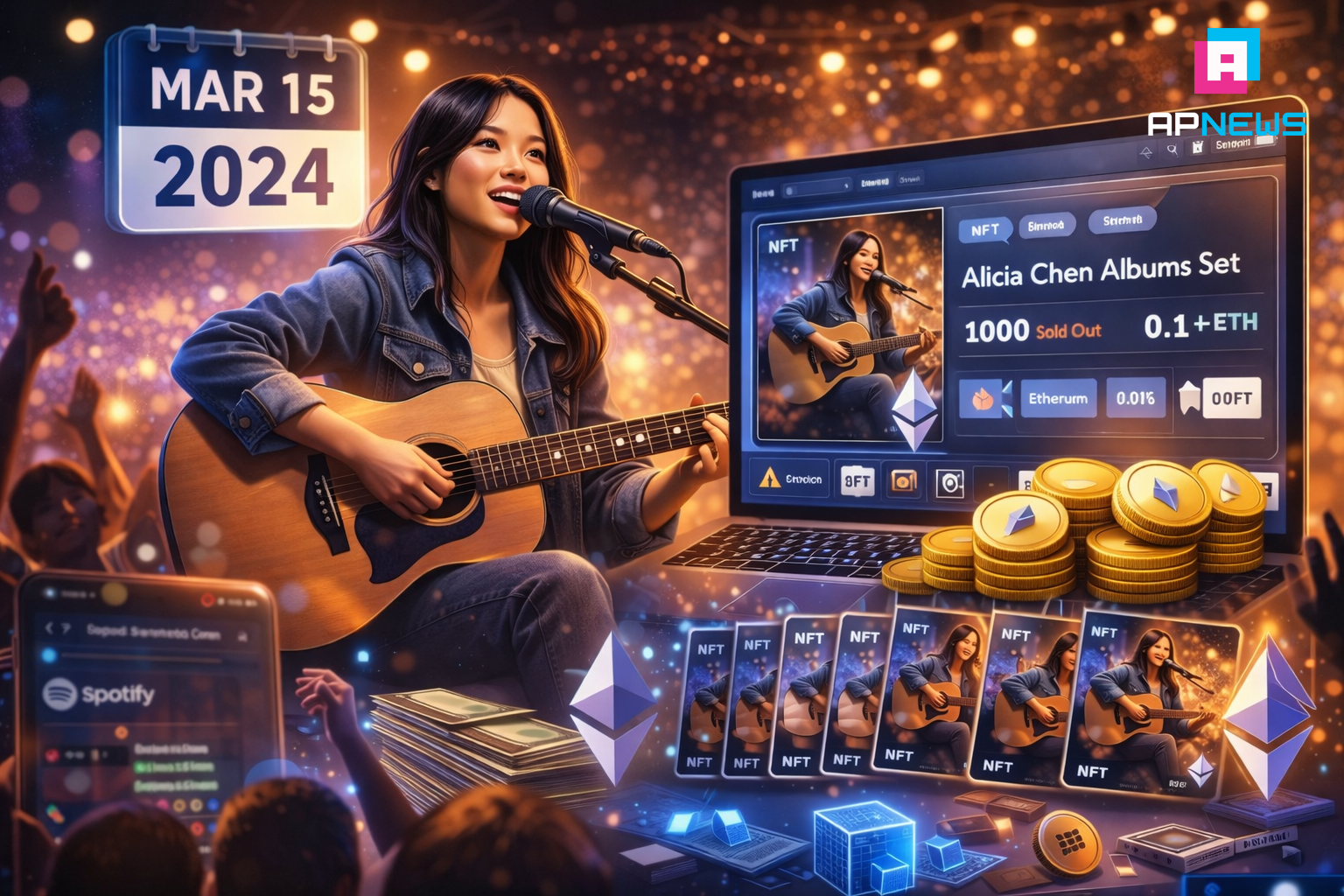
On March 15, 2024, independent musician Alicia Chen made a career-defining move. She did not submit her new album to a record label or upload it to streaming platforms; instead, she packaged all ten songs into a set of NFTs and sold them on the blockchain at 0.1 ETH each. Within 48 hours, all 1,000 NFTs were sold, netting her $320,000—twenty times more than her total Spotify streaming earnings over the past decade.
Behind this silent financial revolution is a paradigm shift reshaping the global music industry. While traditional streaming platforms still defend revenue models of “$3–4 per thousand plays,” a transformation that turns music from “infinitely replicable digital streams” into “ownable scarce assets” has quietly begun. Music NFTs are rewriting the industry’s value distribution formula—not by increasing per-stream payouts, but by fundamentally changing music’s nature, from a consumable product to a capital asset.
The Twilight of the Streaming Economy—When Play Counts No Longer Equal Survival
To understand the revolutionary nature of music NFTs, one must first examine the fundamental dilemmas of the current mainstream streaming economy. Platforms like Spotify and Apple Music have established subscription models based on access: users pay a fixed monthly fee for unlimited playback, and the platform distributes revenue to copyright holders according to play counts. This system creates structural contradictions: top artists receive the vast majority of streams but only minuscule per-play earnings; long-tail musicians, even with loyal fans, struggle to make a living due to insufficient absolute plays; and music’s value is compressed into mere “listening time,” while cultural value, emotional connection, and community identity are completely overlooked.
A deeper problem lies in the platform business model. Streaming platforms are essentially “music libraries” whose core interest is maximizing user retention and subscription revenue, not artist income. Consequently, platforms tend to promote “safe” content that prolongs user engagement. Algorithms favor predictable styles and familiar artists, systematically marginalizing innovative and experimental music. Musicians face a double bind: either create “platform-friendly” music to satisfy algorithms or maintain artistic integrity at the cost of economic marginalization.
Music NFTs offer a third path. They do not attempt to raise streaming royalties within the existing framework—this would fundamentally clash with platform economics—but instead step entirely outside the “pay-per-play” paradigm. By converting singles or albums into scarce digital assets, music’s value is no longer determined by passive plays but by community recognition, cultural significance, and future growth expectations. This is essentially a migration from a “rental economy” to an “ownership economy.”
From “Play Counts” to “Balance Sheets”—Reconstructing Music’s Value
The core innovation of music NFTs lies in redefining how music value is carried. In the traditional model, a song’s value is simplified to an accumulating play counter; in the NFT model, a song’s value exists within a multi-layered asset structure.
The first layer is access and experience rights. Fans who purchase music NFTs gain permanent, platform-independent listening rights. These rights are secured via blockchain smart contracts, independent of any intermediary platform’s ongoing operation. Unlike traditional digital downloads, NFT music files often include high-resolution audio, exclusive remixes, and creation notes, creating differentiated experiential value.
The second layer is ownership and proof of scarcity. Each music NFT is a unique or limited digital certificate proving the holder “owns” a specific version of the work. Ownership may carry different rights: the holder of NFT #1 might receive 1% of song royalties, and the first 100 buyers may gain lifetime priority tickets for future concerts. Scarcity fundamentally changes music’s nature—it is no longer an infinitely replicable bitstream but a digital collectible with a defined supply boundary.
The third layer is community identity and governance rights. Holding a particular artist’s NFT often means joining an exclusive fan community. This identity can be verified across other social platforms, unlocking exclusive content, online meet-and-greets, and even providing input on creative direction. Some forward-looking projects integrate NFTs with governance tokens, enabling holders to influence decisions such as tour cities and collaborating artists—roles traditionally controlled by record labels.
The most radical fourth layer is financial asset attributes. When music NFTs can freely trade on secondary markets, they take on investment characteristics. Fans purchasing NFTs are not merely consuming but making early investments in an artist’s future success. If the artist later achieves mainstream success, early NFT values may increase substantially. This model creates new incentives: fans have a direct economic motivation to help their supported artists achieve broader success, as it increases the value of their own assets.
The Rise of a New Value Chain—How Smart Contracts Reshape Industry Roles
Music NFTs not only change the relationship between artists and fans but also restructure the entire music industry value chain. Traditionally, creation to consumption involves record labels, distributors, copyright organizations, and streaming platforms, each taking a cut. Blockchain and smart contract-based infrastructure automates and transparently encodes these functions.
In creation and financing, artists can raise production funds through NFT presales, avoiding record label advances and associated debt relationships. Smart contracts can establish complex revenue distribution rules: main artist 50%, songwriter 15%, producer 10%, early investors 5%, remaining 20% in a community fund for future promotion and production. All distributions execute automatically with each NFT sale or royalty payment, without intermediaries.
In distribution and promotion, decentralized storage ensures permanent access to music files, unaffected by central server shutdowns. Blockchain-based social graphs allow fans to discover other musicians their favorite artists collaborate with, forming decentralized recommendation networks. NFT scarcity and tradability create unprecedented marketing incentives—fans may voluntarily promote artists to increase the value of assets they own.
In copyright management and royalty distribution, smart contracts allow near-real-time transparent settlement. Every time a song is streamed on traditional platforms or used commercially, royalties can automatically distribute to NFT holders according to preset proportions. This contrasts sharply with traditional systems, where settlements may take months or years. Importantly, this transparency prevents long-standing issues of “black box” operations and unpaid royalties.
Sustainability Question—Can the New Paradigm Benefit Most Musicians?
The rise of music NFTs also raises key questions about sustainability and inclusivity. Current success stories mostly involve artists with established fan bases. Will the NFT model work for completely unknown newcomers? How can an artist with no audience convince people to purchase digital assets representing ownership of their work?
The answer points to core challenges in the music NFT ecosystem: discovery and trust mechanisms. In the traditional system, A&R departments and platform algorithms handle curation and promotion; in a decentralized ecosystem, new mechanisms are required. Possible solutions include: curation networks based on social tokens, rewarding veteran fans for recommending newcomers; reputation-based collaboration networks, allowing new artists to gain credibility through partnerships with established producers and songwriters; and data-driven prediction markets, letting the community collectively forecast an artist’s likelihood of future success.
Another challenge is regulatory and legal compliance. When music NFTs involve future royalty sharing, they may be classified as securities in many jurisdictions, requiring disclosure and registration. Direct investment relationships between artists and fans also bring new responsibilities—if promises are unmet or NFT values collapse, legal disputes may arise. The industry must balance innovation with compliance.
The most fundamental question concerns music itself. When musical works become investable financial assets, does the creative process become distorted? Will artists deliberately craft works optimized for NFT scarcity and hype? Will fans’ evaluation criteria shift from artistic merit to investment potential? The answers will determine whether music NFTs evolve from a novel business model into a sustainable ecosystem that enriches music culture.
A Symphony of Two Futures—Parallel Worlds Coexisting and Integrating The paradigm shift represented by music NFTs will not immediately eliminate traditional streaming. A more likely scenario is the long-term coexistence and gradual integration of both models, serving different needs and contexts.
A foreseeable multi-track future: mainstream pop continues to dominate streaming platforms, generating income through mass plays; independent and experimental artists adopt the NFT model, achieving sustainable creation via deep fan support and asset sales; hybrid models emerge in the middle, with artists releasing both streaming versions and limited NFT editions to satisfy diverse audiences. Platforms may also integrate NFT functionality, allowing artists to add purchasable limited editions to existing streaming catalogs.
The deeper significance of this transformation goes beyond business model innovation. It marks a redefinition of artistic value in the digital era—from passive consumption metrics to active community valuation. When a fan purchases a music NFT, they are buying not just an audio file, but a vote of trust in the artist, a sense of belonging in the creative community, and a shared commitment to cultural value.
This silent revolution in the music industry may ultimately foster a more diverse and equitable creative ecosystem. Here, artistic value is no longer reduced to numbers on a play counter but is reflected through complex community consensus, cultural impact, and emotional connection. The shift from “streams” to “shares” essentially restores music from an industrial-era standardized commodity to a unique cultural asset in the information age—ownable, inheritable, and co-creatable. When the final lines of code are written into smart contracts and the first truly community-owned song begins perpetual playback on the blockchain, the music industry’s balance sheet will be permanently rewritten.