Zach Pandl, head of research at Grayscale , released a report today (11th) pointing out that Bitcoin is at a critical juncture in its "role evolution." Data shows that the correlation between Bitcoin and gold has dropped to a low point, while its 30-day rolling correlation coefficient with the Software Technology ETF (IGV) is as high as 0.73, indicating that its market behavior is closer to that of high-risk growth assets.
While gold prices challenged a record high of $5,000 per troy ounce, Bitcoin continued to fluctuate along with the US technology sector. Zach Pandl stated:
It is unrealistic to expect Bitcoin to replace gold in such a short period of time.
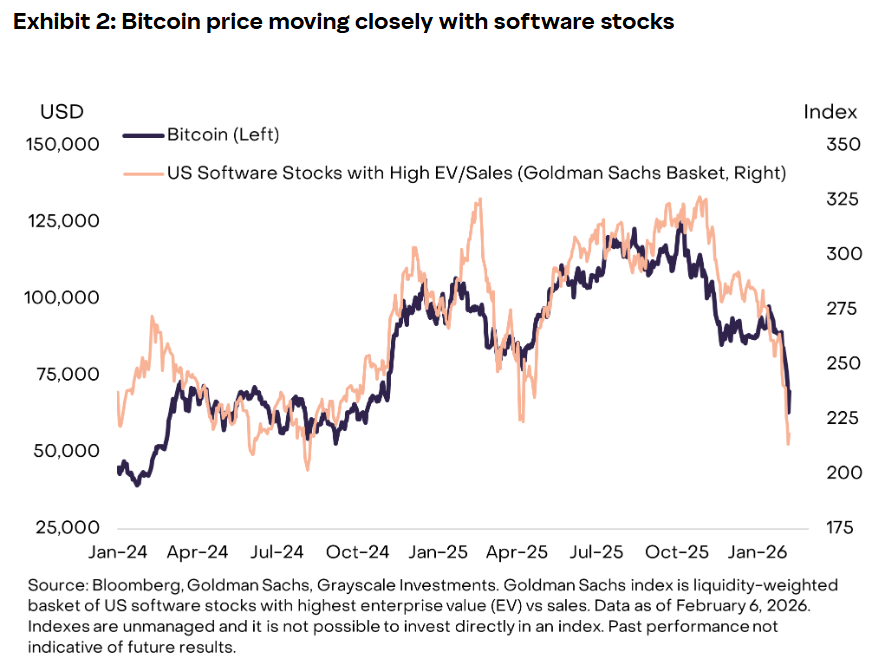
The Grayscale report further analyzes that the strong correlation between Bitcoin and tech stocks stems primarily from the increasing popularity of ETFs. As institutional funds flow into the Bitcoin market in large quantities through ETFs, the asset's relationship with the traditional financial system is becoming increasingly close.
When macroeconomic risks escalate, institutions often prioritize selling highly volatile assets such as Bitcoin rather than viewing them as a safe haven.
Will the AI shockwave affect Bitcoin?
Some analysts believe that the market views Bitcoin as a foundational growth asset for the future digital economy. Therefore, when artificial intelligence (AI) technology impacts traditional software services, Bitcoin will inevitably be affected. This explains why Bitcoin is under pressure alongside software technology stocks facing competition from AI.
However, Grayscale believes this phenomenon is not a failure of Bitcoin as a store of value, but rather an inevitable stage of its evolution after integration into the traditional financial system. The report points out that gold has held a monetary status for thousands of years and remained a pillar of the international monetary system until the early 1970s. In contrast, Bitcoin, with only 17 years of history, is currently in a period of "adjustment and evolution."
Overall, Grayscale remains optimistic about Bitcoin's long-term prospects. The report argues that as the global economy continues to digitize and tokenize, Bitcoin will continue to evolve into a long-term store of value. However, investors should recognize that during this transitional phase, Bitcoin's market performance may resemble that of a high-risk growth asset rather than a traditional safe-haven asset.