In the context of artificial intelligence shifting from purely software models to systems capable of directly interacting with the physical world, the challenge lies not only in AI's reasoning ability but also in its consistent deployment across various robotic hardware types. The lack of a unified AI-native infrastructure means that the development, scaling, and control of robot behavior remain Shard, heavily reliant on individual manufacturers and architectures. OpenMind was developed to address this issue.
So what makes OpenMind special? Let's explore the details of the OM1 platform for AI agents and robots in the article below!
What is OpenMind? The OM1 platform for AI agents and robots.
What is OpenMind?
OpenMind developed an open-source software platform called OM1, designed as an AI-native operating system for artificial intelligence agents . The goal of OM1 is to enable AI to not only thrive in digital environments but also operate directly on physical robots, capable of thinking, learning, and collaborating in real time.
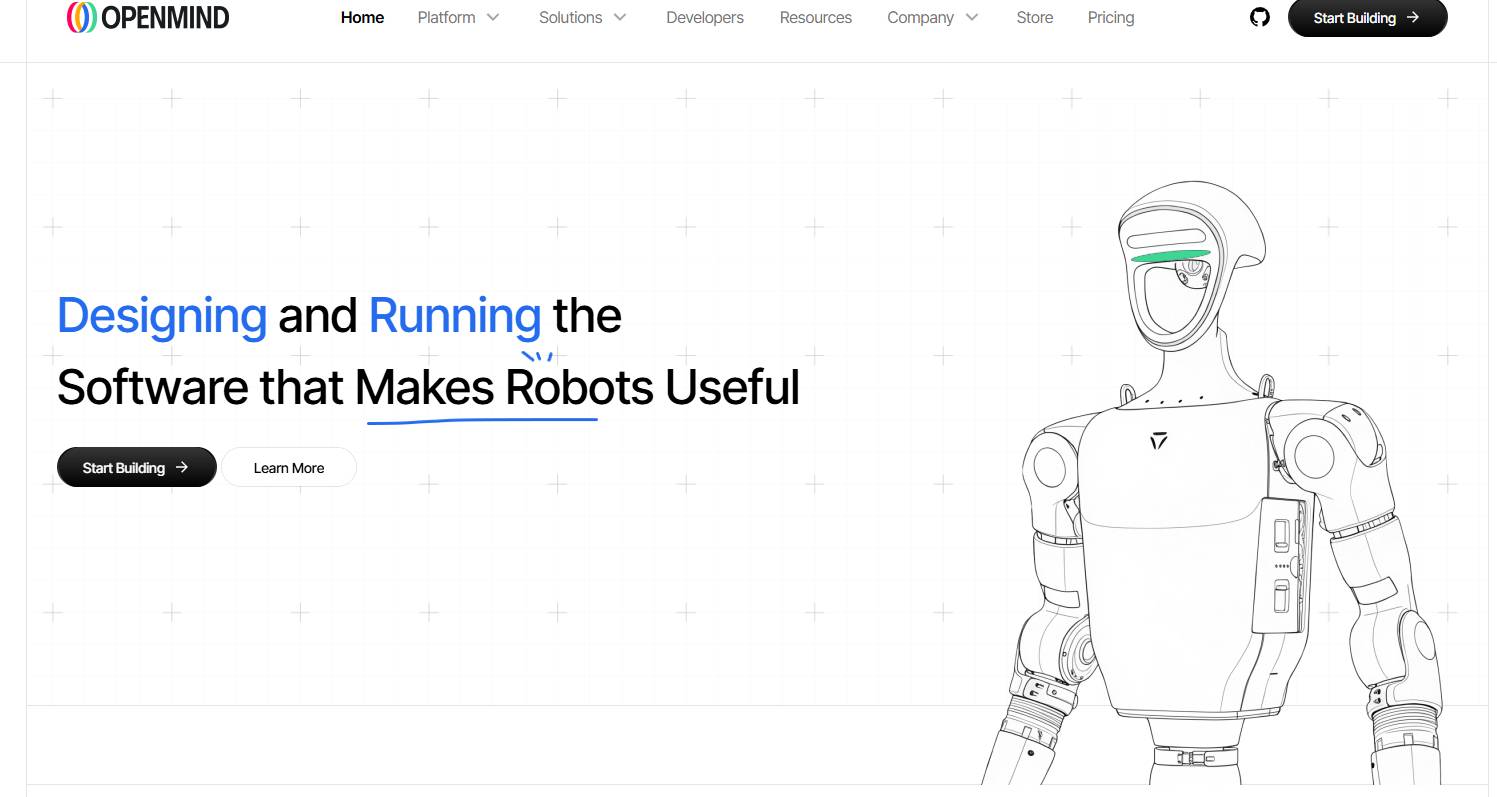
OpenMind Homepage
OM1 is built with cross-platform compatibility in mind, meaning it's not dependent on a specific robot type or manufacturer. The platform can be deployed on a variety of hardware, from humanoid robots and quadrupeds to robotic arms and mobile platforms, while adhering to the MIT license to ensure transparency and community verifiability.
The unique features of OpenMind
The core difference of OM1 lies in its architecture of a fixed-frequency cognitive-decision-action loop, where multimodal data from sensors is compressed and transformed into linguistic context before being fed into the LLM.
This approach allows the same AI logic to be implemented consistently across various hardware forms such as quadcopters, humanoid robots, or TurtleBot 4, through hardware abstraction and standard middleware like ROS2, Zenoh, or CycloneDDS.

OpenMind's architecture
Furthermore, OM1 places a strong emphasis on scalability and collaboration: agent configuration using JSON5, a plugin system for sensors and actions, multi-model LLM integration capabilities (cloud and on-device), and real-time simulation and monitoring tools. On this foundation, OpenMind aims to build an ecosystem where robotic skills, processes, and behaviors can be Chia and developed collaboratively, rather than being locked within closed systems specific to each manufacturer.
Key features of OpenMind OM1
- BrainPack (plug-and-play) : A hardware module that provides computing power to robots, supporting platforms like NVIDIA Thor, and geared towards rapid deployment across various robot families.
- Industrial-grade middleware support : Compatible with popular standards such as ROS2, Zenoh, and CycloneDDS, enabling easy integration into existing robotics ecosystems.
- Governance and accountability : The robot's rules and "constitution" can be stored on a public ledger like Ethereum, ensuring the ability to audit and trace behavior.
- Simulation environment : Integrates with Gazebo to test and train robots in a virtual environment before real-world deployment.
- Developer tools : Including Developer Cookbook, agent management CLI, and WebSim – a web interface for monitoring robot data and responses in real time.
Tokenomics
Currently, the project's official Token has not yet been officially announced. Coin68 will update as soon as more details become available.
Development roadmap
Currently, the OpenMind project's development roadmap has not been officially announced. Coin68 will update you as soon as more details become available.
The OpenMind project development team
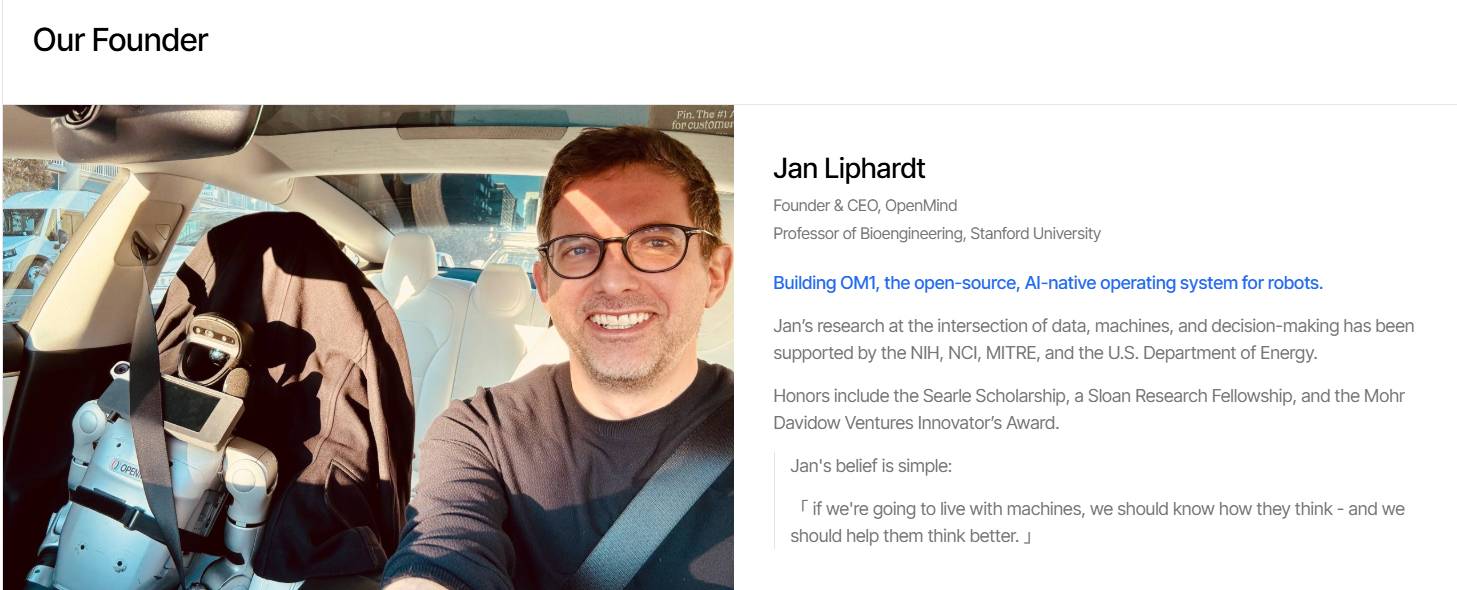
OpenMind Project Development Team
- Jan Liphardt : He is the Founder and CEO of OpenMind. He is also a Professor of Bioengineering at Stanford University. Jan Liphardt's research focuses on the intersection of data, machines, and decision-making, and has received funding from the NIH, NCI, MITRE, and the U.S. Department of Energy. He is also the recipient of numerous academic and innovation accolades, including the Searle Scholarship, the Sloan Research Fellowship, and the Mohr Davidow Ventures Innovator's Award.
Investors and Capital for the OpenMind project.
OpenMind's investors and Capital
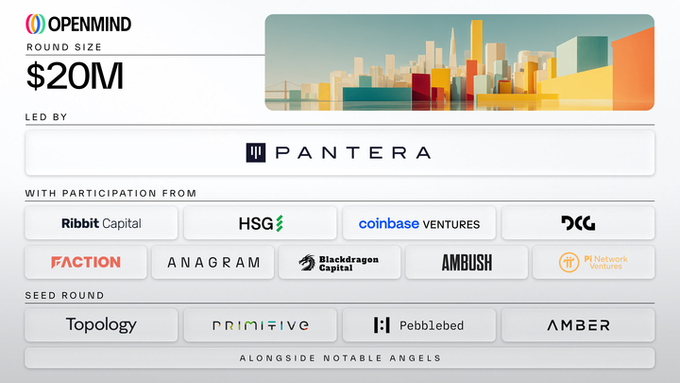
OpenMind stated that the project has raised over $20 million and received backing from numerous investment funds and organizations in the technology and digital asset sector, including Pantera Capital, Ribbit Capital, Coinbase Ventures, Digital Currency Group, and several others.
Summary
Above is all the information about the OpenMind project. Coin68 hopes that readers have grasped the basic information to better understand the project and how it works. We wish you more useful knowledge!
Note: The information in this article is for informational purposes only and is a compilation of publicly available information about the project; it is not investment advice. Coin68 is not responsible for any financial decisions you make.