714,644 Bitcoins
This is Strategy's holdings as of February 12, 2026. At current prices, these Bitcoins are worth approximately $48 billion, representing over 3.4% of the total global Bitcoin supply. This means that one in every 30 Bitcoins in circulation worldwide belongs to this company.
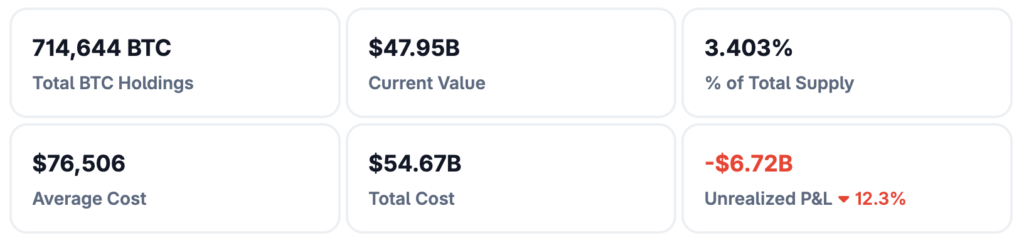
Amid the sluggish crypto market, the company has already incurred a paper loss of approximately $6.7 billion. However, its founder, Michael Saylor, hasn't stopped there. The company's "42/42 Plan" aims to raise $84 billion by 2027: half equity and half debt, all to be used to buy Bitcoin. As of January 2026, $41 billion remains untapped.
Five tranches of perpetual preferred stock
Where did Saylor get the money to buy Bitcoin?
The answer is a carefully crafted combination of financial instruments. Starting in January 2025, Strategy issued five tranches of perpetual preferred stock at a dazzling pace, each with a deliberately chosen name:
STRK (Strike) — 8% dividend, convertible to MSTR common stock. 10 STRK shares can be exchanged for 1 MSTR share. In other words, if Bitcoin and MSTR stock prices rise, you can exchange your preferred stock for common stock and earn more.
STRF (Strife) — 10% fixed dividend, non-convertible, accumulative. If a dividend payment is missed, the interest rate automatically increases by 1 percentage point annually, up to a maximum of 18%. This is a promissory note with a penalty clause.
STRD (Stride) — 10% dividend, non-convertible, non-cumulative. Missed payments will not be reimbursed.
STRC (Stretch) — a floating interest rate designed to compete with money market funds. The ATM program has a capacity of $4.2 billion.
STRE (Stream) — The latest issue, launching in November 2025.
Five product tiers, five risk appetites, and five different investor groups. What Saylor does is essentially break down the risks of Bitcoin, a single asset, into five different financial products and sell them to five different types of people.
Some people want to convert their options (betting on Bitcoin's rise), some want fixed returns (just a stable 10%), some want floating interest rates (to hedge against interest rate risk)... but their money ultimately flows to the same place: Bitcoin.
The combined ATM (Auction to the Market) quota for these preferred shares is: STRK $21 billion, STRC $4.2 billion, STRF $2.1 billion, and STRD $4.2 billion. This totals over $30 billion.
Strategy's flywheel effect
The logic behind MicroStrategy's preferred stock issuance is as follows: Strategy issues new shares (common or preferred stock) ⭢ Uses the raised funds to buy Bitcoin ⭢ Bitcoin enters the company's balance sheet ⭢ Increases the company's asset size and market capitalization ⭢ Higher market capitalization supports larger new share issuances ⭢ More funds are raised ⭢ Buy more Bitcoin (repeated cycle)
This is known as the flywheel effect: as long as the price of Bitcoin rises, or at least doesn't plummet, the flywheel will keep spinning.
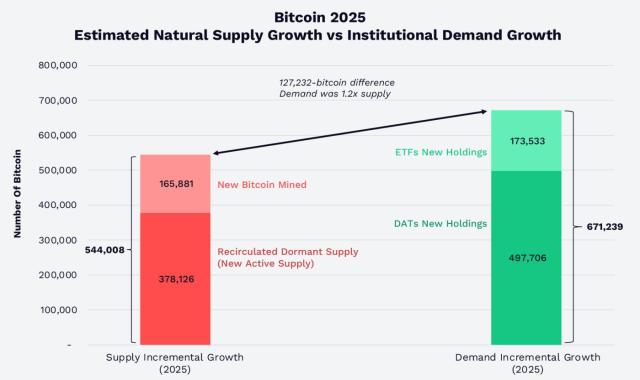
In 2025, this flywheel spun rapidly. Strategy's holdings grew from approximately 440,000 Bitcoins at the beginning of the year to over 670,000 by the end, purchasing more than 230,000 Bitcoins within a year at a cost of tens of billions of dollars. The company's "42/42 Plan," originally called the "21/21 Plan," doubled in size after Bitcoin prices and institutional interest exceeded expectations, with the target increasing from $42 billion to $84 billion.
Saylor called the launch of STRC preferred stock Strategy's "iPhone moment": a groundbreaking product that redefines corporate finance.
But the flywheel has a fatal weakness: it cannot reverse.
If the price of Bitcoin drops significantly, the company's market capitalization will shrink, its ability to issue new shares will be limited, and there will be a shortage of funds to buy Bitcoin, causing the flywheel to slow down. Meanwhile, the dividend obligations of those already issued perpetual preferred shares will not disappear. STRK pays 8% annually, and STRF pays 10% annually. You can choose not to pay, but the debt will snowball at increasingly higher interest rates, up to a maximum of 18%.
The Boundaries of Alchemy
Gold bull Peter Schiff once asked Saylor on social media: "Strategy is losing money. What are you using to pay the preferred stock dividends?"
Critics call it a "Ponzi scheme," while supporters call it "financial innovation." Strictly speaking, neither side is entirely correct. The Bitcoin held by Strategy is a real asset, and as long as the price of Bitcoin doesn't drop to zero, the company has real assets to back it up. However, the problem lies in the high volatility of Bitcoin's price, while the company's obligations—dividends and debt interest—are fixed.
Although Strategy says its current cash flow can cover interest expenses for at least two and a half years, a continued slump in Bitcoin's performance will inevitably affect its fundraising speed.
Saylor 's bet is clear: he's betting that Bitcoin will rise in the long run. Not just a little, but to the point where all his paper losses become a joke. He was ridiculed when he bought in at $11,000 in 2020. Bitcoin later rose to over $100,000. He's now continuing to buy at an average cost of $76,000, and five years from now, looking back, it might be another story of "why didn't I buy in back then?"
His ultimate strategy is that when Strategy's holdings and market capitalization reach a certain level, the market will be forced to include MSTR in major indices. The inflow of passive funds will further drive up the stock price, starting a new flywheel. In December 2025, Strategy was already included in the Nasdaq-100 index, and the next target is the S&P 500.
A machine that never stops
The story of Strategy, in essence, is a story about irreversibility.
This machine was designed without brakes. Saylor believed that in a world where fiat currencies were constantly depreciating, stopping was the biggest risk, so he transformed the company into a one-way Bitcoin accumulation device: only buying and never selling, only taking in and never giving out.
He now sits atop 714,644 bitcoins, with a paper loss of $6.4 billion, paying at least $700 million in dividends annually, and billions more in ammunition ready to buy more. Will this machine ultimately prove Saylor a prophet, or will it allow him to repeat the script of March 20, 2000? Nobody knows yet.
But one thing is certain: in the history of finance, no one has ever used perpetual preferred stock, cumulative dividends, and an $84 billion capital plan to gamble on an asset that is only 17 years old. This is the capitalization of faith.