Author: Daniel Krawisz
Source: https://nakamotoinstitute.org/mempool/its-not-about-the-technology-its-about-the-money/
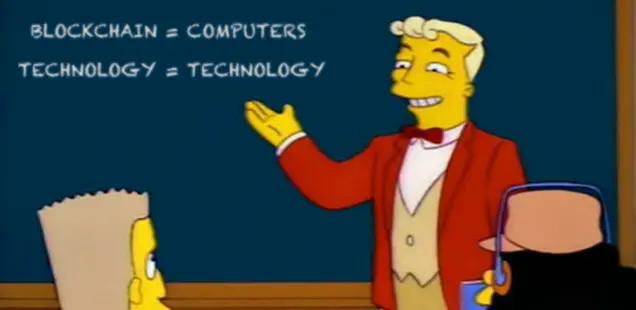
Blockchain technology
The Bitcoin community is full of people who know nothing about economics or cryptography. All they know is that if they hadn't sold during the downturn, they'd be millionaires now. They console themselves that there's still hope, because Bitcoin is just the "MySpace" of cryptocurrencies, and they still have a chance to be among the first to participate in another revolution. These people may be dangerous, but most are also prey. (Translator's note: MySpace is a pioneering social media website.)
I think that's probably where the term "blockchain technology" comes from. It allows people to imply that Bitcoin clones are promising without reminding the audience of Bitcoin itself. If someone talks to me about "blockchain technology," I'll be highly skeptical and categorize them as someone who has no idea what they're talking about. If I eventually find them to be clever, then they're probably a fraud .
When people talk to you about "blockchain technology," you can usually replace the word with "mana," "mindfulness," or "quantum" without affecting their interpretation. "Blockchain technology" has become a mantra for some Bitcoin enthusiasts to use to secure investment from venture capitalists and others, much like a male bird's song to attract females. This term is for those who have plenty of spare cash but don't know where it came from.
I don't see any other use for "blockchain technology" in the general sense, besides its application in Bitcoin. In Bitcoin, blockchain is a technology that solves the " double-spending problem " of electronic money and doesn't grant any participant the privilege of creating new units of currency or establishing transaction history. It's an extremely expensive and complex method aimed at maintaining a continuously updated ledger. How often do I actually need to record transactions this way? I would say it's only a good approach when the game is so important that it's unsafe for anyone to act as referee. I don't really need it that many times, but I think it's a good idea that blockchain is a good alternative to oppressive aspects of the monetary system. Beyond that, I'd rather keep my ledgers private than have them all public.
In places where the problem of double-spending isn't involved, blockchain has no applications whatsoever. In these places, blockchain is used much like a database, so you could simply replace it with a distributed hash table. People are already using blockchain to create timestamps. This is because the Bitcoin network has become a well-known source of information. If you only needed timestamps, you certainly wouldn't have needed to invent blockchain first.
However, people who can't stop talking about "blockchain" are still running all over the Bitcoin community, and they won't shut up until they're buried in money. I really can't believe it took people so long to recognize this trick, but I hope it doesn't continue. Blockchain doesn't have many applications. However, it has one application 2 , which is becoming a currency, and its importance is overwhelming.
Money as an illusion
The ultimate fallacy about money is explaining this purely social phenomenon using physical attributes. <sup>3</sup> Gold is not valuable because it is durable, interchangeable, easily transportable, or scarce; it is valuable because of a beneficial and self-sustaining tradition in which it occupies a special place. Indeed, the physical properties of gold make such a tradition possible, but they do not determine whether such a tradition can arise; other commodities with similar properties can also become traditionally established monetary commodities. Of course, the same applies to Bitcoin. Without the technology behind it, it certainly cannot function, but what makes it important is the fact that it is perceived as having value, and therefore can be used to exchange for goods and services. Those who believe that "blockchain technology" is important are making the same mistake as those who believe that gold has intrinsic value.
What I find strange is that I know perfectly well I've heard many people express correct views on what money is, but when I seriously consider the implications of those views, they look at me like I'm crazy. I hear people say, "Money is just a shared illusion," or "Money can have any value as long as we all agree." Yes! Both are true! This is what I'm trying to say. If money is a shared illusion, then you can't replicate Bitcoin's value by replicating the technology behind it. You have to replicate that illusion as well—which you can't do. You can have two blockchains, but only one will have the shared illusion that gives it value, while the other will be worthless.
If that sounds strange, consider the opposite idea: you can create value effortlessly. Every new blockchain is built on the promise that by simply paying the fixed cost of copying Bitcoin's code (without any changes) (which itself doesn't generate any revenue), you can create a valuable investment.
But is there magic in time? Human actions all have real costs and benefits. Money may simply be something that some people have assigned value to, but which doesn't have many direct uses. That's not a big deal, even if it sounds absurd; if there's an action that benefits people based on that belief, then people will maintain that pattern of behavior. Others had better understand what they're doing, or they'll become relatively poorer.
Money as a behavior
The most common idea about gold is to store it away and leave it untouched for a long time. Therefore, the price of gold should primarily be explained by the reasons people want a commodity suitable for long-term storage, plus a smaller amount of demand generated by gold's uses in jewelry and industry. We can study money as a behavior by abstracting away all its uses beyond long-term storage. Regardless of how silly this sounds, we simply know that (storing) it brings some benefits because people actually do it, and have been doing so for a long time.
" Money as a behavior "—what I mean is that everyone has a socially agreed-upon number that is objectively linked to them. They can show their numbers to others, and everyone will agree on the value of that number. People can also do things like subtracting something from their own number and adding it to someone else's. Moreover, people want their numbers to be bigger. This means they are willing to give up something in exchange for an increase in the number. If we understand the costs and benefits of increasing numbers, then we can understand the price of those numbers in the market.
There could be many reasons why people can act this way. These numbers might correspond to the quantity of a physical commodity, such as gold or seashells, which people can physically give to another. They might also correspond to numbers managed and guaranteed by an institution, such as US dollars or gold in the game World of Warcraft; or they could be numbers stored on a blockchain (like Bitcoin); or even, we could all use a system of honor, each tracking their own balance and not cheating.
Economists typically define money as a unique commodity within an economy. I don't do that. In reality, there may be more than one commodity used as money. However, I will demonstrate that, in the long run, we can expect one currency to dominate.
Currency risk
People often explain money by pointing to the inconvenience of barter systems. While barter may indeed be inconvenient, this alone is insufficient to explain the existence of money. Ideally, we could all agree to use a commodity as money. However, there's no guarantee that everyone will. Imagine a group of highly skilled economists who deeply understand and appreciate the idea of money, but lack sufficient confidence in each other to make it a reality. The first person to use money will take a risk, having to work hard or sell their possessions for something of little value other than storage. This risk will only be rewarded if everyone else follows suit, but how can they be assured that they will?
For nearly a year, Bitcoin was in this predicament. While Bitcoiners speculated that Bitcoin could one day become a currency, its price remained at zero. As a result, it was completely useless as a currency. For a long time, Bitcoiners hoped that Bitcoin's price would rise above zero, but such a wish alone cannot become a reality. When Bitcoin first achieved a price greater than zero, its software aspect did not fundamentally change; what changed was people's willingness to exchange it for US dollars.
Broadly speaking, accepting money always incurs personal costs, even if that money is widely adopted. If I accept money as wages, how do I know that it will still have value when I finish my work and prepare to shop? If my wages were something I could directly consume, at least I would still obtain its utility, wouldn't I? But if I accept something whose primary purpose is as a medium of exchange, then I am essentially relying on the future acceptance of that money by others.
This is why people cannot make money a reality simply by their will , and why the inconvenience of the barter system cannot explain the existence of money. Because there are risks involved. To explain why people would use money, we need to find personal benefits that match individual costs; otherwise, people will never use money, no matter how beneficial it may be to society.
The utility of money
Using money offers individuals a very simple benefit. Those who accept money can postpone deciding what to buy. Those who don't want to use money must have a clearer idea of what goods they will accept as payment. Furthermore, when a person possesses money, they are not bound by obligations. If I am the first to accept money as payment and I win the bet, then I gain the option to choose what I want later, without having to make a choice based on limited information at present. This benefit explains why some people want safekeeping goods. If they wish to retain options, they can wait until the real opportunity arises before opening the safe.
I believe the trade-offs I've presented here explain the value of money. I'm not proving that users incur no other costs or benefits, but I'm unaware of any other benefits. If you can demonstrate other reasons for holding currency, please do so. Now I'll discuss the impact of these trade-offs on the value of money.
The value of money
In this article, I'll look at value from an investment perspective. Therefore, the value of a currency is the purpose it serves in your portfolio and the extent to which you want to fulfill that purpose. For investors, the value of a currency is determined by the trade-off between "locking in" and "opportunity." If they want to postpone decisions more, they need more cash. If they want more income, they should buy stocks or bonds.
The reason people might want to postpone decision-making is that the window of opportunity for an investment to find a suitable price is very short. In business, a problem is that it can take a long time before people realize they made a mistake, and such mistakes are quite common. At that point, the business needs cash to survive and get back on track. This is why investors want a readily available cash balance. You can't predict when this will happen, but as long as you have cash, you're prepared to face any challenge. Holding a stock locks you into a specific business, while cash gives you open options.
Buying an investment is a form of commitment because you can't always easily convert it into cash. As mentioned earlier, it might coincide with a price downturn, so the investor can't recoup the same amount of cash they invested. If the investment market crashes, the investor might not be able to maintain the commitment and would have to accept losses and sell. Conversely, investors who pragmatically commit to a lock-in are less concerned about recessions because they are prepared to weather any difficult times.
The interesting thing about the opportunity vs. locking trade-off is that a general change in how money is used within an economy can alter the nature of this trade-off for an individual. The higher the demand for money, the lower the risk for an individual holding it. If you are the first person to sell goods or labor in exchange for money, you might seem crazy or unwise to gamble that others will want it in the future. Conversely, if many people are using money, then you (accepting money) are simply hoping that hyperinflation won't occur in the near future. In this case, worrying about such a slim possibility would be ridiculed as needless anxiety.
In short, the more people use it, the more valuable the currency becomes. This conclusion may seem obvious compared to the length of the text I used to derive it; however, it contains many interesting implications that are difficult for many in the Bitcoin community to accept because they've bet their money on the opposite assumption. As more and more people start holding the currency, everyone else's rational reaction is to try to hold more units of currency than they currently have. Therefore, everyone will simultaneously try to increase their cash balance, and they will acquire it by selling more other goods. In other words, all prices tend to fall, and the currency becomes more valuable. Essentially, everyone will end up richer, but they will end up with more valuable units of currency, not just a larger quantity; and ultimately, they will find that a larger proportion of their portfolio has been converted into currency.
Network effects
This is the opposite of most investments. If a stock's price rises, its value decreases because the dividend-to-price ratio decreases. If the price rises too high, an investor might eventually want to sell it and buy something cheaper. Conversely, Bitcoin priced at $100 today is more valuable than Bitcoin priced at $100 a few years ago, despite the significant changes in Bitcoin's exchange rate. The greater value comes from the fact that Bitcoin holders have more opportunities to decide whether to sell.
The positive feedback loop between price and value suggests that the growth and contraction of currency can be self-sustaining. You might find this conclusion hard to accept. After all, in a business, value is created through hard work and meticulous strategy, yet currency can acquire value through self-driven processes. I welcome anyone to interpret Bitcoin's value in other ways. Calling it a "bubble" is unacceptable, because that's the same thing I'm saying. Currency is essentially a self-sustaining bubble. We don't yet know if Bitcoin can reach a self-sustaining state, and even if it can't, proponents of "blockchain technology" are still wrong, because then there wouldn't be a good blockchain at all.
What does a self-sustaining bubble look like? Naturally, the growth of money has a limit. As the value of money increases, the benefits to individuals holding more units of money eventually diminish. This happens as the market capitalization of currency becomes a larger proportion of the overall economy. There are only so many errors that can be generated within the economy, waiting for cash holders to capitalize on. Once enough investors hold large amounts of money to capture all the worthwhile errors, the economy becomes a money glut. At this point, individuals holding more money no longer benefit, even if the value of the currency has increased. This prevents the value of the currency from rising further until more people or businesses enter the economy.
This boundary is independent of the technology behind the currency. If people are honest enough, then a system of honor is sufficient to run a currency. Therefore, the value of a currency is a macroeconomic phenomenon, even for a small, quirky cryptocurrency like Bitcoin. This is why Bitcoin can be worthless one year and valuable the next, even without fundamental changes to the software and protocols; and why its price can fluctuate wildly in a short period, seemingly without reason. This is because the value of a currency is a shared illusion, and the price is determined by the vividness of that illusion.
How is the value of Bitcoin created?
For a year after Bitcoin's initial appearance, it had no price and was completely valueless. Therefore, its value wasn't created as soon as the software was developed. It arose from subsequent investments. After it first acquired a price, it experienced a period of rapid price increases. Bitcoin's price can rise or fall rapidly without any apparent reason. Small price increases can be explained by increased demand. Increased demand means Bitcoin becomes more useful and therefore more valuable. Thus, more people buy, leading to another wave of price increases. This frenzy makes uninformed people doubt whether Bitcoin truly exists. Those who previously thought Bitcoin was foolish might now think they should buy some, just in case it becomes a thing of the past. In other words, they begin to believe that Bitcoin's only use is what money excels at—dealing with unforeseen circumstances.
In the previous section, I mentioned a hypothetical scenario: a group of economists want to develop a monetary economy but can't because everyone feels the investment is too risky. Here's how they could solve this problem. They could sit around a round table and take turns investing small amounts of money. This way, no one would take on too much risk. Perhaps after a round, their economy still wouldn't be monetizable, but they could see who was willing to take on small amounts of risk. If everyone showed a willingness to invest something, then many might be willing to take on a second round of risk. If this game continues, the economists will start thinking about how wealthy they would become if they could successfully acquire more units of currency. Soon, the game will no longer allow for taking turns investing because everyone will try to sell as much as possible to buy more while the currency is still cheap.
Bitcoin didn't originate from a barter system. The US dollar and other state-controlled currencies have long dominated almost all trade. However, the earliest investors in Bitcoin had very similar considerations to these economists. For many, the idea of actually being able to buy things with Bitcoin would be fantastic. However, it can't buy anything yet, and its investment prospects depend on the assumption that it will one day be needed to exchange for goods. How do people assess the risks of such a possibility? The fact that other currencies already exist doesn't change this. From a Bitcoin investor's perspective, Bitcoin might actually exist within a barter system—the goods being the US dollar, Japanese yen, euro, and British pound, rather than tea, silk, salt, and flint. The only difference is that state-controlled currencies are better competitors than tea and salt, making the risk of accepting Bitcoin even greater than if it were born into a true barter system.
Competing currencies
I'm not against competition between currencies—I mean, people shouldn't be prohibited from creating them. My objection lies in my view that competition between currencies is monopolistic, so advocating a new currency as an investment without considering this reality is extremely dishonest or foolish. Therefore, when I say I oppose currency competition, I mean that anyone creating a new currency should ideally prove their idea can replace the current system, or else be considered a fraud.
The fact that money exhibits a positive feedback loop of demand and value means that, generally speaking, it is impossible for two currencies to reach a stable equilibrium. Any slight imbalance between them will be amplified. Even if one currency is only slightly more popular than the other, people will respond by demanding slightly more. Thus, what is already more popular will become even more popular. Any two currencies will interact in this way, leaving one currency that dominates the rest.
Many newcomers to Bitcoin are misled by the belief that diversification is crucial. The problem with diversification is that it's possible to create an infinite amount of worthless cryptocurrency at zero cost; if you evenly distribute your investments, all your money will be wasted. Diversification only makes sense with investments that aren't worthless. If we're looking at a bunch of stocks that have already started paying dividends, then diversification does make sense. Conversely, there are now virtually countless scam coins . In late 2013 and early 2014, new scam coins appeared and were marketed every day. They could keep producing them at that rate until everyone who thought diversification was a good idea went bankrupt. Now, all the slow learners are bankrupt, and the focus has shifted to using "blockchain technology" to deceive unsuspecting venture capitalists.
Accepting payments in any currency always carries risk, even with a widely used currency like the US dollar. If everyone uses the same currency, they can coordinate to minimize that risk. If you expect people to use two currencies, you have to come up with some reasoning: how using two currencies can offset the risk in another way. I've never seen any Altcoin proponent or "blockchain technology" enthusiast come close to solving this problem. Obviously, if the two currencies are nearly identical, like Bitcoin and Litecoin, then the one with the larger market capitalization has an advantage. Recently, Litecoin's price has decoupled somewhat from Bitcoin, so perhaps Ren Meng has already realized this. Once Litecoin loses its illusion of shared ownership, no amount of hype can bring it back.
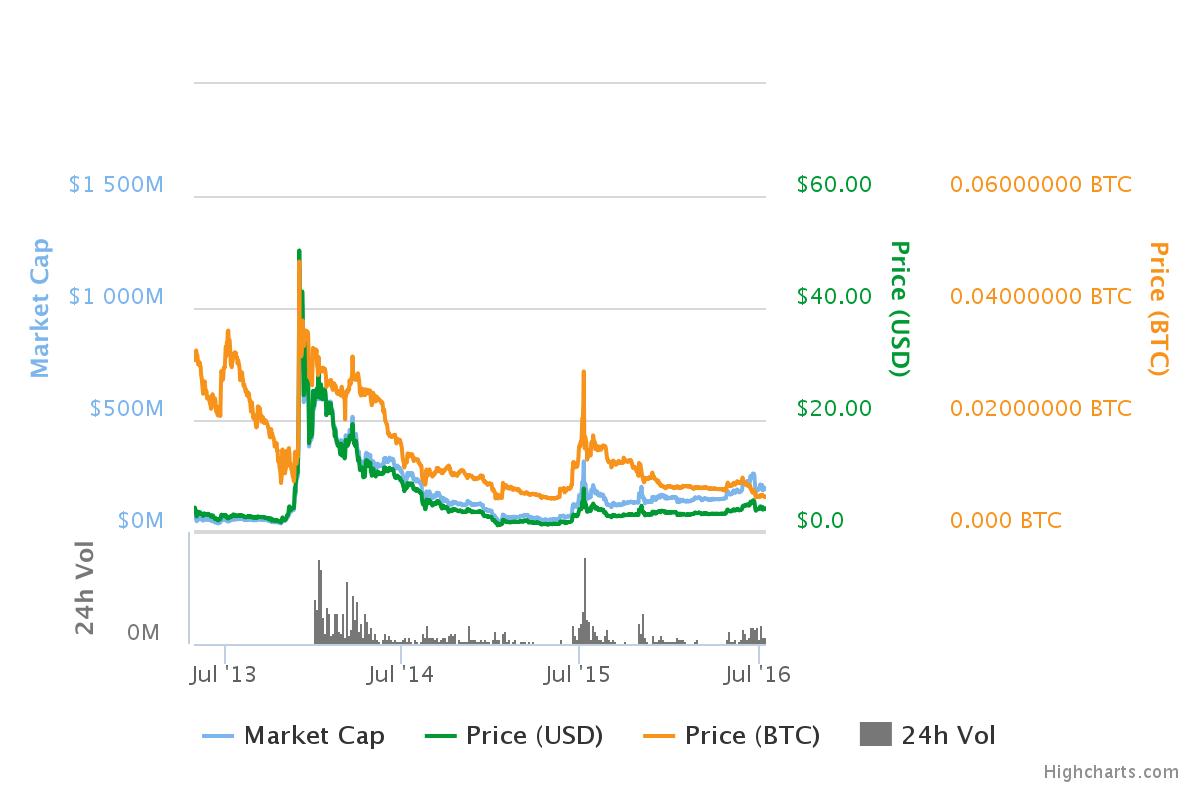
- Litecoin price, all time period (from CoinMarketCap ) -
But what about a more complex design? Let's assume Ethereum can actually function and compete with Bitcoin to some extent. Does Ethereum's "smart contract design" truly offer an advantage over Bitcoin? I don't see how Ethereum's smart contract system provides greater opportunities to utilize ETH (compared to Bitcoin). No matter how cool smart contracts sound, it only makes ETH another application coin, and people will avoid holding it by not holding it or holding it for as short a time as possible. This will drive the price down until it becomes useless in trading.
By the way, I prefer to call myself a "Bitcoin minimalist" rather than a " Bitcoin maximalist " because other blockchains seem useless and easily obsolete.
Bitcoin vs. US Dollar
Conversely, to be precise, Bitcoin has appreciated against the US dollar (and other fiat currencies). The US dollar is not suitable for storing "just in case" because it loses value due to inflation over time. You can't carry US dollar cash with you, or the police will confiscate it; if you deposit it in a bank, your account will be frozen if you use it for unacceptable purposes. You can't hold US dollars like you would Bitcoin. Holding Bitcoin is not without risk; to be precise, as long as you safeguard them properly, you can expect your share to remain the same in the total.
National currency is influenced by factors you are unaware of or cannot control. These factors are managed by committees who serve the government that issues the currency. The jargon used by these committees is not only incomprehensible to most people, but also unbearably tedious for those who can understand it. Everyone is affected by them, but most people are too lazy to try to understand them. They manage the currency in the "national interest," but it doesn't always align with your interests. They can change the rules governing how you can spend the currency, or they can increase the supply. Generally, it's impossible to predict what they will do, at least in the long run.
However, under Bitcoin 's current rules , none of this is possible; moreover, it would be very difficult to change these rules and ultimately make such things possible. While many new Bitcoins will be created in the future, the entire issuance schedule is well-known and thus already reflected in the current Bitcoin exchange rate. Therefore, Bitcoin will not lose value due to inflation. It may lose value due to a lack of popularity, a risk that is greater than that of the US dollar (currently).
Therefore, from an investment perspective, there is a genuine qualitative difference between Bitcoin and the US dollar. This doesn't mean Bitcoin will necessarily beat the dollar. It simply means Bitcoin has relevant competitive advantages. Bitcoin still has significant disadvantages: slow transaction confirmation and difficulty in maintaining anonymity. However, Bitcoin has consistently performed well against the dollar, and real-world businesses rely on it. Furthermore, every time Bitcoin's exchange rate rises, its risk relative to the dollar decreases.
Conclusion
Therefore, what's particularly interesting about Bitcoin's monetary aspect is its potential to become a preferred commodity for storage purposes. If this comes to pass, its value will continue to be debated until it becomes an important part of the global economy. This would be a huge change for the world and for early adopters of Bitcoin. You can call me delusional, but I believe the probability is much higher and more obvious than the probability of a blockchain outside of Bitcoin finding a use case.
The Bitcoin protocol is like a magnificent engineering masterpiece. Each part is perfectly suited to its function. It's not the most interesting technology; what's most interesting is what's generated by using it. As a concept, blockchain has no reason to leave the small circle of developers and engineers. However, when people observe Bitcoin, the only term they can use to understand it is that it's a new technology. Yet, Bitcoin is more like a new tradition than a new technology. It's like a small group of people starting a train at a packed music festival; you can bet the train will keep getting longer and longer.
If anyone talks to you about "blockchain technology," you'd better leave . They're just trying to sell you their "new decentralized crowdfunding blockchain IoT" scam. You know they're lying because everyone who acts that way is a fraud, and non-fraudsters do things to differentiate themselves. Anyone who knows what they're talking about knows that piling up buzzwords doesn't generate meaningful ideas. Unfortunately, if people lack basic critical thinking and everyone expects to profit from others' stupidity , then nobody wants knowledge, at least not until they find the best way out. That day may never come, because while they all think they can profit from others' stupidity, they're more likely to become prey themselves.
footnote
1. However, someone's obtuseness doesn't mean they can't be a scammer. Based on my experience in the Bitcoin community, I believe many scammers have an instinct to remain as oblivious as possible to their own methods of acquiring wealth, so they can continue to deceive themselves into believing they are brilliant entrepreneurs.
2. " Do one thing, and do it as well as possible . "
3. This article presents the Austrian School's monetary theory. For a deeper understanding of this idea, refer to any standard Austrian School work, such as Murary Rothbard's * Man, Economy and the State *, or Mises' * Human Behavior * .
4. The Austrian School economists' concept of a "barter system" refers to an economy where no goods are used as currency, although the term has a more concrete meaning for many .
5. In the United States, it is actually Congress and the executive branch that change the rules, while the Federal Reserve changes the money supply . This distinction is not important for the purposes of this article, but some argue it is significant because the Federal Reserve is designed as a private sector entity, while Congress is composed of elected representatives.
6. Including Hillary Clinton . ↩