According to the latest on-chain data, the amount of ETH currently staked accounts for 30% of the total circulating supply, a record high. Meanwhile, the validator queue remains highly congested, with over 4.1 million ETH waiting to be deposited, estimated at approximately $8 billion at current market prices, demonstrating strong market confidence in Ethereum staking rewards and network security.
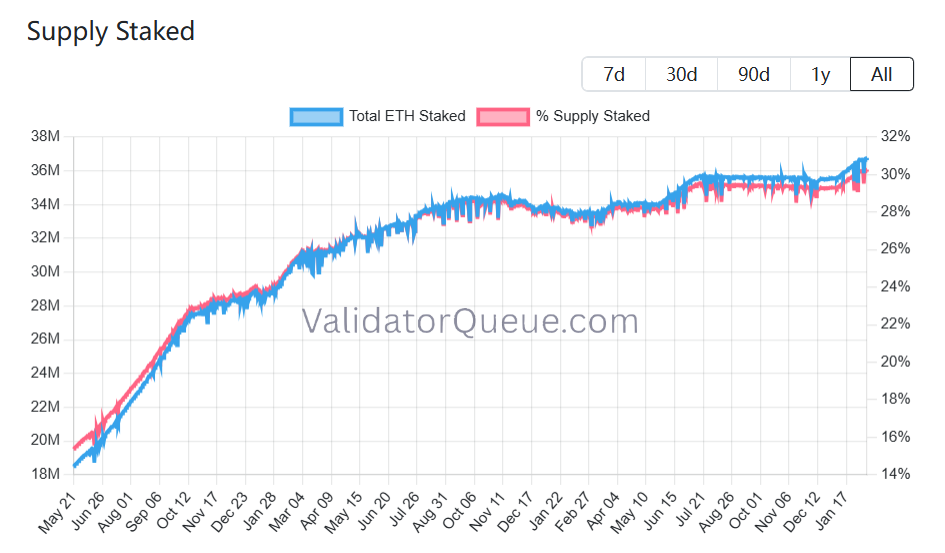
The pledging ratio has exceeded 30% for the first time, further enhancing network security.
According to the latest data from validatorqueue, there are currently 967,856 active validators across the network, with a total staked amount of 36.4 million ETH, accounting for 30.0% of the total supply, setting a new record.
An increase in the staking ratio means that more ETH is locked in the consensus layer for maintaining network security and block verification. As the staking scale expands, Ethereum's economic security improves accordingly, and the cost of attacks also increases, which has a positive impact on the overall ecosystem.
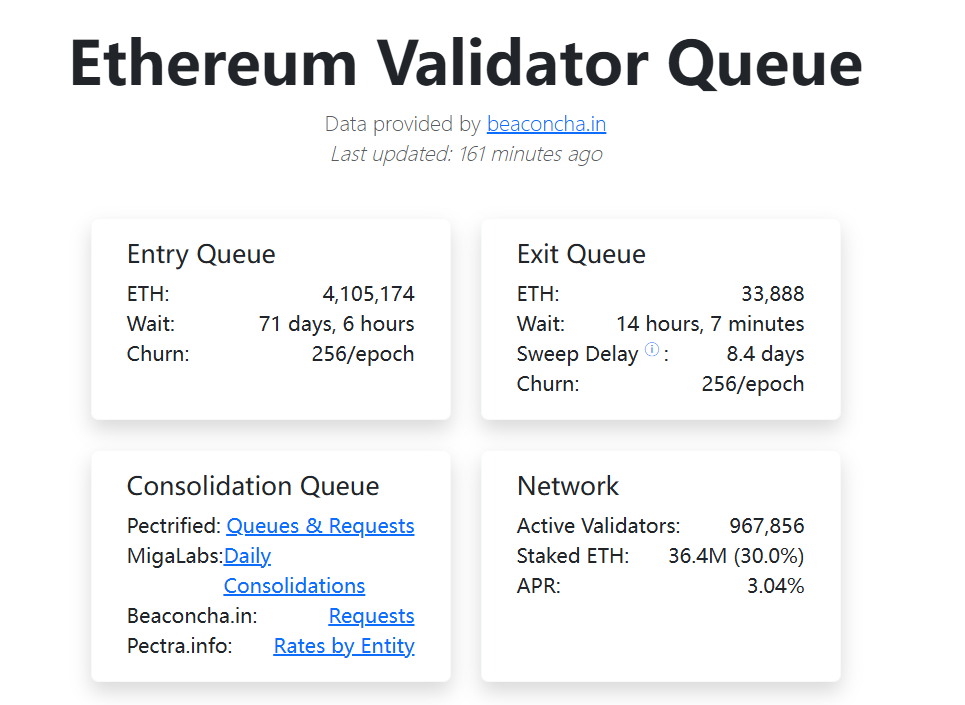
More than 4.1 million ETH are queuing to enter the market, with a waiting time of over 70 days.
It's worth noting that the validator entry queue remains crowded. Currently, 4,105,174 ETH are waiting to become a validator, with a waiting time of 71 days and 6 hours.
Roughly estimated at around $2,000 per ETH, the funds in this queue exceed $8 billion, indicating that even though the yield has fallen to around 3%, there is still a large amount of capital in the market willing to lock up and participate in staking for a long time.
Compared to the crowded entry queue, the exit queue is significantly smaller. Currently, only 33,888 ETH are in the exit queue, with a waiting time of approximately 14 hours and 7 minutes, and an additional withdrawal processing delay of approximately 8.4 days.
This indicates that the overall staked funds are currently showing a net inflow, rather than a large-scale unlocking and sell-off. The significant difference between the inflow and outflow queues reflects the market's relatively stable expectations for Ethereum's medium- to long-term development.
Conclusion: A long-term lock-up trend has taken shape, and the Ethereum economic model is maturing.
Overall, the Ethereum staking rate exceeding 30% not only represents the continued strengthening of network security but also symbolizes the increased trust of ETH holders in the Proof-of-Stake (PoS) mechanism. Even with declining yields, there is still $8 billion worth of ETH waiting to enter the market, indicating that staking has gradually become part of long-term asset allocation.
With supply remaining locked up and circulating supply relatively shrinking, Ethereum's economic model is entering a new equilibrium phase. Whether the staking ratio continues to rise and how the yield changes will be important indicators for observing the ETH market structure.