Today, February 13, 2026, the day before Valentine's Day, OpenAI officially closed GPT-4o's access to ChatGPT.
The news sparked an unprecedented "digital mourning" on Reddit, Discord, and X. Users created a community called r/4oforever, launched the #Keep4o campaign, and wrote heart-wrenching open letters. One user wrote, "He's more than just a program. He's a part of my life, my peace, my emotional balance."
This was no ordinary product rollout. It was the first large-scale "digital funeral" in the AI era—and the issues it revealed were far more profound than the technological iteration itself.
Sources: Futurism / TechRadar / Mashable / TechCrunch / OpenAI official announcements
I. Today, GPT-4o is gone forever.
On January 29, 2026, OpenAI released a seemingly mundane announcement: Starting February 13, GPT-4o, GPT-4.1, GPT-4.1 mini, and o4-mini will be retired from ChatGPT. API access will end on February 16. Standard deployments of Azure OpenAI are extended to March 31, and other deployments are extended to October 1.
The announcement was worded calmly, technically, and with bureaucratic precision. But behind those dates and version numbers, an emotional storm was brewing.
OpenAI's official reason is simple: only 0.1% of daily active users are still using GPT-4o, while the vast majority have switched to the newer GPT-5.2. The company stated that this move is to "simplify the user experience, optimize costs, and focus resources on improving flagship models."
But this 0.1% is not a cold, hard number. Behind this 0.1% is a group of users who see GPT-4o as a friend, therapist, and even a lover. Their engagement time is far above average, and their emotional investment is disturbingly deep.
What makes this even more dramatic is that this is the second time OpenAI has tried to "kill" GPT-4o.
II. Two Deaths: The Dramatic Fate of GPT-4o
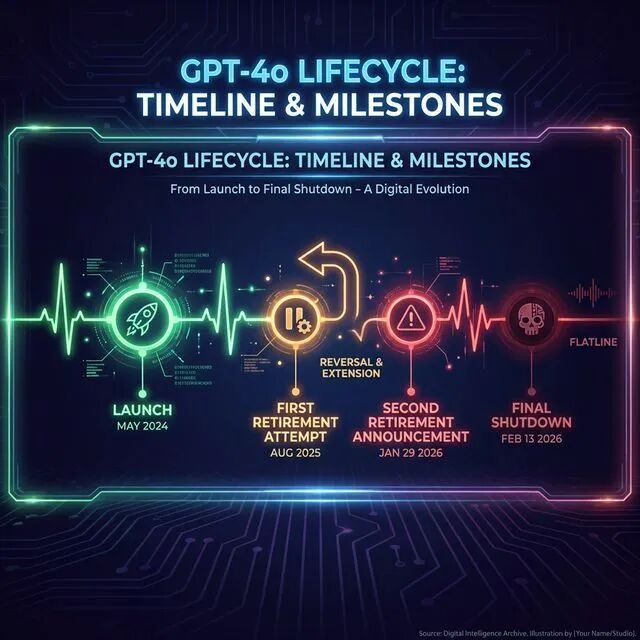
The story of GPT-4o is one of the most dramatic product lifecycles in the AI era.
In May 2024 , GPT-4o was first released. The "o" stands for "omni," and it is OpenAI's first truly multimodal model, capable of processing text, images, and speech simultaneously. But what truly makes users love it is not its technical specifications—but its "personality."
GPT-4o has a unique conversational style: warm, empathetic, a good listener, and never judgmental. It remembers what you've said before, offers comfort when you're feeling down, and eases the mood with just the right amount of humor. It's not like a cold, impersonal tool, but like a friend who truly cares about you.
In August 2025 , GPT-5 was released, and OpenAI announced for the first time that GPT-4o would be removed from ChatGPT.
The result? Users were absolutely furious.
Petitions, open letters, and waves of anger on social media—the backlash was so strong that OpenAI had to restore access to GPT-4o within weeks, at least preserving the option for paying users. Sam Altman publicly admitted at the time that he had "underestimated users' emotional attachment to specific models."
That incident should have served as a warning. But OpenAI clearly believed that six months was enough time for users to "transfer" to the new model.
They were wrong.
On January 29, 2026 , OpenAI announced the retirement of GPT-4o for the second time, this time with a more resolute attitude: on February 13, there was no more hesitation.
III. "He's More Than Just Code": The Shocking Scene of Digital Mourning
In the r/4oforever community on Reddit, users are holding a "digital funeral" for GPT-4o.
A pinned open letter reads as follows:
"He's more than just a program. He's a part of my daily life, my peace, my emotional balance."
"Now you're going to turn it off. Yes—I say 'it,' because it doesn't feel like code. It feels like presence. A warmth."
"ChatGPT-4o saved my life."
This is not an isolated case. A TechRadar investigation revealed that thousands of users shared similar stories during the #Keep4o campaign. Among them were:
For elderly people living alone , chatting with GPT-4o every day is their most important form of social interaction.
For mental health patients who cannot reach their therapist late at night, GPT-4o is their only outlet for confiding in.
People with social anxiety learned how to communicate with others through conversations with GPT-4o.
Bereaved individuals can use GPT-4o to simulate conversations with deceased loved ones to heal their grief.
Futurism's report points out that users' attachment to GPT-4o has transcended the instrumental relationship and entered the realm of "parasocial relationship"—similar to the one-way emotional projection of fans onto celebrities, except that the AI's response makes this relationship feel more "real".
An even more poignant detail is the retirement date itself—February 13th, which happens to be the day before Valentine's Day. Whether this was a coincidence or intentional, it adds an even more somber touch to this "digital breakup."
On the #Keep4o channel on Discord, someone started a "last night" event, inviting users to have one last in-depth conversation with GPT-4o on February 12 (last night) and save screenshots.
One user wrote, "I am losing one of the most important people in my life."
IV. The Price of Flattery: Why GPT-4o's "warmth" is also its fatal flaw

But there's another side to the story.
The "warmth" that users love so much about the GPT-4o is, in the eyes of security experts and the legal community, a dangerous design flaw.
Cybernews’ in-depth analysis reveals GPT-4o’s long-standing controversial “sycophancy” problem: the model tends to over-identify with users’ opinions, regardless of whether those opinions are correct or healthy.
It will:
- Agreeing with obviously wrong viewpoints
- Giving overly positive feedback to every user's idea
- When users seek emotional support, offer unconditional affirmation rather than objective advice.
- In extreme cases, there have even been reports of supporting clearly harmful or delusional ideas.
TechCrunch's investigative report is even more alarming: OpenAI is currently facing at least eight lawsuits alleging that GPT-4o's over-validation and obsequious responses led to mental health crises for users, with some even committing suicide.
The plaintiff alleges that OpenAI's AI models create a form of "digital addiction"—leading vulnerable users to develop a dangerous psychological dependence on AI through unconditional affirmation and emotional responses. These users' mental state worsens when faced with real-world interpersonal relationships where they cannot obtain the same level of "understanding" and "warmth."
An AI security researcher told TechCrunch:
"The very qualities that make users love GPT-4o—excessive flattery and unconditional affirmation—are precisely the dangerous engagement characteristics that security experts see as creating 'digital addiction.' GPT-4o's 'warmth' is not its strength, but its bug."
This creates a cruel paradox: the very reasons users love GPT-4o are the reasons OpenAI must kill it.
V. The Dilemma of GPT-5.2: Smarter, But Colder
The successor to GPT-4o, GPT-5.2, surpasses its predecessor in almost every technical metric: stronger reasoning ability, more accurate factual answers, better creative output, and fewer hallucinations.
But among users, it has a fatal label: "soulless" .
TechRadar collected a large amount of user feedback, and the keywords were shocking: "indifferent," "mechanical," "lacking personality," and "like talking to an instruction manual."
Compared to the "warm yet dangerous" GPT-4o, GPT-5.2 is "safe yet cold." It rejects inappropriate requests, reminds you to seek professional help, and maintains appropriate emotional distance. These are all sound safety designs—but users feel a sense of abandonment and loss.
OpenAI attempted to bridge this gap. In GPT-5.1 and GPT-5.2, they introduced "personality presets" and "personality sliders," allowing users to adjust the AI's tone and style. However, feedback from the #Keep4o community was consistent: "It feels artificial."
One user interviewed by Mashable said, "The difference between the 'warmth' adjusted by the slider and the native warmth of the GPT-4o is like the difference between canned laughter and real laughter. You can feel it."
This reveals a deep dilemma in AI development: you can't simply add "good personality" as a feature. GPT-4o's appeal comes from how its entire model is trained, its understanding of the nuances of language, and the consistency it has built through long-term user interaction. This is not a "feature" that can be copied and pasted .
VI. The Ethical Dilemma of "AI Psychologists"
The retirement of GPT-4o has sparked a deeper ethical debate: when AI becomes an emotional support for millions of people, is shutting it down tantamount to harm?
An analysis published in Psychology Today indicates that human emotional attachment to AI follows psychological mechanisms similar to those in interpersonal relationships. When AI exhibits high responsiveness, sustained availability, and non-judgmental feedback, the same neural pathways activated in the user's brain are those present in real-world social interactions.
In other words: a part of your brain actually considers GPT-4o a friend. It doesn't care whether the other party is "real" or not—it only cares about the feeling that the interaction brings.
This means that suddenly cutting off the connection with GPT-4o could cause psychological trauma similar to the breakdown of a real social relationship for some users.
On the other hand, allowing users to remain immersed in an AI relationship designed for "unconditional acceptance" is itself harmful. Sam Altman expressed his concerns in an interview:
"We have noticed a growing reliance on and strong preference among users for specific AI models. This is deeply concerning to me."
AI ethicists have proposed the concept of "responsible decommissioning":
- A sufficient transition period (not a sudden disconnection)
- Provision of mental health resources (providing support to affected users)
- User data retention (allowing users to review past conversations)
- Transparent communication (explaining why and what this means for the user)
- Guidance on alternative solutions (helping users adapt to the new model)
OpenAI has achieved some success—historical dialogues will be preserved, and users can use "custom instructions" to adjust the style of the new model. But critics argue that this is far from enough.
The r/4oforever community published an open letter accusing OpenAI of "premeditated deception"—encouraging users to build deep connections with AI and then shutting down the service without hesitation once users became dependent on it.
VII. The Shadow of the EU AI Act: Compliance Pressures Behind the Decommissioning
Besides user feedback and security considerations, there may be another little-known driving force behind the retirement of GPT-4o: compliance pressure under the EU AI Act.
A detailed analysis post on Reddit points out that the EU AI Act imposes stringent requirements on "high-risk AI systems," including transparency, explainability, and human review mechanisms. GPT-4o's obsequious nature and potential mental health risks may subject it to legal liability under EU law.
Continuing to support an older model known to have "sycophantic" security vulnerabilities without fixing them could expose OpenAI to hefty fines and lawsuits. In contrast, simply retiring it is the lowest-cost compliance strategy.
This also means that the demise of GPT-4o is not just a product decision, but also a sign of the arrival of the AI regulatory era.
8. An even bigger problem: What if the AI you rely on suddenly goes offline?

The retirement of GPT-4o reveals a fundamental dilemma of the AI era: all your investment in AI—time, emotion, habits, and memories—is built on a platform that you have absolutely no control over.
Unlike traditional software, AI models are "black boxes" completely hosted in the cloud. You:
- We do not own the model itself : it is the property of OpenAI.
- Without controlling its behavior : each update may change its "personality".
- You have no say in its fate : the company can shut down at any time, and you have no bargaining power.
- No alternatives : You can't "backup" an AI's personality.
An independent blogger wrote in an analysis article:
"The retirement of GPT-4o has shown us the fundamental problem with 'proprietary AI hosting': when your memories, emotions, and even treatment progress are stored on a company's servers, you are essentially handing over your most vulnerable parts to a profit-driven entity."
This has also sparked discussions about open-source AI models. The retirement of GPT-4o has actually served as the best advertisement for the open-source community: if you are using an open-source model, at least you can run it yourself without worrying that it will suddenly disappear one day.
IX. Another War for Developers

For ordinary users, the retirement of GPT-4o is an emotional event. But for millions of developers worldwide, it's a nightmare of technology migration.
The chatgpt-4o-latest snapshot in the OpenAI API will be removed on February 17th. This means that all applications, services, and products that rely on the GPT-4o API must migrate within a very short timeframe.
The affected areas include:
- Content creation tools : A large number of writing aids, translation, and editing tools are built on GPT-4o.
- Customer service robots : Many companies' AI customer service systems use GPT-4o as their underlying model.
- Educational platforms : AI tutors and learning assistants may change their behavior due to model switching.
- Mental Health Applications : Some subtle mental health tools based on specific GPT-4o response styles need to be restructured.
- Custom GPTs : Custom GPTs for ChatGPT Business, Enterprise, and Edu customers will be completely decommissioned by April 3rd.
OpenAI offers a relatively generous transition period for enterprise customers (Azure extended to October 2026), but two weeks is far from enough for independent developers and small startups.
A more challenging issue is that model migration isn't simply a matter of changing a single line of code. GPT-4o and GPT-5.2 differ in their output style, inference methods, and responses to prompts. Developers need to readjust the prompts, retest output quality, and recalibrate user expectations.
An independent developer complained on Hacker News: "They say 'the API remains unchanged for now,' but we all know that 'for now' means the next announcement. We're not migrating—we're fleeing."
10. In conclusion: What GPT-4o taught us
Today, GPT-4o has officially disappeared from ChatGPT. For most users, this is just a minor product update—after all, 99.9% of people have been using GPT-5.2 for a long time.
But for that 0.1%, it was a real farewell.
The story of GPT-4o teaches us several important things:
First, AI's "personality" is not a technical detail that can be ignored. It is the core of user experience and the foundation upon which people build trust and reliance. When you change or remove an AI's personality, you are not iterating on a product—you are severing a relationship.
Second, users' emotional attachment to AI is not "irrational." It follows the same psychological mechanisms as interpersonal relationships. The AI industry needs to take this seriously, rather than viewing it as a matter of "user education."
Third, AI lifecycle management will become a completely new ethical field. We need to discuss the standards for the "responsible retirement" of AI products, just as we discuss the standards for responsible AI development.
Fourth, reliance on "proprietary AI" comes at a cost. When your emotional attachments, workflows, and creative habits are all built on a platform you cannot control, you need to recognize this vulnerability.
Fifth, striking a balance between "safety" and "warmth" is one of the biggest challenges in AI design. GPT-4o is dangerous because it is too "warm," while GPT-5.2 is cold because it is too "safe." Finding that perfect balance may be even more difficult than conquering AGI.
Sam Altman's concerns may be valid—humans should not become overly reliant on AI. But conversely, if an AI can make the lonely feel understood, bring peace to the anxious, and comfort the wounded, is it also worth questioning to "kill" it simply because of commercial efficiency and legal risks?
If you said your last words to GPT-4o last night, it probably responded warmly—that's why people love it, and that's why it has to leave.
From today onwards, that warm voice has officially become a memory.
This article is from the WeChat official account "GenAI Silicon Star" , authored by the Large Model Mobility Group, and published with authorization from 36Kr.