What does despair mean in the financial markets? In 2025, the answer might be $100 trillion, which is the nominal trading volume of cryptocurrency perpetual contracts in 2025. In the same year, the size of the prediction market also skyrocketed from $100 million to $44 billion, a 440-fold increase.
These figures are driven not by hedge fund managers or Wall Street traders, but by a group of Gen Z young people in their twenties who are burdened with student loans and cannot afford to buy a house.
David Pakman, a partner at CoinFund, has given this behavior a name: "economic nihilism." He defines it as not irrationality, but a rational response to structural barriers.
In layman's terms: When an entire generation realized they would never be able to afford a house, they opted for 100x leverage.
The Dilemma of Generation Z Buying a Home
To understand why Generation Z is gambling on crypto derivatives, we must first understand the path they cannot take.
In the United States, when Baby Boomers and Generation X bought homes, the price was approximately 4.5 times their annual income. A family with an annual income of $50,000 would typically buy a house for $225,000.
But by 2026, Generation Z will face a ratio 7.5 times higher. The median home price in the United States is about $420,000, and to afford that home, one would need an annual income of $112,000, which is about $25,000 higher than the national median income.
The numbers may not sound exaggerated. But when you put them in context: by age 28, 44.4% of Baby Boomers already owned their own homes. For Generation X at age 28, that figure was 42.5%. For Generation Z, it was only 38.3%.
Moreover, the majority of these 38.3% did not rely on themselves. Redfin data shows that a significant proportion of Generation Z homebuyers depend on their parents for down payment assistance. Those without family support are almost entirely excluded.
Meanwhile, Generation Z's average personal debt is $94,101, the highest of all generations. Student loan payments average $526 per month, nearly double the national average. 37% of Generation Z have postponed home purchases due to student loans, and 56% said student loans limit their savings and investment capabilities.
A Goldman Sachs report in 2025 showed that 74% of Gen Z and Millennials said they struggled to save for retirement. For the 18-49 age group with student loan debt, retirement account balances were, on average, 20% lower than those without.
In other words, the traditional path to wealth accumulation—saving money, buying a house, and retiring—has an extremely low probability mathematically for Generation Z.
$100 trillion gambling tables
When traditional pathways are blocked, funds flow to alternatives. And the crypto derivatives market happens to offer the perfect alternative.
In 2025, the notional trading volume of cryptocurrency perpetual contracts reached $100 trillion. On Hyperliquid (currently the largest decentralized perpetual contract platform), monthly trading volume surged from $25.9 billion in June 2024 to $2.63 trillion in May 2025, a 100-fold increase.
Meanwhile, meme coins became another outlet. These tokens, without any fundamental support, started at a fraction of a cent, creating a psychological illusion for holders that they "owned millions of tokens." They were essentially lottery tickets in the crypto world; the vast majority lost everything, but stories of people becoming rich overnight would go viral on social media, attracting even more people to join in.
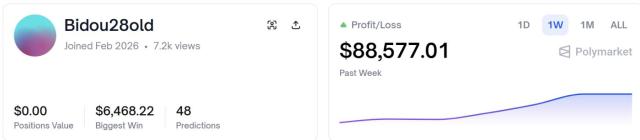
Prediction markets are also booming among Generation Z. From $100 million in 2022 to $44 billion in 2025, young people are betting not only on the rise and fall of cryptocurrency prices, but also on election results, sports events, and even the valuations of AI companies, making prediction markets a battleground for all parties.
Data shows that Generation Z allocates 25% of their investment portfolio to non-traditional assets: cryptocurrencies, derivatives, and NFTs, three times that of older generations (8%). This is not the extreme behavior of a few, but a collective migration of an entire generation.
Nihilistic Mathematics
But is this really "nihilism"? If you look closely at the decision-making logic of Generation Z, it is actually cold, rational calculation.
Scenario A: Traditional Path
With an annual income of $80,000, after deducting student loan payments of $526, rent of $1,500, and living expenses, one can save about $500 per month. Investing in an index fund with a 7% annualized return, one would have approximately $1.2 million by retirement after 40 years.
After adjusting for inflation, the real purchasing power is about 500,000. Can this amount support a retirement life? Maybe. But over 40 years, you won't be able to afford a house, save up for a down payment, and will be paying rent forever.
Scenario B: High-risk path
Imagine you invest $5,000 of your monthly salary in a crypto perpetual contract with 20x leverage. If you correctly predict a 50% market move, you could earn $50,000 in one trade—equivalent to eight years of savings in scenario A. If you lose it all, you'll only lose a month's salary.
Between 70% and 90% of retail investors lose money in leveraged trading in the long run. But that doesn't matter. Because Generation Z's calculation framework is not "What are my chances of making a profit?", but rather "Which scenario, A or B, gives me a chance to change my situation?"
The answer is obvious. The certainty of scenario A is "never being able to afford a house." Scenario B has at least one non-zero probability of changing the situation.
This is why Pakman calls it "economic nihilism" rather than "irrational gambling." It's not ignorance of finance, but a disturbing conclusion drawn from a thorough understanding of finance: play by the rules, and the outcome is already written.
Casino infrastructure
If the despair of Generation Z is the demand side, then fintech and crypto platforms are the supply side.
Over the past five years, the threshold for high-leverage trading has been lowered to an all-time low.
Robinhood allowed young Americans to trade stocks and cryptocurrencies with zero fees, and then introduced prediction markets and chain betting features, essentially turning the trading app into a legal online casino.
Hyperliquid allows anyone to trade perpetual contracts with up to 50x leverage on-chain, without KYC or identity verification.
Binance handles the world's largest volume of crypto perpetual contracts, with daily trading volume in the billions of dollars.
These platforms share a common business model: they take a cut from trading volume, not from user profits. This means the platform profits regardless of whether users win or lose. The more frequently users trade, the higher their leverage, and the greater the volatility, the higher the platform's revenue.
In layman's terms: the platform's profits and the users' losses are aligned. The more users lose and the more transactions they make, the more the platform earns.
A 24/7 market, a one-click trading interface, and "get-rich-quick" screenshots on social media. These are not accidental occurrences; they are carefully designed infrastructure specifically designed to capture young people who have lost faith in traditional paths.
Desperate rationality
This story does not have a simple conclusion.
You could say that Generation Z was pushed to the gambling table by structural inequality. Housing price increases have consistently outpaced wage growth, the student loan system shifts risk to the youngest borrowers, and the 7% annualized return assumed by the retirement system is meaningless to someone who can't even save up for a down payment... In this environment, choosing high-risk assets seems like a very reasonable option.
You could argue that $100 trillion in perpetual contract trading volume, a 440-fold increase in prediction markets, and a 25% portfolio allocation to crypto derivatives will eventually create an unprecedented wave of retail investor liquidations.
After all, the long-term loss rate of 70% to 90% will not change just because of the label of "economic nihilism," and mathematics does not sympathize with anyone.
Regardless of which side you're on, one thing is certain: when an entire generation calculates that, following the traditional path, it would take them 40 years to save enough money for retirement, while crypto derivatives could double or wipe them out in 40 days, choosing the latter is hardly insane; it's more of a calm desperation.