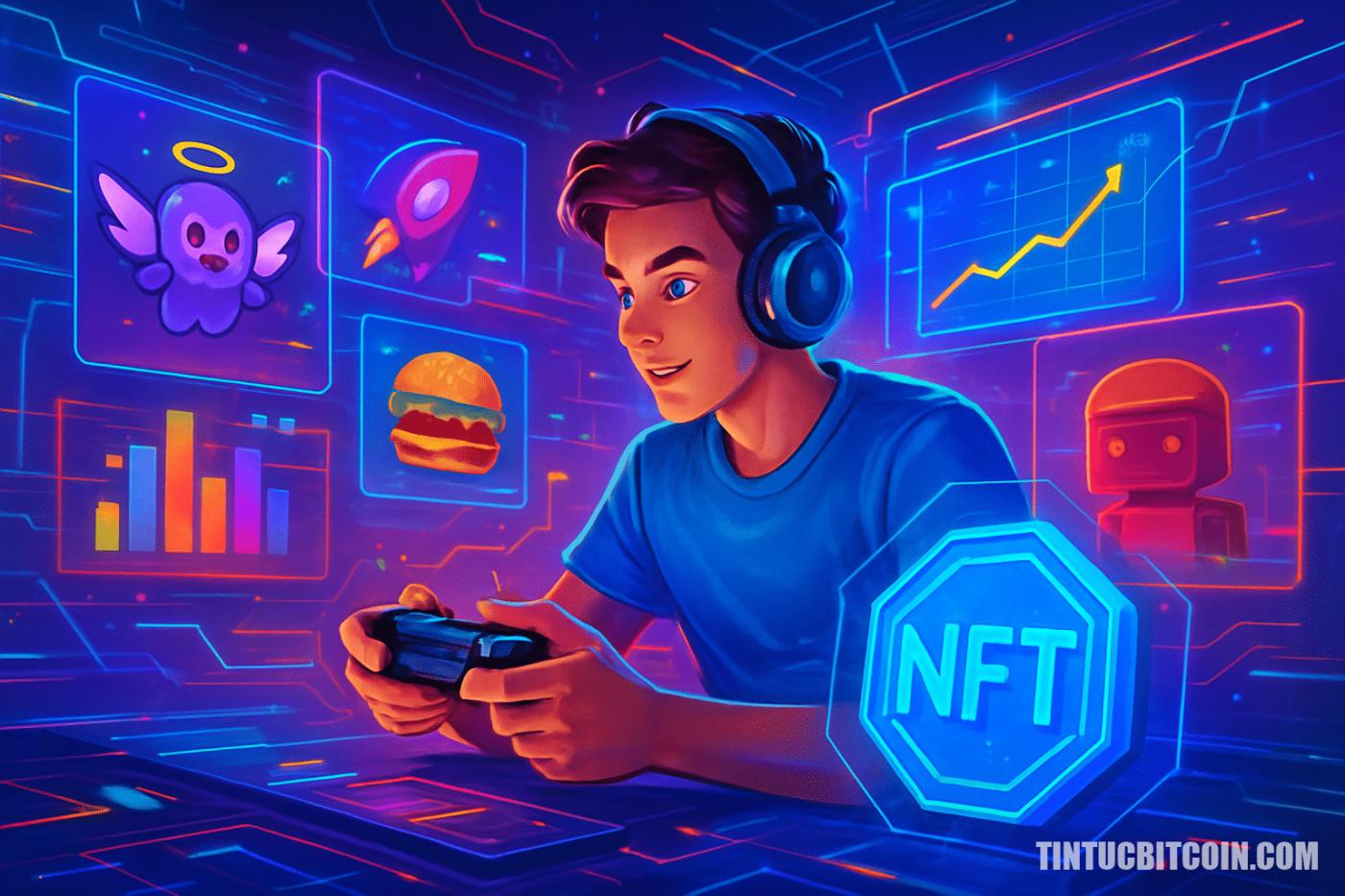
Play-to-Earn (P2E) Non-Fungible Token games in 2025 have shifted from "collecting for speculation" to an ecosystem where players actually own in-game assets and can trade them, earning rewards based on their level of participation.
The maturation of blockchain infrastructure means that Non-Fungible Token in games are no longer an experiment. Many projects focus on ownership, asset exchange, and the digital economy, but this comes with different learning curves and market risks depending on the game.
- Non-Fungible Token have expanded from collectibles to in-game assets that are owned and tradable.
- Eight typical P2E games include metaverse, MMORPG, battle royale, card games, and fantasy sports.
- New players should start slowly, experimenting with the game's reward and economic mechanics before making large investments.
In-game Non-Fungible Token are shifting from collectibles to utilities and the digital economy.
Non-Fungible Token gaming is now focusing on in-game asset ownership, trading capabilities, and reward models linked to gameplay, rather than just "buy and hold."
When Non-Fungible Token first emerged, they were primarily collectibles such as digital art, avatars, and virtual items. Over time, the role of Non-Fungible Token expanded as the underlying technology stabilized, facilitating the development of products with greater experiential and economic depth.
In blockchain games, the core difference is that assets can exist independently of a centralized server. This opens up markets for items, virtual land, cards, or "characters" that can be bought, sold, and transferred, sometimes even used in different contexts depending on the project design.
Decentraland is a metaverse of virtual lands where players can create and monetize their experience.
Decentraland offers a user-owned virtual world where each plot of land is an Non-Fungible Token and can be built upon to generate revenue from activity within the metaverse.
Decentraland is a decentralized metaverse built on Ethereum, centered around digital land ownership. Players can develop plots of land into interactive spaces such as galleries, minigames, or business models, then generate revenue by renting them out, hosting events, or selling digital goods.
The MANA Token is used for in-game purchases, trading, and governance. New players can explore the open world or participate in quests, while advanced users can build scenes, write scripts, or develop decentralized applications to enhance the metaverse experience.
Decentraland doesn't emphasize the traditional "leveling up by killing monsters" loop, but rather is a sandbox focused on creativity, ownership, and a user-generated content-based economy.
Treeverse is an open-world MMORPG that combines PvP, PvE, and Non-Fungible Token to generate passive income.
Treeverse is an MMORPG set in Arboros, allowing players to engage in PvP/PvE combat, gather resources, and use Non-Fungible Token to generate income streams within the in-game economy.
In Treeverse, players explore an open world, craft and gather resources from the environment and their own land, and battle mythical creatures. The game supports both PvE and PvP, suitable for those who enjoy adventure or competition.
Collectible Non-Fungible Token can be "grown," then harvested and sold within the internal economy, creating opportunities for passive income depending on the strategy. SEED is the in-game currency, while ROOT is the Governance Token in the Treeverse universe.
Blast Royale is a free-to-play mobile battle royale game featuring tradable Non-Fungible Token .
Blast Royale is a free mobile survival shooter game where players participate in short matches and can collect and trade Non-Fungible Token.
Blast Royale employs a battle royale model: players parachute to a landing spot, pick up weapons and items, and then try to be the last survivor. Each match lasts approximately 6 minutes with up to 48 players, suitable for the fast-paced gameplay on mobile devices.
The game features multiple modes such as solo, duo, squad, custom game, and seasonal tournaments. Players can collect and trade Non-Fungible Token such as melee weapons, parachutes, avatars, and "death markers," supporting personalization and trading on the marketplace.
Gods Unchained is a strategic card game with a free-to-play model and GODS Token .
Gods Unchained combines traditional TCG mechanics with blockchain ownership, allowing players to earn GODS Token through competition and use them for crafting, Staking, or trading.
Players build decks based on different "gods," each system possessing unique abilities and strategic advantages. Turn-based battles require optimal timing, deck coordination, and resource management to outperform opponents, making deck-building skills and meta understanding crucial.
The in-game economy revolves around GODS Token , which can be earned from ranked wins, daily quests, and events. GODS can be used to create new cards, Staking for passive income, or trade outside the game.
The highlight is the free-to-play model: new players can receive a basic deck to start with without any upfront cost. However, climbing the ranks requires strategic depth and the ability to continuously optimize your deck.
RavenQuest is an MMORPG based on the Web2 Ravendawn platform and brings assets to the blockchain.
RavenQuest is an MMORPG developed from Ravendawn, integrating blockchain technology so that players can truly own items and customize their character classes based on archetype combinations.
RavenQuest inherits its foundation from its predecessor Web2 game, Ravendawn, and adds a layer of asset ownership using blockchain technology. The goal is to make in-game items player-owned assets, rather than entirely dependent on a centralized system.
Gameplay allows players to choose one of eight archetypes: Holy, Protection, Shadow, Warfare, Archery, Spiritual, Wizardry, and Witchcraft. Players can combine up to three archetypes to create their own character build, thereby shaping their combat Vai and tactics.
Players can participate in open-world PvP or team up with friends to complete PvE missions, suitable for both competitive groups and those who prioritize exploration and quest grinding.
My DeFi Pet combines pet breeding, raising pets, and DeFi with the DPET Token .
My DeFi Pet is a blockchain pet game where players collect, breed, battle, and use DPET Token for activities such as breeding, crafting, Staking, or DeFi mechanics.
The game focuses on collecting and developing digital pets with different characteristics and appearances. Players can train, upgrade, and send their pets into turn-based battles against other players, creating tactical classes based on stats and skill sets.
DPET Token are used for breeding, purchasing new pets, crafting items, and participating in events. Players can earn DPET through battles, selling rare pets on the marketplace, Staking, or participating in in-game DeFi activities such as liquidation pools and lending as part of the project design.
The pet collection and training mechanics are relatively accessible, but optimizing rewards often requires investing time in breeding high-value pets or upgrading combat skills. When the trading market is slower, effectiveness tends to depend on long-term planning and level of engagement in the game.
Sorare is a fantasy football game that uses licensed player cards and rewards based on real-world performance.
Sorare combines Non-Fungible Token collecting with fantasy football strategy, where results are based on real-life player performance and players can receive Non-Fungible Token or SOR Token .
Players build their teams using officially licensed player cards from various leagues, then participate in fantasy tournaments that reflect real-life match results. Each card has a different rarity, impacting team building strategies and competitiveness in each category.
Rewards come from participating in tournaments and leagues, where points are based on real-world match data. Players can receive valuable Non-Fungible Token or SOR Token , and trade them on the transfer market to maximize profits.
Card prices fluctuate based on player performance, rarity, and market demand, making "reading form" and timing of purchases crucial. Sorare has a strong player base, especially among football fans, and although entry is free, competition increases as Stake rise.
The Sandbox is a content creation metaverse that owns LAND Non-Fungible Token and monetizes using SAND.
The Sandbox is a metaverse platform that allows users to create, own, and monetize experiences, with LAND being an Non-Fungible Token and SAND being the Token used for trading, Staking, and governance.
The Sandbox empowers users to design their own interactive spaces instead of following a fixed storyline. Players can create content using software like Game Maker and VoxEdit, then deploy the experience onto the virtual land, turning their creativity into commercially exploitable products.
LAND ownership is central: each Shard of land is an Non-Fungible Token that can be developed, sold, or leased. The SAND Token powers the economy, facilitating asset purchases, Staking , and governance participation.
Players can earn money by creating and selling Non-Fungible Token assets, hosting games or experiences on LAND, or trading land on the marketplace. The ecosystem also serves as a destination for creators, brands, and the community to hold events, sell collectibles, or run a “digital store.”
Strategies for newcomers to P2E Non-Fungible Token games in 2025
The safest approach is to start with the free-to-play version, test the reward mechanics and market liquidation in the game before investing a large Capital .
The Non-Fungible Token gaming market in 2025 will be more diverse and player-focused, but opportunities to own and earn rewards always come with the requirement to understand the rules of the game, Token economics, and volatility risks. Each game has a different level of "commitment," from casual play to optimization as a strategy.
New players should try out the core mechanics, observe the "earn and spend" cycle in the game, and engage with the community to understand how the project works. Prioritize options with free or low-cost entry points to reduce risk during the learning phase.
Before investing, it's important to distinguish between the gaming experience, collectible value, and resale potential of the asset. Even with the same Non-Fungible Token model, the earning potential can vary significantly depending on the game, market conditions, and player skill.
Frequently Asked Questions
How do P2E Non-Fungible Token games differ from traditional games?
P2E Non-Fungible Token games allow players to own in-game assets in the form of Non-Fungible Token or Token, which are tradable and sometimes exist independently of the centralized server system. Traditional games often only "grant usage rights" to items within the account, making them difficult to transfer outside the game.
Which games are suitable for beginners who want to try P2E with low risk?
New players should prioritize games with a free-to-play model or those that allow pre-participation before purchasing assets, such as card/competitive games with starter sets or games with clear basic gameplay loops. Only then should they consider buying Non-Fungible Token once they understand the in-game economy.
Why is "ownership" important in Non-Fungible Token games?
Because it transforms virtual items, cards, or land into player-owned assets that can be bought, sold, or used according to market mechanisms. Ownership helps create an economy where players participate in pricing, rather than being entirely dependent on the publisher.
Is it guaranteed to make money playing P2E?
No. The potential for earning rewards depends on skill, time spent participating, market demand for Non-Fungible Token/ Token, and the reward design of each game. Some games require an understanding of trading tactics or strategies, and profits can fluctuate with market cycles.