
This article is machine translated
Show original
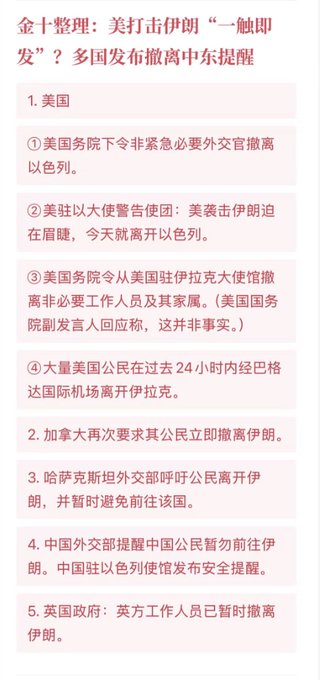
Geopolitical risks between the US and Iran have escalated again, with several countries calling for evacuation of their residents. Is war really imminent? Who are the primary targets of the US strike against Iran?
According to the latest news, multiple countries have begun calling for the evacuation of residents, and Trump has indicated a willingness to fight, making geopolitical risks a potential threat once again this weekend!
The Ford-class aircraft carrier has docked at an Israeli port, nominally creating a dual-carrier situation in the Middle East. Although Middle Eastern countries have stated they will not allow the use of their own airfields to directly attack Iran, the US has prepared over 200 refueling aircraft in preparation for a potential airstrike. What is the significance of this clear indication of a possible attack? My personal analysis boils down to two points:
1. Military pressure is being used to try to get Iran to compromise better after negotiations. Although Oman mediated to avoid a direct diplomatic conflict between the two sides, if Iran maintains a tough stance in negotiations, military pressure will be inevitable and a necessary move. After all, the United States has already established a military presence in the Middle East, and it is not a pity not to use it.
However, this is not a real attack, but rather a symbolic gesture rather than a practical one. It is very likely that the United States is deliberately releasing signals of a possible attack to urge countries to call on their residents to evacuate, creating a sense of impending attack throughout Iran in the short term. This would put military pressure on Iran, forcing it to compromise and make concessions on the agreement in order to better complete the negotiations.
2. Real attacks, from emotional pressure to real military pressure. Now that the military deployment is complete, if emotional pressure is ineffective, the United States may directly attack Iran. However, such a "high-profile" attack is unlikely to target key objectives, such as Iranian high-ranking officials, uranium enrichment storage sites, missile depots, or nuclear research laboratories.
Having experienced the airstrikes last June, Iran will inevitably be on guard against another major military attack. Moreover, such defense is not something Iran can do on its own; it is very likely that it has received assistance from "other countries" in terms of prevention and control.
Therefore, the US attack was most likely aimed at high-value targets that were poorly defended and difficult to move. For Iran at present, there are not many such targets, so they are probably crude oil depots along the coast and at key locations.
Given the current US strategy, using F-22s to breach the defenses and then followed by air-to-ground attacks by fighter jets is the most efficient and cost-effective attack strategy. Moreover, the crude oil depot is the economic lifeline of Iran, and its flammable and explosive nature makes it difficult to extinguish the fire in the short term after an attack. The symbolic significance is greater, and the damage to Iran will focus on the economy, causing economic losses but not to the point of a "do-or-die" situation.
If an attack does occur, what are the possible follow-up developments?
If the United States really attacks Iran, Israel will be the most worried, because Iran has been waking up since last year. Since it cannot threaten the United States, it will simply target Israel. Once the United States attacks Iran, Iran's primary target for retaliation will be the aircraft carrier and Israel.
Israel is facing an extremely fanatical enemy. If Iran were to launch a full-scale attack on Israel, Israel, with its vast territory and strategic depth, would be unable to defend itself. Therefore, any US attack on Iran should only cause pain, not death, otherwise it would face a crazed Iran.
Given Iran's land area and military capabilities, which are neither the best nor the worst, a complete overthrow would require ground troops; otherwise, airstrikes would not be sufficient. Therefore, how to attack Iran in the face of its extreme madness without incurring a similarly violent backlash is a difficult question to answer, a concern shared by both the United States and Israel.
The Ford-class aircraft carrier's docking at Israeli ports is primarily for defense purposes. If Israel wants to receive US protection, it either needs to spend money or provide political resources, giving its all to support Trump's midterm election victory.
In conclusion, this weekend presents a potentially dangerous geopolitical situation, so caution is advised, especially at this crucial juncture in the US-Iran negotiations, and given Trump's penchant for stirring up trouble over the weekend.
If, as I suspect, it is indeed a localized attack, and Iran also symbolically attacks Israel, it creates a situation where the US win big, Iran win big, and Israel win big defensively, which is a win-win situation for everyone.
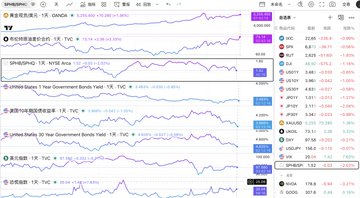
However, due to the financial markets, a degree of caution remains. Currently, rising gold and oil prices, coupled with safe-haven demand, have driven up the price of US long-term bonds, particularly with the 10-year Treasury yield falling below 4% for the first time in four months.
Creating geopolitical friction may not be a bad thing for the United States. In addition to gold and crude oil benefiting from geopolitical friction, the US dollar and US Treasury bonds, the core assets of the US dollar, also receive ample liquidity.
In the short term, the outlook for risk assets is not good for the US dollar, and the decline in US stocks, especially in the face of Friday's geopolitical conflicts, makes a retreat in risk assets and risk aversion inevitable. However, with the existence of artificial intelligence narratives, the short-term pullback will not directly lead to a collapse of US stocks, so the Trump administration is not worried.
Of course, the geopolitical tensions cannot last too long. Rising oil prices are detrimental to global and US inflation and pose a threat to the US as well. However, this threat has been somewhat mitigated after the US acquired Venezuelan oil. Nevertheless, the US still cannot ignore energy inflation.

Cato_KT
@CatoKt4
02-27
美伊第三轮谈判我认为最乐观的信号点就是启动了“间接谈判”,在第三轮谈判前,阿曼从中调停,先于谈判双方各自谈话,然后促成了第三次美伊会谈。 x.com/CatoKt4/status…



Scary

From Twitter
Disclaimer: The content above is only the author's opinion which does not represent any position of Followin, and is not intended as, and shall not be understood or construed as, investment advice from Followin.
Like
Add to Favorites
Comments
Share