Today
Intel
Market
Earn
Settings
Account
Theme Selection
Light
Dark
Language
English
简体中文
繁體中文
Tiếng Việt
한국어
Followin APP
Mine Web3 Possibilities
App Store
Google Play
Log in
Cato_KT
Follow
Posts
Cato_KT
03-03
Thread
#Thread#
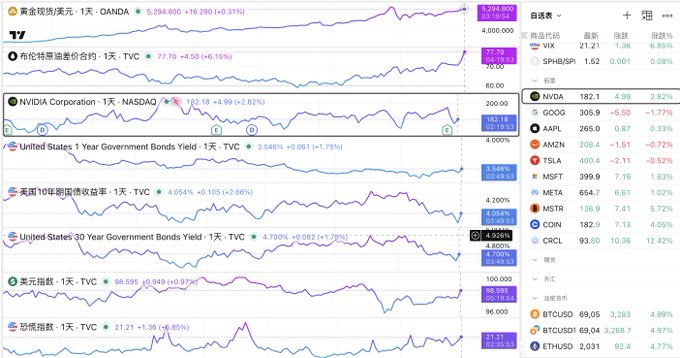
The current macro market is a bit perplexing. Normally, Middle East geopolitical risks would lead to liquidity flowing into safe-haven assets, resulting in a sell-off of risky assets. However, the current situation is different; gold and oil prices have fallen in the short term, while the US dollar has risen. Regarding US Treasuries, both 10-year and 30-year bonds have been sold off, with yields rising. This means that financial liquidity is again converting assets into cash, primarily in US dollars, which is clearly illogical. On the risky asset side, the weakening US stock market surprisingly strengthened tonight. It's clear that geopolitical risks haven't hindered the movement of risky assets, especially tech stocks. The VIX index has risen to around 21, indicating increased risk volatility. In this context, #Bitcoin's rebound, driven by the US stock market, is truly baffling. Frankly, I'm unsure what the current financial market is trading on. Geopolitical risks haven't diminished. Is it because of Trump's speech tonight? Trump's speech tonight has undoubtedly increased Middle East geopolitical risks and raised the possibility of ground troops being deployed. Is this the main driver boosting risky assets? Is America still great? Is the US military demonstrating its global dominance? Is this the current market narrative? Forgive me, but I truly can't see through this situation right now. If this continues, I can only admire the Trump administration's excellent management skills! twitter.com/CatoKt4/status/202...
BTC
0.37%
Cato_KT
02-28
Thread
#Thread#
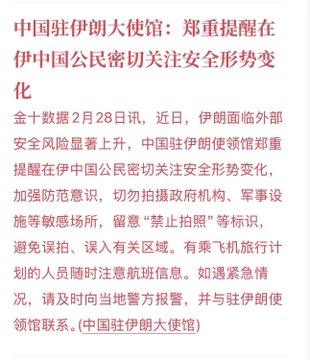
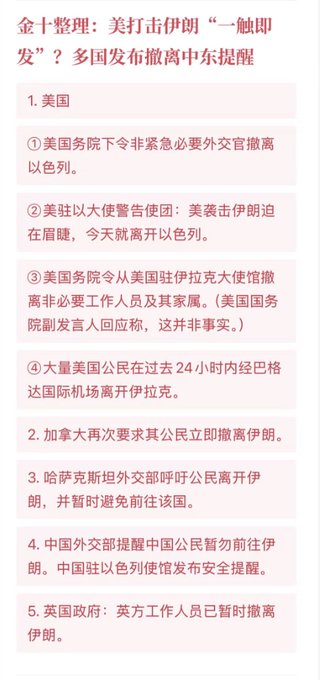
Geopolitical risks between the US and Iran have escalated again, with several countries calling for evacuation. Is war really imminent? Who are the primary targets of the US strike against Iran? According to the latest news, multiple countries have begun calling for the evacuation of residents, and Trump has indicated a willingness to fight, making geopolitical risks a potential threat once again this weekend! The Ford-class aircraft carrier has docked at an Israeli port, nominally creating a dual-carrier situation in the Middle East. Although Middle Eastern countries have stated they will not allow the use of their own airfields to directly attack Iran, the US has prepared over 200 refueling aircraft in preparation for a potential airstrike. What is the significance of this clear indication of a possible attack? My personal analysis boils down to two points: 1. Military pressure is being used to try to get Iran to compromise better after negotiations. Although Oman mediated to avoid a direct diplomatic conflict between the two sides, if Iran maintains a tough stance in negotiations, military pressure will be inevitable and a necessary move. After all, the United States has already established a military presence in the Middle East, and it is not a pity not to use it. However, this is not a real attack, but rather a symbolic gesture rather than a practical one. It is very likely that the United States is deliberately releasing signals of a possible attack to urge countries to call on their residents to evacuate, creating a sense of impending attack throughout Iran in the short term. This would put military pressure on Iran, forcing it to compromise and make concessions on the agreement in order to better complete the negotiations. 2. Real attacks, from emotional pressure to real military pressure. Now that the military deployment is complete, if emotional pressure is ineffective, the United States may directly attack Iran. However, such a "high-profile" attack is unlikely to target key objectives, such as Iranian high-ranking officials, uranium enrichment storage sites, missile depots, or nuclear research laboratories. Having experienced the airstrikes last June, Iran will inevitably be on guard against another major military attack. Moreover, such defense is not something Iran can do on its own; it is very likely that it has received assistance from "other countries" in terms of prevention and control. Therefore, the US attack was most likely aimed at high-value targets that were poorly defended and difficult to move. For Iran at present, there are not many such targets, so they are probably crude oil depots along the coast and at key locations. Given the current US strategy, using F-22s to breach the defenses and then followed by air-to-ground attacks by fighter jets is the most efficient and cost-effective attack strategy. Moreover, the crude oil depot is the economic lifeline of Iran, and its flammable and explosive nature makes it difficult to extinguish the fire in the short term after an attack. The symbolic significance is greater, and the damage to Iran will focus on the economy, causing economic losses but not to the point of a "do-or-die" situation. If an attack does occur, what are the possible follow-up developments? If the United States really attacks Iran, Israel will be the most worried, because Iran has been waking up since last year. Since it cannot threaten the United States, it will simply target Israel. Once the United States attacks Iran, Iran's primary target for retaliation will be the aircraft carrier and Israel. Israel is facing an extremely fanatical enemy. If Iran were to launch a full-scale attack on Israel, Israel, with its vast territory and strategic depth, would be unable to defend itself. Therefore, any US attack on Iran should only cause pain, not death, otherwise it would face a crazed Iran. Given Iran's land area and military capabilities, which are neither the best nor the worst, a complete overthrow would require ground troops; otherwise, airstrikes would not be sufficient. Therefore, how to attack Iran in the face of its extreme madness without incurring a similarly violent backlash is a difficult question to answer, a concern shared by both the United States and Israel. The Ford-class aircraft carrier's docking at Israeli ports is primarily for defense purposes. If Israel wants to receive US protection, it either needs to spend money or provide political resources, giving its all to support Trump's midterm election victory. In conclusion, this weekend presents a potentially dangerous geopolitical situation, so caution is advised, especially at this crucial juncture in the US-Iran negotiations, and given Trump's penchant for stirring up trouble over the weekend. If, as I suspect, it is indeed a localized attack, and Iran also symbolically attacks Israel, it creates a situation where the US win big, Iran win big, and Israel win big defensively, which is a win-win situation for everyone. However, due to the financial markets, a degree of caution remains. Currently, rising gold and oil prices, coupled with safe-haven demand, have driven up the price of US long-term bonds, particularly with the 10-year Treasury yield falling below 4% for the first time in four months. Creating geopolitical friction may not be a bad thing for the United States. In addition to gold and crude oil benefiting from geopolitical friction, the US dollar and US Treasury bonds, the core assets of the US dollar, also receive ample liquidity. In the short term, the outlook for risk assets is not good for the US dollar, and the decline in US stocks, especially in the face of Friday's geopolitical conflicts, makes a retreat in risk assets and risk aversion inevitable. However, with the existence of artificial intelligence narratives, the short-term pullback will not directly lead to a collapse of US stocks, so the Trump administration is not worried. Of course, the geopolitical tensions cannot last too long. Rising oil prices are detrimental to global and US inflation and pose a threat to the US as well. However, this threat has been somewhat mitigated after the US acquired Venezuelan oil. Nevertheless, the US still cannot ignore energy inflation. twitter.com/CatoKt4/status/202...
US
2.5%
Cato_KT
02-27
Thread
#Thread#
The development of the industry is still "people-oriented," and talent reserves are the core of the growth of crypto companies. However, talent reserves and training are also the biggest "sunk costs" for these companies. The crypto industry has been in a slump these past few months, with many institutions and projects laying off staff. Being able to recruit and increase talent reserves against this headwind truly requires a long-term vision! Unfortunately, I don't have the qualifications, and I don't have a security guard position available, otherwise I really would like to give it a try!
sisi
@sisibinance
02-26
📢摇人(欢迎大家狠狠推荐) 无论你是想重新出发,还是蓄力前行,这里给你舞台 不惧过往,只耀锋芒 不拘起点,只守初心 https://jobs.lever.co/binance/8fbac816-2ba8-41f3-b21a-58a8b8b35aaa…
Cato_KT
02-26
Thread
#Thread#
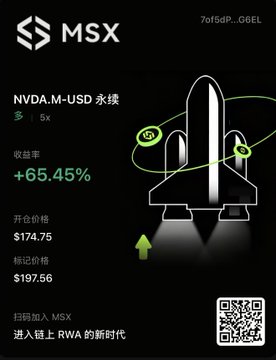
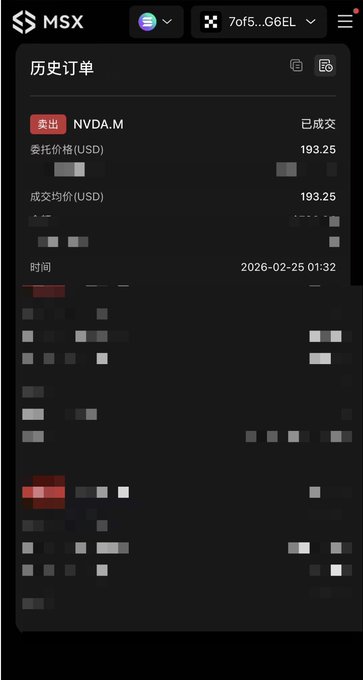
With Nvidia's earnings report about to be released, the market expects a "bright" report. But can the actual earnings report "soothe" investors' fragile hearts amid such high expectations? After the US stock market closed on February 25, Nvidia released its fourth-quarter and full-year financial results. Due to the increased investment in artificial intelligence infrastructure by major technology companies in the second half of 2025, the market expects increased demand for Nvidia's business, and its performance expectations have also increased accordingly. Currently, adjusted earnings per share for the fourth quarter are expected to be $1.54, with revenue of $66.1 billion. In addition, the market expects data center revenue of approximately $60.7 billion in January and first-quarter revenue of $72.9 billion. Due to increased investment in artificial intelligence funds and overly positive market sentiment, Nvidia has experienced short-term stock speculation. Currently, Nvidia's stock price in the US is up 2.14%, leading the gains among the seven major tech companies, indicating a clear period of market enthusiasm. The risk market is always about trading beyond expectations, so the current market is not trading on current expectations, but rather on the future potential of Nvidia. Several points need to be noted: 1. How are Blackwell chips selling? Given the US technology restrictions, can Blackwell provide Nvidia with better growth momentum? 2. Will the growth in the first quarter of 2026 exceed the expected $72.9 billion? 3. Can the gross profit margin be maintained above 75%? What are venture capitalists expecting in the future? The biggest risk for Nvidia's earnings report tonight is not during the US stock trading session, but after the report is released! A. Exceeding expectations: If the financial report shows that Blackwell's sales are strong, with 2026 growth exceeding expectations and gross margin showing stable growth, then the next few days this week present a good window for short-term profit-taking, especially for short-term traders. Current market expectations are positive, so once the good news is priced in, be wary of "sell the news!" B. Below expectations. Current market sentiment is optimistic, but if the actual situation falls short of expectations, the optimism will be over. Concerns about artificial intelligence will continue to grow in the coming days. Coupled with the market exceeding expectations and the actual financial report falling short of market expectations, the stock price will inevitably be under pressure in the short term. At this point, it is necessary to patiently wait for the right time to buy or add to the position. Nvidia is the world's largest company by market capitalization and a leader in the artificial intelligence concept. It still has potential in the future. However, if there is a disappointing sell-off due to its short-term overvaluation, it will inevitably create a reasonable buying point or buy the dips position. Personal trading strategy: 1. I sold some of my NVDA spot holdings last night, which was a reduction in my holdings. I was planning to buy back in after the earnings report was released. To be honest, I didn't expect the earnings report expectations to only take effect today. I sold my holdings too early! 2. Contracts: The low-leverage contracts were previously liquidated by #CRCL, resulting in the wiping out of my positions, which was quite regrettable and painful. Fortunately, I still had some funds on hand, so I added to my positions in several NVDA contracts. Currently, the returns are good, with an average cost of 174. I feel the position is good, so I plan to hold them long-term. However, I am prepared for potential drawdowns in profits. If you are also a short-term trader, I don't recommend doing what I did. Instead, I think you can take partial profits after the financial report is released and then open a new account. If your cost basis is similar to mine or even lower, and if you want to hold for a longer period, I suggest you continue to hold! US stock trading channel: msx.com/?code=pD0t @BeliaSchoo91221 @BTCBruce1 twitter.com/CatoKt4/status/202...
CRCL
281.68%
Cato_KT
01-30
Thread
#Thread#
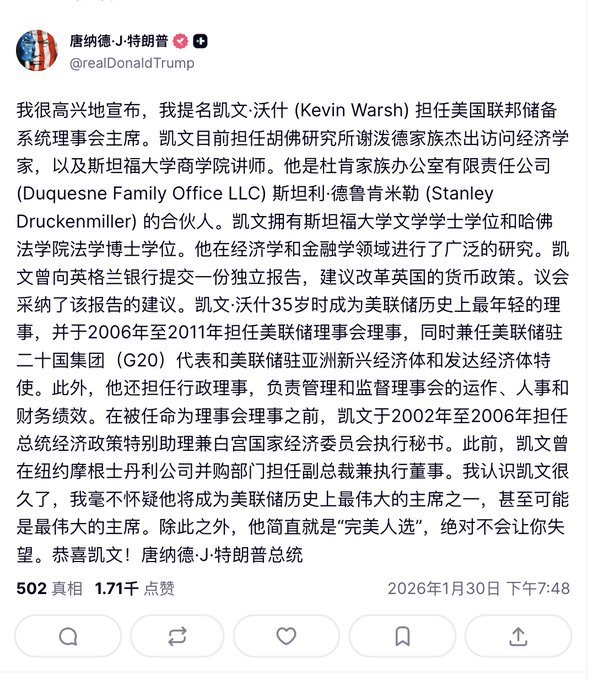
Just moments ago, Trump didn't back out and directly announced his nominee: Kevin Warsh was nominated as the new Federal Reserve Chairman. Now that my second point of contention is cleared, let's focus on the first one. We need to pay attention to whether Warsh, as the future chairman, will begin speaking, in conjunction with Bessenter, to boost confidence in the dollar. Currently, in the main narrative of the macro market, while the government shutdown remains unresolved, Trump's recent communication with the Democrats suggests a high probability of avoiding a large-scale shutdown. Tonight's December PPI data has relatively low weight; the market will likely price in the new Fed Chairman tonight. The market expects Warsh to not support large, consecutive interest rate cuts and to maintain a policy of tightening liquidity. This expectation is unfavorable for risk markets but will boost confidence in the dollar and US Treasury bonds. We'll see if this is priced in later during the US trading session. In fact, unless Warsh changes his previous views, his nomination is currently less beneficial to risk markets and interest rate cuts than Powell's. twitter.com/CatoKt4/status/201...
Loading..