Within minutes of the US-Israeli airstrikes, outflows of crypto assets from Nobitex, Iran's largest crypto exchage, surged by 700%.
Written by: angelilu, Foresight News
On February 28, 2026, the United States and Israel launched their first joint airstrike against Iran. Within minutes of the news breaking, assets on Nobitex, Iran's largest cryptocurrency exchange, began flowing out at an abnormal rate. Meanwhile, on the other side of the Middle East, after several days of war, the Tel Aviv Stock Exchange in Israel closed at a record high on March 2.
The same war, two drastically different financial signals: one of capital celebration, the other of wealth flight. This picture may be the best entry point to understand the true role of crypto assets in geopolitical conflicts.
Nobitex outflow surges by 700%
Nobitex is Iran's largest cryptocurrency exchange, with over 11 million registered users and a total transaction volume of $7.2 billion in crypto assets in 2025. It is a core infrastructure of Iran's crypto ecosystem.
According to on-chain monitoring data from blockchain compliance agency Elliptic, Nobitex saw a 700% surge in outbound cryptocurrency flows within minutes of the US-Israeli airstrikes. Fund flow data indicates that these assets were being transferred overseas, primarily to foreign crypto exchage that have historically received large amounts of Iranian funds.
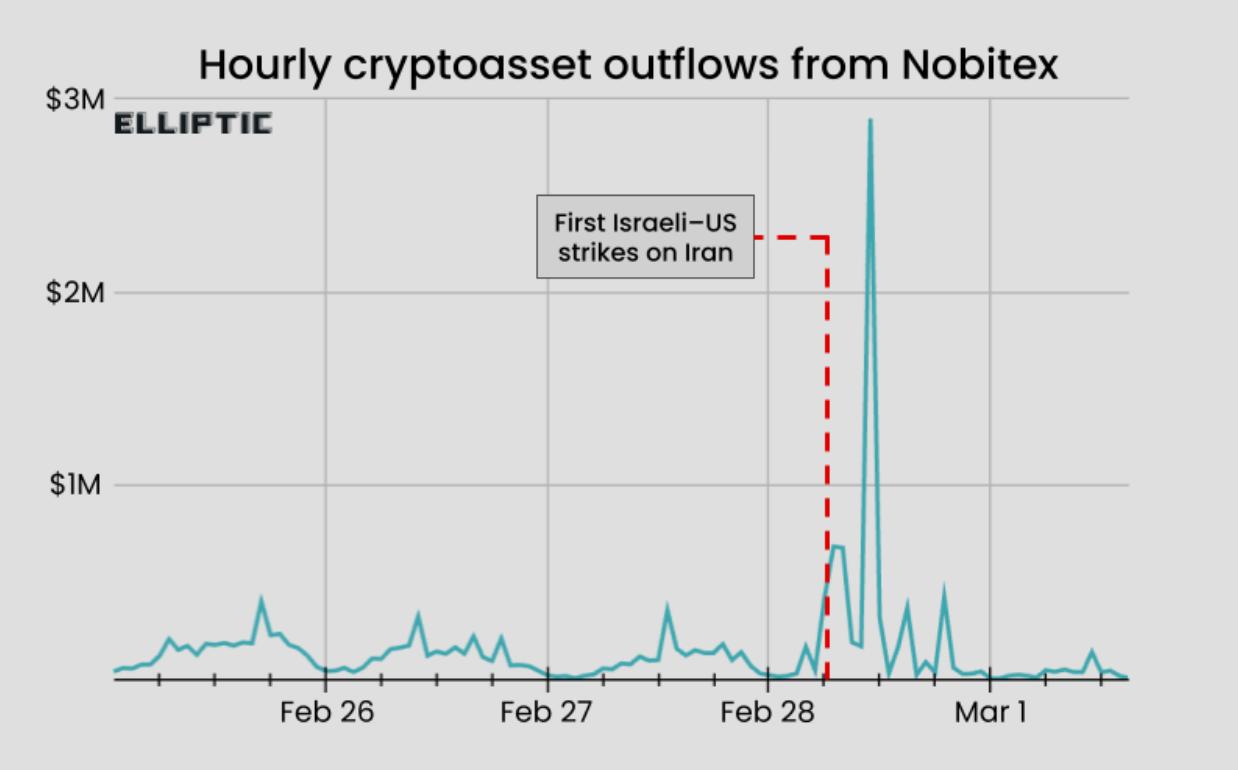
Shortly after the US announced sanctions against Iran, crypto assets saw two more small surges, suggesting that they may be being used in attempts to circumvent these sanctions.
A careful analysis of the chart data reveals that before the airstrikes, Nobitex's normal baseline outflow of funds was approximately $300,000-400,000 per hour, with a peak outflow of about $2.8 million per hour. While the absolute amounts aren't huge, they reflect a behavioral signal: the first reaction to the news was to transfer assets out. Furthermore, Elliptic only monitored the traceable on-chain portion. A large number of cryptocurrency transactions in Iran were conducted through over-the-counter (OTC) and peer-to-peer (P2P) channels, which are completely invisible in this data; the actual outflow scale is likely much larger.
This is not an isolated incident. Elliptic's tracking shows that Nobitex has experienced multiple outflow peaks since January 2026: On January 9, large-scale demonstrations broke out in Iran, and the government subsequently implemented an internet blockade, resulting in the highest outflow of the year that day. Even during the internet outage, some assets continued to flow out, indicating that some people were able to bypass the blockade and continue operating; subsequently, the US Treasury Department imposed sanctions on two UK-registered exchanges (Zedcex and Zedxion) with ties to Iran, causing Nobitex's outflow to surge again briefly.
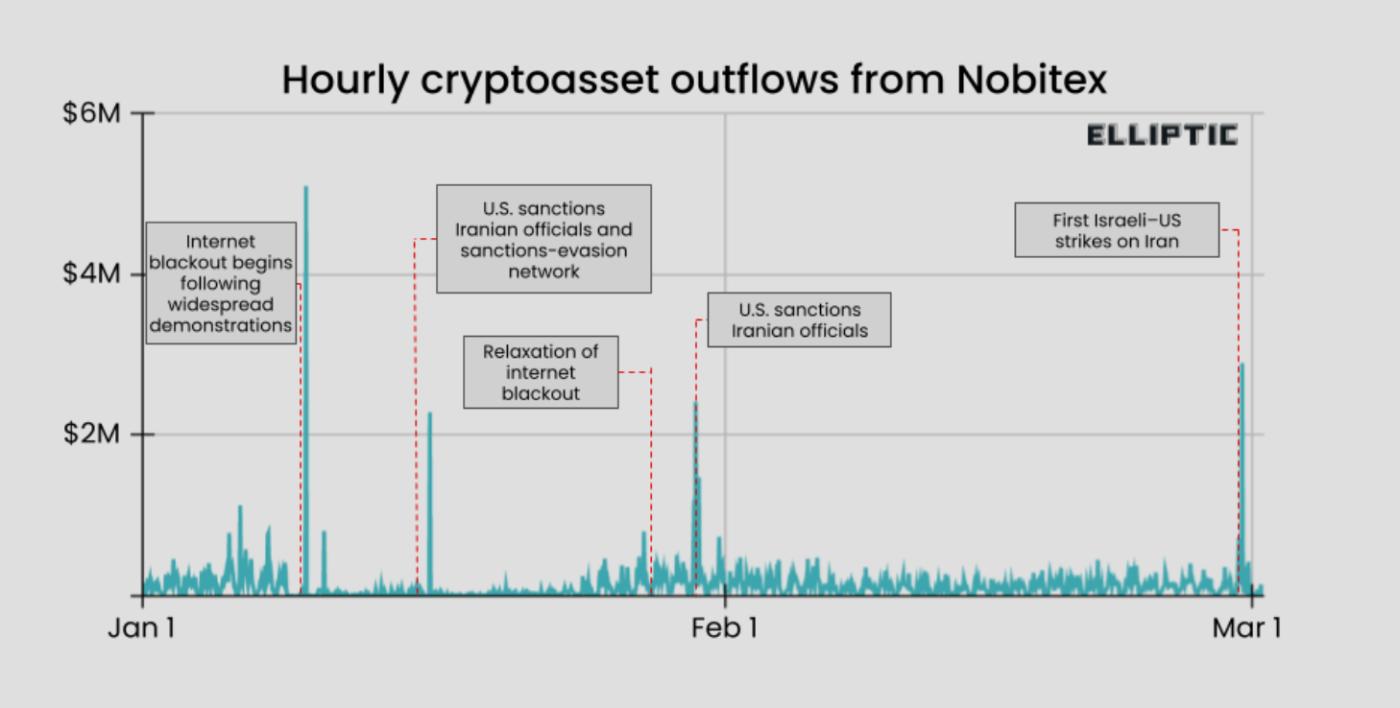
Three peaks and three trigger points—sanctions, internet shutdowns, and airstrikes—jointly outline a pattern: whenever political or military risks in Iran rise, crypto assets become the first choice for capital flight.
Why encryption, and not banking?
The answer to this question lies in Iran's decades-long history of sanctions.
Since the Islamic Revolution of 1979, Iran has long been under severe sanctions from the United States and Western countries, cut off from the SWIFT international settlement system, and its residents have been virtually unable to transfer wealth abroad through traditional banking channels. Cryptocurrencies offer a workaround: Iranian rials (the Iranian currency) are exchanged for stablecoins such as USDT, then transferred to overseas wallets via on-chain transactions, and finally enter overseas exchanges. The entire process bypasses any traditional banks, making it difficult for sanctions to intervene.
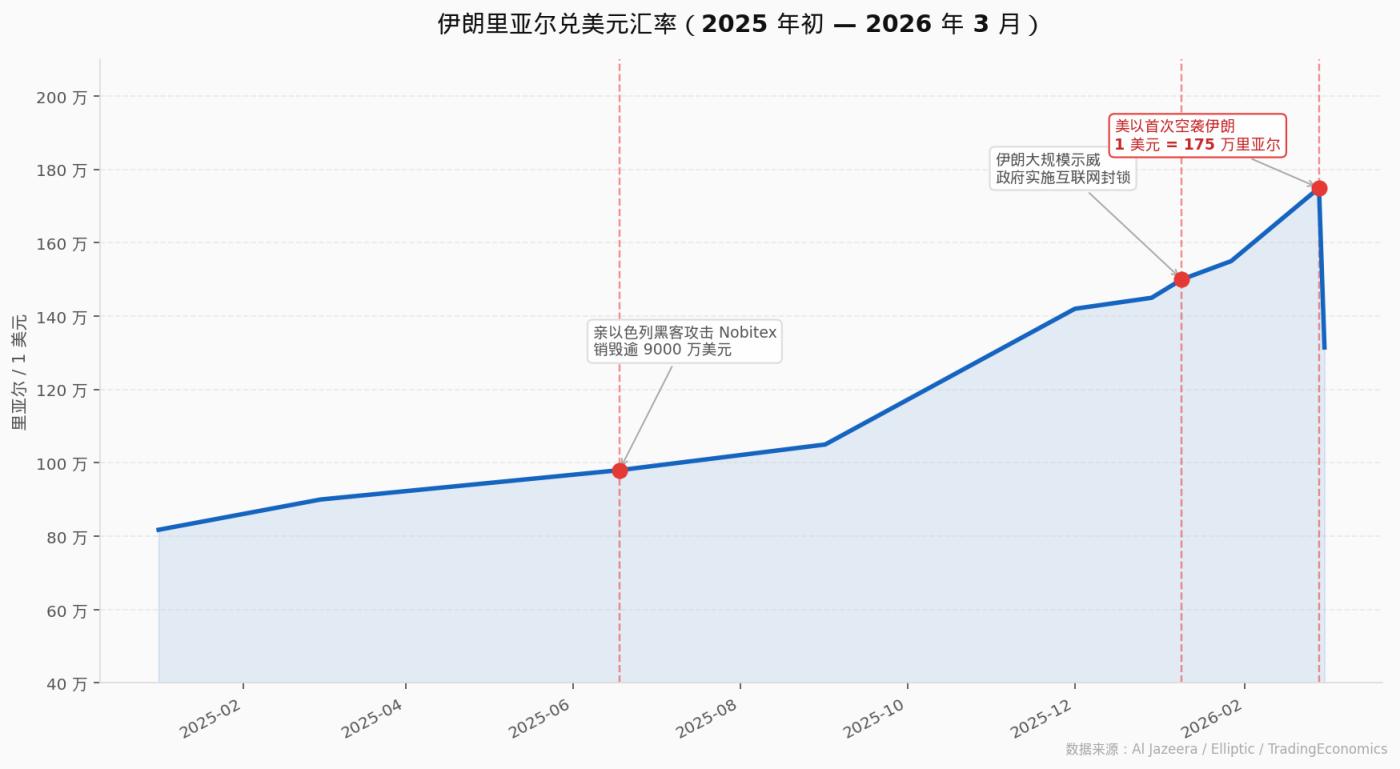
The collapse of the riyal also provides the most direct motive for fleeing. In early 2025, 1 US dollar was worth approximately 817,500 riyals; by January 2026, the exchange rate had fallen to 1.5 million riyals; after the airstrikes, the riyal hit a record low in a single day, falling to 1.75 million riyals to 1 US dollar.
Amid long-term international sanctions and geopolitical conflicts, food prices in Iran have risen by over 72% year-on-year, and the national inflation rate has reached 42.5%. At the time of the 1979 Islamic Revolution, one US dollar could only be exchanged for approximately 70 rials. This means that in just over forty years, the purchasing power of the rial has shrunk by more than 25,000 times, and the wealth of the people has been almost crushed to dust under the relentless march of time.
Previously, U.S. Treasury Secretary Bessant publicly admitted during a congressional hearing that the United States deliberately created a dollar shortage in Iran, leading to the accelerated collapse of the rial, and characterized this as part of its strategy toward Iran.
More noteworthy is that this approach isn't limited to ordinary citizens. Elliptic research shows that the Central Bank of Iran itself holds at least $500 million in USDT through Nobitex as a reserve to support the rial exchange rate and circumvent sanctions. The contradiction of a government simultaneously regulating and relying on crypto assets demonstrates the irreplaceable function of crypto assets in sanctioned economies.
Historical Patterns of Warfare and the Outflow of Cryptographic Data
Iran's case is not an isolated one, but a pattern that has been repeated in many countries.
In February 2022, Russia invaded Ukraine, prompting the West to impose the harshest financial sanctions in history, including removing its major banks from the SWIFT system. The ruble subsequently plummeted, and trading volumes of Bitcoin and USDT within Russia surged. However, Russia's situation differs from Iran's: constrained by the liquidity cap in the crypto market, large-scale circumvention of state-level sanctions is difficult, resulting in relatively limited actual outflows.
In August 2021, the Taliban seized power in Afghanistan, and the outflow of crypto assets peaked at approximately $150 million that month, mainly due to capital flight from Kabul's elite. Subsequently, the Taliban announced a ban on cryptocurrencies, and the market quickly went to zero.
In summary, the pattern is clear: war or crisis triggers a surge in the outflow of crypto assets. The difference with Iran is that the outflow here has become a systematic rhythm, not an occasional reaction, but a regular channel for capital flight.