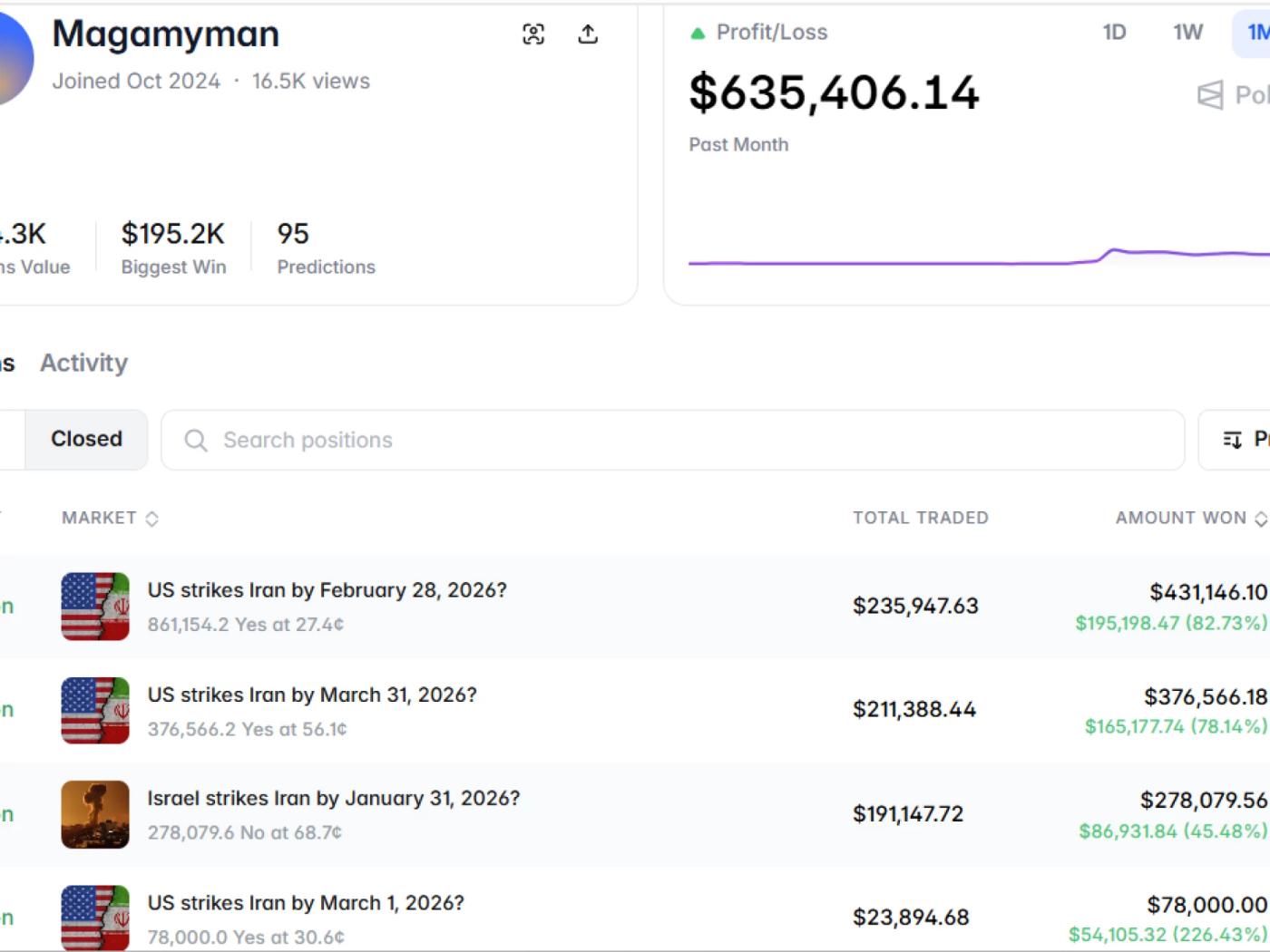
A trader known as “Magamyman” made $553,000 betting on the death of Iran’s Supreme Leader on Polymarket, sparking regulatory controversy over whether war and death-related prediction markets encourage insider trading and inappropriate incentives.
Article by Bobby Allyn
Source: NPR
Article compiled by: Chang
According to NPR, an account named "Magamyman" on the prediction market platform Polymarket bet that Iran's Supreme Leader Ayatollah Ali Khamenei would "lose power" before his assassination, ultimately profiting more than $553,000.
On February 28, the United States and Israel launched airstrikes against Iran, killing Khamenei and several other senior Iranian military leaders. Iran subsequently retaliated by striking Israeli and US military bases in the Gulf region.
According to reports, transactions related to "when the US will launch airstrikes against Iran" on the Polymarket platform alone exceeded $500 million. This quickly drew attention from members of Congress and regulators.
U.S. Senator Chris Murphy stated on the X platform, "It's unbelievable that this is legal." He said he would push for legislation as soon as possible to ban such transactions surrounding war and death.
The White House denied any involvement in the transaction.
However, the Trump family has ties to Polymarket. Donald Trump Jr. served as an advisor to the platform, and his venture capital firm, 1789 Capital, invested millions of dollars in the company. Furthermore, the Trump administration has dropped two previous federal investigations into Polymarket launched during the Biden administration.
Is there a controversy surrounding "insider trading"?
This is the latest controversy surrounding whether prediction markets could become "insider information arbitrage tools".
Previously, in January of this year, an anonymous trader made hundreds of thousands of dollars in bets before the arrest of Venezuelan leader Nicolás Maduro. In February, Israeli authorities accused the two of using classified information to bet on impending military action during the June conflict between Israel and Iran.
Currently, large transactions related to the removal of Iran's Supreme Leader are taking place on overseas trading platforms operated by Polymarket, and therefore are not directly subject to the jurisdiction of US regulatory agencies.
Although the Trump administration approved Polymarket to establish a platform in the United States, it has not yet been fully launched publicly. Most U.S. users access the platform via VPN.
Legal Boundaries and Platform Disagreements
In the United States, most prediction markets are regulated by the Commodity Futures Trading Commission (CFTC) and are considered "futures contracts" rather than gambling.
Under U.S. commodity exchange law, trading around death and war is generally considered illegal because such markets provide financial incentives for violence and human suffering.
This legal boundary is reflected in how another prediction platform, Kalshi, handles it.
Following the confirmation of Khamenei's death, Kalshi suspended trading in related markets for "further review." Subsequently, Kalshi CEO Tarek Mansour stated that the company would refund related transaction fees, adding, "We do not list markets directly linked to the death."
Kalshi stated that he will issue partial refunds to traders based on the last traded price before the death was confirmed, in order to avoid violating legal provisions prohibiting "profiting from death."
The decision sparked strong dissatisfaction among traders, with some users accusing the platform of "leaning its rules towards compliance rather than market outcomes."
Calls for regulation are growing louder
Amanda Fischer, a former SEC official and current member of the financial reform organization Better Markets, said Congress should take action to prevent “distorted incentives surrounding death and war.”
She pointed out: "Prediction markets are providing speculative opportunities surrounding war or assassination. The controversy over how the Khamenei market should be settled demonstrates that such markets should not exist in the first place."
This incident has once again sparked widespread discussion about the legal boundaries of prediction markets, the risks of insider information, and war-related financial speculation.