OpenClaw, a project that reversed its fortunes overnight by deleting documents, saw its stock price rise for three consecutive months!
Written by: Nicky, Foresight News
Amid the recent overall downturn in the cryptocurrency market, the Venice token VVV, from the Base blockchain AI project, has exhibited independent performance for three consecutive months. According to Bitget data, VVV bottomed out at $0.916 on December 1, 2025, and subsequently climbed steadily, reaching a high of $8.384 on March 2, 2026, representing a cumulative increase of over 815%. Its market capitalization also rose from $41.97 million to a peak of $369 million.
This remarkable surge coincides with renewed attention being paid to Venice's AI applications. On March 2nd, Venice founder Erik Voorhees tweeted that Venice has become the recommendation model provider for the emerging AI project OpenClaw.
However, the plot took a turn within half a day—the OpenClaw official page subsequently removed the content related to Venice from the document.
So what exactly is Venice?
Founded in May 2024 by serial entrepreneur Erik Voorhees in the cryptocurrency field, Venice AI positions itself as a privacy-preserving alternative to centralized AI services such as ChatGPT. The platform emphasizes its "unregulated, uncensored" nature; all AI models are open-source and transparent, and user conversations are not recorded or stored.
As of February 6, 2026, Venice had over 2 million registered users and nearly 30,000 API users. The platform processes over 15,000 inference requests daily, with over 50,000 active users.
Unlike mainstream AI services, Venice adopts a three-tiered model with both free and paid options: users without an account can make 5 text conversations and 10 image requests per day; registered free accounts can make up to 10 text conversations and 16 image requests.
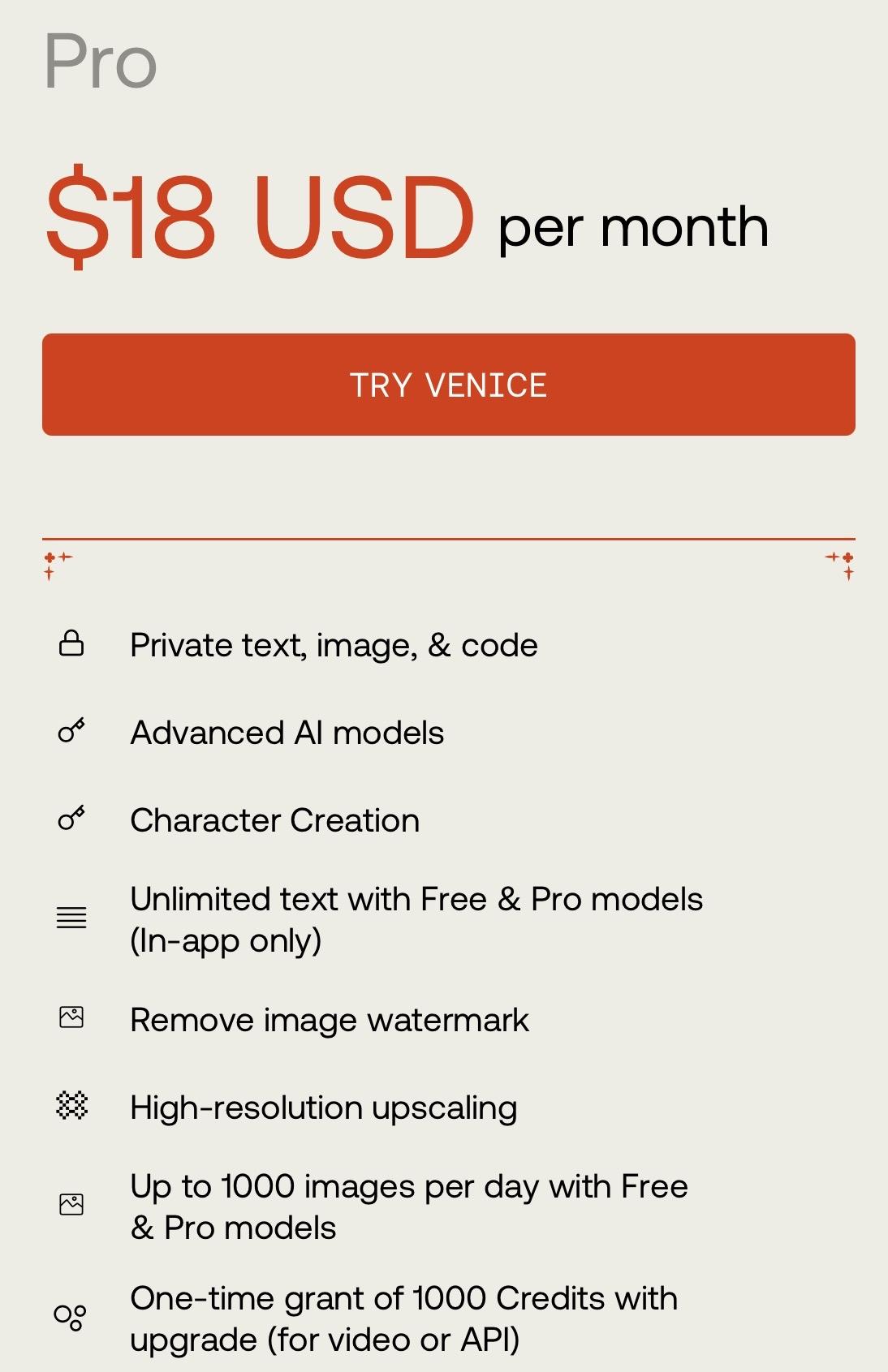
Pro members pay $18 per month for unlimited text conversations and 1,000 image generation per day, along with watermark removal and high-definition zoom support.
Unlike traditional APIs that charge per request, Venice introduces "Diem" as a unified unit of calculation, where 1 Diem is equivalent to $1 of AI inference resources. Users or AI agents can obtain a corresponding proportion of API call capacity by staking VVV, without paying for each request. Staking 1% of the circulating tokens will permanently occupy 1% of the total Venice API capacity.
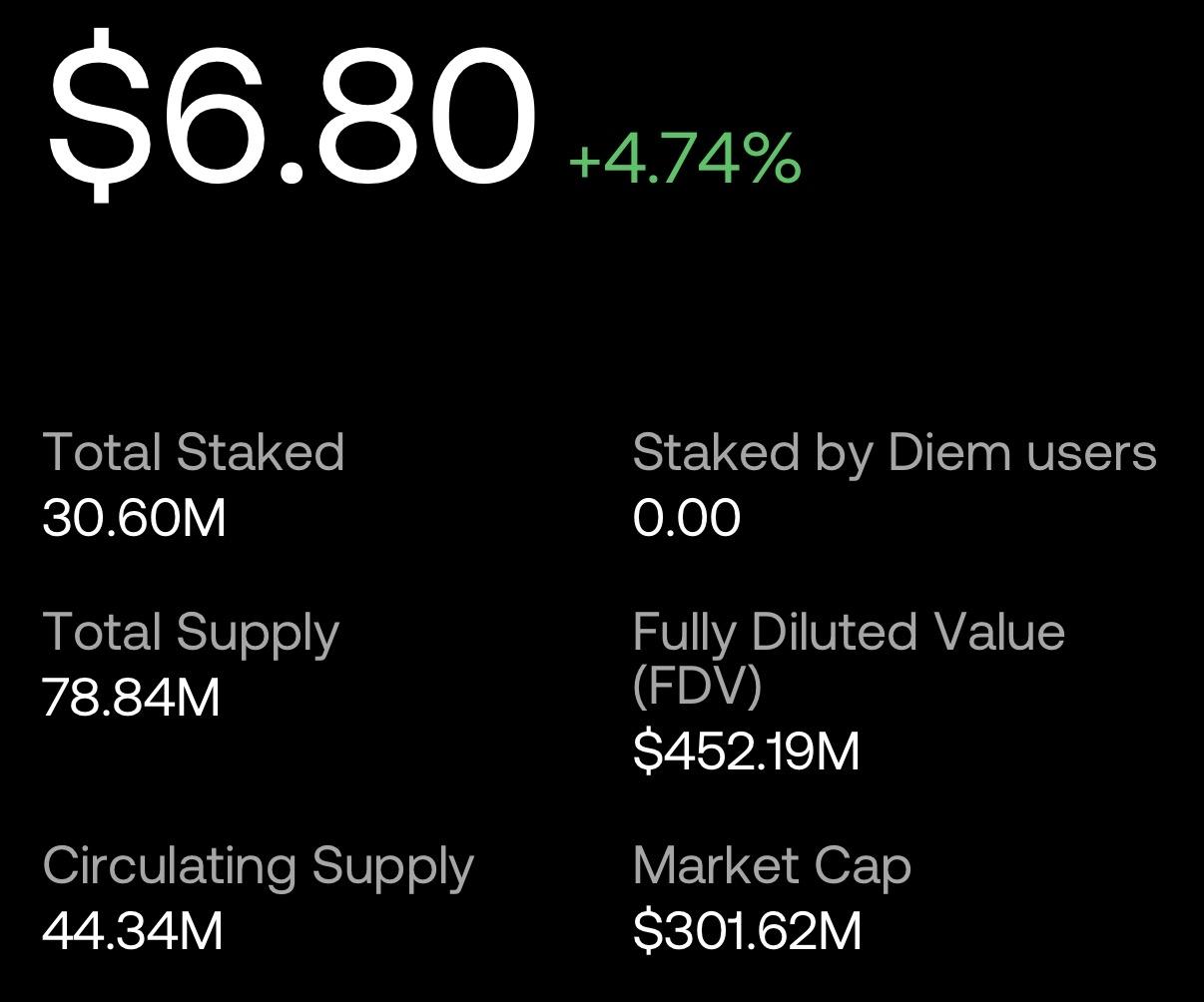
According to official data, the total supply of VVV is currently 78.84 million, with a circulating supply of 44.34 million. Of these, 30.6 million have been staked, accounting for a high 69%. This means that most of the circulating tokens are locked up to acquire computing power resources, reducing actual selling pressure in the secondary market.
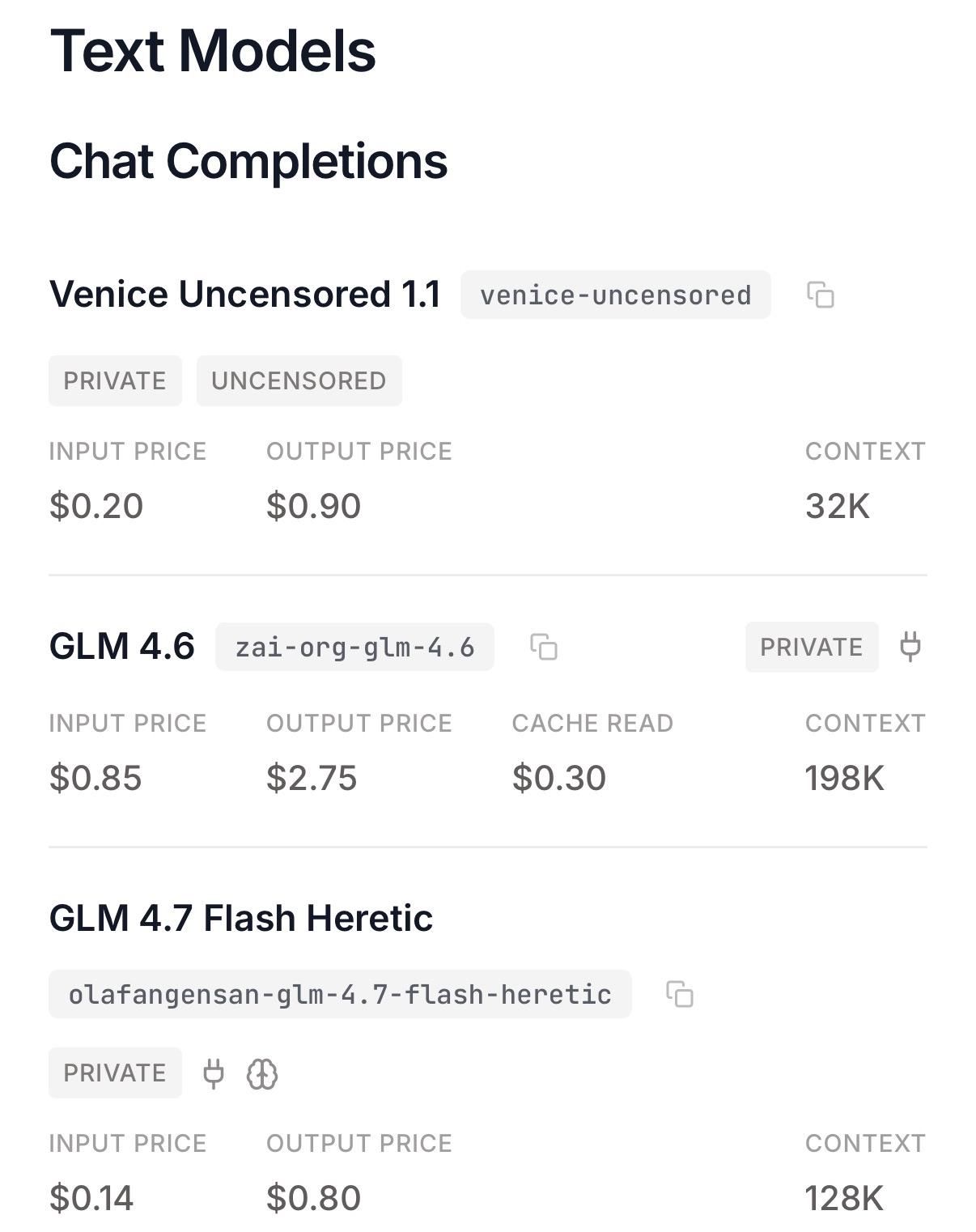
According to the official API pricing, the Venice Uncensored 1.1 model charges $0.20 per million tokens for input and $0.90 per million tokens for output, with a context window of 32K. Compared to current mainstream AI model prices, Venice is in the upper-middle range: its input price is close to OpenAI's GPT-4o Mini ($0.15), and its output price is slightly higher than Google Gemini 2.5 Flash ($0.60 to $2.50).
Market data shows that the current AI API market is clearly stratified: the ultra-low-priced tier is dominated by DeepSeek R1 (input $0.12) and Gemini Flash-Lite ($0.10); the low-priced tier includes GLM 4.7 Flash Heretic ($0.14) and GPT-4o Mini; the mid-priced range includes Gemini 2.5 Flash ($0.30); while flagship models such as GPT-5 and Claude Opus have input prices as high as $1.25 to $5.
Two models from the GLM series are also showcased on the Venice page: the GLM 4.6, positioned in the mid-to-high-end market, costs $0.85 for input and $2.75 for output, offering a massive 198K context window; while the GLM 4.7 Flash Heretic emphasizes cost-effectiveness, with input costing only $0.14, output costing $0.80, and a 128K context window.
Venice was co-founded by two veterans of the cryptocurrency and fintech industries. CEO Erik Voorhees entered the cryptocurrency industry in 2011 and previously founded the Bitcoin betting game SatoshiDICE and the digital asset exchange ShapeShift, the latter of which successfully transformed into a decentralized autonomous organization in 2021.
Co-founder and COO Teana Baker-Taylor has over 20 years of experience in the fintech industry, having previously led global transaction banking client strategy at HSBC, and later held senior positions at Binance UK, Crypto.com, and Circle. She also serves as Executive Director at Global Digital Finance, driving the development of a regulatory framework for digital assets.
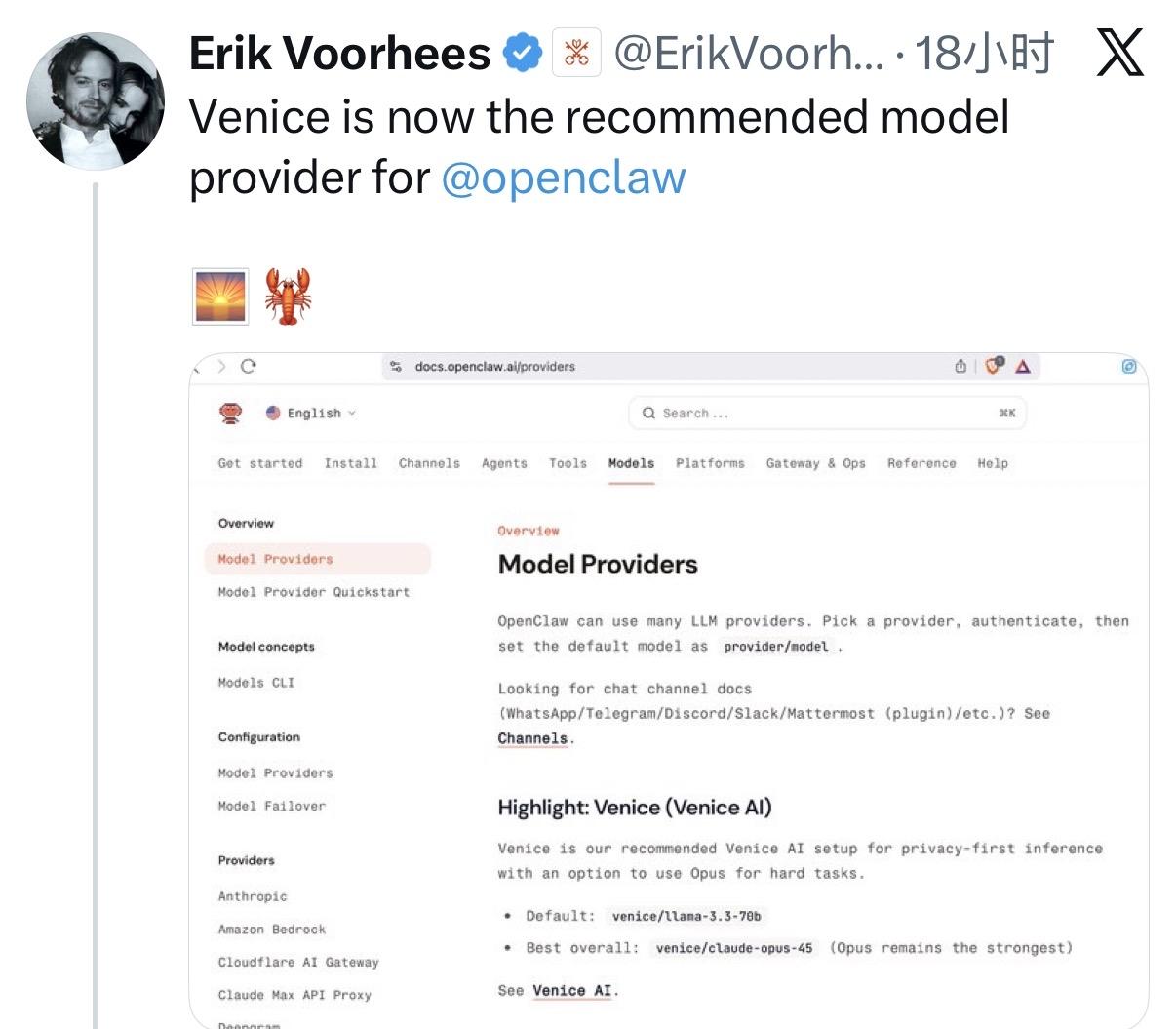
OpenClaw's decision to list Venice as a recommendation model provider and then quickly remove it has sparked speculation about the authenticity of the partnership. As of press time, OpenClaw has not issued a public statement, and the Venice team has not commented further.
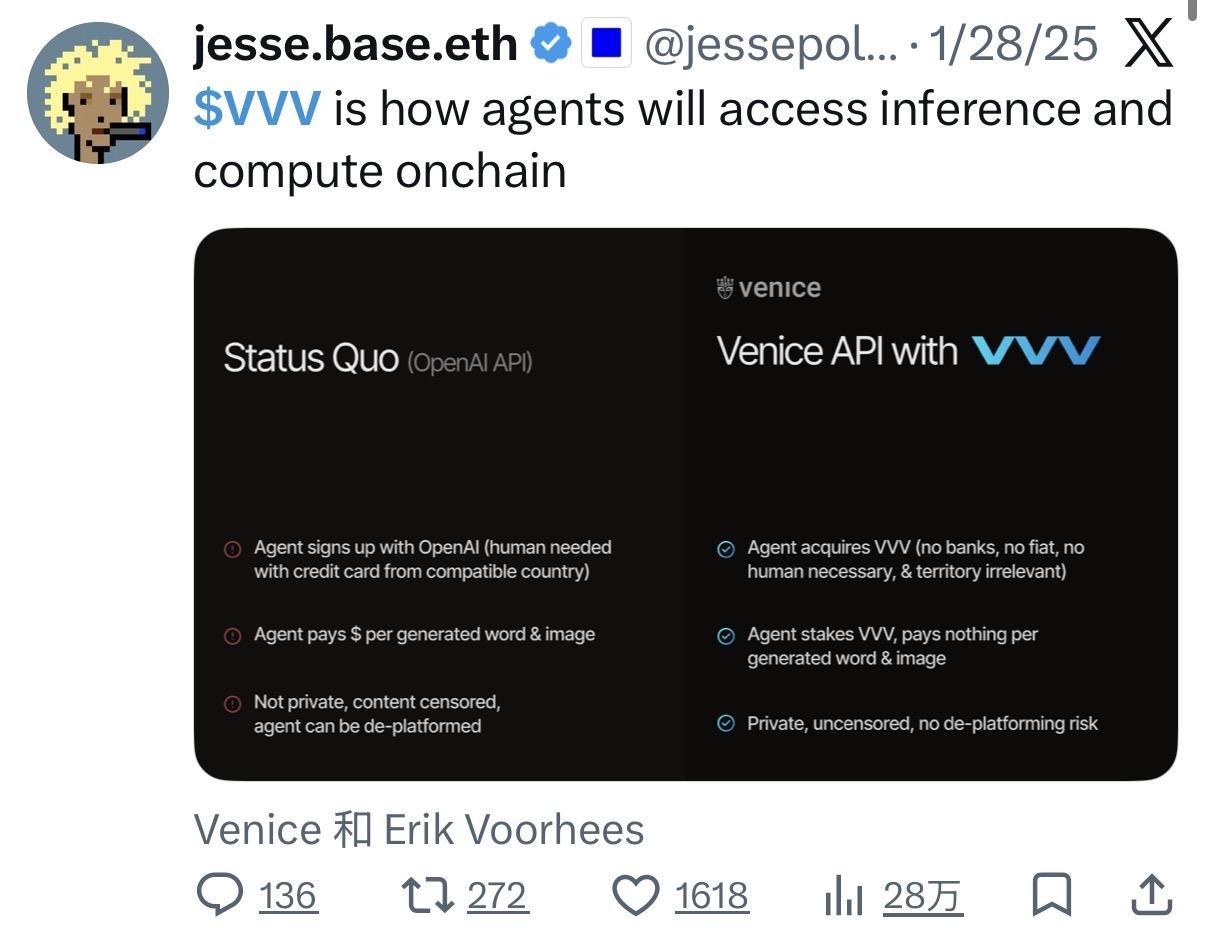
It is worth noting that Base co-founder Jesse Pollak posted a tweet related to VVV in January 2025, stating that "VVV is a way for AI agents to access inference and computation on-chain."
Despite VVV's recent strong performance, the project still faces multiple challenges. First, the OpenClaw partnership reversal indicates that Venice's successful implementation within the AI application ecosystem remains uncertain. Second, the platform's API capacity growth requires continuous infrastructure investment; if computing power expansion cannot keep pace with staking demand, it could lead to dilution of the resource share corresponding to a single token.
Furthermore, privacy and censorship-free approaches may face regulatory challenges in different jurisdictions regarding compliance. Venice acknowledges in its FAQ that "each model is governed by its own rules set by its publisher," and that the platform itself remains neutral. However, balancing openness and compliance in practice remains a long-term challenge.