Table of Contents
ToggleOn March 3, U.S. President Donald Trump announced on social media that he had ordered the U.S. International Development Finance Corporation (DFC) to provide political risk insurance and financial guarantees "immediately" at "very reasonable prices" for all shipping trade through the Persian Gulf, particularly energy transport.
Trump also stated that, if necessary, the U.S. Navy would begin escorting oil tankers through the Strait of Hormuz "as quickly as possible."
A White House official acknowledged, "As military operations escalate, the energy market is facing increasing pressure, particularly on Qatari liquefied natural gas (LNG) and Saudi crude oil exports."
Key Background of DFC Intervention
The Strait of Hormuz is a critical energy chokepoint, handling approximately 20% of global oil trade. Iran previously announced the strait's blockade in retaliation and reportedly shelled more than a dozen oil tankers that ignored warnings. Trump ordered the DFC to intervene, effectively providing "national credit" to private shipping companies and reducing financial risk for shipowners.
Looking back at the risks of tightening oil exports from oil-producing regions, during the Iran-Iraq War in the 1980s, Washington re-flagged Kuwaiti oil tankers and provided them with naval escorts, while private insurers also withdrew from the Persian Gulf on a large scale.
However, according to USNI News , the U.S. Navy has privately informed shipping industry leaders that it currently "lacks sufficient naval resources" to carry out escort missions. The high-risk area stretches from Kuwait to Duqm in Oman, a distance of approximately 1,000 nautical miles, far exceeding the range of previous escort operations, and currently about one-third of the U.S. fleet is deployed in the Middle East for strike missions.
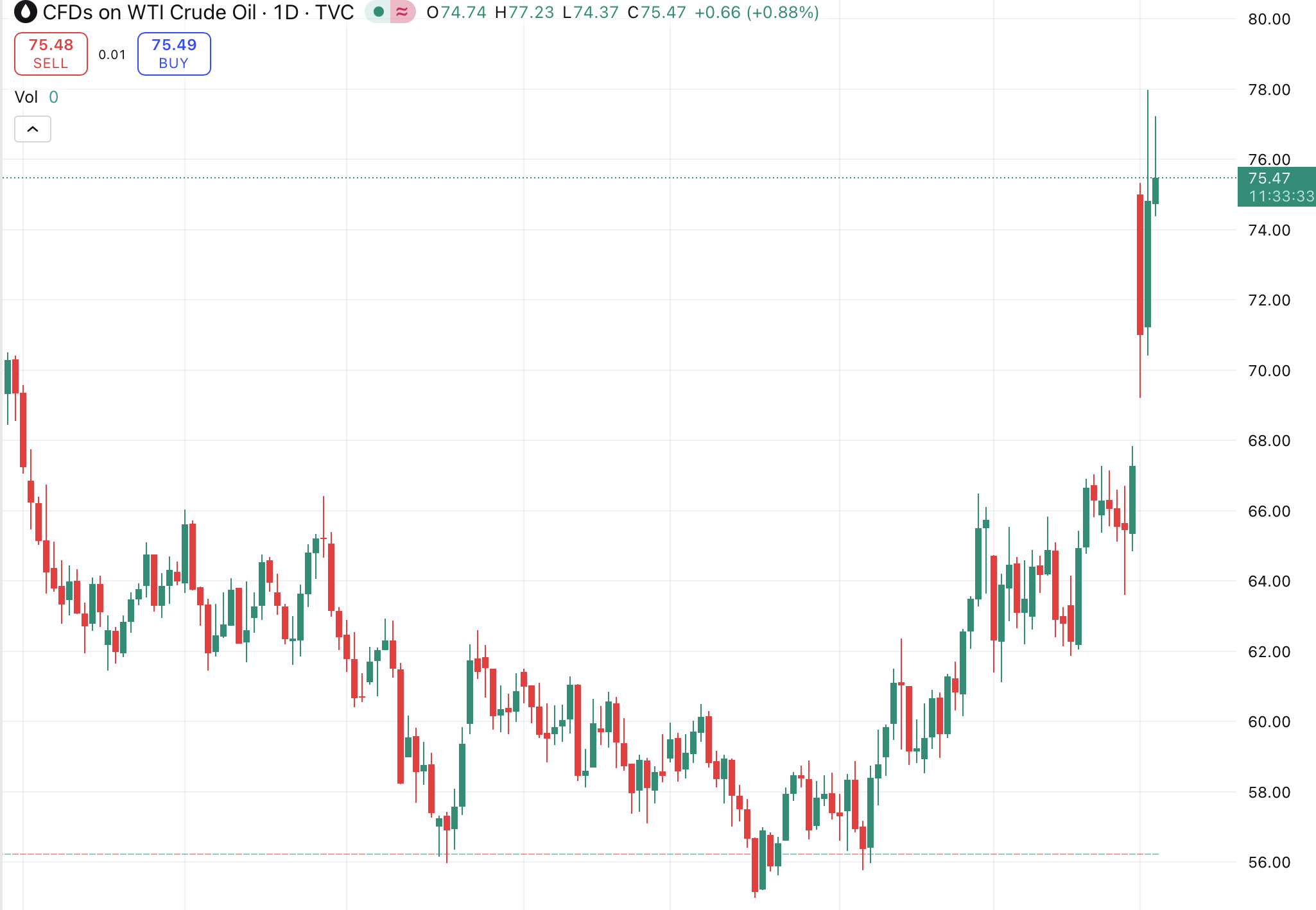
WTI crude oil prices surged 9% intraday before falling sharply due to Trump's remarks.
On the 3rd, driven by fears of escalating conflict and energy supply disruptions, WTI crude oil futures surged by more than 9%, approaching $77 per barrel; Brent crude oil also soared, briefly breaking through $82 per barrel.
However, oil prices fell significantly in the afternoon after Trump released his statement on DFC insurance and naval escort. According to CNBC, WTI ultimately closed at $74.56 per barrel (+4.68%), and Brent closed at $81.40 (+4.71%). Although the gains were still significant, they had narrowed considerably from the intraday highs.
BTC defies the trend and rises above 71,000 USD, demonstrating resilience rather than safe-haven appeal.
In contrast to the dramatic fluctuations in oil prices, Bitcoin climbed to $71,000 on March 4, extending its multi-day rebound since the outbreak of the conflict. BTC has steadily recovered from its initial low of $63,000, and the total market capitalization of the crypto market has returned to $2.36 trillion.
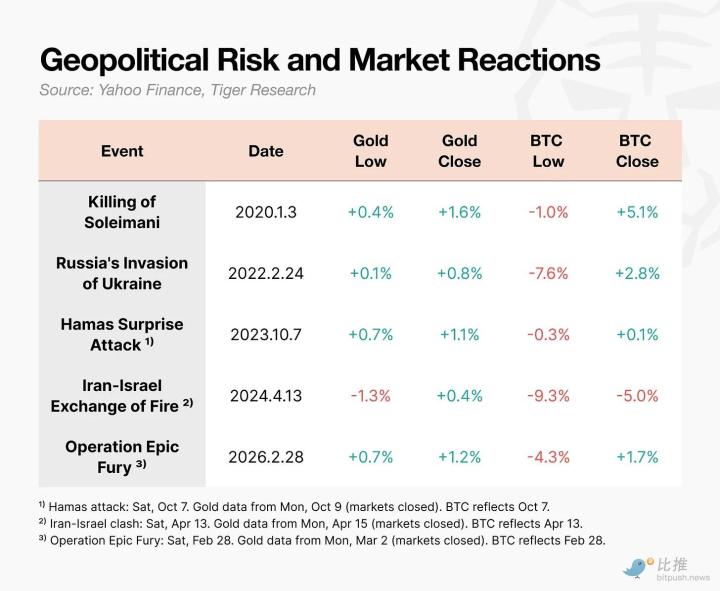
But does this mean that Bitcoin has become a contrarian "digital safe-haven asset"? The answer is probably no. Gold surged to a record high of $5,308 per ounce during the same period, demonstrating classic safe-haven characteristics; in contrast, BTC's rebound was driven more by stable inflows of institutional funds and technical momentum.
However, there are also optimists. BitMEX founder Arthur Hayes pointed out that the longer the US-Iran conflict drags on, the greater the pressure on the Federal Reserve to eventually cut interest rates or expand its balance sheet, "and that will be the real buying opportunity for Bitcoin." Meanwhile, BTC's 60-day volatility has fallen below the S&P 500, highlighting the increasing structural maturity of the crypto market, supported by long-term holders and institutional capital.