Author: Blue Whale News
Blue Whale News, March 5 (Reporter Hao Yan) – The ever-evolving AI world has recently seen another hot topic.
The recently viral AI model OpenClaw has been hailed online as a "next-generation super AI," with some even saying that if your social circle hasn't been discussing OpenClaw lately, you're definitely a "veteran" in the field.
OpenClaw is a "weekend project" initiated in November 2025 by Peter Steinberger, a retired Austrian programmer. It is an open-source AI framework that allows large models to gain local operating system privileges, enabling AI to execute shell commands and manipulate the file system, achieving so-called "local agent sovereignty." In other words, it is not just a chatbot, but an AI assistant that can actually perform tasks.
However, unlike DeepSeek and ChatGPT, which are easy to use, OpenClaw, as an open-source intelligent agent project, has a certain learning curve. This has led to the fact that those who profited first are now essentially "OpenClaw on-site installation" providers.
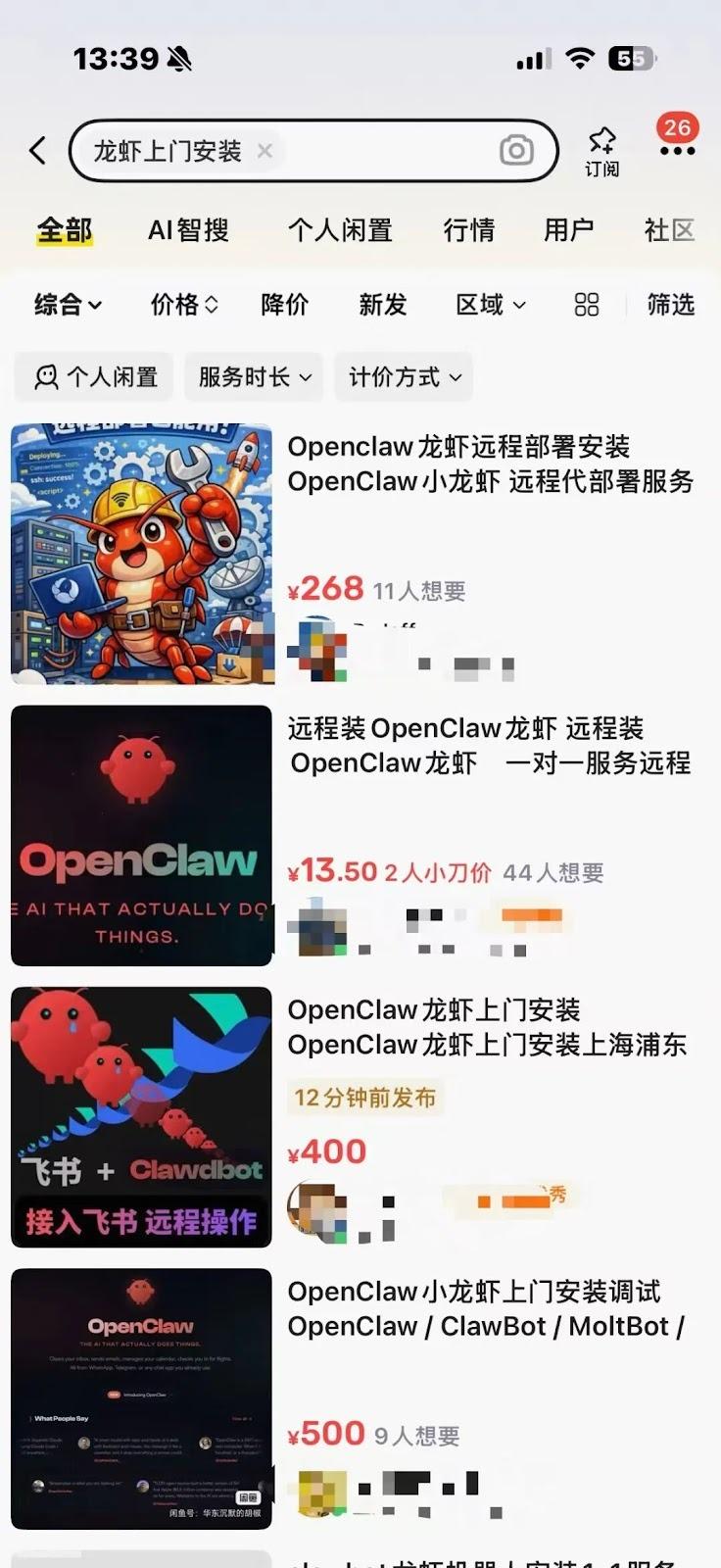
Programmers are starting a new business with on-site installation starting at 500 yuan.
As the name suggests, "OpenClaw on-site installation" refers to someone specifically installing OpenClaw on a customer's computer offline. Currently, searching for "Lobster/OpenClaw on-site installation" on platforms like Xiaohongshu and Xianyu reveals that this service seems to have established a market price, ranging from 300 to 800 yuan, with 500 yuan per session being the most common price. In contrast, "remote installation" is significantly cheaper, priced around 50-100 yuan. Blue Whale News found that several related online stores currently show over 1000 units sold, demonstrating the popularity of OpenClaw.
According to several vendors offering on-site installation services, the "on-site" service typically includes: OpenClaw installation, model debugging, and hands-on training, with the entire process taking more than 2 hours.
Because OpenClaw has a certain learning curve in terms of installation and usage, programmers have become the main force for "on-site installation." Xiaohongshu blogger "Xika Wants Freedom" shared her installation experience on her company's intranet after trying OpenClaw herself, unexpectedly attracting many inquiries from colleagues. She discovered that everyone had a strong enthusiasm and demand for OpenClaw, so she started posting on social media. "That very evening, people contacted me to inquire about installations. On the busiest day, I had over 30 people. But on-site installation is physically demanding, and I can't accept all these orders; I do some screening."
With the explosive popularity of OpenClaw, "on-site installation" seems to have become a hot sector, with many people starting to "compete for services." Some advertise "guaranteed to teach and learn" on their product details pages, while others offer "free 24/7 problem solving," and some even offer "one free cooking service, including cooking common dishes" in addition to "on-site deployment." This unexpected direction of "service competition" in the industry.

Besides individual business owners, many "brokers" have also started a business connecting customers with "on-site installation" services.
Blue Whale News discovered that some organizations previously engaged in computer repair and network maintenance have begun recruiting "on-site installation personnel" on social media, gathering them in community groups for unified order dispatch. The job postings explicitly state that programmers are limited, but a certain level of "explanation skills" is required. Orders come from all over the country, including not only AI-intensive cities like Beijing, Shanghai, Guangzhou, and Shenzhen, but also major cities across China such as Suzhou, Wuhan, Xi'an, and Chengdu.
Is on-site installation of OpenClaw a genuine need or just an "anxiety tax"?
Blue Whale News reporters learned from several programmers who provide "lobster on-site installation" services that, in addition to some self-media or cross-border e-commerce businesses with clear needs, many customers who consult and deploy OpenClaw have not even thought about what they want to use it for. "Many people just see it online out of curiosity and deploy it first, without thinking about what they will use it for."
Zhu Feng, a serial entrepreneur and product and technology expert, told Blue Whale News that the extent to which OpenClaw can meet the work needs of ordinary people remains questionable. "Deploying OpenClaw is not a simple installation issue; it involves a series of configurations. The type of model and capabilities you are configured with directly affects your usage. At the same time, some platforms, due to considerations of risk control, copyright, and commercialization, cannot smoothly support this kind of automated invocation. In such a closed ecosystem, the capabilities that OpenClaw can achieve are relatively limited. So, while self-media is hyping it up a lot, there is still a long way to go before it can be truly implemented by ordinary people. It's more important for ordinary people to make good use of their existing model capabilities rather than spending 500 yuan to install this."
This is another side of the OpenClaw craze.
The explosive popularity of OpenClaw has once again created an atmosphere of "AI entering a new era": tech bloggers are vying to review it, startup bloggers are showcasing their zero-frame startups, and even experts selling courses are turning to "how to achieve OpenClaw freedom," with hundreds of thousands of views and titles like "AI Awakening" and "Complete Liberation for the Working Class," elevating OpenClaw to a pedestal. The fear of being left behind by the times is amplified in this atmosphere: "If I don't install OpenClaw, will I be obsolete?" "Everyone else is using AI to work efficiently, while I'm still manually copying and pasting..."
According to "Sika Wants Freedom," the anxiety is indeed real. "As people in the internet industry, we are quite anxious ourselves. We worry that if we don't catch up with the AI wave, traditional jobs like writing code and doing operations will be replaced by AI. The most anxious people are probably these people. They have already achieved certain results in their professional fields, so they know clearly that there are many skills in this professional field that can be quickly replaced. Everyone is looking for skills that AI cannot replace."
However, "Sika Wants Freedom" also believes that it is meaningful to actively engage with these new tools. "I may just install them now to learn about their capabilities, and I may not be able to implement them immediately. But one day in the future, I may suddenly remember that I have an application scenario where I can use them, and at that time, I can come up with something. It's not like having a nail and then looking for a hammer."
The explosive popularity of OpenClaw is like a mirror, exposing the widespread technological anxiety in society, but also demonstrating the infinite possibilities of technological progress.