Nvidia's killer feature this time is an attempt to solve this problem from the ground up by providing an enterprise-grade security layer through built-in privacy tools and access control, making digital employees more compliant. This is also their biggest source of confidence in attracting major software companies.
Article author and source: Lei Technology
Nvidia, which makes a fortune selling chips, is now looking to expand into the application layer.
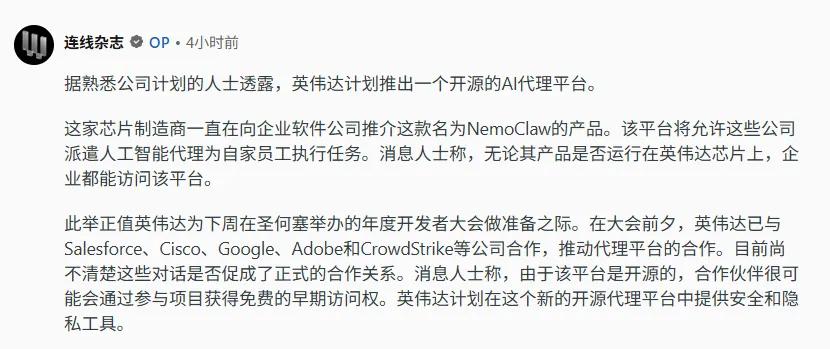
On March 10, according to Wired magazine, Nvidia is expected to launch an open-source AI agent platform called NemoClaw at its annual GTC developer conference next week.
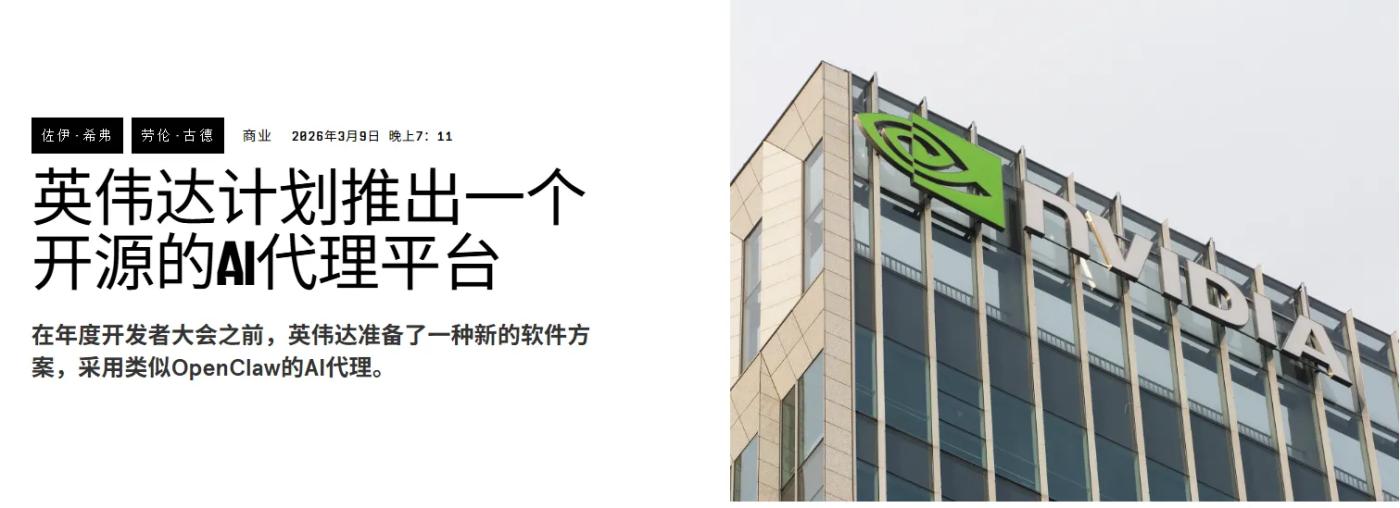
Sources familiar with the matter revealed that a major highlight of this platform is that it breaks down the reliance on underlying hardware. Even if enterprises do not use NVIDIA's proprietary chips, they can seamlessly integrate with the platform and distribute AI agents to employees to automate internal work tasks.
Functionally, it is similar to the well-known OpenClaw, which is an agent that is deployed on the user's local machine and can autonomously access the Internet, manage files, and even perform continuous tasks.
Now, following the explosive popularity of OpenClaw, an unprecedented "crayfish" craze is sweeping across the world.
In addition to AI companies such as Zhipu, Kimi, and MiniMax, major internet companies such as Alibaba, Tencent, ByteDance, and Baidu have also launched their own one-click deployment tools, hoping to capture users' minds by lowering the deployment threshold for users and pre-installing their own large model APIs.
Nvidia's entry into this field is in line with this trend.
Nvidia has always been the undisputed leader in AI computing hardware, but its presence in AI applications and software ecosystems is relatively weak.
Seeing major AI vendors and internet companies building their own application ecosystems, Nvidia clearly doesn't want to remain just a shovel seller forever. The launch of NemoClaw is a crucial step in their attempt to establish dominance in the software ecosystem era through an open-source model.
To this end, Nvidia has proactively contacted tech giants such as Google and Adobe to explore deeper collaborations.
However, while having AI do the work sounds wonderful, the reality is quite different.
According to foreign media reports, due to the extremely unpredictable behavior of AI agents, companies such as Meta have explicitly banned employees from using OpenClaw on their work computers. Even Summer Yue, Meta's AI security director, had a large number of her work emails maliciously deleted by an out-of-control AI, and her continuous intervention during the process was to no avail.

Security and controllability have become the biggest pain point for OpenClaw (and similar products).
Nvidia's killer feature this time is an attempt to solve this problem from the ground up by providing an enterprise-grade security layer through built-in privacy tools and access control, making digital employees more compliant. This is also their biggest source of confidence in attracting major software companies.
At this point, an ordinary person might ask, what does this have to do with us?
In my opinion, the implications are enormous. When even a computing power giant like Nvidia starts personally setting the rules for intelligent agents, it means that the widespread adoption of true digital employees is drawing ever closer.
Perhaps soon, the first thing ordinary people will do every day when they go to work will be to assign tasks to their local AI assistant, and then make the core decisions themselves.
As long as it doesn't accidentally delete the boss's emails, it's fine.