Original title: Stripe's MPP vs. x402: What Actually Happened Today
Original author: Nick Sawinyh, defiprime.com
Compiled by: Peggy, Blockbeats
Editor's Note: Regarding the question of how the Agent makes payments, x402 and MPP present two almost opposite paths.
x402 follows a protocol minimization approach: it embeds payment directly into HTTP requests, implementing payment upon request in the simplest way. With no accounts and no intermediaries, it resembles the open, permissionless design of the early internet, making it suitable for long-tail developers and decentralized scenarios.
MPP, on the other hand, maximizes system performance: it addresses issues of high-frequency trading, risk control, and fiat currency access through sessions, streaming payments, and a compliance system. It doesn't pursue pure functionality but prioritizes meeting real-world business needs, making it more suitable for enterprise-level and large-scale applications.
The difference between the two is essentially two solutions to the same problem: whether to make payment part of the protocol or to make it a layer of the system.
Therefore, they are not entirely competitive, but rather distributed across different segments: x402 covers the long-tail demand of open networks, while MPP handles high-frequency and commercial traffic. In an nascent agent economy, this differentiation may be inevitable.
The following is the original text:
The HTTP status code 402, defined in the HTTP/1.1 specification in the late 1990s, has been waiting for a purpose. It means "Payment Required." The initial idea was to embed payment capabilities into the Web's protocol layer, allowing machines to purchase resources as easily as requesting web pages.
However, this vision has largely failed to materialize. For years, this status code has only appeared occasionally in some peripheral scenarios, such as Shopify's rate limiting response and Apple Mobile Me's billing errors, but no one has truly built the micropayment future it implied. Instead, we have credit cards, subscription-based paywalls, and API key mechanisms, all of which are essentially designed for human operation.
Today, two competing paths to realizing this future have emerged, both announced on the same day. I'd like to outline what they are, their differences, and why Stripe is betting on both.
x402: A simpler solution
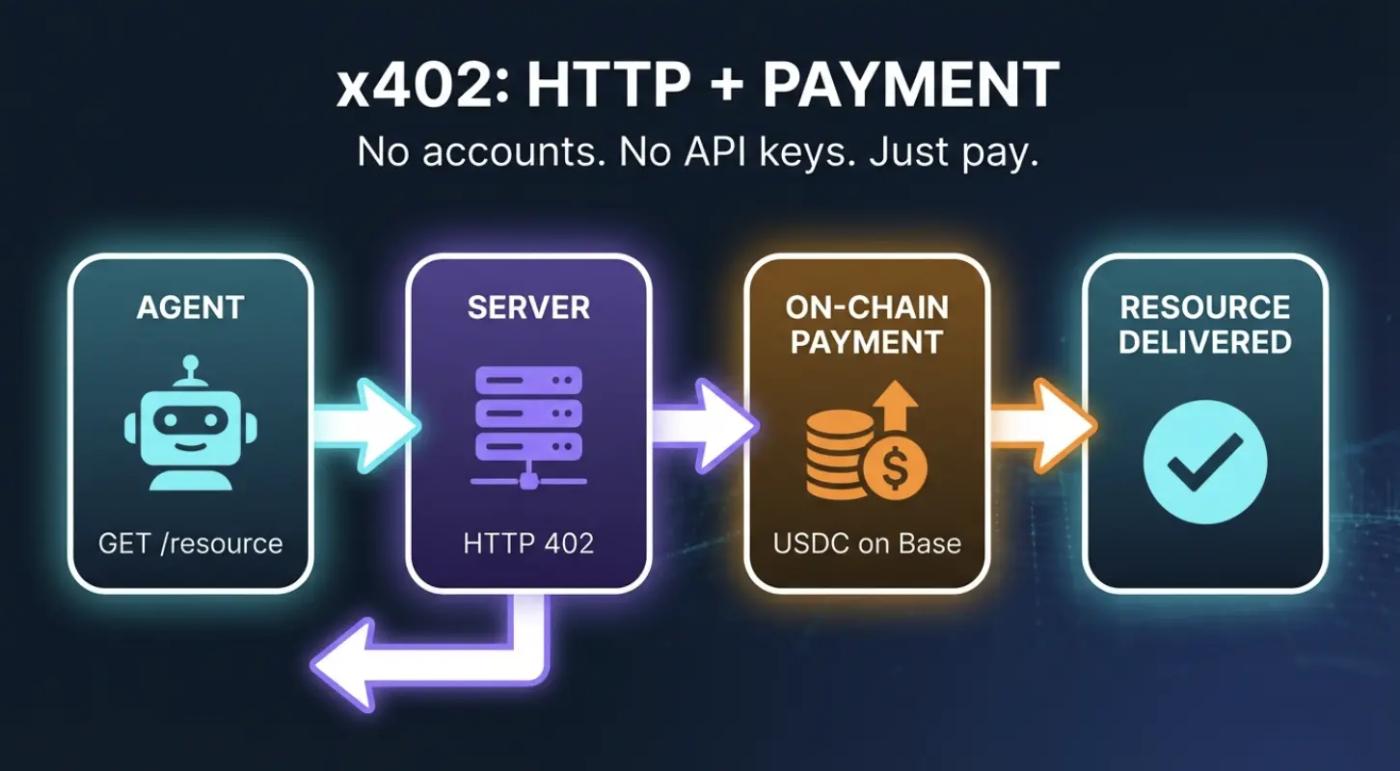
Coinbase officially launched x402 in May 2025, and its core concept can be described as extremely simple to the point of being radical. A client requests a resource; the server returns an HTTP 402 response, informing the client of the fee, the token used, and the blockchain on which the payment will be made. After the client completes the payment on-chain, it attaches the payment receipt to a new request, and the server then delivers the resource.
It's that simple. There's no account system, no API key, and no subscription mechanism. It's just a single HTTP request round trip with a payment inserted in between.
Stripe now offers native support for x402 within its payment system, allowing merchants to receive these payments directly through their existing backends. However, x402 remains essentially a protocol led by Coinbase, governed by the x402 Foundation, which Coinbase and Cloudflare jointly launched in September 2025. The protocol is fully open-source (Apache 2.0 licensed) and provides SDKs in multiple languages, including TypeScript, Go, and Python.
Regarding the scope of support, Coinbase's official documentation indicates that ERC-20 payments are currently supported on Base, Polygon, and Solana. Meanwhile, the ecosystem is exploring extending this to other chains such as Avalanche, Sui, and Near, but the level of maturity varies.
Looking at the adoption data, this part is a bit more complex. Coinbase states that x402 has processed over 50 million transactions through its Agentic Wallet infrastructure. That sounds impressive, but according to CoinDesk's on-chain analytics data from Artemis, cited on March 11th, the daily transaction volume is approximately 131,000, totaling about $28,000, with an average payment of only about $0.20 per transaction. About half of these transactions appear to be more like testing or gamification than genuine commercial transactions.
But this isn't necessarily a bad thing. This protocol was designed for a market that doesn't truly exist yet: a world where AI agents make micro-payments (even less than a cent) for API calls and data queries. And the merchants serving this market are only just beginning to emerge.
For example, Google's Agentic Payments Protocol (AP2, part of the A2A framework) has integrated x402; Lowe's Innovation Labs also demonstrated a demo: an AI agent can complete the entire process from product discovery and research to order placement in one go. Meanwhile, World (founded by Sam Altman) released AgentKit this week, adding human verification capabilities to the x402 wallet.
The core assumption behind this is that as long as payments are made as lightweight as HTTP requests, application scenarios will naturally emerge. Whether this holds true remains to be verified.
MPP: Full-Stack Solution
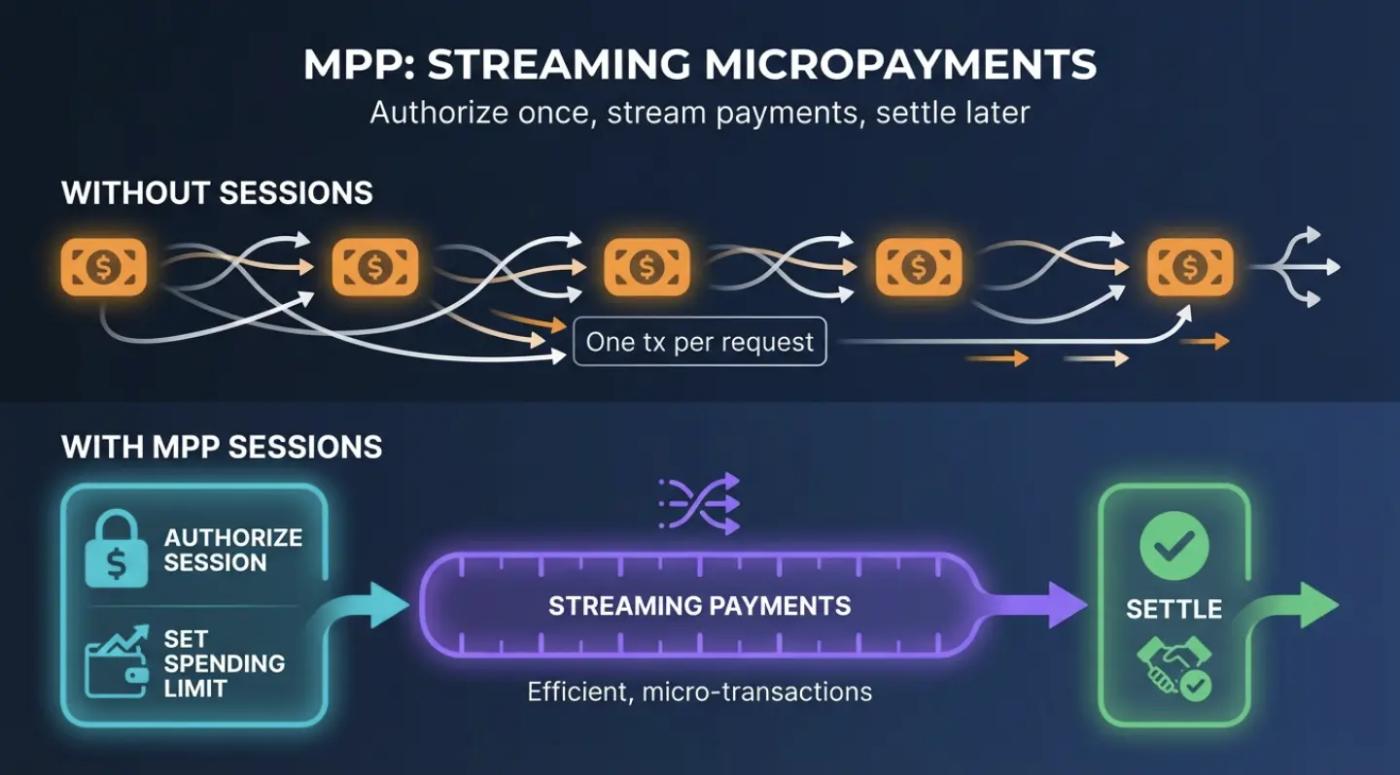
Stripe and Tempo have chosen a different path. The Machine Payments Protocol (MPP) was launched today alongside the Tempo mainnet. Unlike x402, which serves as a lightweight wrapper layer on top of existing blockchains, MPP is specifically designed for high-frequency trading agents.
Its core mechanism is sessions. Unlike initiating an on-chain transaction for each resource request, an agent can authorize a spending limit upfront and then continuously make micro-payments within that limit. If you are an AI that needs to query data sources thousands of times per hour, you would never want to sign and broadcast an on-chain transaction every time, and sessions are precisely designed to solve this problem.
The Tempo blockchain is also built around this need. It supports tens of thousands of transactions per second, has sub-second confirmation times, and has no native gas token. Users can directly pay transaction fees with stablecoins, saving them the cumbersome step of having to purchase some random token before making a transfer.
Another component worth understanding is Stripe's Agentic Commerce Suite, which includes Shared Payment Tokens (SPTs). This isn't part of MPP itself, but rather an extension mechanism of Stripe that can be used in conjunction with it. SPTs allow agents to securely transfer a user's bank card or wallet credentials to a merchant without exposing real data. These credentials are for single transactions only and have time limits, essentially acting as a programmable, self-destructing authorization. In practice, this means an agent paying via MPP can use USDC on Tempo, a user-linked Visa card, or even a combination of both.
According to the Tempo mainnet launch blog, its partners include Anthropic, DoorDash, Mastercard, Nubank, OpenAI, Ramp, Revolut, Shopify, Standard Chartered, and Visa. The Block reports that MPP already had over 100 services in its payment catalog at launch, including Alchemy, Dune Analytics, Merit Systems, and Parallel Web Systems. Matt Huang, co-founder of Tempo and Paradigm, stated in an interview with Fortune that this field is still in its early stages, and MPP is designed to expand to more on-chain environments beyond Tempo in the future.
Why does Stripe support both?
If you've already integrated with Stripe, the most practical answer is: you don't need to choose between the two.
Stripe supports x402 and MPP through two separate integration paths, rather than abstracting them into a single interface. For x402, the documentation primarily covers the process of generating deposit addresses, on-chain monitoring, and settling funds to a Stripe account—you handle the 402 response, while Stripe manages the underlying crypto payment infrastructure. Currently, USDC on Base is supported, with future expansion planned. For MPP, merchants can receive session-based streaming payments through the same PaymentIntents API.
Stripe's Agentic Commerce Suite, launched in December 2025, is built on these two payment tracks. Merchants simply upload their product catalogs and select the AI agents they wish to integrate; Stripe handles product discovery, checkout processes, fraud prevention, and tax processing. Currently, URBN, Etsy, Coach, Kate Spade, and Ashley Furniture are already using it, and integration with platforms such as Wix, WooCommerce, BigCommerce, Squarespace, and CommerceTools is also complete.
Their strategy is actually quite clear: control the abstraction layer and let the underlying protocols compete freely.
In comparison
From a macro perspective, both protocols are doing the same thing: enabling machines to pay for resources via HTTP. But the real differences lie in the details.
x402 (led by Coinbase) vs MPP (Stripe + Tempo)
standardization
x402: Fully open source (Apache 2.0), driven by the x402 Foundation with multi-party participation (Coinbase, Cloudflare, Visa, Google).
MPP: An open standard developed jointly by Stripe and Tempo, and is part of the Stripe Agentic Commerce Suite.
HTTP mechanism
x402: Revives an HTTP 402 by initiating a request with PAYMENT-REQUIRED and completing the retry with PAYMENT-SIGNATURE.
MPP: It also uses the challenge-response mechanism, but uses the Payment HTTP Authentication Scheme (IETF draft), which binds the challenge ID through HMAC.
Payment underlying layer (Rails)
x402: Designed to be unrelated to on-chain operations, it is currently supported on Base, Polygon, and Solana, and is still being explored on other chains.
MPP: Based on the Tempo blockchain—an L1 blockchain optimized for payments, supporting 10,000+ TPS, sub-second confirmation, and no native gas token; the long-term goal is to achieve cross-chain compatibility.
Payment methods
x402: Pure stablecoin, completely on-chain.
MPP: Supports USDC + SPT on Tempo (Stripe's mechanism), enabling a mix of crypto and fiat currencies (bank cards, wallets, BNPL).
Settlement method
x402: Settlement is done on-chain (approximately 200ms to several seconds), with verification and settlement handled by facilitators such as Coinbase.
MPP: Tempo provides sub-second confirmation, and Stripe automatically posts transactions and handles compliance.
Merchant access
x402: Open source middleware (Express, Hono, Next.js, etc.), which can be self-built or used with facilitator.
MPP: Directly connects to Stripe's PaymentIntents API, with risk control, taxation, refunds, and reports all built-in.
Core Innovation
x402: Extremely simple and vendor-free, similar to the Unix philosophy in the payment field.
MPP: High throughput + fiat currency integration, enabling streaming payments and micro-payment aggregation through sessions, as well as programmable spending control based on SPT.
Key partners
x402: Coinbase, Cloudflare, Google (A2A/AP2), Visa, World, Anthropic (MCP).
MPP: Stripe, Visa, Lightspark, Anthropic, DoorDash, Mastercard, OpenAI, Shopify, Revolut, Standard Chartered Bank.
x402 is more like your preferred solution when building open systems: independent developer APIs, decentralized data marketplaces, or any service that doesn't want to rely on payment processors. Its specifications could be written in a white paper, and integration requires only middleware and a wallet address. This purity is appealing—although the limitations of pure cryptography also mean a narrower audience.
MPP, on the other hand, is a completely different paradigm. If your agent needs to conduct hundreds or even thousands of transactions in a single session without wanting to record each transaction on-chain, then it's a more reasonable choice. The session mechanism keeps most interactions off-chain until final settlement; Stripe's compliance system handles risk control and taxation; and SPT's hybrid model allows agents to move beyond stablecoins and directly access users' Visa and other payment methods. It's less elegant, but closer to reality.
Interestingly, they aren't entirely competitors. x402 covers long-tail open scenarios, while MPP covers enterprise-level high-frequency traffic. Stripe's strategy is also clear: don't bet on a single protocol, but ensure that whichever path wins, the funds ultimately flow into Stripe's account system.
The reality: Where exactly has it developed to now?
To be honest, there are almost no truly large-scale transactions yet.
According to Coinbase's x402 release information, early partners included Hyperbolic (GPU inference payment) and Anthropic (MCP protocol integration). Stripe's blog mentions agent scenarios that charge per API call (such as CoinGecko). Tempo launched with over 100 services in its catalog. Cloudflare's Agents SDK natively supports x402, and some small projects on Base L2 are also experimenting with using x402 as a payment gateway.
Overall, however, the transaction volume is small, the number of merchants is limited, and most activities are still in the experimental stage.
This is not surprising. This is typical of any new payment infrastructure in its early stages. The so-called partner list can vary greatly between signing a letter of intent and actually going live, and these announcements are usually not clearly differentiated.
Even more noteworthy are the heavyweight players behind the infrastructure. Stripe processed $1.9 trillion in payments in 2025, a 34% year-over-year increase. Meanwhile, Coinbase, Cloudflare, Visa, Google, and a whole network of partners including Tempo have all entered the fray.
In other words, the track has been laid. Only one question remains: In 2026, will AI agents really need to conduct large-scale transactions on this track? Or is it more like laying fiber optic cables in 1998—the demand hasn't arrived yet, but the infrastructure has already been built?
Which one should we choose?
If you're building an open, permissionless system, x402 is a more natural choice. No platform registration or payment provider integration is required; simply import the middleware and link your wallet to receive payments. The trade-off is that you'll have to handle compliance, risk control, and fiat currency settlement yourself.
If you're already within the Stripe ecosystem and want to integrate agent traffic—MPP is more suitable. Session, streaming payments, fiat + crypto hybrid, and a complete compliance system are essentially more like a configuration upgrade than a system rebuild.
If you only care about one thing: that I can receive payments regardless of which protocol the agent uses, then the answer is: use Stripe. It supports both.
The HTTP 402 finally came in handy. However, it had been almost 27 years.