Author: TechFlow TechFlow
Original title: Gold has betrayed everyone.
On March 23, spot gold fell to $4,100 during trading, erasing all gains for the year.
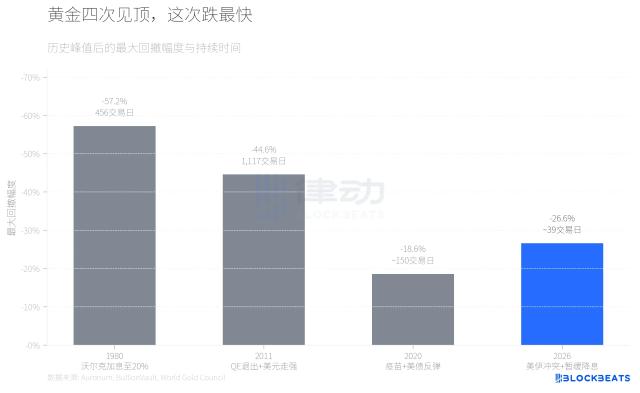
Just 57 days ago, gold was at its all-time high of $5,600. Since then, it has fallen by more than 27%, marking the most severe decline in gold prices since 1983.
Do you remember January 29th, when countless analysts around the world were shouting that "gold will break 6,000"? Little did they know that what followed was a massacre.
Gold bulls, none survived.
Those who used to flaunt their gold bars, show off their achievements, and post selfies on Xiaohongshu are now filled with lamentations.
The epicenter of everything is in the Middle East. The US and Israel's strikes against Iran have entered their 24th day. The Strait of Hormuz is closed, oil prices have broken $100, and the war is escalating.
War should drive up the price of gold; this is common sense accumulated by humankind over thousands of years. But this time, common sense has failed.
Many people attribute the cause to interest rates, the US dollar, stop-loss orders, etc. These are all correct, but the real problem may be that when a crisis comes and panic sets in, what institutions want is not to preserve value, but liquidity.
The gold you bought is no longer the gold you thought it was.
Is gold not a "safe-haven asset"?
Over the past three years, gold has risen from less than $2,000 to a record high, with a cumulative increase of more than 150%.
During the upward trend, the market has always had a ready-made explanation: risk aversion during times of turmoil, the collapse of the dollar's credibility, central banks in emerging countries increasing their reserves, de-dollarization... Each of these explanations is plausible on its own and quite inspiring.
However, this explanation cannot withstand data verification.
During the peak of US inflation in 2021 and 2022, gold prices fell for two consecutive years. After 2023, as inflation gradually cooled, gold prices began to surge. There is a strong negative correlation between the two: the higher the inflation, the lower the price of gold; the lower the inflation, the higher the price of gold. The saying "buy gold to hedge against inflation" has proven to be a contrarian indicator over the past three years.
The Federal Reserve's real interest rates have remained high over the past three years, and the textbook ironclad rule that "high interest rates suppress gold prices" has quietly become ineffective.
What's even more intriguing is the relationship between US stocks and gold. They almost go hand in hand, rising and falling together. One is a quintessential risk asset, and the other is considered a safe-haven asset; their correlation coefficient reaches an astonishing 0.7.
Putting these three sets of figures together, there's only one conclusion: gold is no longer part of that logical chain. It rises along with US stocks but moves inversely to inflation; it exhibits characteristics of a risk asset, not a safe-haven asset.
The real driving force
Who transformed gold into this?
There has always been a genuine demand: central banks in emerging economies. Following the Russia-Ukraine war, central banks in Poland, Turkey, China, and Brazil began large-scale gold purchases. This reflects genuine strategic reserve needs, not speculation, but rather a five- to ten-year strategic plan. However, central bank gold purchases are a slow process; they establish a bottom, but are not the main driver behind pushing gold prices from $2000 to $5626.
The institutions that jumped on the bandwagon were the ones that drove up gold prices.
They saw central banks buying and saw it as a signal; they heard about "de-dollarization" and thought the logic was impeccable; they saw gold prices soaring and felt it would be a loss not to jump on the bandwagon. Non-commercial net long positions, representing speculative activity, continued to climb, peaking at nearly twice the historical average.
But there is a less-mentioned structural problem hidden here: most of these positions do not actually correspond to physical gold.
Today's gold market is no longer the simple logic of buying one gram and storing one gram in your warehouse. COMEX futures, the London OTC market, gold ETFs, CFD contracts, crypto gold contracts… all sorts of derivatives are combined, and the daily trading volume of paper gold has long been dozens of times the annual global production of physical gold. Some studies estimate that for every ounce of physical gold on the market, there may be dozens of paper claims. The vast majority of these contracts are settled in cash and never involve actual metal.
The margin ratio for futures contracts is typically only 6% to 8% of the contract value, meaning that leverage of more than ten times is common. The London OTC market is even less transparent, with unsecured gold positions opened between banks essentially creating gold on paper.
This structure works fine in a bull market; leverage amplifies returns, making everyone happy. However, it plants a time bomb: once the price reverses direction, highly leveraged long positions are not forced to sell, but rather forced to sell because their margin is insufficient, leading to automatic liquidation without any room for negotiation.
Bubbles always look the same: real demand is the bottom line, a good story ignites the fire, chasing funds flock in, the derivatives market magnifies the chips ten or twenty times, and finally pushes the price to a level that real demand simply cannot support.
Gold is no exception this time.
War is the fuse, not the killer.
Why did gold prices fall when war broke out?
Because the war made one thing clear: interest rate cuts were out of the question.
With oil prices breaking $100, inflationary pressures have reignited, and the market has already priced in a 50% probability of a Federal Reserve rate hike. The core logic behind gold was originally betting on a low-interest-rate environment; low interest rates made holding non-interest-bearing gold profitable. Once this logic is reversed, gold's appeal is fundamentally severed.
The rise in the US dollar index is a dangerous signal. Since the outbreak of the war, the US dollar index has rebounded by nearly 2%, and global funds are flowing to the US dollar. As a dollar-denominated asset, gold has become more expensive for non-US buyers.
Then those 380,000 long positions started to sell.
But this time, the retreat wasn't just a voluntary withdrawal; it was more of a forced liquidation. When gold prices started to fall, highly leveraged futures accounts were the first to hit the margin warning line, and the system forced liquidation. The sold orders pushed down prices, and the falling prices triggered more liquidations, which in turn pushed prices down further. This was a self-reinforcing spiral, completely different in scale from panic selling by retail investors.
Stocks and bonds fell in tandem, forcing many investors to sell gold for cash; another group withdrew their money from gold and invested in the energy sector. Ordinary liquidations, leveraged margin calls, and liquidity withdrawal—three forces simultaneously converged on the same outlet.
This scenario is not unfamiliar. In March 2020, when the pandemic broke out, gold also experienced a flash crash. That time, no one said the logic behind gold was flawed; everyone understood: in the face of a liquidity crisis, there are no safe-haven assets, only cash. What you sell isn't important; what matters is being able to convert it into cash. No matter how precious gold is, it's still something you have to sell.
The underlying mechanism this time is not fundamentally different from that in March 2020. The only difference is that this time, gold is burdened with an additional layer; it is no longer a safe-haven asset, but a risky asset filled with speculative positions and derivative leverage.
A liquidity crisis compounded by leverage liquidation—two knives falling at once.
Two scripts
No one can give you a clear answer on what to do next.
The 380,000 long positions were not fully closed out, and gold fell below $4,200 today. From the price pattern, the bottom is approaching, but there is no reason to reverse.
If the war stops, there will be a rebound, but that will undoubtedly give those who are trapped in losses an opportunity to sell.
If the war continues, oil prices will not fall, inflation will not subside, and expectations of interest rate hikes will not diminish, and gold prices will continue to decline.
But history has also offered another scenario. During the oil price shock triggered by the 1979 Iranian Revolution, gold didn't fall; it rose from $226 to $524, finally reaching its historical peak in early 1980. The logic at the time was: persistently high oil prices and stagflation expectations completely eroded the dollar's credibility, leaving funds with nowhere else to go but to flow into gold. If this war drags on, inflation truly spirals out of control, and the Federal Reserve's interest rate hikes fail to save the economy, this path could very well repeat itself.
JPMorgan Chase and Deutsche Bank maintained their year-end price targets of $6,000 to $6,300.
But one thing is certain, regardless of the specific scenario, this round of crashes has proven: when a liquidity crisis truly arrives, no asset in the market is inherently immune. Gold and Bitcoin, no matter how compelling the stories have been for the past two years, all have to take a backseat to the phrase "I need cash."
Therefore, gold is now at a true crossroads. On one hand, the bubble is bursting, leverage is being liquidated, speculative funds are leaving the market, and gold prices continue to bottom out; on the other hand, the war is dragging on like a chronic disease, stagflation expectations are overwhelming everything, and gold is regaining its position as the "last bastion."
The quiet gold shops in Shuibei, the posts on Xiaohongshu asking "Can I still break even?", and the people who treat gold like a piggy bank—they haven't actually bought the wrong assets.
They simply believed a grander story at the wrong time; black swans always arrive when you're most excited.
The story isn't over yet; it's just that we don't know whether it will end up as a tragedy or a sequel.
Twitter: https://twitter.com/BitpushNewsCN
BitPush Telegram Community Group: https://t.me/BitPushCommunity
Subscribe to Bitpush Telegram: https://t.me/bitpush