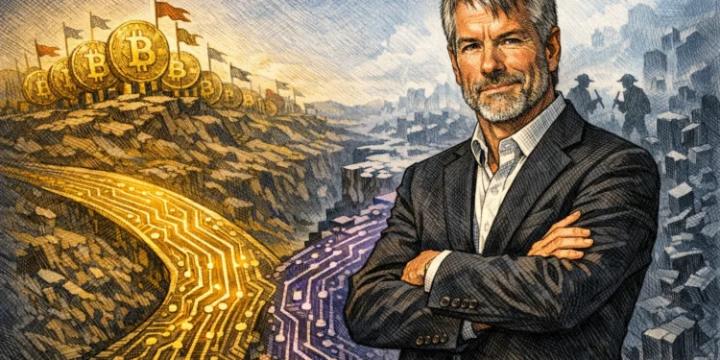
Bitcoin drops thousands of dollars whenever President Trump makes tough tariff comments on Truth Social. It falls when oil prices rise. It falls again whenever the Federal Reserve Chairman speaks. Whenever the numbers on the screen plummet, commentators in unison chant: "Risk-seeking sentiment in risk assets is at work."
That's true. But when it's repeated as the whole truth, we're missing something important.
Is Bitcoin truly being traded as Bitcoin in the market today?
This is the core issue.
Markets cannot tolerate complexity. Faced with assets that are difficult to understand, investors instinctively simplify them. It's convenient to categorize Bitcoin as a "risky asset." It rises with the Nasdaq and falls with any threat from Trump. This definition makes everything easier, from establishing positions and deciding on stop-loss orders to writing reports.
The problem is that the drawer is too small.
Bitcoin is not issued by any country or central bank. Its total supply is permanently fixed at 21 million coins. The "halving" mechanism, which reduces mining rewards every four years, is not related to human policy decisions but is inscribed in the algorithm. It operates on a network that is impervious to national borders, permissions, and censorship. This is a technological alternative to the financial system and a philosophical protest against fiat currency.
These characteristics will not disappear because of a single tweet from Trump.
However, the market forgets its true nature every day. No, not forgets, but deliberately ignores it. Algorithms will signal to sell Bitcoin when Nasdaq futures fall. Leveraged positions are liquidated, and prices fall further; prices fall further, panic spreads; panic spreads, and more sell-offs occur. After this cycle repeats several times, the proposition that "Bitcoin is a risky asset" will become as solidified as a self-evident truth.
This creates a peculiar paradox. Narrative creates prices, and prices, in turn, seem to prove the narrative. The market begins to believe that the story it has created is reality.
Economists call this "self-fulfilling expectations." But self-fulfillment is not permanent. When the gap between the story and reality exceeds a certain limit, cracks will appear without warning.
History has proven this. Throughout 2022, Bitcoin moved like a shadow of the Nasdaq. The "correlation of risky assets" was considered an ironclad rule. However, in early 2023, amidst a series of banking upheavals, Bitcoin rebounded strongly. As distrust of the traditional financial system intensified, the market suddenly rediscovered another side of Bitcoin. Only then did it realize that the "risky asset" category was not a suitable option.
That's the key point. The essence of Bitcoin hasn't changed. What has changed is the lens through which the market views it.
Every time the lens is changed, the price adjusts dramatically. During those adjustments, investors with incorrect positions suffer losses without even realizing it. This is because they have believed in the simple formula of "risky assets".
The narrative surrounding Bitcoin continues to evolve. At one point it was "digital gold," at another, a "speculative asset," and at yet another, an "asset integrated into mainstream finance." Each story contains a portion of the truth, but none of them represents the entirety of Bitcoin.
When the market focuses solely on one story, Bitcoin's other attributes fail to be reflected in its price. Only when reality betrays the story does the market belatedly rewrite the price. These are often the moments we call "booms" or "crashes."
As an investor, you must ask yourself this question: Am I trading Bitcoin right now, or the current narrative about Bitcoin?
The two may seem similar, but they are actually quite different.