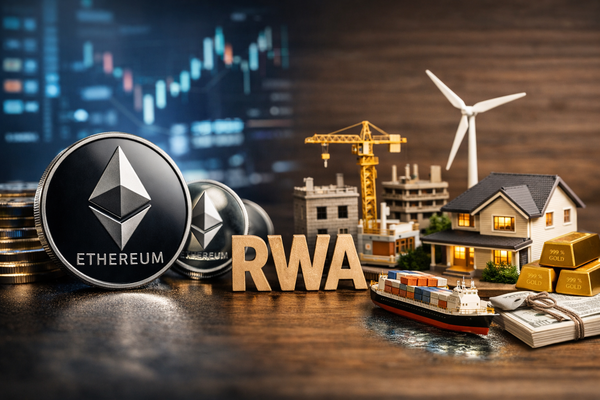
The Ethereum network has once again demonstrated its characteristics as a 'profitable chain.' Network fees reportedly surged by 36% as demand for Real-World Assets (RWA) and USDC-based payments increased. However, market interpretation is shifting, as this indicates a strengthening of the revenue structure driven by the expansion of actual financial activities, rather than just a simple increase in transaction volume.
This current trend differs in nature from the existing "speed competition" landscape. While Solana has previously driven transaction volume by emphasizing throughput per second and low fees, Ethereum is evolving to accumulate revenue centered on high-value-added financial activities such as payments, settlements, and asset issuance. In particular, the issuance of RWA tokens and stablecoin payments are areas where institutional funds flow in directly, characterized by demand that is more sustainable than short-term traffic.
The key is not 'how much is traded,' but 'what kind of money flows.' While memecoins or speculative trading can temporarily congest the network, they have limitations in terms of the quality and stability of earnings. On the other hand, RWA and stablecoin payments are connected to real economic activities such as government bonds, funds, B2B transactions, and international remittances, generating recurring fee revenue. This structure acts as a factor that enhances Ethereum's long-term earnings defense.
Ethereum's dominance in the RWA market remains evident as well. Amid the rapid growth of tokenized assets, it maintains its position as the underlying infrastructure of choice for institutions. This signifies that it is establishing itself as a 'payment layer for on-chain finance,' going beyond a simple blockchain platform.
On the other hand, Solana continues to maintain strong competitiveness. Based on low fees and fast processing speeds, it is attracting large-scale traffic and transactions centered on retail investors, while some stablecoin payments and institutional experiments are also ongoing. However, if the market gradually shifts from being volume-driven to profitability-driven, the gap between the two chains is likely to widen in the 'quality of earnings' rather than speed.
This fee hike carries significance beyond a short-term rebound. This is because the very competitive landscape of the blockchain industry could shift if RWA and stablecoin payments become widely adopted. Ultimately, Ethereum is being re-evaluated not as a "widely used chain," but as a "chain through which expensive finance passes," and this is highly likely to become a key criterion determining future capital flows in the market.