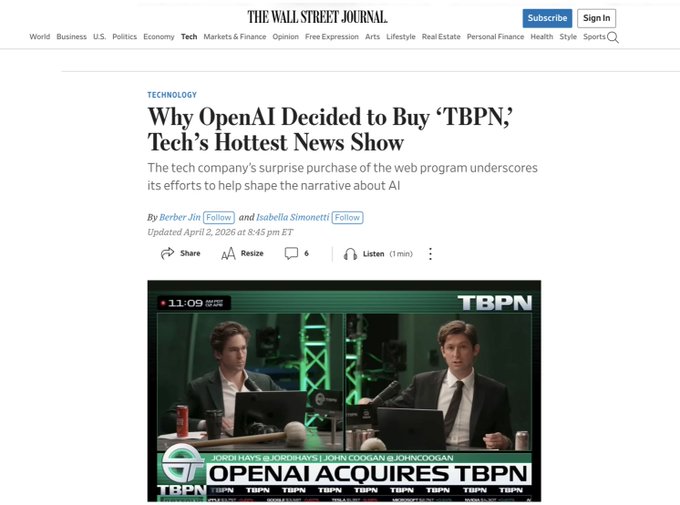
I woke up to the news of @OpenAI acquiring @tbpn for a few hundred million, and my first reaction wasn’t surprise, it was recognition. What they’ve built in ~17 months is not just a show, it’s a new primitive for how ideas get created, processed, and distributed in public. Most people will bucket this as “podcasting” or “media”. I think that misses the point. What TBPN really cracked is a format that sits at the intersection of three things that are becoming increasingly scarce in an AI-heavy world: taste, agency, and performative thinking. Let me explain what I mean. We’re moving into a phase where content itself is abundant. AI can generate summaries, scripts, clips, even entire personalities at scale. In that world, the value shifts away from production quality or access, and towards judgment. What to talk about, what to ignore, what questions to ask, how to react in real time, how to connect seemingly unrelated dots on the fly. That’s taste. Agency is about showing up consistently with that judgment, without hiding behind edits, without overfitting to what has worked before, and without waiting for permission. Live formats force this in a way recorded media never will. You cannot smoothen your thinking after the fact. You either have a point of view or you don’t. And then there is the performative layer. Not in the sense of theatrics, but in the sense of thinking in public with enough clarity and energy that other people can plug into your cognition. This is much harder than it looks. It requires conviction, context, and a willingness to be wrong in real time. When you combine these three, you get something that feels very different from traditional podcasts or interviews. You get a living system of ideas. That’s what TBPN built. If you’ve seen even a few clips of John Coogan and Jordi Hays, you’ll notice they are not trying to predict the future or narrate the past. They stay anchored in the present and keep peeling layers off what is happening now. The result is that even when you disagree, you feel like you’re participating in the thinking, not just consuming an output. Interestingly, they were always clear that this was not meant for a mass audience. The live viewership was relatively small. But the depth, the repeat consumption, and the downstream distribution made it disproportionately valuable. That trade-off, niche over scale in the short term, seems to have paid off. This is also the exact insight that pushed us at Offline to start @OfflineOnAir. @offline_members, at its core, is a community of founders who are building across very different sectors, but when you hear them speak in closed rooms, the conversations are far more nuanced than what makes it to the internet. Most public content tends to collapse into either storytelling or surface-level commentary. There is very little space for real-time, first-principles thinking about what is actually happening in technology and why it matters. We wanted to create a format that could capture that. Not just what happened, but why it happened. Not just who raised money, but where that money actually goes. Not just trends, but the underlying shifts in science and infrastructure that enable those trends. And importantly, we wanted to move away from heavily edited conversations that tend to converge to the same set of guests and the same origin stories. So TON became an attempt to build a high-signal, live, unfiltered layer on top of the ecosystem. Something that is closer to a working session than a polished broadcast. What we underestimated, at least initially, is how demanding this format is. Running a show like this is not just about turning on a camera and talking. There is a constant operational load. Sourcing and coordinating multiple high-quality guests every week. Staying on top of both Indian and global tech so that you’re not underprepared on air. Building the muscle to show up with energy and clarity irrespective of how your day has gone. Investing in the right tools and infrastructure so that the experience is not broken for the audience. And then everything that happens after the stream, editing, clipping, distribution, which in itself is a specialised function. We’re now 75 episodes in, with 150+ guests across founders, builders, and investors, and it still feels like we’re at the very beginning of understanding what this can become. Along the way, we’ve received a wide spectrum of feedback. Some of it is encouraging, some of it is fairly critical. People have pointed out issues with energy, with stream quality, with the format itself feeling derivative. Most of that feedback is directionally right. But this is the trade-off we’ve consciously chosen. To build this in public, without over-optimising for perception in the early days. To treat the show as a compounding system rather than a finished product. The reason this acquisition matters to me is not just validation of a format. It signals that platforms like OpenAI are starting to value not just content, but contexts where high-quality thinking happens consistently in public. If AI becomes the default layer for information, then human-led, taste-driven, real-time interpretation layers on top of that become incredibly valuable. We’re still very early in this shift. And if anything, this pushes us to go deeper, not broader. If you’ve been watching TON and have strong opinions on how it can improve, what it should do more of, or less of, I would genuinely prefer to have that conversation on the show itself. It’s a better medium for disagreement and refinement than comments or DMs. The space of new media is going to look very different over the next few years. For now, we’ll keep showing up, keep iterating, and keep thinking in public.
Sector:

From Twitter
Disclaimer: The content above is only the author's opinion which does not represent any position of Followin, and is not intended as, and shall not be understood or construed as, investment advice from Followin.
Like
Add to Favorites
Comments
Share
Relevant content