The six principles of cryptographic security systems proposed by Kerckhoff in the 19th century are still applicable today, and have had a profound impact on subsequent cryptography, open source movement and blockchain.
Written by: Peng SUN
Even if any details of a cryptographic system are known, it should be secure as long as the key is not compromised.
——Kirckhoff Principle
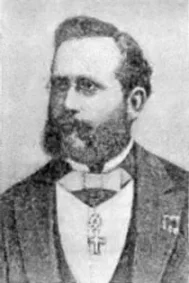
Fig. 1: Auguste Kerckhoffs (1835-1903), Dutch linguist and cryptographer
I. Introduction
As a human being, there will be secrets, and everyone should have their own privacy. But most people may be like me, it is difficult to control their privacy since they were young. Do you still remember when we had puppy love in middle school, we had to pass small notes to the people we liked many times a day, but some accidents would inevitably happen. For example, a piece of paper needs to pass through many hands before it can be passed on to oneself or the other party. During this period, the content of the small note will either be secretly read by the passer, or will be caught by the teacher during the pass. Once the content of the small note full of love words is seen by others, we will inevitably fall into embarrassment; if the teacher finds out, we will be criticized, written a review, and even brought to the parents. I believe that quite a few of my friends will have similar experiences.
If you can, who wants their privacy leaked? Someone might think of using tape to seal the small note, or clip the small note in the book. But in fact, this is a change of soup but not medicine. Once the number of times increases, everyone will always be aware of it. Some students will also think of encrypting the content of the small note, for example, "I miss you very much, let's go together after school", expressed in symbols that others cannot understand, is "BHLGDCMJBIFNAEK":

This is the method of classical cryptography, and the process of encryption and decryption is more artistic and interesting. However, in modern society the risks are greater. Because the frequent transmission of information needs to change different mechanisms, and each mechanism must be transmitted along with the small note, so it still won't have a good effect. If both parties use a complete symbol conversion mechanism, then within a certain period of time, humans or modern computers can crack it. Therefore, when using classical cryptography methods, the information in the communication process between the two parties is always transmitted in an insecure channel.
Is there a way to completely solve the problem of channel security? It is currently not possible, but if based on the assumption that the channel is insecure, modern cryptography provides "symmetric/private key cryptography" and "asymmetric/public key cryptography" to achieve the security of the cryptographic system:
The first is "symmetric/private key cryptography". Assume that there is a small safe specially suitable for storing small notes. Alice and Bob have assigned two identical keys for this purpose, and lock the safe every time after storing small notes. This small safe is arrived by many classmates Alice can use the key to unlock it in her hand, and then use the key to lock it after replying to the message, and then use the same key to unlock it after passing it to Bob, so as to ensure the safety of the message during transmission. But this method also has disadvantages, because the two people use the same key, if one of the keys is accidentally obtained by a rival, he/she can copy the same key, and then can communicate without the knowledge of both parties. Next, secretly check the information of both parties.
The second scheme is "asymmetric/public key cryptography". One weekend, Alice and Bob went to buy two sets of safes with the same mechanism, each with a public key and a private key. This public key indicates who is the owner of the safe, and the safe ensures that each small note cannot be taken out after being put in, and the safe can only be opened through the private key. When Alice wants to write a letter to Bob, she puts the small note into Bob's safe, and after passing it through many classmates, it reaches Bob's hands, and Bob uses his own private key to open the safe. During the entire communication process, no one can open Bob's safe except Bob who holds the private key, not even Alice. Conversely, if Bob wants to write to Alice, he just needs to use the safe with Alice's public key. After discovering the practicability of this cryptographic system, other students will also be interested. They can also buy safety locks with public and private keys. After that, everyone can happily use this cryptographic system for private communication.
This is the core point of modern cryptography: secrets and privacy must not be leaked because the cryptosystem is intercepted in the channel, and the security of the cryptosystem only needs to depend on the security of the key (in public key cryptography, it depends on the private key).
However, we are less aware of cryptography in our daily life, and usually come into contact with account login passwords of different information systems. But this type of password is just a user password that is easy for humans to read and remember, and the computer will use it to generate a more complex key in the sense of cryptography.
In fact, in modern society, the application of modern cryptography technology has invisibly penetrated into all aspects of daily work and life. Our various privacy, data and assets on the Internet are encrypted and protected by cryptography behind the scenes. For example, second-generation ID cards, anti-counterfeit train tickets/electronic invoices, bank cards/online banking U-shields, car smart keys, 4G/5G/WiFi, mobile calls, WeChat message transmission, voice/video calls, email, mobile payment, Internet Shopping, Baidu/Google/Alibaba cloud storage, HTTPS access to web pages, etc.
So, who was the first to propose such a cryptographic thought that has such a profound impact on modern society? Why was this cryptographic system designed?
Under normal circumstances, some people think of Shannon, the founder of modern cryptography. His " Communication Theory of Secrecy Systems " based on information theory uses "the enemy knows the system" as a security assumption when analyzing the security of a system. However, "the enemy knows the system" is just a refinement and summary of Shannon's predecessors' thinking. The real inventor is Auguste Kerckhoffs, a Dutch linguist and cryptographer in the 19th century. .
In early 1883, Kirkhoff published two reports entitled " La Cryptographie Militaire " in the "Journal des Sciences Militaires" (Journal des Sciences Militaires), establishing his status as a pioneer in modern cryptography in one fell swoop. . To this day, academic monographs and papers in the field of cryptography and network security are still citing Kerckhoff’s masterpieces, and Kirkhhoff can be vaguely seen on social platforms such as Twitter, Medium, and Reddit. Most of these literatures cite the six principles of cryptographic security systems proposed by Kirkhoff in "Military Cryptography" [10]:
- Even if it is not mathematically uncrackable, the system should be practically uncrackable;
- The system should not contain any confidential items, even if it falls into the hands of the enemy, it will not cause trouble;
- The key must be easy to communicate and memorize without having to write it down; and both parties can easily change the key;
- The system shall be capable of telegraph communication;
- The system should be portable and should not require two or more people to use it (should only be able to be used by one person);
- The system should be easy to use without taxing the user's brain or having to remember long lists of rules.
These principles are still relevant and instructive today. Among these six principles, the second one has been refined into the famous "Kirckhoff Principle". Although born in the telegraph era, the system-open cryptography principles he advocated are open and shared, and are fully applicable to the communication needs of computers, the Internet and the World Wide Web. Key cryptography, open source movement and blockchain and other technologies and encryption communities have had a profound impact.
As a link between the past and the future in the history of classical cryptography and modern cryptography, Kirkhoff's value is self-evident.
As early as 1998, Jean-Claude Ganac, an Esperanto enthusiast, wrote a biography for Kerckhoff ; in 2013, two cryptographers Remy Gros-Stewart and David ·Nakachi collected new archives on the basis of Ghanaco and wrote a new biography for Kerkhoff. His article " Kirkhoff's Legacy " introduced Kerkhoff's life more comprehensively and in detail. However, little is known about this achievement in the Chinese-speaking world.
Today, as cryptography enthusiasts, we have the responsibility and necessity to write the story of this great cryptographer. During the writing process of this article, we have communicated with the authors of the article "The Legacy of Kirkhof" by email on many historical and document issues. Husband's first-hand file information. However, this does not mean that the writing of this article can only be an imitation and plagiarism of previous research.
On the contrary, this article attempts to reorganize historical materials with new structures and perspectives on the basis of existing materials, break them into wholes, rewrite Kerckhoff, and introduce his life to a wider public. The difference from "Kirckhoff's Legacy" is that the former did not introduce Kerckhoff and cryptography, but this article will not only present the humanistic origin and political and social background of "Military Cryptography" to readers, but will also explain one by one Analyze the contributions of Military Cryptography and their connection to the application of cryptography in contemporary society.
2. Studies and careers: Kerckhoff's intellectual pursuit and enlightenment mission
Jean-Guillaume-Ulbes-Victor-François-Alexander-Augus, 19 January 1835, in the village of Nuss in the Duchy of Limburg (the largest town in the province of Limburg) in the Netherlands Jean-Guillaume-Hubert-Victor-François-Alexandre-Auguste Kerckhoffs von Nieuwenhof is born. Kerkhoff grew up in a family of social privileges. His father, Jean-Guillaume Kirkhoff, was the mayor, clerk and justice of the peace (juge de paix) of Nus at the time, and his mother was Jeanne. Tert Elizabeth Lintjens. [5] Most of his family members are doctors, doctors and government officials, with relatively high social status and cultural level (see appendix for details).
Kerkhoff has shown excellent IQ since he was a child, and his favorable family environment also allows him to wander in the ocean of knowledge without worry. Throughout his life, he never left his pursuit of intellectual life, and even shouldered the enlightenment mission of modern French education.
(1) Early Enlightenment of Modern Science
There are not many archival materials about Kerckhof's early years. The earliest began in 1847. At the age of 12, he studied in a boarding school in Rolduk, the Netherlands, for 5 years. Kerkrade municipal records show that Kirkhoff's final grades improved from sixth in his class in first grade to third in his class in fourth grade, earning a second or third every year. Scholarship, always among the best students in the class.
Childhood reading experience gave him a foundation of knowledge in mathematics, history, law and geography, while the gymnasium in Maastricht-sur-Meuse brought the 17-year-old Kirkhof into the palace of scientific knowledge. At the age of 20, Kerckhoff studied philosophy for two years at the University of Liège in Belgium. During college, he shortened his name to what we remember today as Auguste Kerckhoffs. At the same time, he was studying natural sciences in Leuven. By the time he graduated from university in 1857, Kerckhoff already had a good foundation in modern scientific knowledge, and his academic career had come to an end. [5]
(2) Feedback to society: the opening of a career as a professional teacher
Throughout Kerckhoff's life, an interest in language persisted. Although in his view, language is just a tool, he regards language teaching as his life's work. After graduating from university, Kerckhof went to the city of Eindhoven, where the Batavians (thought to be the ancestors of the Dutch during the Renaissance) lived, to start his career as a professional teacher teaching modern languages. In 1860, Kerckhof left Eindhoven to teach at a private institution in Meau, France, and spent a year studying in England to perfect his English. In 1863, after resigning from Meaux, he went to Melun as a teacher of English and German. On October 19 of the same year, he was appointed president of Mellon College.
In his first three years in Melun, the 30-year-old Kerckhoff was lucky enough to start his own family. He met a French woman named Marie-Emilie Twining, and the two married on July 5, 1864 in the 10th arrondissement of Paris, and their love was born on May 13, 1865, the The newborn baby girl was called Pauline. [5]
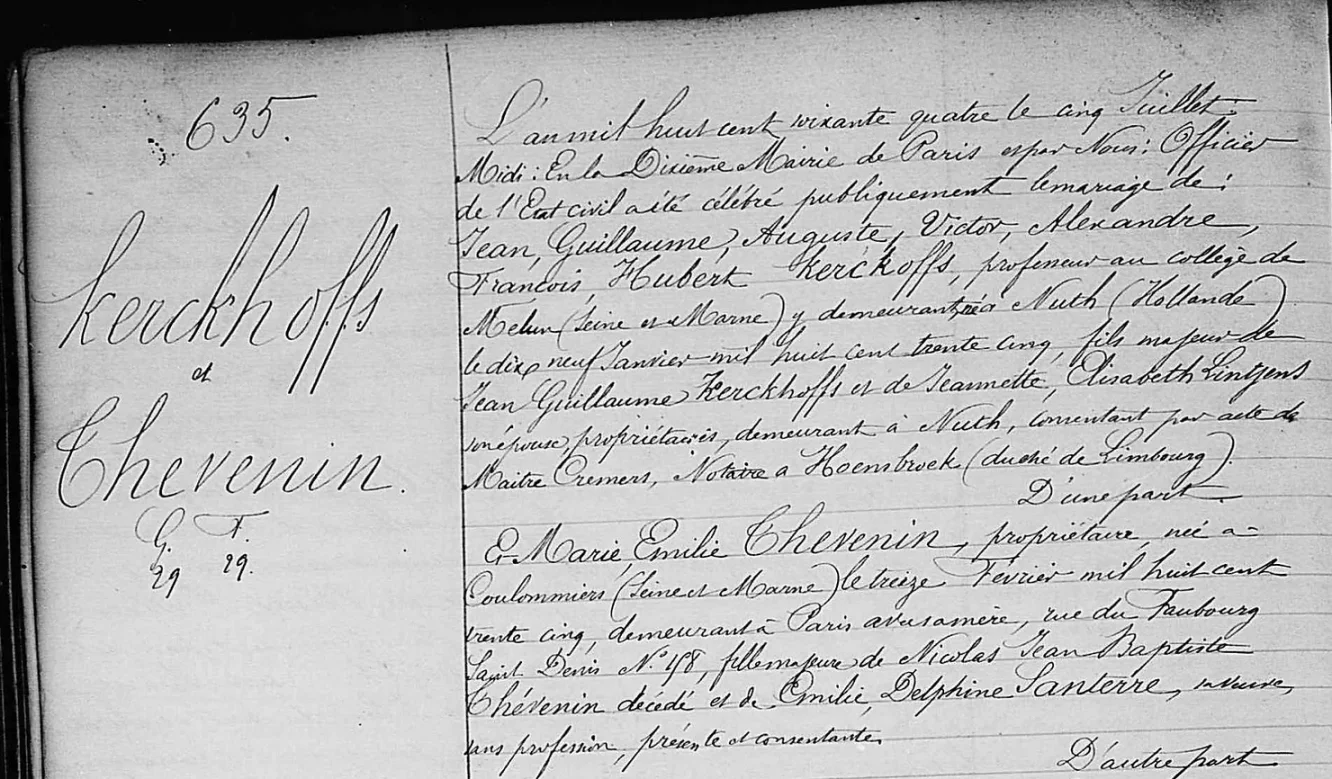 Fig. 2: Marriage certificate of Kerkchoffs and Tvigning in the Paris archives; image source: " Kerkchoffs' Legacy " written by Jean-Claude Caraco, Rémi Géraud-Stewart, and David Naccache.

Fig. 3: Pauline's birth certificate dated 13 May 1865 in the Melun Archives; image source: "Kerkchoffs' Legacy".
The family has not affected Kirckhoff's career and pursuits. During his ten years at Melun, he has been eclectic, combining intellectual pursuits with educational careers. On the one hand, he continued to learn new knowledge of modern and ancient languages, mathematics, history and archaeology; on the other hand, his enthusiasm and dedication to education were also completely released. He believed that education could help the French people to complete enlightenment, Toward modernity and science. Because in France at that time, education was dominated by the Catholic Church for a long time, and the Church was the ignorant embodiment of anti-modernity and anti-rationality. In 1867, the Provincial Council approved Kerckhof to offer free English lessons in Melun every winter. In addition, he was one of the main founders of Melun's "Society for the Encouragement of Education", and devoted himself to the post of "Secretary-Librarian" of the association with diligence and selflessness. [5]
The thriving career also made Kerkhoff's living conditions quite affluent. It is estimated that his annual salary working in Melun is about 2,000 francs, and his total assets reach 25,000 francs. At the same time, he can earn an additional income of 3,000-4,000 francs every year by letting students stay at home and teaching. [5]
(3) Dr. Kerckhoff: Continuing your studies and starting a new career
The achievements in his career did not stop Kerckhoff in his heart, after all, he is an intellectual with intellectual pursuits. Although he was able to teach his students German, his thirst for knowledge led him to study the more esoteric fields of linguistics. As early as 1871, he passed a competitive examination assessing his ability to teach German. In early 1873 he left Melun College to study classical German philology at the Universities of Bonn and Tübingen in Germany. In 1876, Kerckhoff graduated with a German Doctor of Philosophy and a Master of Arts degree. [5] In other words, Kerckhoff completed the master and doctoral training in two universities in three years, which is quite rare.
During his doctoral period, Kerckhoff's political and social status and honor in continental Europe also improved significantly. He was awarded the rank of Knight of the Portuguese Order of Christ for his mentorship to the young Count Rodrigo Pereira Felicio de San Mamede of the House of San Mamede, who was to become Secretary to the King of Portugal. From 1876 to 1880, Kerckhoff tutored two other children of the family, and was successively awarded the officer's badge of the Order of Christ and the Military Order of St. James of Portugal. [5]
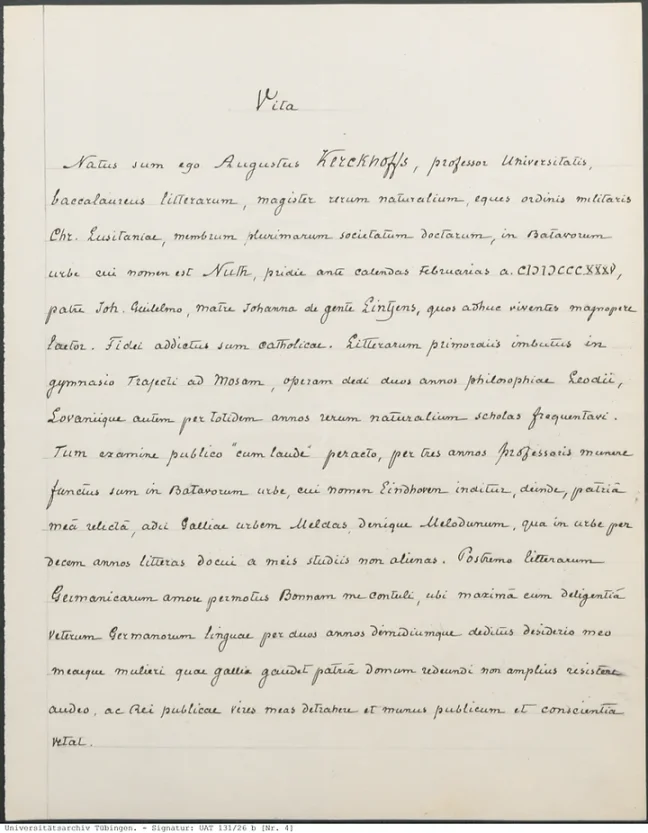
Fig. 4: Kerkchoffs' biography in Latin, 1876; image source: "Kerkchoffs' Legacy".
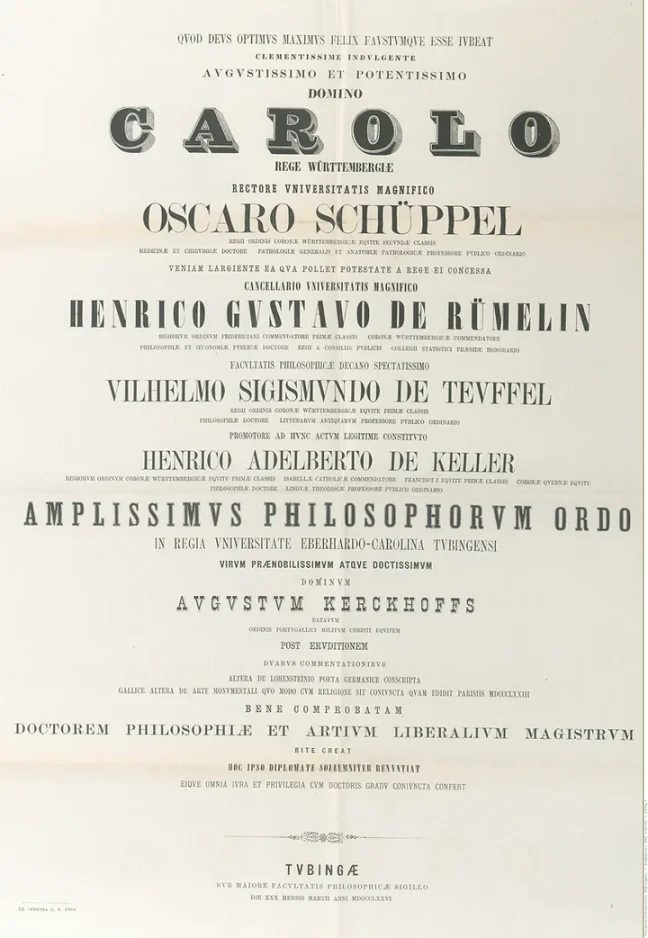
Fig. 5: Kerkchoffs' doctoral diploma; Image source: "Kerkchoffs' Legacy".
The addition of a Ph.D. helped Kirkhoff's career, and he went to teach at better schools. In 1880, Kerckhoff applied to be the head of the German Department of the famous French Military Academy Polytechnic, but he was not admitted because a staff member did not record that he had been naturalized as a French citizen in 1873. On November 1 of the following year, Kerckhoff was awarded the German chair at HEC Paris and taught at the municipal school of Aragon.
Kerkhoff did not stop. He still wanted to be a leader in modern French enlightenment education and hoped to get a German teaching chair in a normal school. However, this time he was not favored, and then he also left the Aragon School. However, luck finally came. In 1883, when Joufery, Prime Minister of the Third French Republic, promoted "free, compulsory, and secular" national education to realize the secularization of French education, Kerkhoff's long-term contribution to the "Association for Encouraging Education" and Melun Education For his selfless contribution, the French Ministry of Public Education awarded him the title of Academic Officer. [5]
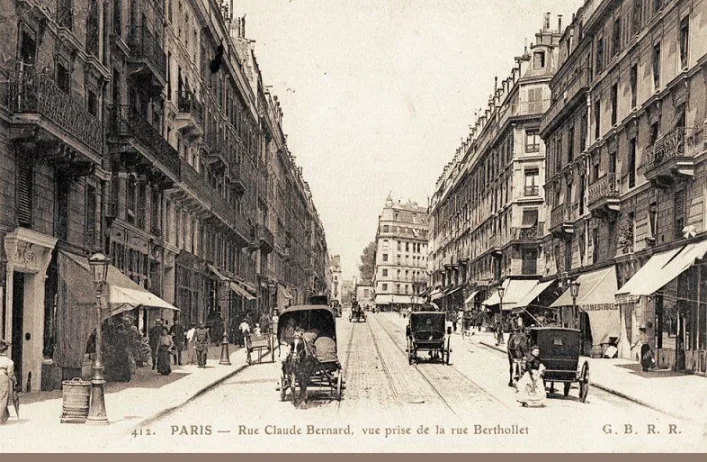 Fig. 6: Kerkchoffs lives at 62 Rue Claude Bernard in Paris (on the left); image source: "Kerkchoffs' Legacy".
(4) Joining the Mainstream Intellectual Circle: Kirkhoff's Academic Friends
In addition to the pursuit of knowledge and devotion to education, Kerckhoff's erudition-oriented intellectual life is also reflected in academic exchanges. He kept acquainted widely throughout his life, having corresponded with Victor Hugo as early as around 1860, and represented the local branch of the French Archaeological Society at the 1868 International Congress in Bonn, Germany. [5]
In 1883, Kerckhoff formally joined the Paris Anthropological Society. Founded in 1859, the society was the first academic society in the world to use the term "anthropology" with the goal of integrating science and philosophy, including medicine, paleontology, ethnology, archaeology, linguistics, sociology , psychology, and philosophy. The Paris Society of Anthropology adopts a membership invitation system, and most of the people who participate in club activities are doctors, linguists, paleoanthropologists, administrators, artists and other people with high social status. Remy Gro-Stewart said Kerckhoff may have been introduced by an acquaintance. More likely, he found himself interested in the topic of the Paris Anthropological Society and tried to find like-minded friends.
The development of the Paris Society of Anthropology reached its peak around 1880, and Kerckhoff's joining during this period clearly recognized more intellectuals and scholars. After that, Kerckhoff's intellectual pursuits had a broader space for development. For example, in 1873, Kerckhoff published the academic paper "Monument Art and Religious Thought" in the "Gazette of the Archaeological Society of Seine-Marne", but after joining the Paris Anthropological Society, he continued to publish in the "Paris Anthropology" within two years. Published 5 academic papers on archeology and anthropology in journals such as "Journal of Chinese Academy of Sciences". In addition to archaeological sophistication, linguists from the Paris Anthropological Society also contributed to Kerkhoff's Volapuk language, which will be mentioned later. [11]
3. The pioneer of modern cryptography: Kirkhoff and "Military Cryptography"
In the same year that he joined the Paris Anthropological Society, Kerckhoff published the famous "Military Cryptography". This paper plays a role in connecting the past and the future in the history of cryptography. It not only makes a systematic summary and analysis of classical cryptography, but also provides inspiration for modern cryptography born in the middle of the 20th century.
This chapter will start with the humanistic origins of cryptography and archaeology and the background of the Franco-Prussian War, and introduce the root of Kerkhoff’s research on cryptography. great contribution.
(1) Humanistic origins of cryptography and archaeology
Before the birth of modern cryptography, classical cryptography was more of an art and belonged to the category of humanities. For example, cryptography was also a topic of discussion at the Paris Anthropological Society at that time. From the beginning, cryptography has been closely related to text and language.
First of all, cryptography as a subject concept includes cryptography and cryptanalysis. Cryptography in the classical era was a product of military needs. The transmission of military secret information often uses a universally readable "Language" is encrypted into another text or symbol that is usually incomprehensible. Only by mastering this set of encryption rules/principles can the cracker interpret the true content of the text. This is a transformation between languages. For example, Julius Caesar's "Gallic Wars" mentioned the use of Greek letters instead of Roman letters to translate information into symbols that the enemy could not understand; al-Hikmah), many Arab scholars have creatively invented the deciphering unit by virtue of their high level of linguistics, mathematics, statistics and religious studies in order to study Muhammad's apocalypse and its chronology in the Qur'an. Frequency analysis of table ciphers. [2]
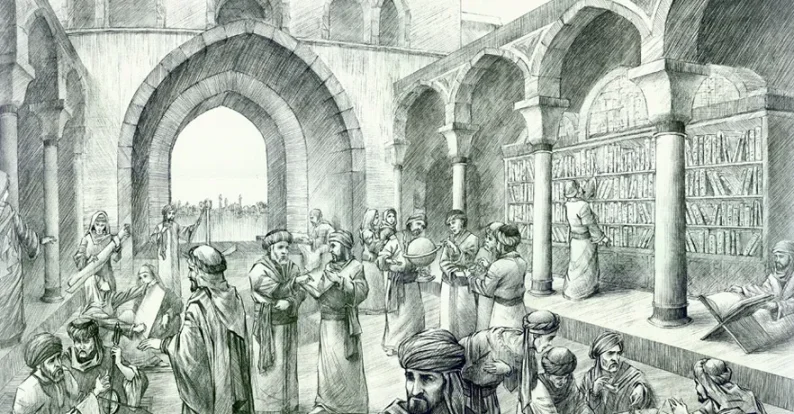
Fig. 7: The Arabian Palace of Wisdom, a medieval center of learning; Image source: Mvslim.com
By the end of the eighteenth century, cryptography's most romantic achievements in deciphering texts were inseparable from archaeology. In 1799, 154 French scholars accompanied Napoleon’s Egyptian expedition encountered the most famous Rosetta Stone in the history of archaeology. French linguist Champollion deciphered one of the world’s oldest codes—— Ancient egyptian hieroglyphs. After Champollion, archaeologists flocked to it. Sumerian and Babylonian cuneiform (Cuneiform) and Indian Brahmi (Brahmi) were deciphered one after another, and people's interest in cryptography is also increasing. [2] For example, Charles Babbage, who was the first to introduce mathematics into cryptography to decipher multi-table substituted ciphers, was interested in archeology, and Friedrich, who will also be mentioned later, also cracked multi-table substituted ciphers Kaszyski turned to archaeology after studying cryptography. [1]
 Fig. 8: Champollion's notes on deciphering hieroglyphics; image source: Ziereis Facsimiles
As can be seen from the above, Kerckhof was already involved in archeology in the 1860s. Therefore, whether it is Kirkhoff's personal linguistics skills or the overall development of French academia in the 19th century, Kerkhoff's interest in and research on cryptography is undoubtedly a matter of course.
(2) The direct impact of the Franco-Prussian War
It must be noted that Military Cryptography of 1883 was to some extent a product of patriotism and nationalism. This first goes back to the Franco-Prussian War in 1870. The root of the Franco-Prussian War was that Prussia under the leadership of Bismarck tried to unify Germany, which originated from the period when Napoleon ruled Europe, merging city-states and princes, sowing the seeds for the future German unified nation-state. However, the Prussian-Prussian War in 1866 made France realize that the process of German unification threatened France’s dominance in Europe, and some Prussian officials also hoped to arouse German nationalism through the war against France.
In 1871, the Franco-Prussian War ended with the defeat of France and the signing of the Treaty of Frankfurt (ceding the provinces of Alsace and the Moselle to Germany and paying 5 billion francs in compensation), and the German Empire, which was unified through the war, became the largest power in continental Europe. The shameful treaty of the Franco-Prussian war of land cession and indemnity deeply hurt the hearts of the French, and there was a strong revanchist sentiment in the country.
Although a rational intellectual, Kerckhoff lived in the geographic center of 19th-century Europe, influenced by the French Revolution and keen to invent the modern nation-state. He defined himself as a patriot, loyal civil servant and Catholic. [5] Therefore, whether it is active or passive, as a person in history, he cannot stay out of it.
In 1870, Kirkhof, who was working at Melun College, joined the French National Guard as soon as he learned of the war. Throughout the war he was "one of the staunchest men in prison service", defending Paris against the invasion of Prussian troops[5]. Perhaps Kirkhoff joined the National Guard without hesitation because he was applying for French citizenship four months before the war broke out.
As a first step towards naturalization, Kerckhoff wrote to the Minister of Justice on March 16 requesting that he be granted residency in France under Article 13 of the Napoleonic Code. On May 23, Kerkhoff received a letter allowing him to establish residency in France, but had to wait three years before applying for French citizenship. Therefore, Kirkhoff wrote to the Minister of Justice again on August 29, informing him that he had served in France for more than three years and that he could apply for French citizenship. [5]
The second investigation of him by the French government took place three years later. At this time, Kerckhoff was preparing to leave for Germany to study for a doctorate. There are relationships". But the administration clarified all that and praised Kirkhoff for his National Guard service. On November 19, 1873, the French Council of State decreed that "Mr Kerckhoff is entitled to the rights of a French citizen". [5]
In 1876, Kerckhoff was about to graduate and faced the choice of staying in Germany or returning to France. Although his love of the German classical language was a transcendent intellectual pursuit, he still claimed: "I cannot resist my longing to go home, nor my wife who loves her native France, and besides, I public office and my conscience forbids me to refuse to serve this country”[5].
Therefore, after returning to France, Kerckhoff began to contact the military.
Three years ago, when he applied for a PhD in Germany, he mentioned in his report to the French government that he learned German classical languages in order to be able to work as a German teacher at the French Military Academy. As mentioned above, he also applied for a professorship at the Military Academy as promised. Of course, it is also difficult for us to guess why a military academy needs a German classical language teacher. We also have no conclusive evidence to prove the relationship between Kirkhoff and the military, but some materials show that Kerkhoff can gain an in-depth understanding of the current situation and development of French military cryptography.
In Military Cryptography, Kerckhoff cites the "well-known" abilities of France's "one of the most talented cryptanalysts at the General Command of the Army," Henri Bertolt, during the Crimean War. This fact took place in the most secret department of the War Ministry, yet Kerckhoff was able to know Bertolt's identity in 1880 and comment on his talents. In addition, Kirkhoff also cited the example of the Havas telegram in 1882, which was encrypted and sent to the Cairo branch of the Havas News Agency in London, and the content was related to British military operations in Egypt. The telegram was not made public, and private sending and receiving of encrypted telegrams was prohibited at the time (commercial communications could also use encryption). The Havas news agency has a close relationship with the French Ministry of the Interior and enjoys exclusive means of communication and funding. Kerkhoff was able to know that this telegram also hinted at his background to a certain extent. The article "Kirkhoff's Legacy" makes more educated guesses about Kirkhoff's relationship with the military. [5]
The reference to Kerckhoff's relationship with the military is because France hastily established a modern military general staff after the war, modeled on wartime Germany, in which the "Military Statistical Office" (later changed to the Intelligence Bureau) specialized in collecting and measuring various intelligence. [9] The need for cryptanalysis of military intelligence was the driving force behind the development of French cryptography at the end of the 19th century, and Kirkhoff and the military's demands coincided with each other in cryptography. He keenly captures the communications element of France's defeat in the war:
As can be seen from the obituary published in 1879 in a German newspaper on the death of Captain Max Herring, the director of the telegraph office who discovered the Seine cable in 1870, the lack of a secure secret communication system between the army in Paris and the generals in the provinces caused the besiegers What a help. [10]
In fact, the "lack of secure secret communication systems" is due to the invention of the telegraph in the 19th century, which completely disrupted the way traditional military intelligence (especially cryptography) was communicated. The field cipher during the Franco-Prussian War still used multi-table substitution ciphers to make ciphers to encrypt military information. This encoding mechanism determines that as long as the enemy knows the working principle of these ciphers, all known ciphers at that time can be cracked.
The telegraph era has brought new eavesdropping media, and the transmission of intelligence will be intercepted and monitored more quickly and easily, and the code-breaking work after intercepting intelligence depends on the level of cryptanalysis. Prussia's instigation of war was a premeditated action, so it created a set of difficult-to-decipher coding works in advance, requiring field officers to learn to use codes, and established a powerful telegraph network in the country for intelligence interception. [5][6]
In cryptanalysis, the level of Prussia far exceeds that of France. This is thanks to Prussian military officer Friedrich Kassiski's 1863 book "The Code and the Art of Deciphering", which spends three-quarters of the book answering a question that has puzzled analysts for more than 300 years, namely, How to realize the general deciphering of repeated key multi-table substitution ciphers, and one chapter is dedicated to "French password deciphering". This book was dedicated to Prussian Minister of War Albrecht von Rohn, who was as important as Bismarck, Chief of the Prussian General Staff and Field Marshal Moltke at the time. Obviously, cryptanalysis entered the vision of Prussian high-level officials early. Seven years later the count's army defeated France[1]. On the other hand, although France has already used the telegraph, it has not paid enough attention to cipher coding and cryptanalysis.
(3) Contributions to Military Cryptography: A Guide to Modern Cryptography Encoding and Analysis
Kerkhoff broke away from his amateur interest in cryptography based on archaeology. He not only responded to the needs of French military cryptography after the war, but also directly faced the cryptography brought by the telegraph to communication in a more professional manner. new question.
The invention of the telegraph is the beginning of the information age [2], which realizes the instant and rapid communication of human beings. But at that time, people's understanding of field ciphers was still at the level of "it only needs to be able to resist deciphering before the command he sent is executed", which is completely unsuitable for the cryptography needs of the telegraph era, because "in the long-distance In correspondence, confidential matters often remain important beyond the date the message was sent”[10]. Kerckhoff once criticized this phenomenon:
. . . It amazes me that a most inexperienced analyst can discover the key in less than an hour for wartime cryptosystems taught and recommended by our professors and scholars.
This overconfidence in certain ciphers is difficult for me to explain, except that the disappearance of black rooms and the secrecy of postal correspondence have made cryptographic research stagnant; Exaggeration, combined with serious works without any technical aspects of deciphering, has largely contributed to our false perception of the value of cryptosystems. [10]
He directly pointed out the flaw of most cryptographic systems of the time: they could not provide strict guarantees of unbreakability. [10] Therefore, when other cryptographers were still discussing various cryptographic systems, Kirkhoff went straight to the theme of the times:
It occurred to me, therefore, that those interested in the development of military cryptography . [1]
In "Military Cryptography", he first proposed the difference between the general system and the specific key (the two have become the basic concepts of modern cryptography): all the time, "secret" (secret) refers to "the material part that constitutes the system". : password tables (tableaux), codebooks (codebooks) or various necessary mechanical equipment", rather than "the key itself" [10].
Contrary to the concealed security of this confidential system, the general system proposed by Kerckhoff is considered to be an open shared system, and people do not need to worry about the problem of secret leakage in the process of information transmission:
It doesn't take imagination and doubts about the innocence of employees or subordinates to understand that if a system that requires secrecy is in the hands of too many people, anyone who has been involved may compromise the system.
...
The executive branch […] must absolutely abandon secret methods and make it a matter of principle to accept only procedures that can be taught openly in our schools...and our neighbors could even replicate and adopt this if appropriate . [10]
This is the famous Kerckhoff principle - "Since any details of a cryptographic system are known, it should also be secure as long as the key is not revealed."
Kirkhoff believes that in a cryptographic system, the key is the lowest-cost secret element. Even if it is leaked, the difficulty of system recovery is very small. Because he regards telegrams and field ciphers as inevitable, and believes that any feasible cipher must be able to withstand a large amount of service pressure, and "any cryptographic method used for military purposes must be suitable for telegrams" [10].
He distinguishes between two systems, "one for the temporary communication of a few people, and one for the long-term communication of the chiefs of different armies"[10]. In order to meet the needs of such fast and fast communication, cryptography must minimize the recovery cost of the cryptographic system when it is leaked, otherwise human beings cannot generally enjoy a safe and durable cryptographic security system.
Obviously, the basic assumptions of cryptography put forward by Kerckhoff are based on the prediction of the long-term, remote, simple and reliable instant communication trend in the future, although he did not realize that this is exactly what computers and the Internet have been since the 20th century. , the basic requirements of the World Wide Web era.
The principles of cryptography proposed by Kerckhoff actually started a movement that lasted nearly a century. Symmetric key encryption, one of modern cryptography, realizes the communication between the public and the communication parties using a common key, and the birth of public key cryptography in 1976 brought this century movement to its peak, that is, the secret of the cryptographic system Partially reduced to a minimum, the public key can still be made public, only the private key is kept secret. [8]
Of course, it can be seen from the third principle "both parties can easily change the key" proposed by Kerckhoff. His basic assumption is single-key encryption, and he does not realize that public-key encryption can be realized. However, he pointed out that "the key must be easy to communicate and remember, without having to write it down", which still has reference and guiding significance for the encryption industry. Although the private key has been represented by a human-readable mnemonic, it is still not easy to remember and must be written down. If a breakthrough can be made on this issue, the security of the private key and assets on the chain will be better Assure.
As a pragmatist, Kirckhoff based the secrecy of the ciphertext entirely on the secrecy of a key that is easy to remember and modify, but he realized that under the conditions at the time, it was necessary to imagine a Crackable systems are impossible, so systems that cannot be cracked in practice are sought. He paid more attention to this practical security than to mathematics. [10]
Kerckhoff's insight on this point is still used by modern cryptographers. For example, the ECDSA and Schnorr digital signature algorithms successively used by Bitcoin are both based on the "discrete logarithm" assumption. This difficult assumption assumes that there is no polynomial-time algorithm for solving discrete logarithms in a particular group. Therefore, the security of this cryptographic scheme is based on the insolvability of the "polynomial time" algorithm rather than the "arbitrary" algorithm. This is a concrete manifestation of the "practical security" principle pursued by Kerckhoff.
In addition to proposing the basic conditions of encryption, "Military Cryptography" is essentially a cryptanalysis manual, and the whole book is justifying the name of cryptanalysis. [1] In terms of specific cryptanalysis methods, Kirkhoff found that attempts by contemporary cryptographers to demonstrate the rationality of cryptographic systems through mathematical proofs had repeatedly failed, so he found another way and proposed a method of attacking through cryptanalysis. to test the security paradigm of cryptographic systems. [14]
Kirkhoff believes that only cryptanalysts know the security of a cryptographic system, and only deciphering can effectively test the secrecy performance of a cipher. In his view, cryptanalysis is the only way to the bright avenue of cryptography, and only through the difficult and steep road of cryptanalysis can one reach the truth of the cryptosystem. [1]
He established cryptanalysis as the only reliable test of military codes, a test that continues to this day. The most famous practical example is the open source movement at the end of the 20th century. As one of the main leaders, Eric Raymond (author of "The Cathedral and the Bazaar") reformulated the Kerckhoff principle: "Any No secure software design can be trusted without assuming that the enemy has the source code; therefore, never trust closed source code” [13]. Since then, all civilian cryptographic algorithms under the influence of the open source movement have followed Kerckhoff's principle of system disclosure, because only after numerous attacks from an open and active community of hardcore cryptographers, this cryptographic algorithm will be considered safe. [8]
At the same time, Kerckhoff's principle has become a common measure when security problems arise in the system. For example, on May 15, 2004, a hacker broke into Cisco's internal network, stole the source code for IOS router firmware, and distributed it online. The code leaks could mean "an incoming wave of vulnerabilities targeting the Internet's critical router infrastructure," Ramon wrote in an email. Therefore, whether it is a network security expert or an ordinary user, everyone is most concerned about whether IOS follows the Kerckhoff principle. In Ramon's view, "if Cisco ignores the Kerckhoff principle, users will pay the price", but if "IOS is open source from the beginning, we have a solid basis to believe that it passes the Kerckhoff test -- Open source makes you honest". [13] Similar events continue to drive users to check the product code, which is Kerkhoff's precious legacy to modern society.
Of course, Kerckhoff did not stop. He also contributed two cryptanalysis methods, the overlap method and the bit symmetry method, to later generations of cryptanalysis. Subversive, but they still play a pivotal role in much of modern deciphering. [1]
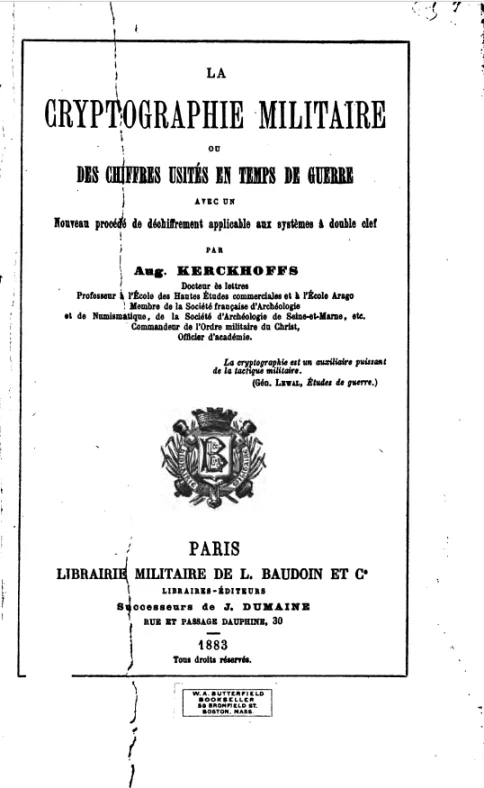 Fig. 9: Kirkhoff's "Military Cryptography" published in 1883; Image source: Harvard University
"Military Cryptography" is known as the most concise cryptography work in history. Kerkhoff condensed all the known knowledge of cryptography at that time into this small book of only 64 pages.
The book quickly became a reference after its publication, and the vengeful French Ministry of the Army bought 300 copies as a must-read, and continued to develop new ciphers under the guidance of Kerckhoff's principles, aiming at even if the opponent knew the encoding and decoding algorithms Also resistant, but simple enough to explain and teach to military personnel. [1]
From 1883 to 1914, 24 works and pamphlets on cryptography were published in France. These French cryptography works highly praised Kerckhoff's "Military Cryptography". As a loyal fan of Kerckhoff, Artillery Major Joseph condensed the six principles proposed by Kerckhoff into one criterion: "accurately "The military cipher must employ a system requiring only pen and paper," which seems to have dictated the choice of field ciphers in France before World War I. Interestingly, due to the frequent quotes from Kerckhoff, Joseph felt compelled to insert the phrase "Mr. Kerckhoff, whose name is frequently used in cryptography" after a long quotation as an apology. [1]
It can be said that under the direct influence of Kerckhoff, French cryptography entered a golden age of comprehensive revival before World War I.
4. Kirkhoff and Volapuk: Carnival and Elegy for Cosmopolitans
Among the legacy left by Kerckhoff, the Volapük language is often neglected, but Kirkhov was deeply involved in this Esperanto movement, and has successively experienced the cosmopolitan Carnival and Elegy.
(1) Collusion: The Cosmopolitans Unanimously
Volapuk was first invented in May 1879 by a Catholic priest named John Martin Schleyer. It is said that one day, Schleier heard from a neighbor that all the letters he had sent to his son in the United States had not been delivered. After investigating, he learned that the post office rejected all letters because Schleier could not write in English. Both recipient addresses are misspelled. This event inspired him to create a new language with simpler spelling rules that could be used around the world. [7]
According to Schreier's notes, he learned more than 80 languages and could speak nearly 50 languages, not only European languages, but also Asian languages such as Japanese and Sanskrit. Accordingly, Schleyer decided to base the new world languages on what he considered the six major "cultural languages" of the world, including English, German, French, Spanish, Italian, and Russian. [7]
In 1880, the first Volapuk textbook was published, and the new language was called "the world language": "vol" stands for "world" and "pük" stands for "language" (language), this is the first great attempt of mankind to unify the world with a man-made language. [7]
Kerckhoff was also a cosmopolitan at heart. Although "Military Cryptography" is to some extent a product of nationalism and has borne the fruits of nationalism, from the perspective of cryptography itself, the general system proposed by Kerckhoff is more open and international. This is also the origin of the cross-century combination of cypherpunk and Kerckhoff principles in the second half of the 20th century.
Kerckhoff was born in the Netherlands, studied in Europe, settled in France, and mastered English, modern and ancient German, Dutch, French and other European languages. His life journey and pursuit of knowledge and truth are cross-border of. The emergence of the Volapuk language touched Kerkhoff’s ideals of cosmopolitanism and internationalism. In 1884, 49-year-old Kerkhoff joined the Volapuk language movement after the publication of "Military Cryptography". Become a Volapukian.
(2) Carnival: From Europe to the World
The year Kerckhof joined Volapuk coincided with the first Volapuk Congress, when only 150 Volapukists gathered in the German city of Friedrichshafen. In 1885, Kerkhoff established the French Volapuk Communication Association, which gathered more than 50 very famous social figures, including scientific circles, government officials, artists, journalists and industrialists, and opened up this The prelude to an Esperanto carnival. Promoted by famous newspapers such as "Times", "Little Daily" and "Liberty", the Wallapuk language has become popular in France, not only among intellectuals, but also at all levels of society, and even people can be heard on the street. Speak Volapuk. From France, Volapuk spread to Spain, Portugal and Belgium. [5]
Perhaps it is the commercial orientation of HEC Paris, or it may be the continuation of the pragmatic spirit in cryptography research. Kerkhoff has shown the instrumental rationality of pragmatism in the Volapuk movement from the very beginning. In July 1885, Kerckhoff published "The Universal Trade Language Volapuk". That same year, in his speech at the opening of HEC Paris's Volapuk course, he emphasized the significance of the colonial-era lingua franca for modern business:
Just as diplomats have a common or common language in their international dealings, so scholars, travelers and businessmen will find an easy and practical means of communicating with the different peoples of Europe and with all the civilized nations of the world Useful.
Everyone knows that doing business with foreigners is very easy and safe because agreements can be made more clearly and precisely in a language that both contracting parties know. Yet it is easy to overlook the fact that, out of the eight hundred or so languages currently in use, it is necessary to know at least forty or fifty in order to maintain communication with the major civilized nations, and that during the past half century railroads and Steamboats have kept us in constant communication with these countries.
Now, if it is not difficult to learn three or four Roman or Germanic languages in a few years, it will take much longer to master one Indian or Semitic dialect. These difficulties are even insurmountable for many if agglutinative languages like Turkish or Japanese, or monosyllabic languages like Chinese or Annan, are taken into account; still account for one-third of the world's total population.
The situation was even more embarrassing for Eastern countries when they wished to do business with Europe. Lacking knowledge of geography and not being fully informed by their political leaders, they often had to resort to the mediation of colonizers or settled foreigners, thus falling victim to machinations fueled by political and religious animosity.
The situation changes entirely if a common language is adopted; the same traveler can visit vastly different countries, the same business magazine can be read and understood in all centers of production and consumption, London or Paris house prices will be replaced by Beijing, Edo , Madras, Alexandria, Constantinople, and Moscow merchants![5]
As a very Zeitgeist, Kirkhoff regards Volapuk as a simple and practical business-oriented language, rather than an aesthetic and intellectual language advocated by scholars such as Schleier. build.
In other words, since the Age of Discovery, mankind has been connected as an unprecedented whole under the global expansion of colonialism in the 19th century, and Kerkhoff hopes to use Esperanto such as Volapuk to break the language gap of the Tower of Babel. To achieve a broader and unified world in an era of rampant socialism. To this end, Kirkhoff spared no effort to promote the Volapuk language. At the same time, he successively published "Complete Volapuk Course", "The First Elements of Volapuk", "Concise Grammar of Volapuk", "French-Volapuk Bilingual Dictionary" and Works such as "A Strict Review of Some Simplification Measures That Should Be Introduced in the Volapuk Language" have lowered the learning threshold of the Volapuk language.
By July 1887, the second Wallapuk Congress was held in Munich, which was well attended and for the first time welcomed truly international visitors. In order to continue the development of the Volapuk language movement, the Congress established the International Wallapuk Language Academy, consisting of 29 members from 15 different countries, with Kirkhoff serving as president. Under this influence, the Volapuk movement reached its peak in 1888. In this year, 182 Volapuk textbooks were published, and the publication rate reached one book every two days. By 1889, 25 Wallapuk or related periodicals were published around the world, and 283 Wallapuk clubs organized meetings. [1]
In August 1889, Kerckhoff hosted the third Volapuk Congress in Paris. Volapuk is still the language of communication at the Congress, and waiters and doormen also use Volapuk comminicate. The Paris World Expo held at the same time witnessed the peak of the Volapuk language movement. Kerkhoff also gave a free lecture on the Volapuk language for the exposition on behalf of the Paris Anthropological Society, that is, "Wola in 12 languages. Volapük grammar in 12 languages.
Interestingly, the wife of then US President Grover Cleveland named her dog "Volapük". The Volapuk language has an equally profound influence on young students. According to Kerkhoff’s letter, he has given 5 lectures on the Volapuk language at HEC Paris. Both expressed their “hope to show their family members their certificates” because “having a diploma in the Volapuk language is the most meaningful”[5].
In just a few years, under the leadership of Kerkhoff and others, the Volapuk movement spread from Germany and France to other European countries and gradually blossomed all over the world. It developed from a community of only 150 members at the beginning to a community of 21 at its peak. A huge organization of thousands of fans. For Kirkhoff, the real carnival is this universal acceptance of the Volapuk language. .

Fig. 10: The International Volapük Academy, 1887, with Schleier in the middle of the picture and Kirckhoff's photo on Schleier's right. Image credit: "Kerkchoffs' Legacy".
(3) Elegy: Tearing from within
However, the heyday also means the beginning of decline, the carnival will eventually end, and the death knell will sound the elegy.
First of all, as a cosmopolitan and a main leader of the Volapuk language movement, Kirkhov has always been besieged by nation-states. There is a tension between modern French state-building and the state's model of social organization.
From 1879 to 1899, the French Third Republic was governed by moderate republicans (also known as opportunistic republicans, Républicains opportunistes) for a long time, and successive governments have been cultivating "republican patriots". After the Franco-Prussian War, competition among nation-states was fierce, and nationalism and patriotism became mainstream thoughts in Europe. The French state and HEC are therefore particularly sensitive to cosmopolitan movements that transcend nation-state borders. In an 1889 letter to the business school, Kirkhoff stated that he had "never encouraged any student to attend any form of lecture in the Volapuk language," and further stated that he "carefully avoided any action". He was "determined to avoid any disputes with the government" and even promised "if the government agrees, I will completely withdraw my support for the Volapukists"[5].
Second, it arose out of the conflict between Schleyer, who wanted to create the richest and most perfect literary language, and Kerckhoff, who wanted to mold it into a simple and practical language of business and science.
In fact, Kerckhoff's grammar book deleted the traces of Schleier's mother tongue German in Volapuk from the beginning, but Schleier believed that he was the father of Volapuk, and he should reserves the right to make any changes.
The conflict between the two intensified until the contradiction became public in 1889, and the Volapuk language movement was divided into two opposing groups: the conservative group dominated by Schleier and the reformist group dominated by Kerckhoff. Thereafter, the two factions each elected members of the Volapuk Institute. When Kerckhoff decided to convene a third Wallapuk Congress in Paris to allow academia to freely decide on the reforms needed, Schreier immediately declared the Congress and its future decisions null and void. Schleier also invited scholars from his own faction to a conference in Almendingen on May 12, which approved only a small number of changes requested by the reformers.
However, due to the conciliation of the American Volapuk activist and diplomat Charles Sprague, the third Volapuk Congress chaired by Kirkhoff did not achieve fundamental reforms in the Volapuk language. But calls for internal reforms have grown louder. In 1890, Kerckhoff published a complete "regular grammar" which caused an outcry from conservatives. In response, Schleyer founded a new Volapuk Institute and later removed Kerckhof from the list of Volapukists. [5]
This radical act caused great damage to the reputation of the Volapuk language in European countries, and although it flourished in the United States and other non-European countries, by the end of 1891 the Volapuk movement had lost three-quarters of its members . Internal disintegration, fragmented consensus, and national pressure have finally brought Kerkhoff, 57, to despair.
In 1892, Kirkhof left the Volapuk Institute and also the Volapuk language. It is embarrassing that in 1902, only 159 people remained in the Wallapuk communication directory, which once had 210,000 people. [5]
Hey! Consensus is as difficult as going to the sky!
5. Aftermath: The Last Ten Years of Kirckhoff
Perhaps because of the disillusionment of the Volapuk cosmopolitan ideal, Kerkhoff was full of depression. When the Minister of Commerce commissioned him to administer a German-language questionnaire for HEC's final exams, Kerckhoff publicly criticized the way the Ministry's examiners carried out the task, a move that led to the termination of his contract with HEC in 1891. Failed to renew.
Subsequently, Kerckhoff obtained a German teaching chair at the Lycée Mont-de-Marsan in Aquitaine, France. The superior leaders of this middle school commented on him: "The knowledge is extremely extensive, and the teaching methods are flexible, rigorous, and accurate. This is rare for a person with such a wide range of interests." [1] In order to be closer to Paris, Kerkhoff also On September 16 of the following year, he moved to a high school in Lorient, Brittany, to teach German.
However, Kerckhoff does not seem to have completely severed its relationship with the Volapuk language. It is related to the major political and judicial scandal (Affaire Dreyfus) in the French Third Republic at the end of the 19th century. In this incident, due to the collusion between the military and the court, it caused strong public dissatisfaction. The anti-Semitism reflected in the incident tore the entire French society into two extreme camps.
Driven by an unadorned sense of justice, Kirkhoff also signed a petition:
The undersigned are protesting in the name of forgotten laws against the pursuit and persecution of Colonel Picard, a hero who advocated for a retrial. [5]
At the same time, Kerkhoff, a "patriot of the republic" who has long accepted the leadership of the republic, also strongly opposes anti-Semitism. He links anti-Semitism with the Volapuk language created by Schleyer to express his position:
In our opinion, words like yudanæn, meaning Jewish [the derogatory Judeln in German], should even be banned from Volapuk; we want nothing to do with anti-Semitism! [5]
Because of his public actions in the Dreyfus affair, Kerckhoff was rated by the headmaster as a "very distinguished" and "conscience" man.
In 1899, Kerckhoff contributed his last small contribution to French cryptography, giving two years of public lectures on cryptography at the National Institute of Documentation. In 1900 Kerckhoff returned to Paris and continued to work as a teacher of German.
On August 9, 1903, when the 68-year-old Kerckhof was on vacation in the Swiss town of Deligen, he wanted to say hello to an acquaintance on an upcoming train from the station, but was unexpectedly snatched away by the train life.
Kerckhoff is buried in the permanently chartered Cimetière du Montparnasse, south of Paris. On May 12, 2020, when Remy Gro-Stewart and David Nakach visited the cemetery, they found that the ancient tomb was extremely simple, unattended and unattended, so it represented the international community. The cryptography community has rebuilt Kerckhoff's tomb. They also formally brought the historical significance and importance of Kerckhof's tomb to the attention of the French authorities in order to avoid its future recovery. [5]
 Fig. 11: Kerkchoffs' burial certificate (no. 646); image source: "Kerkchoffs' Legacy".
Fig. 12&13: On May 12, 2020, Remy Gero-Stewart and David Nakach, on behalf of the international cryptography community, reconstructed Kerkhoff's tomb
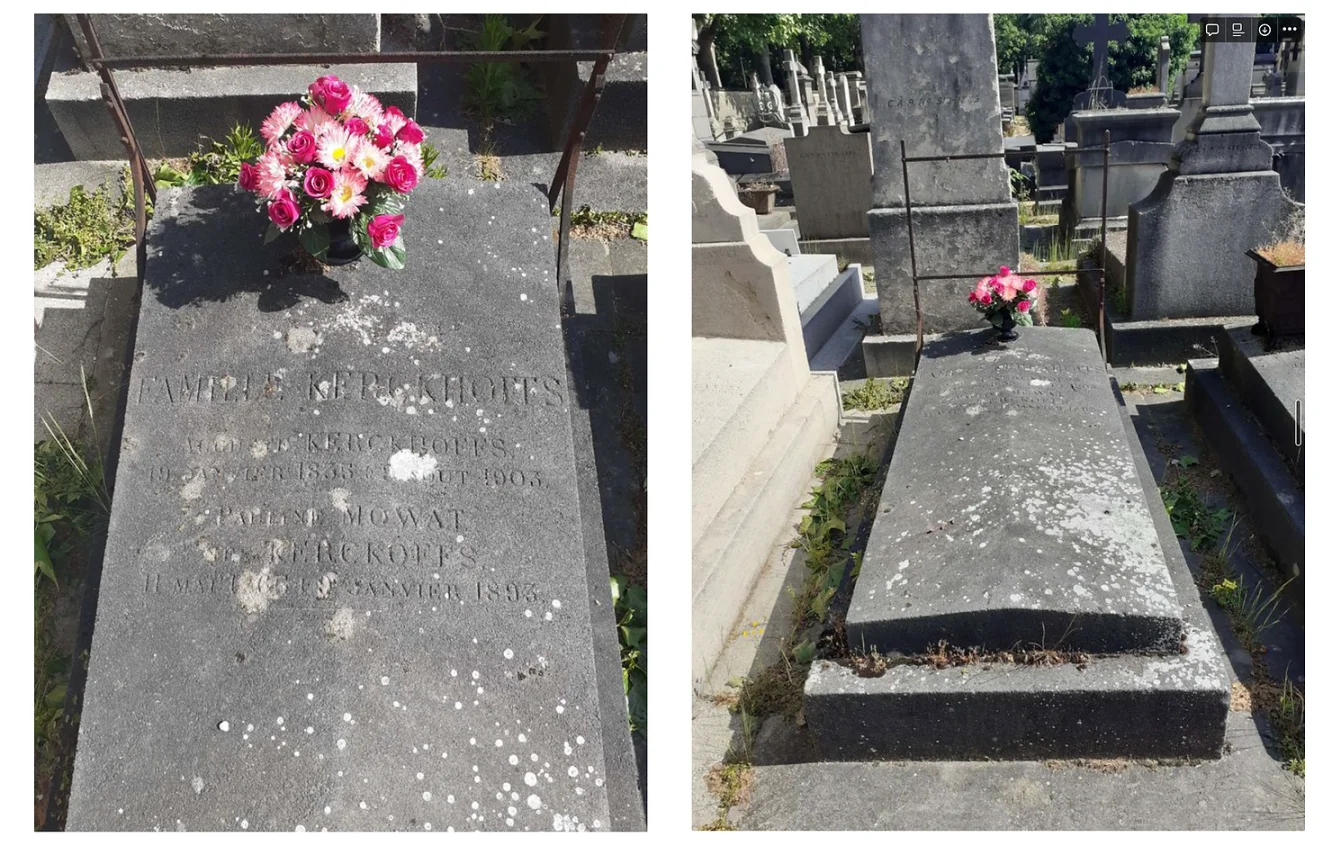
Image credit: "Kerkchoffs' Legacy".
Kerckhoff belongs to the generation of generalists. As an intellectual seeker, in the 19th century when subject specialization was just formed, his thirst for knowledge prompted him to straddle the "two cultures" of science and humanities, and his yearning for knowledge and truth was transcendent. At the same time, his insight into things also has the instinct to transcend the times. While responding to the plight and needs of the times in his life, he entrusts his transcendent ideals in it.
Of course, some people may regret that a person with cosmopolitan ideals is still trapped in the shackles of modern European nationalism and nation-state construction, but we should still have "sympathy for understanding" of history—nationalism and cosmopolitanism are both The embodiment of the zeitgeist of the 19th century. Kerkhoff is a man full of tension. It is precisely because of the nation-state, a powerful ruling machine, that he can demonstrate the value of his thoughts beyond narrow nationalism.
The Esperanto movement more than a century ago has long been ignored, but the cryptography thought that still contains Kerckhoff's cosmopolitan ideal shines in later generations. From "Mathematical Theory of Communication" to "New Directions in Cryptography", from Bruce Schneier to Eric Raymond, Kerckhoff's principle not only guides the development of modern cryptography, but also provides a basis for the development of modern cryptographic systems. Safe escort.
Going back to the beginning of the article, if you could go back in time, would you be willing to learn a cryptography method and communication method that conforms to Kerckhoff’s principles to communicate with your favorite people? Isn't this Kirkhoff's beautiful vision? He stated in "Military Cryptography" that if the system's open cryptography principles are adopted, "our students will freely communicate with whomever they like" [10].
Acknowledgments: This article is one of the special research results of the project "Looking for Cypherpunks" funded by Primitives Lane. Special thanks to Mr. Yao Xiang, the initiator of Primitives Lane, Mr. Liu Feng, partner of BODL Ventures, and founder of Ambi Lab Thanks to Mr. Guo Yu and Kurt Pan, Ph.D. in Cryptography from Fudan University for their careful review and valuable suggestions. Thanks to Raphina from Yuanyu Lilong for providing a lot of help during the writing process of this article! The writing of this article would be unimaginable without you. At the same time, Dr. Rémi Géraud-Stewart and Professor David Naccache of th