Bubbles are a feature, not a bug.
Written by: Joel John
Compile: 0x11, Foresight News
It's been a tough few months, and going to work every morning feels like a battle. Having worked in the financial sector this past quarter, many of us may have begun to understand why our predecessors preferred low-paying "stable jobs" in government. One of the largest crypto exchanges is out of business, token prices are down 90% from all-time highs, and dApps may have fewer than 100 average daily active users. It all makes people suspicious...
Did cryptocurrencies fail?
I’ve spent the past few weeks trying to understand where cryptocurrency as an asset class stands, how it relates to past emerging technology cycles, and what’s next for us. A good friend of mine, Roby John, suggested that I read Carlota Perez's Technological Revolution and Financial Capital to find out. So today's post summarizes my thoughts and observations from the past six weeks. I will post a summary of the notes from the book later. But for now, I'm going to try to use what we've gleaned from similar bubbles in the past to understand what's going on in cryptocurrencies.
understanding bubble
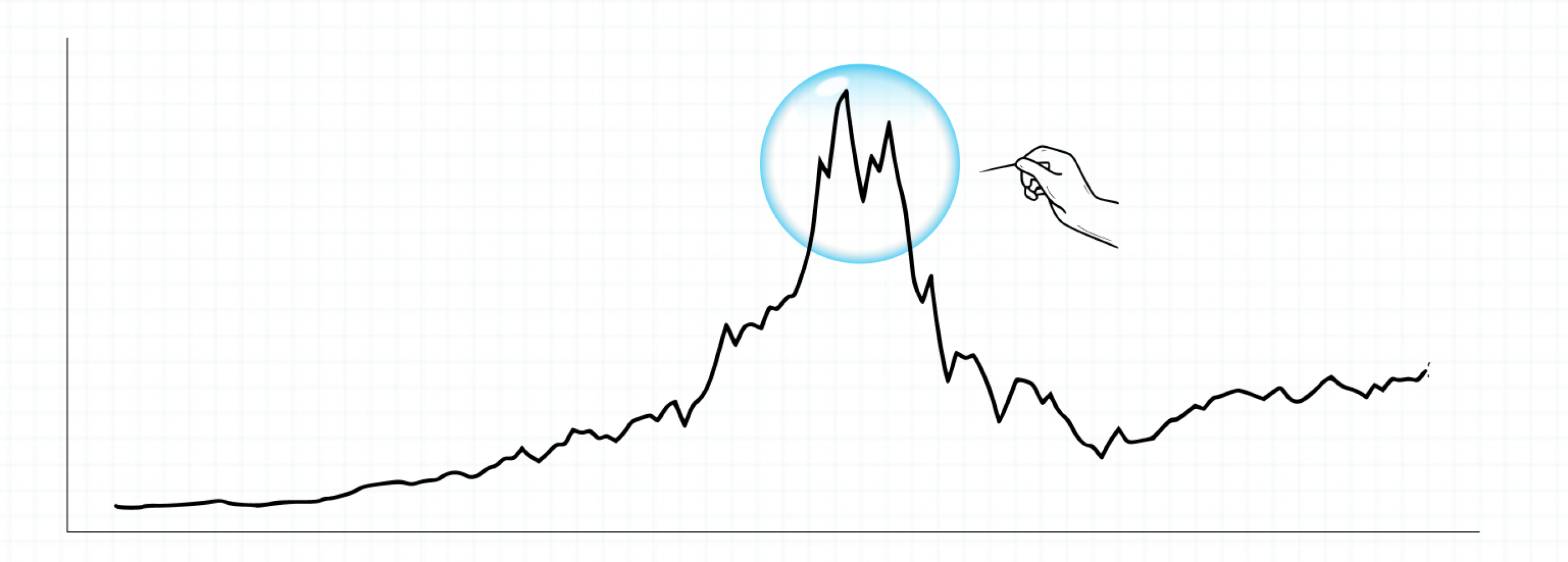
To define a bubble, we need to examine the motivation behind pricing. We buy commodities like coffee or bread because they provide energy for our daily activities and we need them. Barring inflation, their prices more or less align with the supply and demand mechanics behind them, and even as commodities like coffee proliferate, consumers will have cheaper options.
There is a complex set of mechanisms behind the production, storage, transportation and pricing of agricultural products, and everyone needs food. So unless it's a luxury consumer product -- like wagyu, we can predict the pricing. If we don’t, there will be a public outcry, and the government will rush to get prices back to normal, because no one wants angry mobs with torches and pitchforks like in France in the 1780s.
In the case of more complex instruments like stocks, the pricing depends more or less on what you can view. In more conservative societies, people buy stocks on the assumption that a well-oiled business machine will pay dividends. During times of easy money and low interest rates, speculators tend to borrow on the assumption that interest rates will be less than the appreciation in stock prices over time.
Predictive pricing models are not difficult because we have a hundred years of data. For example, we have data on revenues generated by energy companies over two centuries. It is easy to model the future price performance of these assets based on past records. The same is true for revenue data used by Internet companies that emerged in the early 2000s.
Assets have been priced within reason for a while because we have historical precedent for them trading. Now let’s talk about the platform’s governance token, or the monkey picture on the blockchain. Suddenly, the predictability of asset prices is replaced by assumptions.
People have built a market that is governed only by imagination and greed, and it will prosper as long as the profit motive works. Viewed in this light, bubbles are mispriced assets: often designed to be artificially scarce, chased by many buyers, and sold for a profit in the short term.

Every bubble in history has some characteristics in common. History doesn't repeat itself, but it rhymes. Like Eminem lyrics, or something like that.
1. A new asset class or technology
Every new technology has a bubble associated with it. One of the earliest bubbles arose in stocks in the 1700s, and it was the new trading tool of the era. For example, the Mississippi Corporation, which aimed to generate cash flow by mining South American resources, was led by John Law, a colorful figure who was, among many other things, an alleged murderer and creator of paper money. Similar bubbles abound, including in railroads, bicycles, and even telephones.
In the early days, the human imagination tended to have high expectations for emerging technologies, but it took decades for technology to catch up to expectations. Think of the late 1990s, when many of the companies that failed during the dot-com bubble were solving related problems. During this period, the number of people on the Internet was growing; but at that time, the Internet was a luxury that a small number of people could afford. As of 2020, approximately 50% of the world's population is online. This supply expansion means that there is enough liquidity (attention and consumption) for very niche businesses.
2. Lack of data
When a new technology hits the market, more data is needed to show people that their actions are stupid. People don't buy energy stocks at 100 times earnings because decades of data tell them it's a bad idea. New technologies don't have a similar data record, and in this case risk-taking seems prudent, especially for those seeking to escape poverty.
Consider the bicycle example. In the 1890s, when the bicycle market took off, it was assumed that building 750,000 bicycles for a population of 35 million (UK) would translate into huge profits for bicycle manufacturing companies. The reality was that within a decade American-made bikes flooded the UK market and local bike manufacturers went out of business, with around 40 companies going under in that cycle.
Cryptocurrencies have a similar trend. While tools like Nansen and TokenTerminal are becoming easier to verify and assess "real" economic activity on the networks we deploy funds on, there has not been a commensurate increase in data literacy. It will take a while for the market to acquire such skills.
3. Inflated expectations
New technologies capture the hearts and minds of the public because they offer new ways of doing things. The telephone allowed you to yell at people hundreds of miles away; the railroads allowed produce to be shipped and sold across states; figuring out how to refrigerate produce enabled people to freeze food so they could enjoy it in the winter. New tools capture the human imagination. This allows market participants to take on more risk as our assessment of the situation is no longer based on reality or past trends.
The post-pandemic bubble is further reinforced by recurring news that reinforces what people are missing. In the past, people only realized they were missing out on an investment when they were at a social gathering or when they saw their peers profit from a speculative bet. Today, this news is packaged, repurposed, and constantly fed into our feeds by consultants and influencers whose primary motivation is to hold your attention for as long as possible. Easy money has never been easier in the past.
A variation of this can be seen in how influencers market ChatGPT today. In fact, it's a groundbreaking technology. It will dramatically impact our professional lives for the next decade, but is it likely to be oversold? Probably.
4. Arrival of new networks
If you study the history of the web, pretty much every web spawned a new bubble. The discovery of new trade routes was the reason behind the Mississippi and South Sea bubbles. In 1887, approximately 87% of Western Union's revenue came from speculators seeking faster access to market-related data. The Telegraph was key to the 1929 bubble, the technology that allowed market data to be transmitted over long distances. Suddenly, instead of just trading on Wall Street, people could be trading hundreds of miles away in a small suburb. This set the stage for what would eventually turn into the Great Depression.
On Black Monday in 1987, the Dow Jones Industrial Average (DJIA) fell 22% in a single day. It happened right at the time of programmatic selling via computers. The problem is, networks spread narratives, and narratives drive human behavior.
The internet strengthens narratives by spreading them across the globe. Suddenly, the news about Gamestop wasn't an issue for the US stock market, it was a global headline. A group of VC-backed fintech startups offering services to people from India (like me) or Taiwan who want exposure to these stock tools because they read about them on Reddit. The news that Beeple sold his NFT for $69 million sparked a "digital art" craze. Details of these unusual events spread rapidly across the web.
Combining low attention, strong narrative velocity, and risk appetite fueled by growing inequality amid social media's continued delivery of the "ideal lifestyle" is exactly what you've seen over the past two years, throughout A generation buys and sells crap based on recommendations of 30-second clips and funny pictures.
The market in the context of the epidemic
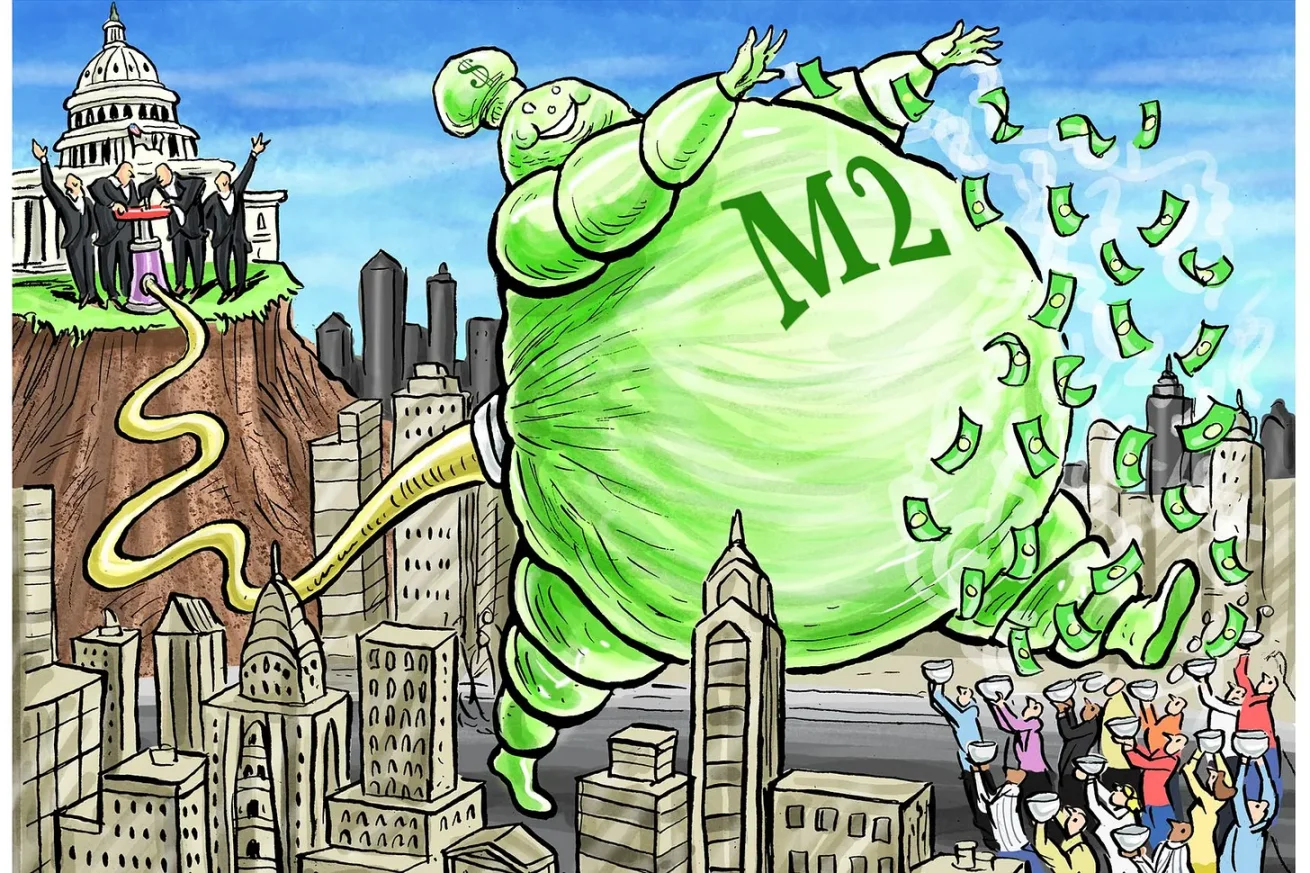
Image credit: Wall Street Journal
History tells us that bubbles are not anomalous. Still, with none of the bubbles in recent memory reaching the size of the digital asset markets of the past few months, what makes this cycle so unique? We won't examine how central bank policies created market bubbles, or how expanding the money supply led to one of the largest bubbles ever created. We will focus on the psychological reasoning behind market participants, acting the way they do.
In fact, the past has been littered with stories of bubbles, none of them on the scale that digital assets have achieved in the past few months. In past tech cycles, we haven't seen JPMorgan buying land in the metaverse. So, what makes this cycle unique? Is it Snoop Dogg's concert in the metaverse, or Elon Musk's platform Dogecoin? It's not just celebrity endorsements for digital assets.
Young people today live in unique times, a time of extreme wealth inequality. It is estimated that American Baby Boomers and the Silent Generation are worth five times more than the average millennial generation. It's even worse when you factor in student debt. One could argue that inequality has always been part of human society, and that younger generations are no worse off than their predecessors.
But the baby boomers and those before them were just keeping up with Jones. Today's millennials are stressed out about the Kardashian family making billions. (Yes, not everyone follows the Kardashians, but every average tech geek, business nerd, finance bro, or whatever variation you choose, has their 20-something version.)
Early in our evolutionary cycle, it made sense to do what the people next to us were doing, because figuring everything out from scratch required resources. Exploring and researching new ways of doing things is a privilege when you risk being killed by leopards or barbarians who invade your village.
For millennia, we have all operated on the same psychological circuits. Imitation is efficient, young people have little to lose and with a growing appetite for risk, they often imitate their peers. These people are fueling the bubble because they haven't experienced a massive recession, which has historical precedent.
The South Sea Bubble of the 1700s was one of the biggest bubbles of its time. Isaac Newton could come up with calculus, but not even all his ingenuity could protect him from losing a fortune in that wild speculation. Part of the reason people were rushing to invest at the time was that the average life expectancy was around 35 years.
If you're in your 20s, it makes sense to take huge risks hoping to make a fortune in your final years. Think about the market rallies in the 1920s (after the Spanish flu) and 2020s (when the COVID-19 hit) and you can see why our markets have been doing the same for the past two years. Epidemics and the proximity of death may make us willing to take more risks than we would otherwise.
We need to recognize the world we have discovered over the past few years. Stories of 12-year-olds making millions selling jpegs influence our behaviour. The pandemic has us locked in our homes, looking for sources of entertainment. The marketplace solves multiple pain points, it gives people a sense of community, a meaningful diversion of attention, and a mirage of opportunities to create wealth during mass layoffs. When investing becomes entertainment, your portfolio can often turn into a joke. This is where we end up.
Combine the era of stagnant wages, ballooning ambitions, our meme appetites and a misguided sense of risk, and you get a sense of what has happened over the past few years. Increased consumption of content from financial influencers, people building their entire identities around the assets they invest in, and corporate CEOs taking on debt to invest in Bitcoin are emblematic of our times.
Thomas Piketty sums up the era in simple terms in his introduction to Capitalism in the 21st Century: a period in which the rate of return on capital far exceeds the value it can generate.
Degen rank above productive people when speculation brings better returns than creation. (He didn't say that, I did)
Institutional imitation
Of course, my friends buying literal garbage coins in the toilet every morning isn’t the only reason digital assets have grown into a multi-trillion dollar industry. Institutions (or leveraged degenerates) play a role in this equation. Let's use venture capital as a benchmark. In the U.S. today, it takes an average company seven years to achieve liquidity, from seed funding to public company exit. During the dot-com bubble, that time was shortened to three years.
The arrival of big funds like SoftBank or Tiger Global changed the trajectory of venture capital as an asset class. Companies are "repriced" into growth-stage companies in a shorter period of time, as long as they can demonstrate some degree of traction. Venture capital backing cash-burning startups is nothing new, but over the past two years it has happened at a much faster pace.
When every company you invest in can raise capital within six to eight months, your job is not to pick winning numbers but to buy as many tickets as possible.
Conversely, large funds have the ability to mobilize large amounts of capital. If a fund manages $1 billion, deploying $10 million is only 1% of the fund. When excess capital chases a limited number of start-ups, rising valuations follow. OpenSea was valued at $13 billion in one cycle in the private market, or MoonPay at $3.4 billion.
If you compare the public market: Coinbase has a market cap of $10 billion and PayTM (one of the leading wallet providers in India) has a market cap of $3.8 billion. Are Coinbase and PayTM worth less than OpenSea and Moonpay? I have no idea. But there may be a psychological effect: Deploying more money at higher valuations is fine as long as there is a healthy public market to exit from.
The public market is the benchmark for where private investors think a startup can ultimately go. Let's say I see a public company valued at $100 and an early-stage related player valued at $1. After listing, its value can be multiplied by 100 times. Naturally, early investors will only make small investments. Suppose you make 10 bets of $10 each, and one of them hits $100. Your overall bet wins and you can get a good return. (In this hypothetical example, I'm not considering the cost of fees, dilution, and lawyers hired).
But that changed when public market valuations converged with private market valuations. Remember how I said above how historical data can help us set prices? Whenever a company like WeWork or Beyond Meat enters the public markets, there is precedent for the value of the company. This means that once the company goes public, the valuation will reset to a more realistic figure. Thus, capital allocators have a choice once a company goes public in a declining market.
Do you put money into illiquid early-stage VCs, or buy directly on the open market like SoftBank did in Q3 2020?

As the saying goes, "money makes money". In other words, liquidity begets liquidity. When public market players don't see returns, private market players sit on the sidelines. Because the appetite to take risks and deploy capital to early players is almost non-existent. The number of IPOs is directly related to the amount of capital deployed in early venture deals. Once VCs see returns from public companies, they switch money back to new startups. The graph above shows the reasons for the rapid growth in venture capital activity over the past few years. An increase in the number of IPOs may be one reason for this.
And vice versa, if venture capitalists don't see any direct path to liquidity, the proverbial spigot through which money flows is turned off. In 2021, SoftBank will complete an average of three deals per week . Not entirely out of the question considering their team size in the Vision Fund is around 400 people. But when you consider Tiger Global's investments over the years, the dramatic acceleration in capital deployment becomes apparent, as shown in this chart from Pitchbook .
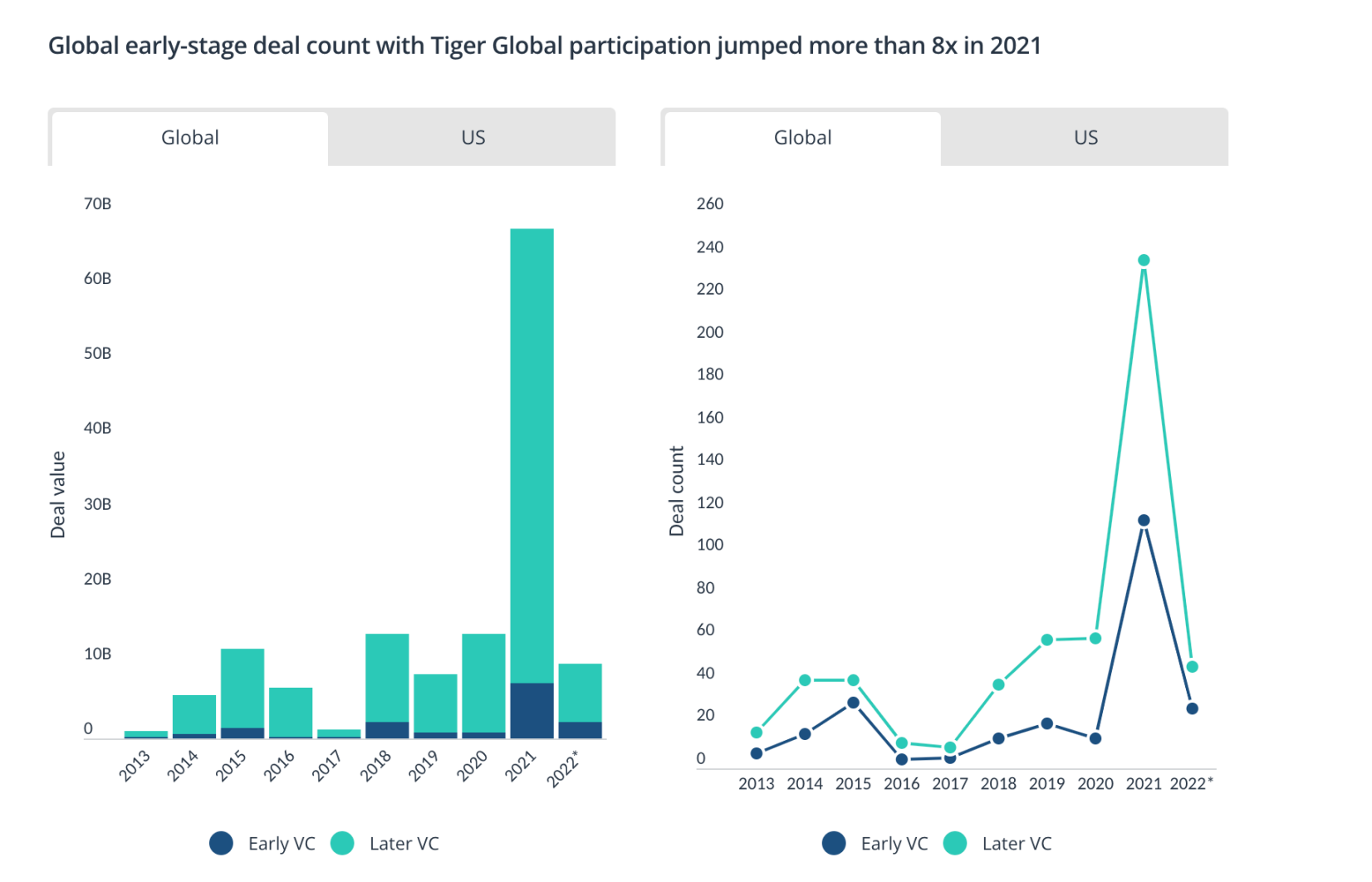
In the longer term, the amount of capital deployed by Tiger Global alone will increase from about $8 billion in 2019 to about $70 billion in 2021. You can also see a similar spike in the number of completed deals. So, on the one hand, money is pouring in, backed by healthy public markets. On the other hand, the number of startups with venture capital backing in their early stages is limited. Combine the two and you have the startup frenzy we've seen over the past two years. That said, the binge we've just seen for a few years is over, and it probably won't return for a long time. For the foreseeable future, cash flow will rule.
What is happening between institutions and startups in the digital asset ecosystem? Just as public markets have been kind to founders looking to take their companies public and seek liquidity, the digital asset space is full of new mechanisms that can provide liquidity to active participants in the market. SBF’s explanation of DeFi yield farming in a conversation with Bloomberg’s Matt Levine is hilarious as it sums up everything that was wrong with the previous cycle.
verifiably insane
What is unique about making Web3 crazy is how retail user interest is piqued and the speed at which retail liquidity enters the blockchain ecosystem. Individuals no longer need to invest in distant visions of what blockchain can achieve, as they did with ICOs in 2017. Instead, you can invest in assets here and now, and the “earnings” of DeFi are considered real.
Things like “earn while you play” and NFTs can engage retail users in ways that concepts like decentralized Uber or on-chain supply chains never could. Combine this with incentives and lock-ins, and NFT transactions could be worth billions of dollars. Everyone wants to be a part of the next Boring Ape, and every company wants a piece of the action.
As an institutional investor, benefiting from it is very simple. You invest in infrastructure that enables founders to go to market (like Alchemy), or you invest in platforms where users trade these assets. Viewed in this light, it's easy to see why so many big names are investing in FTX, they can avoid the directional risk of random altcoins while still benefiting from the frenzy.
Facebook or Amazon would have to spend years channeling network effects to get people to spend on their platforms. Facebook's colossal failure to build any kind of relevance in the Metaverse is emblematic of how difficult it is to get retail users to spend. No one wants to spend all their time in a cartoon about pretending they don't have legs. We already perform to the fullest in our avatars on social networks. Contrast this with seeing crypto-native species in the metaverse.
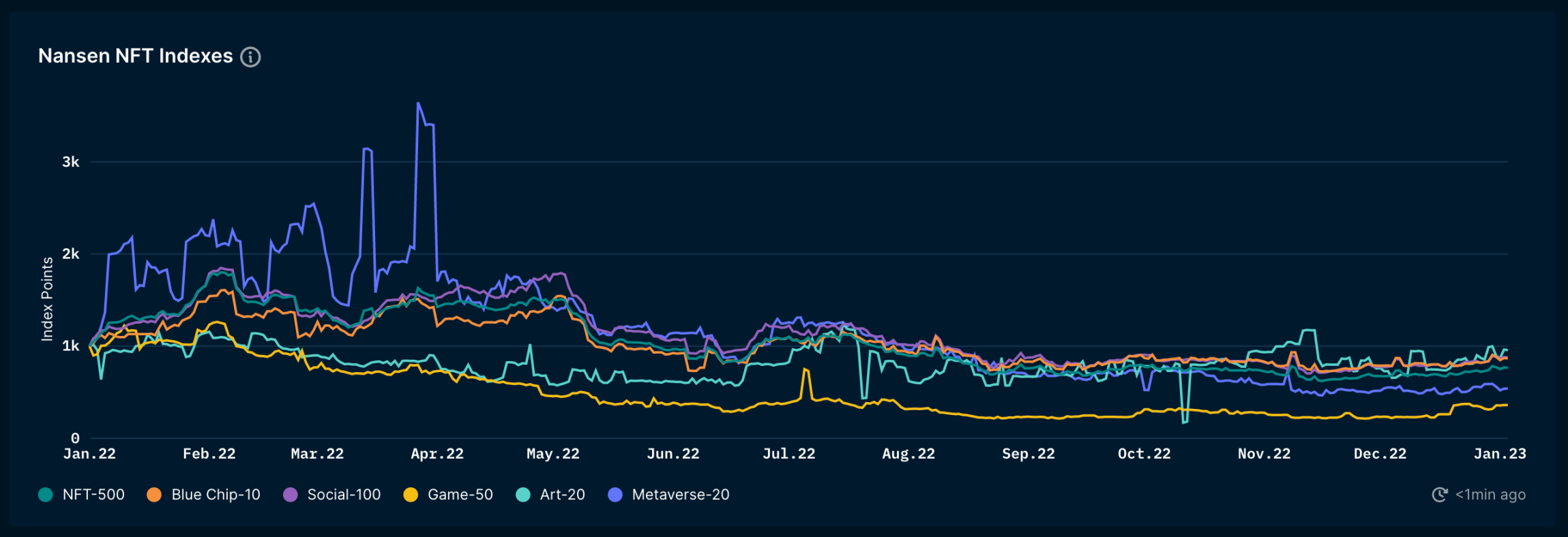
It is common for virtual land and NFTs to be sold for tens of thousands of dollars. The graph above shows that most of them tend to zero in value over time. For the first time in human history, we have the tools to make bubbles. During the South Sea bubble or the railroad bubble, it would still take years to generate any plausible business. In an age when everything is digital, an afternoon of coding can be enough to secure funding from investors, who are often clueless about the digital tools they are rushing to buy.
It would be unfair to suggest that institutional investors are investing in platforms that sell worthless assets to unwitting retail investors. Because many of them are imitating what their peers are doing, or they are responding to the needs of investors (LPs). But it stands to reason that inflated measures — TVL locked in DeFi or NFT instruments traded — are the driving force behind the massive amount of money that has entered the ecosystem over the past two years.
This influx of capital in turn spurred the rapid financialization of everything. When you become obsessed with the fastest way to get customers to transact rather than what they need, you get a sea of predatory tools that sell risk to novelty-seeking customers. Naturally, this leads to market abuse in the short period of time regulators have not yet caught up with what is happening in the new market.
Is it all a dream?
Walking around a beach in Dubai a few days ago, a friend told me that he was "full of confidence" in his ability to make money, no matter which way the market went. He's the CXO of a major blockchain company, and he has every reason to be confident in himself anyway. People like me who entered the market in the 2010s benefited from one of the greatest periods of money supply expansion. We've only seen good times, and if like me you're in your 20s, you have nothing to worry about.
My response to him was to allude to the fact that all technology industries may be in a multi-decade bubble cycle, and we may soon have a moment of reality like previous "hot" industries. There was a time when it was wise to work on cars or electronics.
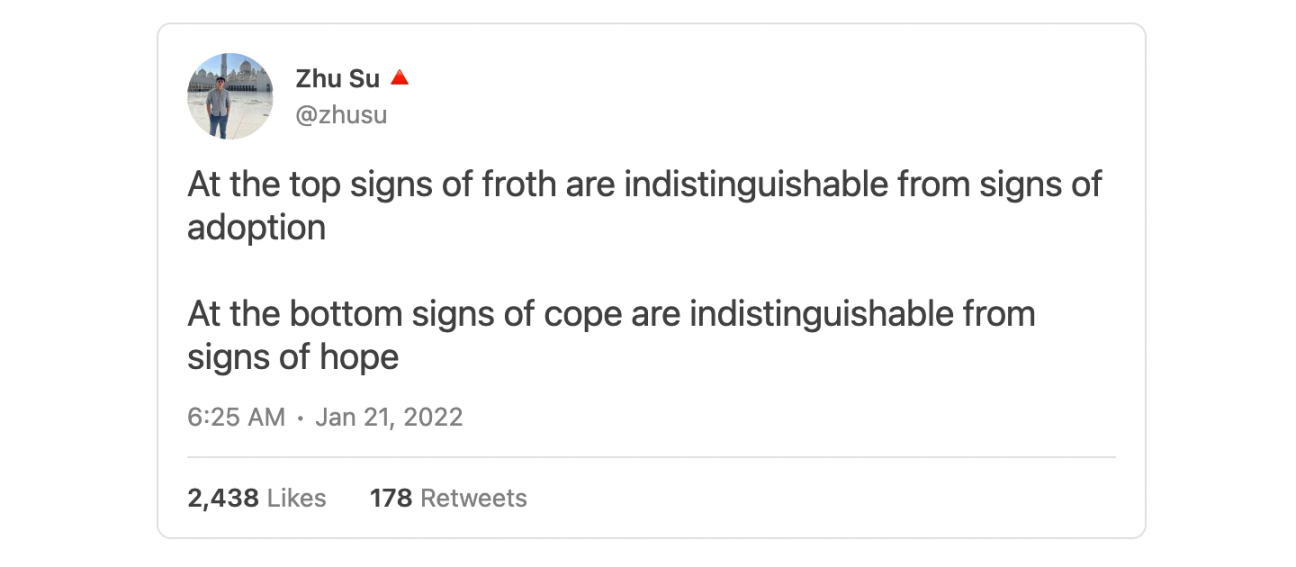
The more I study bubbles, the more I can't help but wonder if we're all living in a dream. Are all cryptocurrencies just illusions? Or is there really hope for what we spend so much time and energy doing? Believing in Su Zhu's supercycle is good, but waking up at 40 and realizing you've spent 20 years on technology that doesn't make sense is also bad. Life is too short to build something no one wants.
In that spirit, it’s worth taking an objective look at how the crypto industry has trended in terms of actual traction over the past few years. I'd love to laugh at how Zk-snarks are breakthrough innovations, or that 30 derivatives-related DAOs with 50 users trying to AirDrop farming are fixing finance. "Innovation" is not what I'm looking for, I'm looking for traction. Verifiable, quantifiable evidence and numbers of people using these things, and graphs with curves on them.
As a benchmark for industry growth, I looked at the 2020 figures and compared them to where they are now. I take this approach because in the first quarter of 2020, most of the things that I find attractive are mature enough to be adopted, but not necessarily mainstream. It makes sense to use Q4 2022 as the other end of the scale because we're six months into a bear market and if all of these indicators were just traders frantically clicking buttons, we'd see a massive drop in bitcoin prices shrink.
I would expect a similar drawdown in active users when considering bitcoin or ethereum prices are down about 75% from their ATHs. Then I screened the use cases that are all the rage: applications in stablecoins, DeFi, and NFTs.
stable currency
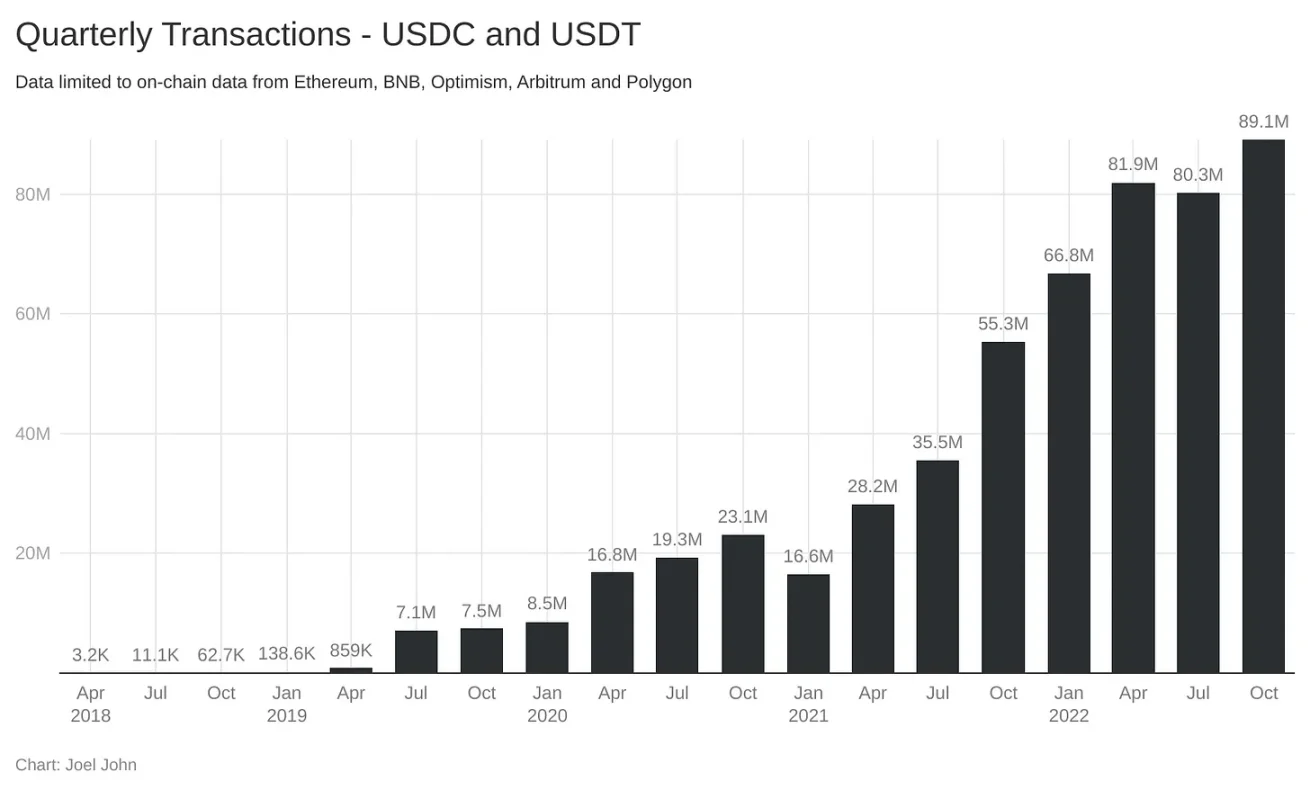
Bitcoin and Ethereum have settled trillions of dollars in transaction volume since their inception, but they serve a niche market that can accommodate volatility in exchange for relative decentralization of the underlying asset. The average person needs something more stable, and stablecoins might serve their needs well. Between USDC and USDT, global on-chain settlement can be completed within a few minutes.
Payments settled on-chain via stablecoins surged to $1.6 trillion last quarter. This represents an increase of approximately 17 times from approximately $90 billion at the end of the first quarter of 2020. I believe the reason DeFi never took off until primitive technologies like stablecoins mature is that we need a stable store of value before complex financial derivatives can be built.

In terms of size, Visa processed about 255 billion transactions in 2021, representing a transaction volume of $14 trillion. Stablecoins account for about 10% of transaction volume and about 3.5% of Visa transaction frequency. This is an apples to oranges comparison. Visa's roughly 40-year head start and decades-long network effects make it the go-to choice for digitizing payments in countries around the world. I don't think stablecoins will compete with them; instead, I use it as a benchmark for growth rates.
In most regions, stablecoins will not compete with regional payment networks. There is no reason to force the installation of alternative payment mechanisms when alternatives already work. For example, in FY 2022, India’s digital payments ecosystem saw about 72 billion transactions without blockchain or additional functionality. In contrast, stablecoin payments saw just 300 million transactions last year.
Instead, stablecoins will dominate digital-first economies that require settlement at global scale, so what does that look like?
Today's web already has examples. Platforms such as Fiverr and Freelancer bring together global labor markets, but their payment infrastructure is a complex web that can hold payments for days. Artists rely on payments from platforms like Spotify and Youtube. Transferring money from them can take months or even weeks to complete. Twitch and its grown-up cousin OnlyFans have proven that there is a market for creators to make a living with, and more and more kids aspire to grow up to be influencers. Do you see a pattern? Our modes of work, study, love and entertainment are all going digital.
Our economies have digitized faster than the payment networks that support them. This matters because the way we consume has also shifted to digital. For example, in October alone, Roblox users spent approximately 4 billion hours in their app. Travel back a billion hours and you'll find yourself foraging for fruit with our distant Stone Age cousins around 110,000 BC.
Google, Microsoft, and Apple each have more than $10 billion in gaming revenue. According to Githyp, the highest number of concurrent players on a single platform is about 3.2 million. This is equivalent to the population of Dubai converging on digital platforms from all over the world at the same time.
Attention takes precedence over capital. Until 2015, while people were still used to consuming digitally, it was acceptable for payment innovation to lag behind platform development. Back then, only a few people spent most of their waking hours looking at 5-inch screens. We find ourselves at an inflection point where funding needs to evolve in order for the internet to take the next step. Slow payments infrastructure can shave a few percentage points off GDP growth, which is common in emerging markets.
A CBDC is a response to this evolutionary arc of our financial infrastructure. They allow governments to regain control while theoretically "enabling" digital-first platforms like Steam or Twitch. We’ll explore this topic in the coming months, but let’s get back to stablecoins first.
Why did I mention how much time we spend in the digital realm? They provide a good background for what follows.
- Stablecoins have seen an increase in trading volume and frequency during the pandemic. They have been stress-tested enough to show that they can provide creators and developers with access parallel to traditional banking. The fact that Stripe allows creators and developers to receive stablecoin payments from anywhere in the world is proof of this.
- Our economy is increasingly digital, global, and ideally permissionless. That means the payment networks we use need to evolve with them. For example, you can't spend weeks between selling digital goods and saving money in the bank. Depending on the regulations of the central banks they deal with, traditional banks may need help meeting the speeds these platforms demand. This is the void that stablecoins will fill.
The reason for this situation comes down to compliance. When a traditional bank opens up its infrastructure to unknown developers from remote parts of the world, it must add compliance conditions. Some bad actor may participate in the bank's infrastructure for every few million dollars that flow through the system.
Compliance is costly to run, and regulators face heavy fines if they deem it risky. Therefore, on the one hand, the cost of compliance keeps rising; on the other hand, any behavior that is seen as not following the compliance procedures will bring losses. In some nation-states, such costs would mean prohibiting operations.
Contrast this with public blockchains such as Ethereum. Now, the compliance “duty” between users, asset issuers (like Circle), custodians (like exchanges), and sellers has been broken. In some lawless dystopian society where regulations don't matter, none of these parties exist.
But it's no longer contained within a single financial entity that makes blanket statements about what's allowed and what's not. Instead, the market decides which risks it considers worthwhile or not. Some people like to play games, some people like to operate the derivatives market, and some people just like to provide services.
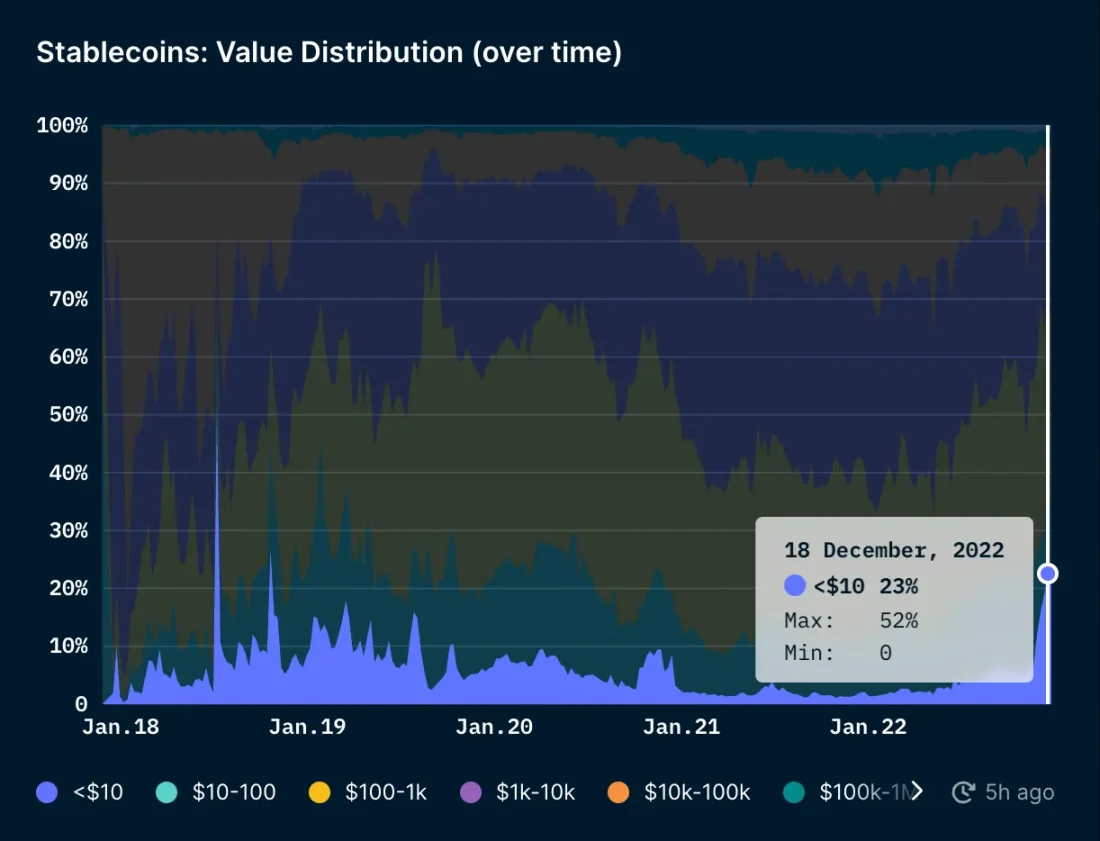
Source: Nansen
Nansen's data breaks down transaction frequency by amount transferred. As of two weeks ago, transactions worth less than $10 accounted for a quarter of all stablecoin transactions; transactions under $1,000 accounted for two-thirds. Transfer settlements worth more than $1 million accounted for 83% of on-chain stablecoin transaction volume.
Despite the high fees, retail users flock to stablecoin transfers as they find them a solid alternative to traditional banking in terms of speed and transaction finality. If large traders were the only ones using stablecoins, we would see a larger share of transaction frequency dominated by high-volume transfers.
Will stablecoins compete with regional payment networks? Probably not. Instead, they will complement a whole new digital economy, especially in use cases that require high-velocity money flows. There is enough evidence for this. DeFi and NFTs are two primitives that have taken off on the back of two years of stablecoin supply expansion. I'll detail how they grow in the next section.
DeFi
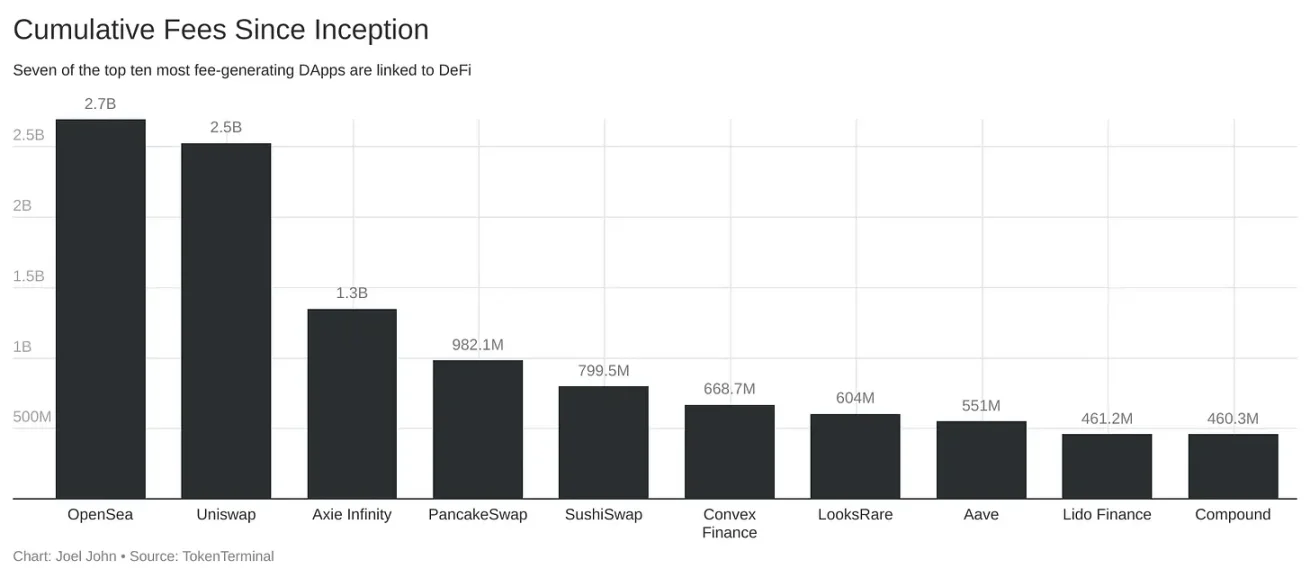
Given the drop in token prices, it would be easy to write off decentralized finance entirely. In fact, many assets in the sector are down more than 90%. It’s a dumpster fire fueled by bad token economics, broken UX, and esoteric tools that no one wants. But there is a different lens to look at things: fees. One way to understand how important DeFi is to the blockchain ecosystem is to look at which applications generate revenue.
I compiled a list of the top ten decentralized applications with the highest cost for your reference. About 7 of the top 10 belong to DeFi in some form. Selection bias? Ok. If you refer to the top 25 on TokenTerminal, you will find that there are about 22 related to DeFi. There is an argument here that DeFi generates more revenue because of its first mover advantage (around 2018) compared to NFTs, which only started to take off around 2020.
Much of the activity in DeFi platforms comes from crypto-savvy users and applications like NFTs that open the market for new entrants. Even accounting for these two facts, DeFi will still generate cash flow in an industry that hardly sees any cash flow. I noticed this when I broke down the revenue generated by well-known decentralized exchanges.
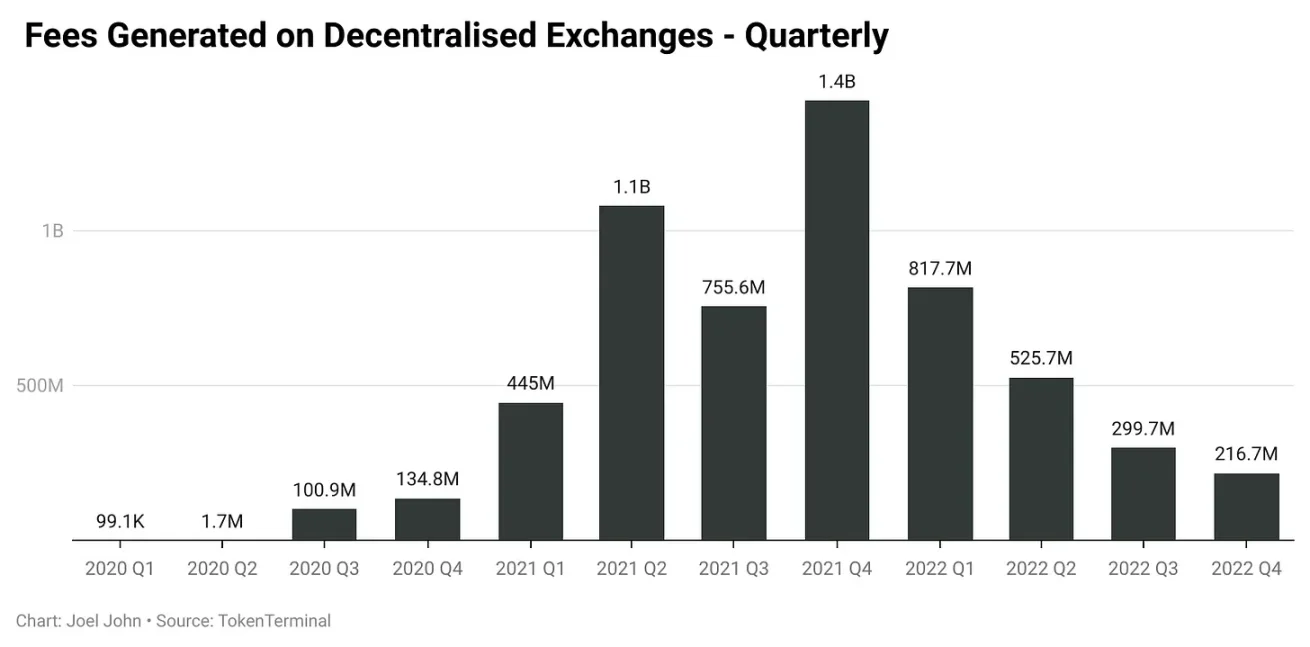
Notably, fees generated by decentralized exchanges are down about 85% from their all-time ATH-All Time High in 2021. To be fair, throughout 2021, things like yield farming and token rewards are driving that number up. But to get the full story, it's best to look at Q2 2022 volumes and compare them to 2020 volumes from two years ago.
I chose these two locations because the second quarter of 2020 is when the DeFi summer is about to take off. The second quarter of 2022 is when Luna and Three Arrows decide to introduce gravity across many of our portfolios.
Even with conservative figures, fees on decentralized exchanges have grown about 200 times between the two periods. Looking at the current quarter's numbers ($217 million), that's a whopping 130x. Naturally, these products are currently used mainly by speculators. A prolonged bear market will wear down any user base for them, and that's what I thought would be the case, then I looked at the active users of these platforms.
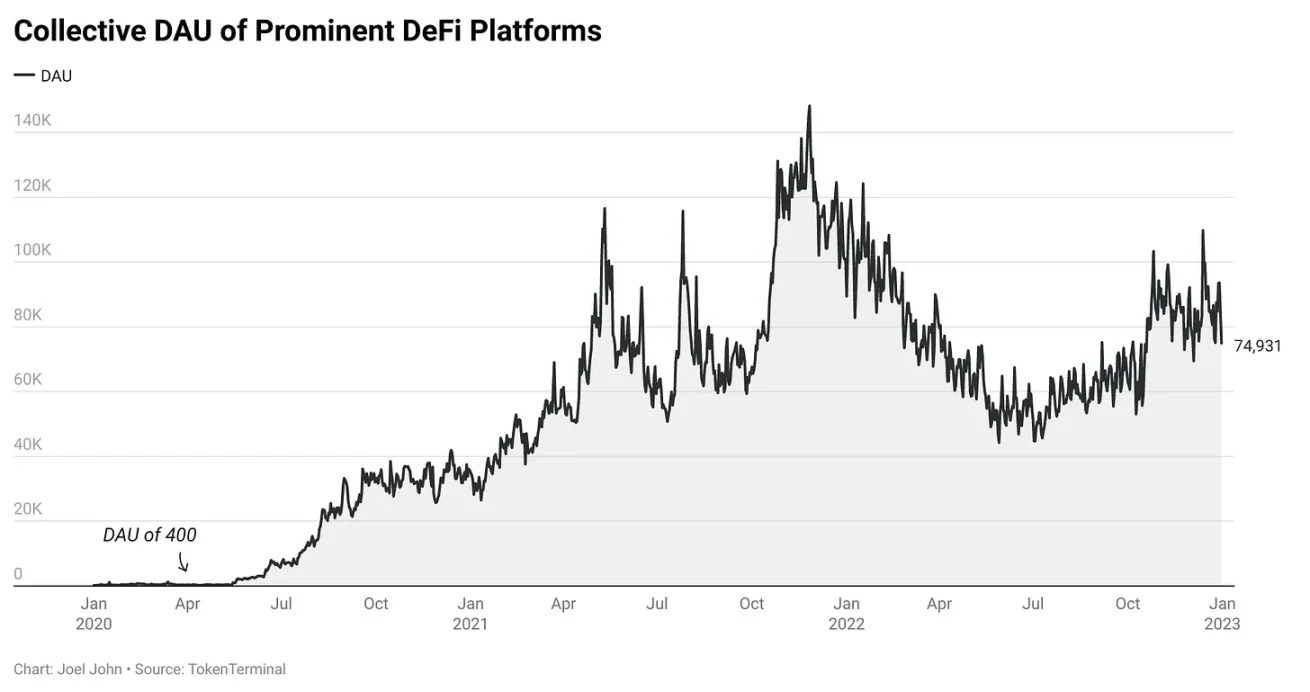
The graph above shows the total number of active users on major DeFi platforms. I think it's limited to ETH users, or in other words, people who are willing to spend a few dollars per transaction, loan or transfer. Interestingly, until April 2020, only about 400 people were using DeFi products per day, with that number peaking at about 140,000 by the end of 2021.
Given the sharp drop in token prices, one could reasonably argue that there will be fewer users of DeFi-related products. But the charts tell a different story, with the number of active users bottoming out around July this year and has been steadily picking up. It has about 75,000 users, still about 200 times the industry's 2020 number of users.
There were also objections to the figure. First and foremost, Uniswap alone accounts for the majority of this DAU. Compared to multiple platforms like Uniswap, Compound and AAVE ’s DAU has “only” grown 10x over the past two years. But that’s because only platforms with daily active transactions will see daily user returns. There is no reason for people to keep repaying their loans every day on a platform like Compound.
The picture above is on the conservative side. Data from DAppRadar shows that on a certain day in the fourth quarter of 2022, the cumulative number of DeFi users is close to about 3 million. This is still below the 9 million or so wallets active in the space until January 2022. For scale, Coinbase has about 600,000 DAUs in the US alone. Now we don't know if all these users are trading on a daily basis. However, the odds are high that most of them will take a quick look at their portfolio.
Assuming 15% of users on Coinbase transact on a given day, that's roughly 120,000 users. In other words, DeFi’s trading user base (60,000-140,000) is somewhat close to that of the largest listed exchanges in terms of number of users. As an ecosystem, the space has grown roughly 100x in revenue, volume, and users in the two years since 2020. There are many reasons for this. As someone who desperately wanted to move to Singapore in 2019, I can attest that bankruptcy helped us focus on building important primitives.
For DeFi to "work" in the second quarter of 2020, it must complete two to three years of preparation work during the last bear market cycle. Just a few years of writing code, researching, and raising money is enough to keep the door open. These primitives will be "production ready" by Q1 2020.
With the perfect storm of a pandemic and the Federal Reserve unwinding its proverbial money-printing machine, DeFi is at the right time. To provide the infrastructure, a generation that has just lost their jobs needs to speculate, invest and yield on a global scale. But if that's the only user base in the industry, then we're going to see a big drop in DAU. But it didn't happen, which leads me to believe that there are tons of users who care about and use these tools every day. With price stabilization and innovative improvements in L2, cross-chain bridges, we will see the next generation of users coming in.
This is not to say that all DeFi is desirable. Our developers often forget the need for auditing. You might be better off keeping your precious dollars in the bank than 90% of DeFi being developed by resource-poor teams. I avoid mentioning real-world asset lending or 30 DeFi derivatives projects that have the same 50 users wanting an AirDrop because those products aren't ready for the average user yet. But when Sam is (allegedly) busy stealing user deposits and the guys at 3AC are (allegedly) giving a hard lesson on why you can't lend without collateral, DeFi is proving to be a viable alternative.
NFT

It is easy to dismiss NFT as a failed financial primitive. I mean, look at the chart given above in relation to OpenSea fees. Explaining the drop in fees from $30 million to $1.06 million on any given day is a good headline. But it ignores our 500x increase from October 2020.
We have not fully discussed two market forces. First, as curiosity about these digital assets declines, we will naturally see fewer sales of these items. People who aren't speculators don't move their assets on-chain every day. They'll buy it once and call it a day. Therefore, the shrinkage of trading volume is very natural.
The drop in the price of many NFTs further contributed to the drop in transaction volume. According to Nansen's NFT index, 20 NFTs related to the metaverse fell by about 49.5% for the year; another index related to 50 game NFTs fell by about 69%. But if you take the index that makes up the top 10 blue-chip NFTs, it’s only down 13% this year in ETH terms. That's better than the S&P 500 , which is down about 20 percent this year.
Is this because our pictures of rocks, monkeys and ugly pixel art are somehow more economically valuable than S&P 500 stocks? Obviously not. People have come to view some of these assets as stores of value for their holdings rather than vehicles for speculation. As the lending market around NFTs develops, it is unlikely that we will see an increasing volume of high-value NFTs. Instead, like in the stock market, people will take out loans against assets they already own.

So is volume doomed to never recover? I do not think so. The emergence of new applications and the return of speculative demand will lead to a rebound in transaction volume. The latter is entirely dependent on the price of digital assets such as Bitcoin and Ethereum. Usually, only traders who are sitting on huge profits go out and buy multi-million dollar jpegs. But the former is now fully under the control of the developers. Despite the sharp drop in price, the number of users who conduct at least one on-chain transaction via OpenSea on a given day has not declined.
According to TokenTerminal data, OpenSea active users increased from 300 daily users in January 2020 to approximately 51,000 on January 2, 2023. Nansen said that every week, we see about 200,000 users in the NFT ecosystem crossing exchanges. Has this number dropped significantly over the past year? The all-time high for this number was about 430,000 users. In an industry that often attracts short-term interest, a 50% drop in a year isn't a disaster, especially when the metric is up 1,000-fold from just 18 months ago.
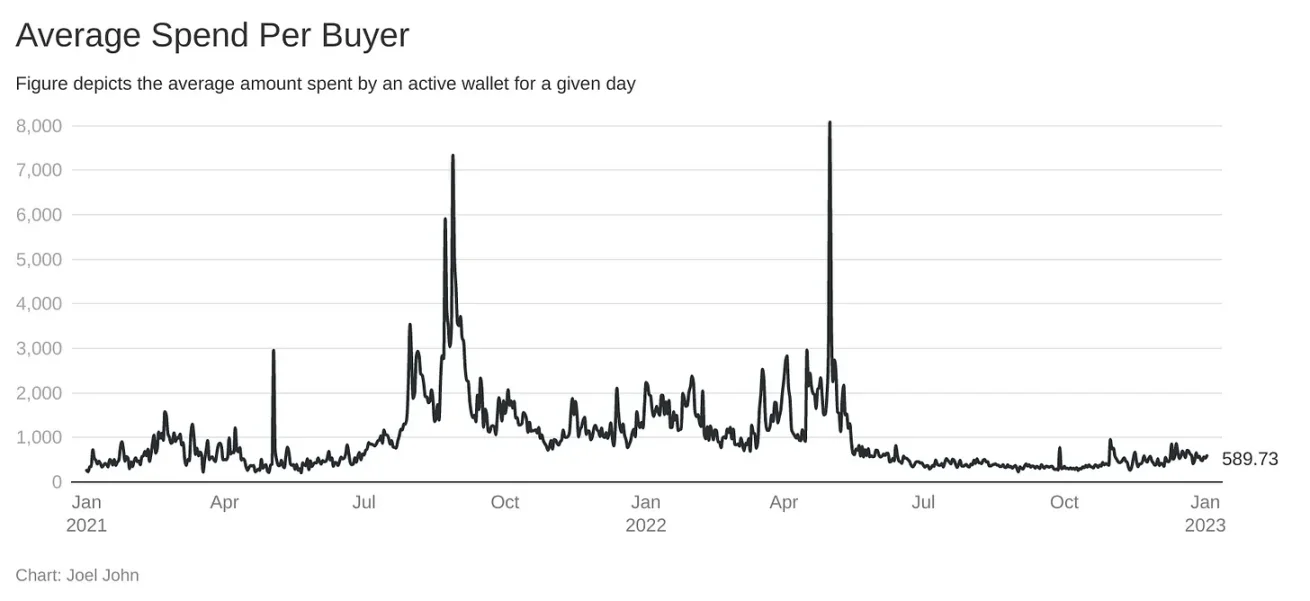
There are different reasons to be optimistic about NFTs as an asset class. This is how it was "retailized". They are being repackaged from speculative tools to consumer tools at prices affordable to the average Internet user. NFT, as a technology of the past few years, echoes what happened in the early days of mobile devices. Infrastructure bottlenecks (Ethereum fee costs) and a handful of assets that appeal to the public psyche mean it's out of reach for the common man.
With the rise of applications such as content consumption, event ticketing, and gaming, the average cost of NFTs has dropped rapidly. The chart above shows how much each buyer spent on NFTs on the Ethereum network over the last year. The peaks were associated with periods of wash trading and speculative betting, but as you can see, they have leveled off over the past 6 months.
I don't believe the average person would spend $500 on an NFT. One could argue that if this remains the case, the asset will not be able to have any meaningful impact. NFTs will trend towards the cost of today's low-cost SaaS products: $10-50, because consumers are used to and willing. There are some early signs that NFTs have the potential to become low-priced mass consumer goods distributed digitally. It happened on one of the largest social media platforms. Twitter? No, Instagram? No, it's happening in weird NSFW'ish corners of Reddit.
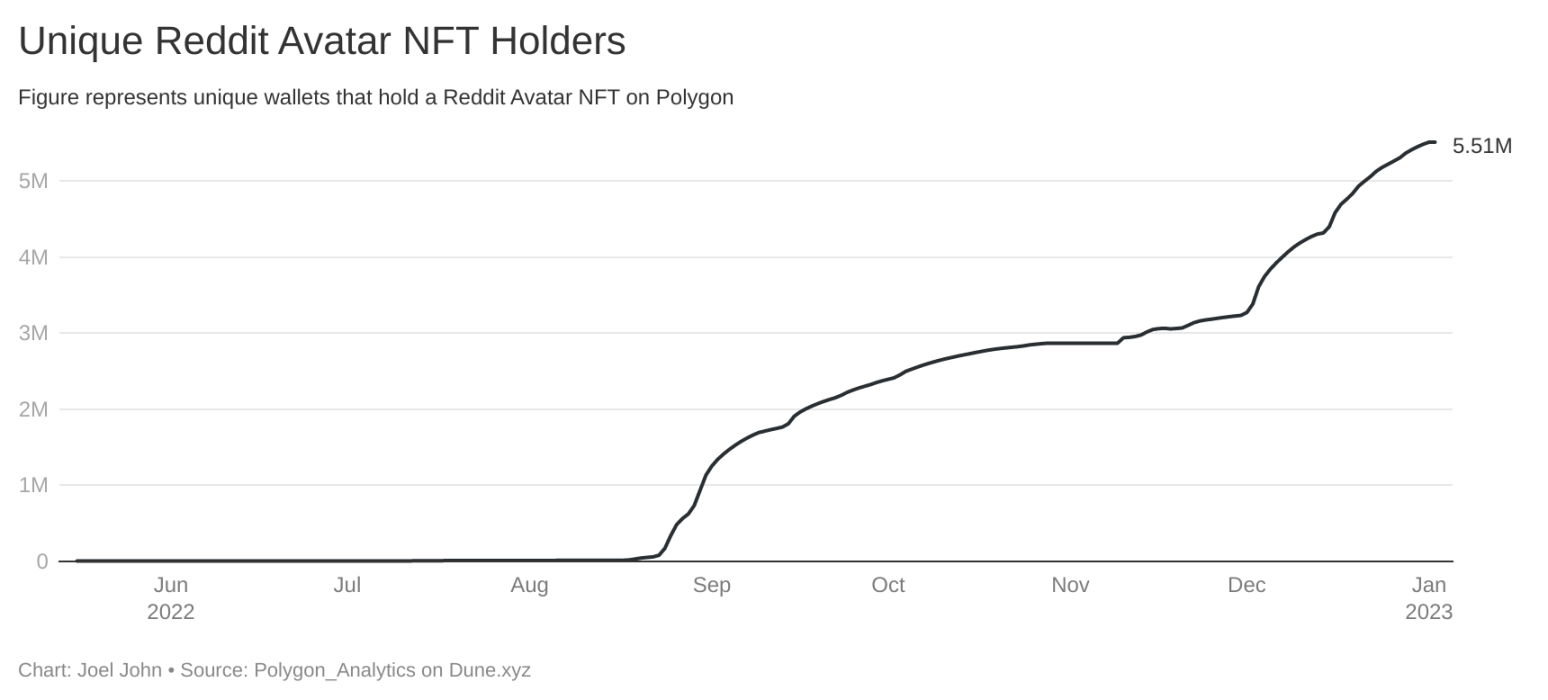
Reddit's Avatar NFT was released on Polygon earlier this year. This comes after the platform has been experimenting with the token for a year. At the time of writing, there are approximately 5.5 million unique wallets connected to Reddit. If we assume that each wallet represents a user, this means close to 6% of the user base owns NFTs, but the fact is that one of the largest NFT ecosystems is brewing on one of the largest Web2 platforms on the planet.
After a period of speculative frenzy, interest in trading these NFTs has dwindled. Most of these assets are claimed for aesthetic purposes or out of curiosity. Remember the $500 figure I quoted above for the average size of an Ethereum NFT transaction? For this collection, it's as low as $100.
NFTs have become speculative vehicles that appeal to a small segment of the internet's users. They go through boom and bust cycles, but are unlikely to stay that way. What may happen instead is that they evolve into essential tools for identifying, tracking, and interacting with users globally in a permissionless manner. By verifying which user purchased a ticket, played a specific game, or attended a specific event, we will unlock new use cases that were not possible before. We've seen early exploration by some brands like Nike.
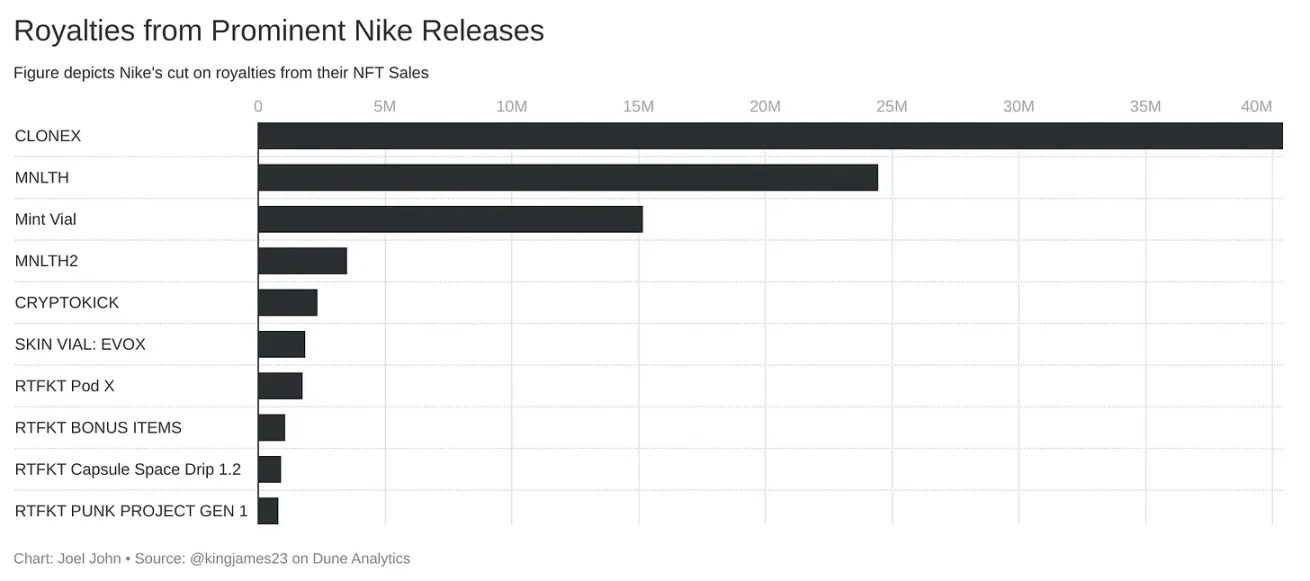
Crucially, Nike's strategy combines the brand's distribution network, its existing suite of digital applications, and Web3 to generate approximately $1 billion in additional revenue for the company over the course of the year. Royalties from these transactions alone amounted to approximately $100 million. From time to time, they release "crates" that can be redeemed for limited-edition sneakers.
Web3 components take sneaker collection to a whole new level. First, anyone in the world can collect or trade these NFTs. The market size is wider than a handful of cities. Second, Nike makes money every time someone trades these NFTs, depending on whether or not they deem a particular sneaker's attributes to be desirable. Third, it opens up the possibility of future digital assets embedded in the digital environment. Imagine a Nike NFT in Fortnite.
On platforms like Twitter and Instagram, there is still room for a surge in NFT adoption by retail users. For example, Instagram's launch of a marketplace and direct subscription offerings within the app will mean creators will develop digital-first collectibles that they can sell to their audiences. They already allow creators to sell NFTs directly to their fans.
While the number of these tools has declined, the user base, distribution channels, and complexity of business models surrounding NFTs have changed dramatically over the past few years. If anyone suggested that Instagram embeds NFTs in products, or that about 2% of Reddit's user base might own NFTs in 2020, we'd think they were overly optimistic. However, we are already in 2023 and seeing the adoption of NFTs by some of the largest Web2 platforms.
I can discuss us with DAOs, zero-knowledge proofs, scaling, bridging, and onramps. But that would be a fruitless intellectual exercise that would not add to the basic story I am trying to convey here. Like all emerging technologies, cryptocurrencies ebb and flow through periods of rapid adoption and bubbles. Because it's simultaneously an emerging technology, a cultural shift, and an asset class, it's home to artists as much as developers, speculators, anthropologists, and those who just want to move their money elsewhere , with no authoritarian government making claims on all borders.
There are years of work behind DeFi, NFTs, and stablecoins before potential interest in the industry becomes an actual user base. Without this kind of effort and commitment during the bear market of the last cycle, it can be said that all cryptocurrencies are a larval industry, and the technology does not make much sense.
but it is not the truth. In the past three years, the industry has grown 100-fold in many ways. Suggesting that the industry is dead because liquidity is falling is like saying the forest is dead because autumn is here. To understand why the industry has thrived despite plunging prices, we have to look at how technology cycles have worked historically.
shrink

My point is that we have just come out of the cryptocurrency mania phase, this is not the end, this is a transitional period that will bring much needed maturity to our industry. While researching this article, I stumbled upon Carlota Perez's Technological Revolution and Financial Capital very early on. Ben Thompson has written a full article about the book here, which sheds light on the relationship between institutions, technology, and capital.
The central thesis of the book is that all technologies experience an S-curve over time. The original Big Bang usually occurs at the tail end of the existing paradigm. In the context of crypto-native payments, we can consider traditional payment rails (such as Visa) being disrupted by new entrants (such as USDC). The early stages of a market often need to attract more interest from the mainstream. This is when early adopters build a foundation and work together on sound principles: out of love for the technology and the problems it can solve.
Over time, there is a decoupling between reality and what technology has to offer. This period of "inflated" expectations sets the stage for a bubble. Finance capital takes increasing risks, hoping for an early paradigm shift. But people usually make some mistakes. Early on, they overestimated the possibilities that new technologies could offer. Later, technology adoption was the wrong timeline assumption. Ben Thompson and Carlota Perez have different views on where encryption fits in the equation.
Note: Carlota Perez shares her thoughts on blockchain's place in the equation in this video .
Fatigue in capital allocation often marks the tail end of a frantic phase. This is often caused by a lack of return on existing investments. Combine that with debt defaults caused by capital handed out in the era of easy money, and you get a point where capital infusions shrink but technological capabilities expand. In other words, the amount of money required to increase the value of a unit for the user is reduced. This changing unit economics sets the stage for the adoption of emerging technologies.
Ironically, we've seen multiple facets of the aforementioned factors come into play. As I write these words, the Winklevii (pun intended, not a typo) brothers are writing an open letter to Barry Silbert seeking to recover funds, and that's bad debt at work. Several venture capital funds may be forced to close within the next six months due to poor investment records. The SAFT will be traded for one cent on the secondary market. For the enterprising founder who sticks around, the cost of talent will come down, and the industry's dead public consensus will mean that only those who truly care about the technical possibilities will stay. The gap between the mania period and the synergy period is where the opportunity lies.
I hate using the word synergy, it feels contrived. But this is the term in the work of Carlota Perez. So I will still use it. A lot of things made us feel like we were on the cusp of a synergy. First, the lack of venture capital in the industry means that incumbents can potentially acquire many startups at very low cost. This will address labor and intellectual property shortages in a cost-effective manner. Second, large Web2 organizations such as Meta, Google, Microsoft, and AWS have all tinkered with the blockchain and developed their own products.
In the early stages of a technology, it makes sense for incumbents to distance themselves from new entrants. Firms like JPMorgan invest in them to maintain exposure, but their reputations won't suffer in the event of a colossal failure. This is how the FANGs have played with Web3. The same goes for banking giants, retail outlets? identical. Even game studios like Ubisoft have ventured into the field with a similar philosophy.
Second, the next few quarters will usher in a period of sobriety when building what people want will be more important than ever. As VCs move away from rushing to plow money into new ventures, founders must focus on the lifeblood that makes all startups worth pursuing: cash flow and scale. What's more: Cash flow comes from people who find the things we build useful.
Every tech bubble in history has been followed by periods of swift action by regulators. Following the South Sea Bubble in the 18th century, the British government enacted the Bubble Act. It prohibits individuals from forming joint stock companies unless authorized by Royal Charter. The Dodd-Frank Act came after the 2008 crisis. What is certain is that next year regulators will be more proactive than ever. Cryptocurrencies and Web3 are also likely to become "political issues" given the number of retail users who have lost money over the past year.
This looks like the end of the industry, everything panicked. But the clarity provided by regulators will open the door for a new generation of businesses to meet the standards the industry needs. There is precedent for this in history. When Mt Gox collapsed due to a massive hack in 2014, there was every reason to think the industry was doomed. But rules from that painful experience have shielded FTX Japan's users. Last week, they made it possible for users to withdraw their assets.
what's next
Did cryptocurrencies fail? I do not think so. A simple argument against it is that as long as Ethereum and Bitcoin are processing transactions, the primitives are doing what they were designed to do. But it would be a cruel joke if I said that we have reached the pinnacle of human progress. We've had enough jokes on ourselves over the past few years. Between random yield farms, multiple forks of the same thing, quick VC unlocks, rush to buy ugly art, arrogant founders and star-eyed employees who work with him four hours a day - the market has it all Character mania.
While we must admit that excesses exist, it is also important to understand that we have come a long way. Bubbles are a feature, not a bug. Human excitement is necessary, and they enable meaningful exits for investors risking in a crash (as we are now) while generating public interest in emerging technologies. No cryptocurrency — or drones, artificial intelligence, or vertical farming — will become embedded in the multiverse of human society at scale without raising expectations and overinvesting.
It's easy to suggest that Web3 is a speculator's market, that the tools we build don't matter outside. But it ignores that all technology is speculative in its early stages. Railroads, bicycles, telephones, the Internet, and shipping companies all had bubbles in their early stages. Just like with cryptocurrencies today, people lost their savings and livelihoods. What follows is ultimately market maturity—a period of clear minds collaborating on meaningful things. If we had destroyed the Internet in the mid-2000s with the dot-com bubble, we would have never seen the trillions of dollars in economic output it generated in the ensuing decade.
It seems to me that what might happen is that the tolerance for garbage will drop dramatically. Founders, investors, and employees will increasingly focus on the metrics that matter: users, revenue, and profits. Unit economics are going to be cool again. With the circus over, the market will filter out the clowns. When the technology matures, we will no longer refer to the use of blockchain as "Web3" as a16z said.
Instead, as we've seen with Instagram, Twitter, and Reddit, these primitives will be embedded in existing experiences. No one calls calling an Uber Uber the same as using GPS and telecommunications to request a nearby driver for transportation, we call it: taking an Uber. The same goes for Google searches and sending text messages. The technique becomes so redundant that it's called a verb. As long as the team can provide an experience that matters to ordinary users, we have something to build on.
As I write this, I can't help but think of the Wright Brothers. The first flight is a few hundred feet long, almost redundant because you'd rather go that far than sit on a metal wing strapped to a loud engine. Blockchain is somewhat similar, clunky and almost redundant. But less than 70 years after the first flight, humans have set foot on the moon. All technologies follow similar trajectories.
Perhaps, we shouldn't dwell on how short these flights are and miss the chance to actually go to the moon. Puns aside, I leave you with the wisdom of a former hedge fund mogul turned travel influencer.