Table of Contents
ToggleAccording to data from Aave, a leading lending protocol, the APY for USDT borrowing has surged to 15.03%, while the APY for deposits has reached 13.43% (USDC is experiencing the same situation).
The trigger for this interest rate surge was the $290 million theft from the Kelp DAO this morning. The attackers deposited over 110,000 rsETH as collateral into Aave to borrow WETH, causing nearly $200 million in bad debt for Aave. (Since the collateralized rsETH was no longer backed by any underlying assets, this constituted systemic bad debt.)
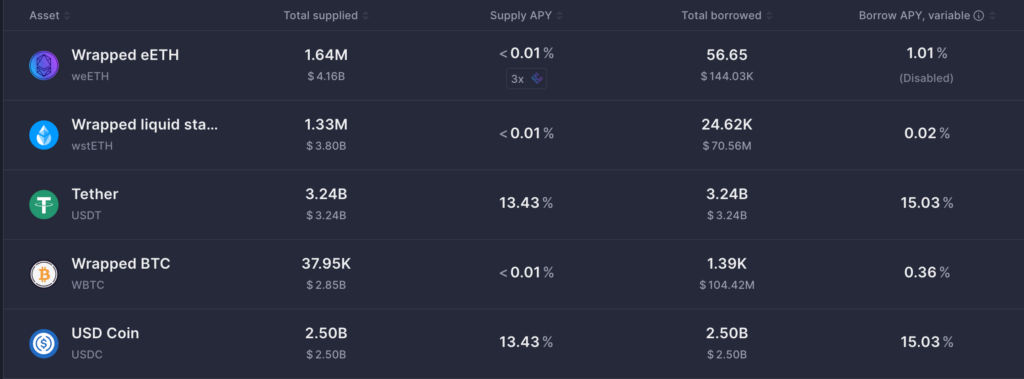
Why did APY (Average Per Chance) surge?
Aave uses the Jump Rate Model for interest rates. The core formula is: Utilization Rate = Total Borrowing / Total Supply.
The optimal utilization rate (U_optimal) of the USDT pool is approximately 92%: below this threshold, the borrowing rate rises linearly and gradually; once it breaks through, the rate enters a steep phase (kink), with an almost exponential surge.
| step | What happened? | Impact on USDT pools |
|---|---|---|
| ① | Depositors are panicking, fearing bad debts held or indirectly exposed by Aave. | USDT Total Supplied Plummets (US$5.4 Billion Withdrawal) |
| ② | Borrowers (especially those using USDT for long positions) are not in a hurry to repay, and some are even borrowing more to hedge their positions. | USDT Total Borrowed Remains Almost Unchanged |
| ③ | With the denominator reduced and the numerator unchanged, capital utilization soared to approximately 99%. | Interest rates plunge into steep zone |
| ④ | Borrowing APY skyrocketed to 15%, and deposit APY followed suit, reaching 13.4%. | The interest rate spread between deposits and loans is approximately 1.6%, indicating a fairly high capital utilization rate. |
Substantial damage to the DeFi sector
LRT / Restaking Track Credit Boost
rsETH, ezETH, and weETH, these LRT (Liquid Restaking Tokens), were originally used as "yield-generating ETH" collateral in various DeFi environments.
As a result, the hackers proved that the casting process could be faked, and the market would reprice all LRT risk premiums.
Aave's risk control capabilities are impaired.
Aave's risk control process for listing new LRTs is questionable: the three lines of defense —LTV, Oracle, and Supply Cap— failed to prevent non-price attacks such as "creation out of thin air." Future LRT listings will likely be more conservative, and the growth rate of TVL in the entire restaking narrative will be cut.
Stablecoin lending cost transmission
Aave USDT is one of the DeFi interest rate benchmarks. A 15% borrowing cost means:
- All delta-neutral strategies collapsed (funding arbitrage, basis arbitrage, borrowing USDT with costs exceeding returns).
- Leveraged revolving loans lead to passive deleveraging (those looping ETH/stETH experience negative cash flow).
- The RWA protocol's lending side has dried up (it originally relied on Aave to borrow USDT to buy US Treasury bonds as a carry trade).
Although it is unlikely to last long, if the situation is not alleviated in time, it could further exacerbate the risk of a chain reaction of liquidation.
Unplug LayerZero OFT
The aftermath of the incident also affected LayerZero's OFT (Omnichain Fungible Token) cross-chain standard. This mechanism allows the same token to flow seamlessly across 20+ chains, but the shared trust infrastructure also means that if one point fails, the entire chain will be shaken.
Several protocols have chosen to directly sever their connection with LayerZero OFT, emphasizing that they have no direct exposure to rsETH and that the suspension is a precautionary measure, with resumption expected in the short term.
This batch of protocols includes: Ethena, Lombard, Euler Labs, TRON DAO, ApeCoin/ApeChain, ether.fi, mETH Protocol, Solv Protocol, MOCA Foundation, and River, totaling more than 10 protocols that have collectively shut down.
 Related reports
Structural damage: Interest rate mechanisms can handle liquidity crises, but not credit crises.
This incident has damaged DeFi not only with the $292 million bad debt figure, but also by exposing several layers of structural problems at the same time.
First, the credibility of the LRT/Restaking sector has been breached. rsETH represents "yield certificates for re-staking ETH," and its value is presupposed to derive from the authenticity of the underlying staked assets. This attack proves that as long as there is a cross-chain bridging vulnerability on the minting side, the entire yield certificate system can be broken by non-price attacks, and such attacks will not leave any abnormal signals at the Oracle layer.
Second, the transmission effect of stablecoin lending costs is already taking effect. Delta-neutral arbitrage positions using USDT to long on ETH are now experiencing negative cash flow as the borrowing APY surges to 14.99%; leveraged looping is being passively deleveraged; and RWA carry trades based on the Aave stablecoin interest rate have seen their carry potential vanish instantly. These chain reactions don't require liquidation events to trigger; they are purely a result of interest rate transmission.
Third, the risk of liquidation cascading still exists, but has not yet been triggered. If the rsETH oracle price drops sharply due to market sell-offs, borrowing positions on Aave secured by rsETH will face liquidation, further depressing the rsETH price and creating a negative cycle. Aave's action of freezing the rsETH market has blocked this path, but at the cost of a forced liquidity lock-up.
Dynamic Zone Viewpoint: Fake Collateral × Real Price = Real Bad Debt; this equation will not change even if the contract is "not compromised".
Kulechov stated that the Aave contract was not compromised, which is true. However, this statement itself illustrates a deeper issue: the security boundaries of DeFi composability are not determined by the strongest piece of Lego, but by the weakest. With rsETH's issuance compromised, Aave's risk control mechanism remained intact, accepting fake collateral, lending out real assets, and incurring real bad debts.
The Jump Rate Model is designed for liquidity crises—when depositors withdraw, rising interest rates attract new deposits and suppress borrowing, bringing the pool back to equilibrium. This mechanism worked effectively in the HTX incident and in the multiple stablecoin decouplings in 2023. However, the core contradiction of a credit crisis is that there is a gap between the book value of collateral and its actual recoverable value, and this gap will not narrow as interest rates rise, but will only widen as the market discovers the truth.
A 14.99% borrowing APY is a signal, not a solution. It tells the market that the funding pool is almost exhausted, but it can't handle the sham collateral that will never be redeemed. Aave's future challenges include: how to absorb bad debts, whether the AAVE collateral in the Safety Module is sufficient to cover the $292 million shortfall, and whether the Supply Cap for LRT-type assets needs recalibration. The answers to these three questions are more important than today's APY figure.