Table of Contents
ToggleThe classroom bell rings, and students file to their seats, but instead of turning on their laptops, they pick up a mechanical typewriter that was phased out at the end of the 20th century from the shelf. This is a real scene in a German class at Cornell University.
According to a report by AP, the instructor, Phelps, began implementing this "analog assignment" in the spring of 2023. Her reasoning was straightforward: "If the assignment is grammatically perfect and wasn't written by you, what's the point of me reading it? Could you write it without a computer?"
For this course, she acquired dozens of manual typewriters from secondhand stores and online markets. Her 7-year-old and 9-year-old children served as "technical support" and also kept an eye on things to make sure no one was using their phones.
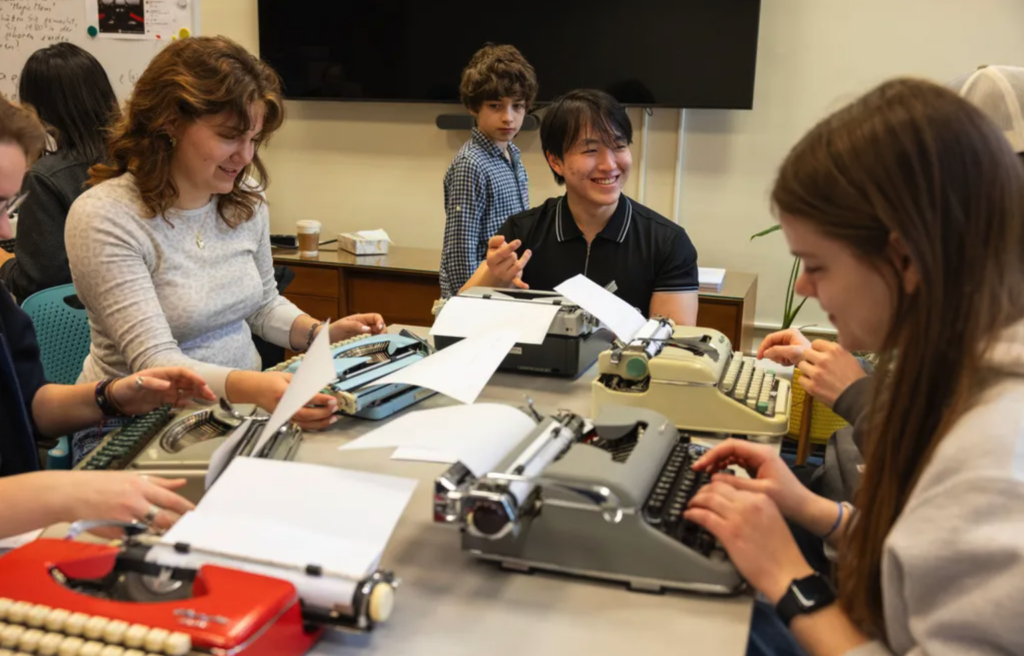
The typewriter taught them things that the screen couldn't.
The report documented the firsthand reactions of several students. Catherine Mong, a 19-year-old freshman, admitted, "I had no idea how a typewriter worked; I'd only seen them in movies." With a broken right hand, she could only type slowly with one hand. In the end, she decided to frame the manuscript, which was covered with X correction marks, and hang it on the wall.
Ratchaphon Lertdamrongwong, a second-year computer science student, had to write a German film review on a typewriter, which gave him a more concrete experience: "Without a screen or notifications, I was forced to think about the problems myself, instead of outsourcing them to AI or Google."
He also observed a long-lost classroom phenomenon: "In the past, people interacted by talking to their classmates and asking them questions. In modern classrooms, everyone is glued to their laptops and phones."
The instructor, Phelps, told AP that this was exactly the effect she wanted:
"Everything has slowed down. It's like the old days when you really did one thing at a time, and doing that thing was fun."
The anti-AI movement is expanding among American universities.
Phelps' typewriter classes are just a microcosm of a larger trend. AP points out that colleges and universities across the United States are launching a wave of "de-digitalization" assessment reforms: returning to paper-and-pencil exams, oral presentations, and on-the-spot handwriting. The core goal is the same: to sever the real-time connection between students and AI.
According to GradPilot, only about 30% of 174 universities in the United States currently have explicit policies on AI use; regulations cannot keep up with the speed of tool adoption. Furthermore, the false positive rate of detection tools used to help teachers determine whether students are using AI is also very high.
Some teachers in the field of writing courses have begun to advocate for the "right to reject AI," demanding that schools guarantee institutional space for human handwritten assignments.
When even thinking is outsourced
Research by BCG and Harvard shows that workers who rely heavily on AI tools for extended periods are prone to cognitive fatigue and may even develop an avoidance tendency towards independent work.
Phelps didn't completely ban AI; she simply set aside one class each semester for students to sit in front of a beeping machine and use their fingers to confirm they still had something to say. The core of this typewriter experiment was: when a tool is powerful enough to do the thinking for you, will you still be able to think for yourself?
The X mark on the manuscript paper is a trace of the thought process, something that AI will never leave behind.
 Related reports
YC's highlighted AI Agent direction: Which applications deserve real attention?
Column | Coinbase CEO: What will happen to the cryptocurrency industry in the next 10 years?