At the end of 2021, Alameda's balance sheet reached a net asset value of approximately US$100 billion, which is still worth US$50 billion after excluding related assets such as SRM. However, due to insufficient hedging of the market, its assets have depreciated by more than 80% this year with the market crash.
Original title: " FTX Pre-Mortem Overview "
By Sam Bankman-Fried
Compiler: Lynch
Summary
In mid-November 2022, FTX International is effectively bankrupt. The FTX saga is, after all, a story between Voyager and Celsius.
These three things combined to eventually lead to the implosion.
a) During 2021, Alameda's balance sheet grows to approximately $100 billion in net asset value, with $8 billion in net borrowings (leverage), and $7 billion in liquidity on hand.
b) Alameda failed to adequately hedge its market exposure. Over the course of 2022, a series of large-scale market crashes, both in stocks and cryptocurrencies, caused the value of its assets to drop by about 80%.
c) In November 2022, an extreme, fast, targeted crash facilitated by the CEO of Binance left Alameda insolvent.
Then the situation in Alameda spread to FTX and other places, similar to 3AC and so on, and finally affected Voyager, Genesis, Celsius, BlockFi and Gemini and so on.
Still, there is potential for more objective recovery funding. FTX US remains fully solvent and should be able to refund all client funds. FTX International has billions of dollars in assets, and I dedicate almost all of my personal assets to clients.
some key points
This article is a discussion about the solvency of FTX International.
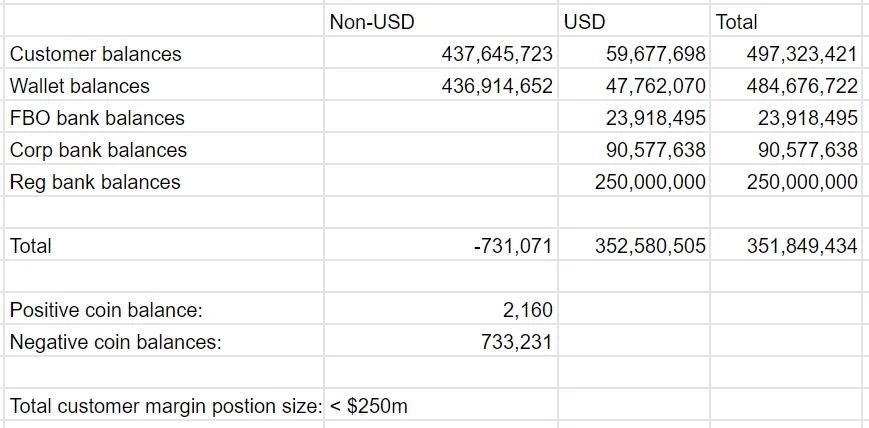
This has nothing to do with FTX US because FTX US is fully solvent and always has been. When I turned FTX America over to Ray and the bankruptcy protection team, it had about $350 million in net cash on hand in addition to client balances. Its funds and clients are segregated from FTX International.
But the absurdity is that FTX US users have not been compensated and have not gotten their funds back.
Here is my balance sheet record when I handed over FTX US:
FTX International is a non-US exchange that operates, is regulated, is incorporated outside the United States, and accepts non-US clients outside the United States.
(In fact, its headquarters is in the Bahamas, incorporated and operated locally in the Bahamas as FTX Digital Markets LTD).
US clients are on the (still solvent) FTX US exchange.
Senators have raised concerns about potential conflicts of interest with Sullivan & Crowell (S&C). Contrary to the statements of S&C, one of the two main law firms of FTX International prior to bankruptcy, and the main law firm of FTX US, their "relationship with FTX is limited and mainly transactional." The CEOs of FTX US are from S&C, they have worked with FTX US on their most important regulatory filings, they have worked with FTX International on some of their most important regulatory issues, and they have worked with FTX US on their most important transactions . When I'm in New York, I sometimes work in the S&C office.
S&C and GC are the main parties, threatening me to appoint a candidate of their own choice as CEO of FTX, including solvent FTX US, who subsequently filed for Chapter 11 bankruptcy proceedings and chose S&C as the debtor entity consultant.
Despite being bankrupt, and despite processing approximately $5 billion in withdrawals in its last days of operation, FTX International still retained substantial assets, approximately $8 billion in various liquid assets as of the time Ray took over.
In addition, there are many potential financing proposals, including a letter of intent signed after filing for bankruptcy protection, totaling more than $4 billion. I believe that given FTX International Inc. a few weeks, it would likely be able to use its illiquid assets and equity to raise enough capital to essentially compensate clients.
However, since the S&C pressured FTX to file for Chapter 11 bankruptcy, I worry that those avenues may have been abandoned. Even now, I believe there is a real possibility that clients will be substantially compensated if FTX International is relaunched.
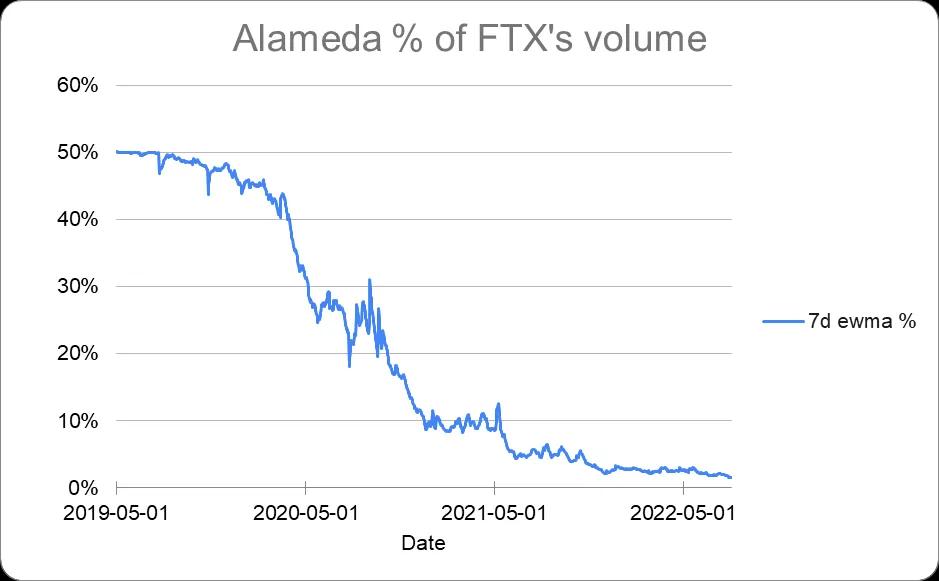
Although FTX's liquidity has mainly relied on Alameda from 2019, by 2022, FTX's liquidity has been diversified, and Alameda's trading volume in FTX has dropped to about 2%.
I didn't steal funds, and I certainly didn't stash billions of dollars. Almost all of my assets, past and present, can be used to support FTX clients. For example, I offered to contribute substantially all or 100% of my personal shares in Robinhood to the client if the bankruptcy team would honor my D&O legal fee recovery coverage.
Both FTX International and Alameda are legitimate and independently profitable businesses in 2021, each making billions.
Then, Alameda loses about 80% of its asset value during 2022 due to a series of market crashes, just like 3Arrows Capital (3AC) and other cryptocurrency companies did last year. And since then, its assets have dropped even more in a targeted attack. FTX was affected by Alameda's decline, just as Voyager and others were affected earlier by 3AC and others.
Note that in many places in the text I am still forced to make approximate judgments. Many of my personal passwords are still held by the Chapter 11 bankruptcy team, not to mention data. If they want to add data to the conversation, I'd welcome that.
Also, I haven't run an Alameda in the past few years.
So, a lot of it is an afterthought, from models and approximations, generally based on data from before I stepped down as CEO, and models and estimates based on those data.
Overview of what happened
2021
Over the course of 2021, Alameda's net worth has skyrocketed, with a market value of roughly $100 billion by the end of the year, according to my models. Even if you ignore assets like SRM, whose fully diluted assets are much larger than float, I think it's still about $50 billion.
And during 2021, Alameda's position is also growing.
In particular, I think it has about $8 billion in net borrowing, which I think is spent on:
a) About $1 billion in interest payments to lenders
b) About US$3 billion to buy out the FTX shares held by Binance from the original investment list of FTX
c) Approximately $4 billion in venture capital
(What I mean by "net borrowing" basically refers to borrowing minus current assets on hand that can be used to repay the loan. This net borrowing in 2021 mainly comes from third-party lending platforms, such as Genesis, Celsius, Voyager etc., not margin trading from FTX).
So by early 2022, I believe Alameda's balance sheet will look roughly as follows.
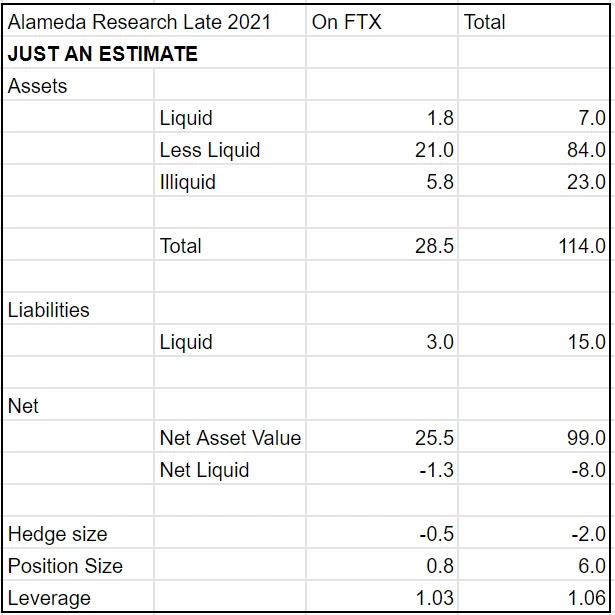
a) Net worth of about $100 billion
b) About $12 billion of liquidity comes from 3rd party desks (Genesis, etc.).
c) ~$10 billion in liquidity
d) ~1.06x leverage
In this case, $8 billion in illiquid positions (with tens of billions of dollars in available credit/margin from 3rd party lenders) seems reasonable and not very risky. In my opinion, Alameda's SOL alone is sufficient to cover the net borrowing. And, it's from the 3rd party lending desk, and I'm told, they all received Alameda's exact balance sheet.
I think its position in FTX International was reasonable at that time. According to my model, it was about 1.3 billion US dollars, with tens of billions of dollars of assets as collateral, and FTX successfully passed the GAAP audit at that time.
Well, it would take a 94% market crash by the end of 2021 to drag Alameda underwater! And it's not just SRM and things like that, Alameda still has a lot of overcollateralization if you don't take that into account. I think its SOL position alone is more leveraged than it is.
But Alameda failed to adequately hedge the risk of an extreme market crash: only a few billion dollars of its hundreds of billions in assets were hedged. Its net leverage ([net position - hedge]/net asset value) was about 1.06 times; it was long the market at the time.
So, in theory, Alameda faces an extreme market crash, but it would take something like a 94% crash to make it bankrupt.
Market Crash in 2022
So, roughly what Alameda looks like going into 2022:
1. Net worth of $100 billion
2. $8 billion in net borrowing
3. 1.06 times leverage
4. Tens of billions of liquidity
Then, over the course of the year, the market crashed again and again. Alameda repeatedly failed to adequately hedge its position until midsummer.
- BTC plummeted by 30%.
- BTC plummeted another 30%.
- BTC plummeted again by 30%.
- Rising interest rates dampen global financial liquidity
-Luna returns to 0
-3AC Liquidation
- Alameda's co-CEO resigns
-Voyager liquidated
-BlockFi almost went bankrupt
-Celsius Corporation collapses
-Genesis goes out of business
- Alameda's borrowing/loan liquidity to decline from ~$20 billion at end-2021 to ~$2 billion at end-2022
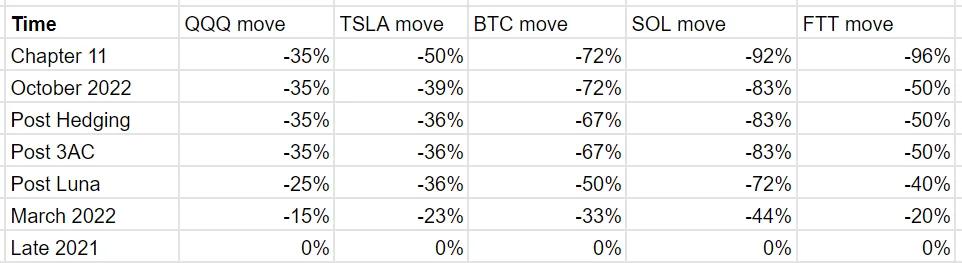
As a result, Alameda's assets have been hit again and again. But this part is not specific to Alameda's assets. Bitcoin, Ethereum, Tesla and Facebook are all down more than 60% this year; shares of Coinbase and Robinhood are down about 85% from their peaks last year.
Keep in mind that Alameda has roughly $8 billion in net borrowing by the end of 2021:
a) About $1 billion in interest payments to lenders
b) About US$3 billion to buy out the FTX shares held by Binance from the original investment list of FTX
c) Approximately $4 billion in venture capital
This net borrowing of $8 billion, minus several billion dollars of hedging, results in an excess leverage/net position of about $6 billion, backed by about $100 billion in assets.
As the market crashes, so do those assets. Alameda's assets, which include a portfolio of altcoins, crypto companies, stocks and venture capital, are down about 80% over the year, which has boosted its leverage little by little.

At the same time, liquidity dried up in lending markets, public markets, credit, private equity, venture capital, and pretty much everywhere. Over the past year, nearly every source of liquidity in the crypto space — including nearly every lending platform — has collapsed.
This means that by the fall of 2022, Alameda's liquidity has dropped from tens of billions of dollars at the end of 2021 to a few hundred million dollars in the single digits. Most other platforms in the space have fallen or are in the process of falling, with FTX being the last survivor.
In the summer of 2022, Alameda ends up heavily hedged on some combination of BTC, ETH and QQQ (NASDAQ ETF).
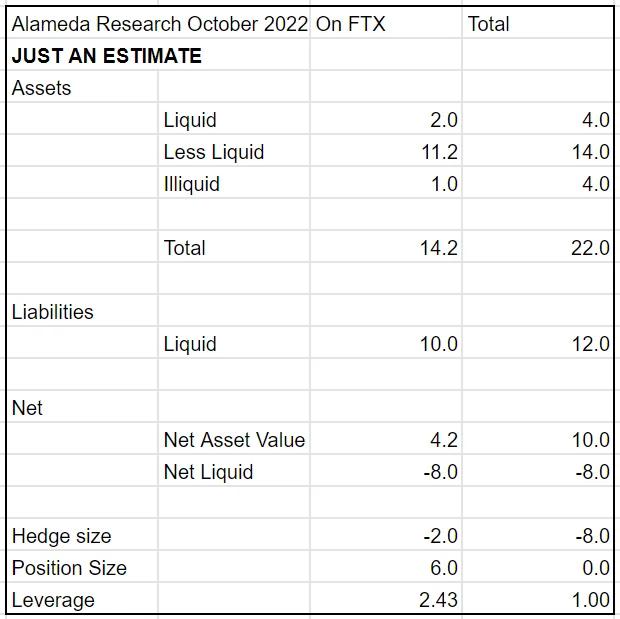
But even after all the market crashes in 2022, shortly before November, Alameda still had about $10 billion in NAV; NAV was positive even if you exclude SRM and similar tokens, it ended up being hedged .
margin trading
During 2022, due to the surge in margin positions, many crypto platforms went bankrupt, including Voyager, Celsius, BlockFi, Genesis, Gemini, and eventually FTX.
This situation is quite common on margin trading platforms; among other things, it also occurs in:
- Traditional finance: LME (London Metal Exchange), MF Global (Ming Fu Global), LTCM (Long Term Capital Management), Lehman (Lehman event)
- Crypto industry: OKEx, OKEx again (basically every week of the year), CoinFlex, EMX, Voyager, Celsius, BlockFi, Genesis, Gemini, etc.
The crash that happened in November
CZ's decisive tweet follows an extremely effective months-long PR campaign against FTX and the crash.
Until the FTX crash in November, QQQ was about half the size of Alameda's portfolio and BTC/ ETH was about 80%, meaning Alameda's hedge (QQQ/ BTC/ ETH) was somewhat effective . The hedges weren't big enough until the 3AC crash, but in October 2022, unfortunately, they finally are.
But the rout in November was a targeted attack on Alameda's holdings, not broad market volatility. In a few days in November, Alameda's assets fell by about 50%; Bitcoin fell by about 15% to only 30% of Alameda's assets, and QQQ was completely unchanged. As a result, the bigger hedge Alameda ended up taking over the summer didn't work. It helped every crash that year, but not this one.
Over the course of the 7th and 8th of November, things went from tense but mostly under control to eventually becoming clearly insolvent.
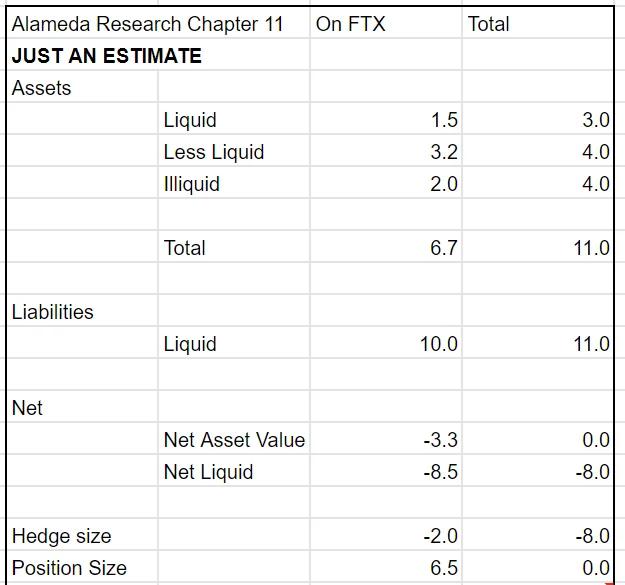
As of November 10, 2022, Alameda will only have ~$8 billion (only semi-liquid) assets left on its balance sheet, and roughly the same amount of current liabilities, ~$8 billion:
A bank run requires immediate liquidity, and Alameda has none.
This fall, Credit Suisse fell nearly 50% on the threat of a bank run. The threat of a bank run. At the end of the day, its run on the banks was unsuccessful. FTX does not.
So as Alameda became illiquid, so did FTX International, since Alameda had a margin position on FTX; and the bank run turned that illiquidity into insolvency.
That means FTX joins Voyager, Celsius, BlockFi, Genesis, Gemini, and others suffering collateral damage as borrowers' liquidity crunches.
All of this is for illustration: no funds were stolen. Alameda lost money by not adequately hedging the market, as 3AC and others have done this year. FTX has been affected, as Voyager and others have been affected earlier.
end
Even so, I think FTX has the potential to compensate all clients if there is a concerted effort to raise liquidity.
When Ray took over, the company received billions of dollars in financing offers, and has since received more than $4 billion in financing offers.
Had FTX been given a few weeks to raise the necessary liquidity, I believe it could have substantially compensated clients. What I didn't realize at the time was that Sullivan & Cromwell had the potential to undo these efforts by putting pressure on Ray and filing for Chapter 11 bankruptcy protection (including for solvent companies like FTX US). I still think it would be possible for clients to be substantially compensated if FTX International were to relaunch today. Even if they don't, there are tons of assets available to clients.
Many of these were data from a company (Alameda) that I was not running at the time. I regret that I have been slow to respond to public misunderstandings and material misstatements. It took me some time to piece together what I could, I don't have and don't have access to much relevant data, a lot of it from a company I wasn't running at the time (Alameda).
I have been planning to give my first substantive account of what happened when I testify before the House Financial Services Committee on December 13th. Unfortunately, the DOJ moved to arrest me the night before, preempting my testimony with an entirely different news cycle. Either way, the draft testimony I was going to give leaked.
I still have a lot to say about why Alameda failed to hedge, what happened to FTX US, what led to bankruptcy proceedings, S&C, etc. But at least it's a start.