Original article by Odaily Odaily( @OdailyChina )
Author|Golem ( @web3_golem ) 
Crazy Monday! After 3 months, Bitcoin has once again broken the $80,000 mark.
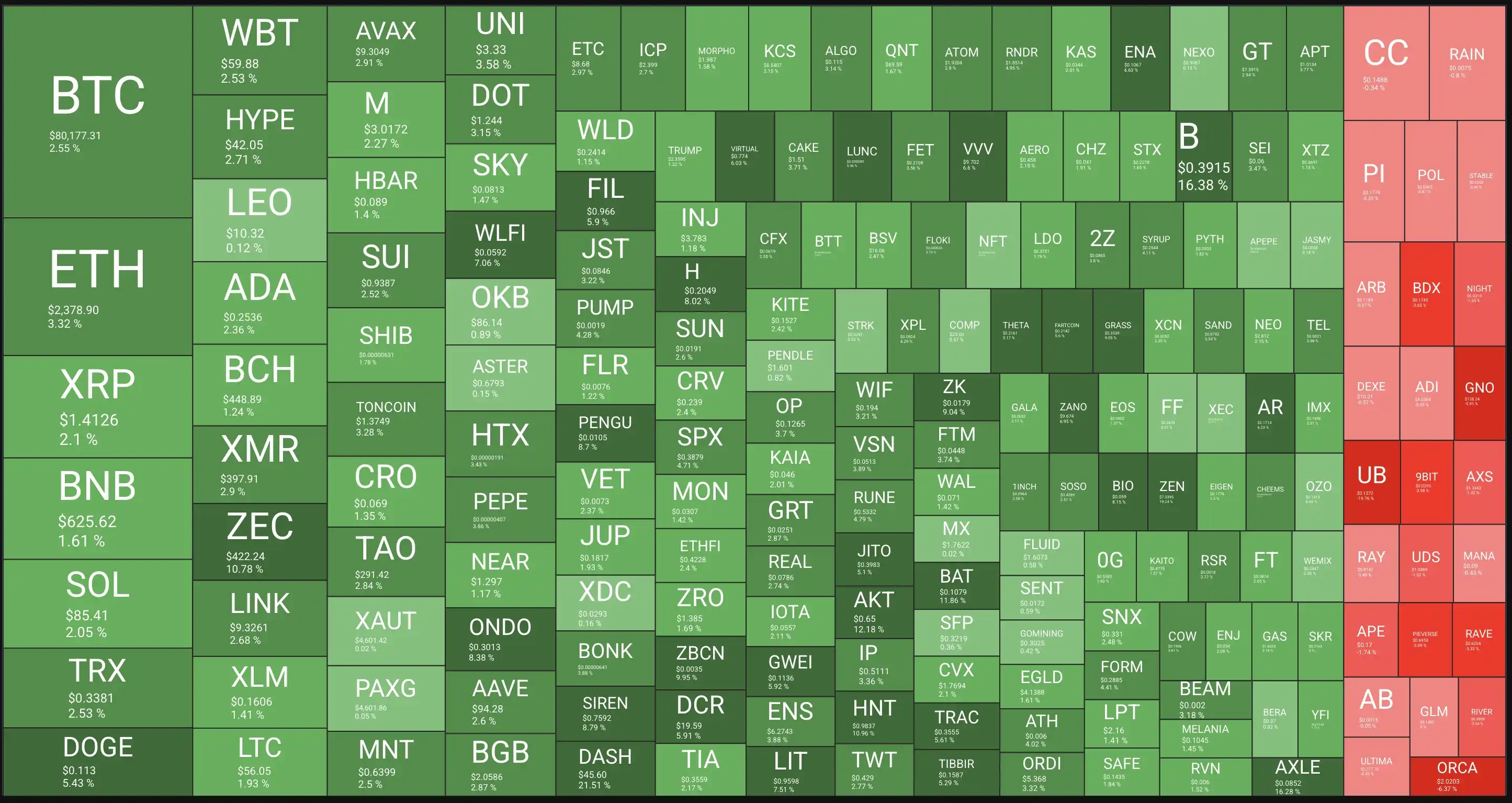
The Altcoin market has also recovered. According to Quantify crypto data, in the past 24 hours, more than 80% of the top 200 Altcoin by market capitalization have risen to varying degrees, with DOGE rising by more than 5.43%, ZEC rising by more than 10.78%, and WLFI rising by more than 7.06%.
In terms of derivatives, according to Coinglass data, $286 million in positions were liquidated across the network in the past 12 hours, mainly short positions, amounting to $251 million. The liquidations occurred when Bitcoin broke through $80,000. In addition, $152 million in BTC and $75.5 million in ETH were liquidated.
This rally wasn't exclusive to the crypto market; Asian stock markets opened sharply higher on Monday, with the MSCI Asia Pacific Index rising 1.9%, erasing losses since the Iran war. Tech stocks rebounded, with SK Hynix shares surging nearly 10%, TSMC jumping over 6%, and Hong Kong-listed tech stocks also rising collectively, with Xiaomi Group up over 10% and Alibaba (09988.HK) up over 6%.
Meanwhile, according to Gate data, WTI crude oil and Brent crude oil prices also saw slight declines, with WTI crude oil prices remaining around $101 per barrel.
When both the cryptocurrency and stock markets rose on Monday, and oil prices also fluctuated slightly, investors familiar with the situation probably guessed that it was financial market manipulator Trump who had intervened again.
Markets anticipate that Trump's "Operation Freedom" could open the Strait of Hormuz.
On the evening of May 3, Eastern Time, Trump announced that he would begin assisting ships to leave the Strait of Hormuz starting Monday (Middle East time). He stated that many countries unrelated to the current Middle East disputes were requesting the United States to release ships blocked in the Strait of Hormuz; in order to provide humanitarian assistance, the United States would safely guide their ships out of the restricted waters, and named this operation "Project Freedom."
Following Trump's statement, the U.S. Central Command also announced that it would provide military support for the operation to clear stranded ships in the Strait of Hormuz, including guided-missile destroyers, more than 100 land-based and sea-based aircraft, multi-domain unmanned platforms, and 15,000 troops, stating that this move was in response to Iranian military attacks on merchant ships passing through the strait.
Trump's unilateral actions naturally angered Iran. As early as May 2nd, Ali Nikozadeh, Deputy Speaker of the Iranian Islamic Parliament, emphasized in an interview along the Strait of Hormuz that Iran would absolutely not back down from the Strait of Hormuz, and stated that the parliament had already approved a "Strait of Hormuz Management Law," which includes provisions such as permanently banning Israeli ships from passing through this crucial waterway, requiring ships from "hostile countries" to pay "war reparations" for passage, and requiring other ships to obtain Iranian authorization for passage.
Therefore, Iran views Trump's "Operation Freedom" as a violation of US jurisdiction over the Strait of Hormuz. Shortly after Trump announced "Operation Freedom," Ibrahim Aziz, chairman of the Iranian Islamic Parliament's National Security and Foreign Policy Committee, stated that any US intervention in the new maritime order in the Strait of Hormuz would be considered a violation of the ceasefire agreement.
On April 8, the United States and Iran signed a two-week temporary ceasefire agreement. As the ceasefire was set to expire on April 21, Trump announced its indefinite extension to allow for continued negotiations with Iran. Although a ceasefire has been implemented, control of the Strait of Hormuz has remained in Iranian hands during this period, and it has never been fully opened for passage.
In terms of consequences, if Trump forces "Operation Freedom," the current situation between the US and Iran could escalate from negotiations back into armed conflict. Not only would the Strait of Hormuz become impassable, but in the long run, the impact of war on global financial markets would be far greater than today's gains.
Of course, whether the outspoken Trump will actually implement the "Operation Freedom" plan remains uncertain. It is currently Monday morning (May 4th) Middle East time, but there are no reports of the US military successfully escorting merchant ships through the Strait of Hormuz. Is this yet another classic TACO (Trump Always Chickens Out) deal? (Related reading: Did he win or lose the war? Trump: I profited )
Iran seems to be accustomed to this Trump-style "boy who cried wolf" narrative. Iranian scholar Seyed Mohammad Marandi stated in late March, when Trump posted about manipulating oil prices, that "Trump makes these kinds of statements every week when the market opens to suppress oil prices ." Therefore, Ibrahim Aziz also dismissively remarked when Trump announced the "Freedom Plan," saying that no one would believe such a "blame-shifting" tactic.
While it remains to be seen whether "Operation Freedom" will actually be implemented, Trump's eagerness to restore normal passage through the Strait of Hormuz is evident, as this not only involves the national interests of the United States but also concerns whether Trump can maintain his presidency.
On May 3, according to the latest ABC/Washington Post/Ipsos poll, Trump's disapproval rating reached 62%, the highest in his two terms. With the midterm elections approaching, this approval rating is quite unfavorable for Trump, so he urgently needs a performance to turn the tide. Reopening the Strait of Hormuz would be the most ideal goal (although the current problems are also his own doing).
On the one hand, externally, opening the Strait of Hormuz is another demonstration of the United States' global deterrent power. Trump can package it as a complete victory over Iran, showcasing America's strength. On the other hand, domestically, restoring passage through Hormuz could lower global oil prices, quell discontent among the American public and related stakeholders. Simultaneously, lower price levels could increase the chances of newly appointed Federal Reserve Chairman Warsh persuading other officials to agree to an interest rate cut at the June policy meeting, injecting vitality into the market. ( Related reading: Powell's farewell may not be a departure, Trump's rate cut plans may fall through )
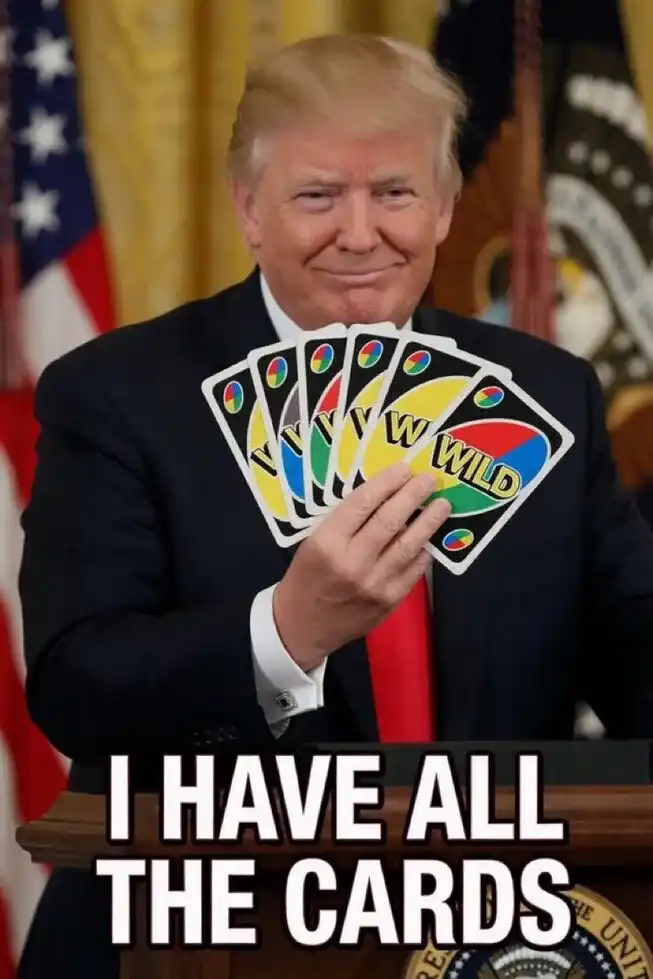
On the morning of May 4th, Trump posted a photo on Truth Social showing him holding several cards, captioned "I have all the cards." On the surface, this appears to be confidence, but often those who have the least chance of winning are the ones who most like to bluff.