Source: Bitcoin Magazine
Compiled by: Felix, PANews
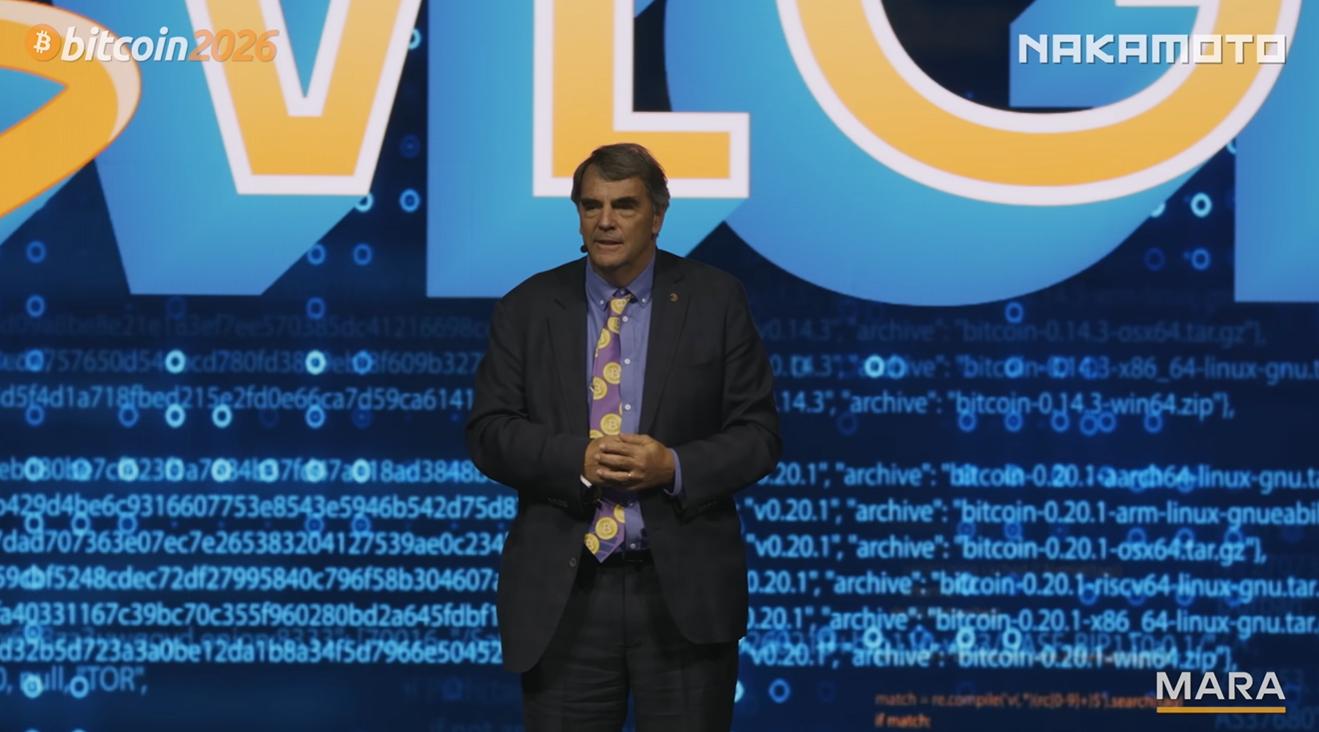
Tim Draper, the Silicon Valley "godfather of venture capital" and billionaire, delivered a keynote speech at the Bitcoin 2026 conference, explaining why holding Bitcoin has transformed from an opportunity into a necessity. Drawing on his disastrous experience on the Mount Gox exchange, the record-breaking auction bidding by the U.S. Marshals Service, and decades of experience in Silicon Valley, Draper illustrated the necessity of the transition from the U.S. dollar to stablecoins and then to Bitcoin.
PANews has compiled the following summary of the speech.
Folks, it's so exciting to see you all, because when everyone runs to the banks saying, "I don't want dollars, I want Bitcoin," you'll be the survivors of this apocalyptic catastrophe. So, you'll be left behind. Anyway, this conference was really fun, truly amazing. I saw Daniel and Eric Tedros, who created Liberty City, where they're building Bitcoin homes. I also saw all sorts of startups developing new Bitcoin projects and more. I saw many people creating a new economic model that will lead us to an anthropological leap. So, this is going to be an extraordinary time; we've experienced ups and downs. Suddenly, we're in the mainstream. How is this possible? Banks want their customers to hold Bitcoin. Governments are rolling out a little red carpet for us all. I think we're all starting to feel this happening, and it's incredibly exciting.
So, what exactly happened? Actually, I've always believed that cryptocurrencies would emerge, and it was mentioned as early as around 2002. A Korean friend of mine said everyone was playing a game called *Lineage*, and he even bought it for his son. He said he once hired someone to control his in-game character while he was at work (as his virtual avatar). I thought, "Wow, that's really important to him." His son wanted a sword as a birthday present, so he bought him one. I was a little confused and asked him what the logic was. He replied, "No, the sword is just the pixels on the screen." So I started connecting the dots: you buy some virtual product with fiat currency, and eventually, cryptocurrencies might appear.
I was once fascinated by this idea. Then Bitcoin came along. Satoshi Nakamoto figured it all out. He created a way to transact without a trusted third party, allowing you to do so without banks or governments. He essentially opened up the entire system and made it permanently maintain a perfect, immutable record. That deeply impressed me.
I bought a lot of Bitcoin at the time, but then the Mount Gox incident happened, and I lost it all, even experiencing situations where others beat me to it. I thought Bitcoin was finished. But when news broke that Mount Gox had collapsed and all the money had been taken, Bitcoin only dropped by about 10% to 15%. I thought to myself, "My God, who would need this stuff?"
At first, I thought Bitcoin was only used for trading illegal drugs and guns, but as I delved deeper, I discovered that people use it for remittances, and businesses use it to pay those without bank accounts. Small communities in Africa and Southeast Asia have integrated into the global economy through Bitcoin. I thought, "Wow, this is much more important than we realize." So I decided to keep buying more Bitcoin.
Later, my friends were all talking about the upcoming Bitcoin auction by the U.S. Marshals Service. They were discussing how much of a discount they could get on Bitcoin. I thought to myself, "If things really go as I expect, it doesn't really matter how much I pay." So I bid above market price and ended up buying more Bitcoin than I had imagined.
From that moment on, I became a staunch believer. I followed Bitcoin's rise and fall, through forests and hills. Then, it suddenly dawned on me, and this idea is now spreading, becoming part of the zeitgeist. I realized: we will start with the US dollar, then move to stablecoins, and finally to Bitcoin.
Let's start with the US dollar. Because the dollar is controlled by the government. This trusted third party is the bank. By the way, have you ever seen these banks? They have glass-walled, steel-structured buildings, and the people coming and going are well-dressed and live extravagant lives, yet they don't provide much service. So, you might think, okay, hopefully there'll be a way to operate differently. And so, we have stablecoins, which allow funds to flow through the system much faster. But it's still pegged to the government and still inflated with government spending. It's not under our control. It doesn't appreciate in value; it's an asset that depreciates over time. So, I just hold onto my Bitcoin and watch it soar higher and higher. Of course, it's cyclical, fluctuating with halving cycles, but the overall trend is upward.
I started thinking about what the future would be like, and suddenly an image flashed into my mind. When I was about 10 years old, my dad gave me a million-dollar bill. I exclaimed, "Wow, a million dollars! What can I do with that? That's so cool!"
He said, "There's nothing we can do." I asked, "What do you mean? There's nothing we can do?" He said, "This is a million dollars from the Confederate States of America. The Confederate States of America lost the war to the Union. All Confederate currency became increasingly worthless, and everyone wanted Union dollars. Confederate currency suffered severe inflation and eventually became worthless."
Fast forward to now. I think it's very likely that this will happen: retailers will start saying, "I accept Bitcoin." Then they'll make more money by holding Bitcoin (we all know that). Next, retailers will say, "I only accept Bitcoin." At that point, there will be a bank run. Everyone will rush to the banks, withdraw their money, and exchange it for Bitcoin. This could be a catastrophic event.
So I'm saying different things to people now. Before, I'd say, "Hey, buy some Bitcoin, it's fun, worth holding." Now I'll say, "You'd better hold Bitcoin." If you want to protect your family, protect your company, protect your country, you have to hold some Bitcoin.
In fact, for a company with substantial cash reserves, it would be irresponsible not to allocate 5%, 10%, or even 15% of its assets to Bitcoin. When Silicon Valley Bank collapsed, we witnessed a near domino effect; the entire banking system nearly collapsed. If that were to happen, as a business leader, you would be responsible for at least two weeks, or even four weeks, of payroll. If you were in Europe, you might even be responsible for several years' worth of salaries.
Therefore, you'd be better off holding some Bitcoin on your balance sheet so you can pay salaries and keep your business running. If you're managing household finances, you should hold about six months' worth of Bitcoin for living expenses. Because what if your dollars suddenly become worthless? If you're a government and your country experiences hyperinflation like the Argentine peso or the Nigerian naira, your government treasury would become worthless if you didn't hold any Bitcoin.
So my attitude has shifted from "Hey, this is a really interesting investment opportunity" to "If you don't hold Bitcoin, you should be scared. You should be very worried." The world doesn't stand still. As a venture capitalist, host of the talk show *Meet the Drapers*, and a university leader, one thing I've learned is that the world changes incredibly fast, and we all have to be prepared to adapt to this ever-changing world. We are about to experience a major human revolution comparable to the invention of money, which will make the world richer. But those of us who hold Bitcoin will be key figures in guiding the world back on track after this catastrophic event.
So go buy Bitcoin, tell all your friends and family to buy Bitcoin, tell all your affiliated businesses to buy Bitcoin, tell your governments to buy Bitcoin, so we won't encounter this potentially terrifying catastrophe. I'm rarely afraid, I'm almost fearless, but this event is indeed a bit scary.
Take action! You've come to the right place. Right here, look around, these people see the future. So now you must go and preach; it's time to tell the world. If you're an entrepreneur, push it as hard as you can. If you manage a household, make sure you have enough Bitcoin for six months' expenses in your coffers. If you run a business, make sure you have at least one month's worth of reserves. If you're a government, make sure you have enough reserves to keep the government stable after a catastrophic event.
Related reading:Full text of Arthur Hayes' latest speech: From AI deflation to wartime inflation bullish, Bitcoin year-end target price $125,000.