TechFlow Summary: Joe Schmidt IV, a partner at a16z, published an article directly criticizing Workday, an HR software giant with nearly $10 billion in annual revenue: its moat looks deep, but its underlying architecture is stuck in 2005, and AI overlays can't save it.
The article dissects why Workday's four-layer defense system (integration binding, proprietary configuration, consulting ecosystem, and multi-year contracts) is simultaneously weakening, and outlines six key product features and implementation paths for an AI-native HCM system. This is a typical publicly released a16z investment paper, explicitly calling on entrepreneurs to build the next generation of Workday.
Workday is probably the most important, yet also the least popular, enterprise software product. More than 10,000 companies use it, tens of millions of employees are stuck in it every day, annual revenue is approaching $10 billion, and market value is about $30 billion.
These numbers have nothing to do with how well the product works. An HR administrator's daily routine is like this: running reports across three pages, managing payroll cycles in Excel because the system is too complex, monitoring business partners' promotion processes step-by-step with Zoom open, and waiting for IT to explain which integration crashed this week.
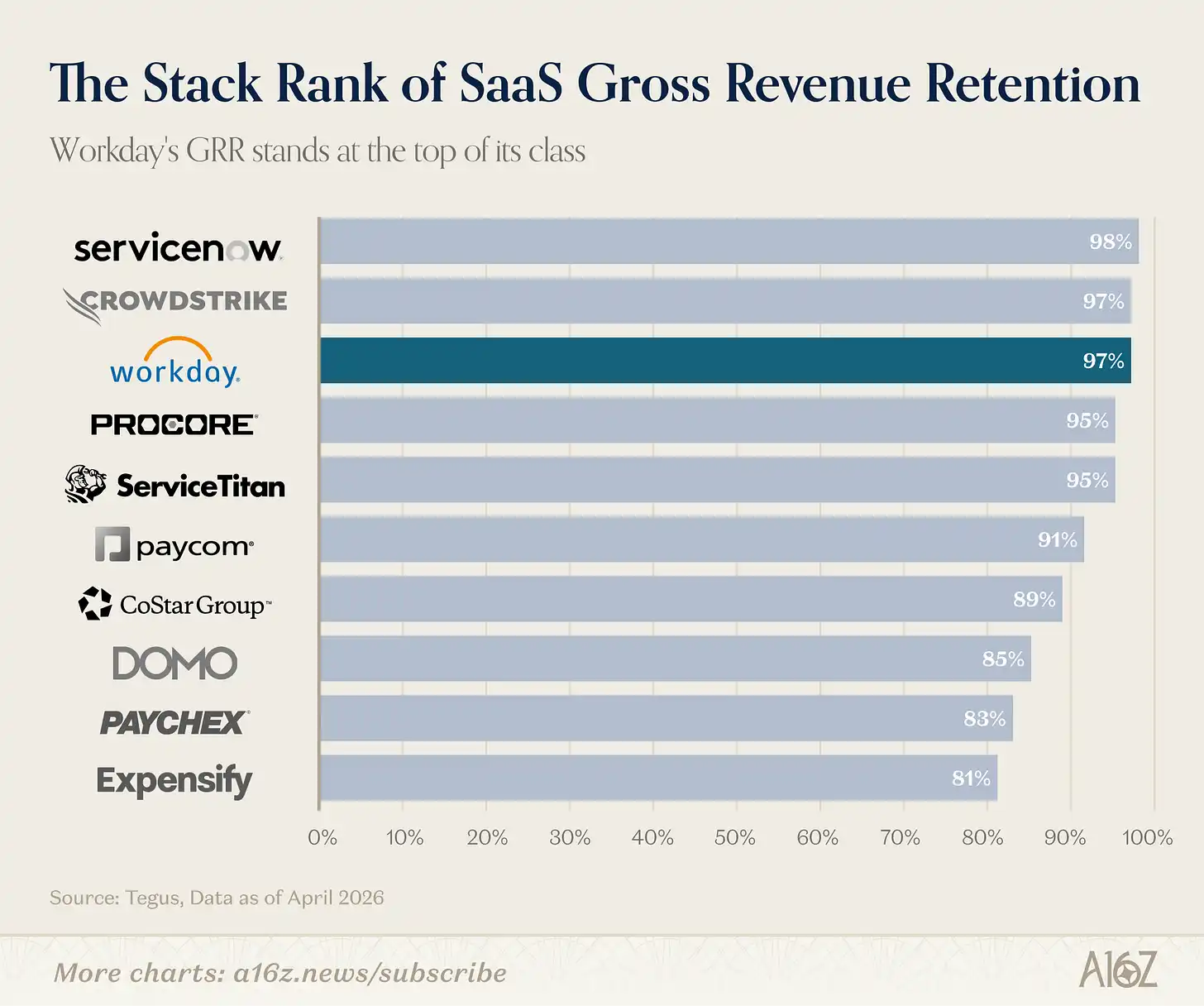
A near 100% customer renewal rate would generally be interpreted as a sign of a good product. But Workday's situation is different—the high renewal rate is because people who want to leave can't.
HCM (Human Capital Management) is the last area in the large enterprise software category without a native AI challenger.
This situation is about to change. A transformation far greater than the platform migration that gave birth to Workday is underway, and Workday's end is near.
Cloud migration has created Workday
Workday itself is a product of platform transformation. In 2005, after PeopleSoft, which dominated the market at the time, was hostilely acquired by Oracle, its two founders, Dave Duffield and Aneel Bhusri, bet that the migration from client/server architecture to multi-tenant cloud would reset the HRIS (Human Resources Information System) category.
They judged that Oracle and SAP couldn't catch up in terms of architecture, and that within ten years, all client/server architecture HRIS systems would become legacy maintenance services. At the same time, they saw large enterprises shifting from large upfront capital expenditures to predictable annual operating expenses, and from outright license purchases and self-built data centers to subscription models.
Workday won on two fronts simultaneously: it was the only mainstream HRIS designed from day one with a multi-tenant cloud architecture, and its pricing model perfectly aligned with the shift in enterprise procurement towards subscription models. Within a decade, it became the default choice.
Why is Workday so hard to shake?
Over the past two decades, every serious attempt to penetrate the enterprise-level Workday market has failed for the same reason: Workday's moat lies not in the product itself, but in everything surrounding it.
Workday is deeply intertwined with technology and human resources. It sits at the center of hundreds of integrations—payroll, benefits, ATS (Appointment Tracking System), expense reports, identity verification, finance, state taxes—none of which can be cleanly migrated. Each instance is built on thousands of hours of muscle memory: an administrator has been running the same performance cycle for four consecutive years, and a payroll manager has memorized the seventeen-step performance payout process.
Adding a new cost center can affect reporting, integration, job structure, salary levels, and benchmarking systems, and it will only work if all systems and all people are updated in sequence.
Dedicated configuration layer. Workday's configuration method differs from most enterprise systems. Integration is built using Workday Studio—a proprietary tool with a deployment cycle of 6 to 18 months, requiring a certified consultant to operate it. Reports run on Workday's own BIRT implementation, calculated fields use Workday's own expression syntax, and tenant configuration utilizes the platform's unique business processes and security framework.
These skills have no market outside the Workday ecosystem: there's no open-source community, no Stack Overflow, and developers and clients who hire them are locked into their own resumes.
Consult Cartel. Over 10,500 certified consultants worldwide workday implementations at Accenture, Deloitte, Kainos, PwC, KPMG, and more than 150 smaller service providers. A project takes 6 to 18 months and costs between $300,000 and over $1 million , with implementation fees typically equal to 100% of the annual software cost.
This service economy may be more valuable than the products themselves—it lobby for Workday, absorbs customer complaints, and gives the world's largest company a vested interest in maintaining Workday.
Workday locks its clients into multi -year contracts . Even if a client wants to switch tomorrow, they are structurally forced to wait until the contract expires.
With its four-layer architecture, Workday boasts one of the highest total revenue retention rates among enterprise software, making it one of the most difficult products for most large enterprises to remove.
Why is it the window of opportunity now?
Some might say, "For twenty years, challengers have come and gone, but Workday just can't break through." That's true. New players either target startup clients (the path taken by Rippling and Gusto) or enter a difficult niche market (Deel focuses on cross-border employment).
Workday was also busy. In 2025, under the Illuminate brand, it released more than 25 AI features, launched more than a dozen intelligent agents, acquired Sana Labs and Pipedream, and launched the Flex Credits pricing model based on usage. Accenture, Nike, and Merck all signed contracts with it. AI ARR exceeded $400 million, with triple-digit year-on-year growth.
However, Flex Credits and "AI ARR" are more like procurement innovations than product innovations. Signing up for Flex Credits and using AI agents to run core HR processes in a production environment are two different things.
The reason for Flex Credits' existence is very practical: every enterprise CIO and CFO has "AI investment" in their 2026 KPIs, which needs to be proven by actual expenditures; and in the earnings calls of every traditional software vendor, "AI revenue" is the first figure asked.
Flex Credits is a procurement structure that both parties need—the customer commits to a credit pool, which is included in the AI expenditure budget; Workday records the commitment as AI ARR; as for which agent runs which process, that's up to Illuminate to come up with something useful. Both sides meet their KPIs, no one needs to commit to specific deployments, and then they can celebrate signing the contract together.
Don't just listen to us. A major Workday service partner recently wrote, "Most organizations are unaware that these capabilities exist, let alone how to activate them." Customers have begun to resist paying incremental token fees on top of their already renewed subscriptions.
Long-term Workday administrators we spoke with described Illuminate as: the same manual management work wrapped in a chat interface. Each Illuminate feature is an additional layer superimposed on the same form approval engine—AI ARR can grow by triple digits, while the underlying product remains unchanged.
But this time was different. All three variables changed simultaneously, finally exposing Workday's weakness.
First, enterprise IT is finally re-evaluating its core systems. Large enterprises are conducting AI readiness assessments of systems they thought they could lock in for ten years, such as ITSM, ERP, and HCM.
The rapid pace of change in the AI technology stack has turned outdated architectures into liabilities. A company aiming to lead in AI cannot rely on an HRIS system designed in 2005. When the CHRO and CIO asked, "What does the AI-native version of this look like?" Workday's answer was selling consumer credits on the same engine—that was the breakthrough.
Second, the tools needed for the rebuild are in place. The same action is happening at the next level of the enterprise technology stack: companies like Tessera are already doing AI-native SAP migrations at the Fortune 500 scale—ERP is an order of magnitude more complex than HCM, and a single ECC to S/4HANA upgrade can cost $700 million and take three years.
HCM is a similar problem but with a smaller surface area. Furthermore, with vendor-owned front-end deployment service teams (rather than Accenture), the implementation layer is no longer the same moat it once was.
Third, Workday cannot close the gap internally. The company has bet on three directions: Illuminate is the intelligent agent product that customers want, Sana is the new "entry point" for work, and the upcoming Agent System of Record is the governance layer for intelligent agents across the entire enterprise.
All three are built on the same form approval engine—a powerful but 20-year-old infrastructure that is difficult to configure and modify, and cannot keep up with the actual needs of modern HR organizations. Adding AI on top of it won't change the underlying structure.
Workday's true underlying asset—a trillion-level transaction dataset—sounds impressive, but in reality, what matters most at runtime is how the data is connected to workflows, permissions, and integrations, and every layer of this technology stack is now a liability.
Workday can add AI to its platform, but it cannot become AI-native without starting over—and starting over is precisely what a listed company or a company driven by installation volume cannot do.
As we've discussed, the Fortune 500's system replacement cycle is about to begin for the first time in two decades, driven by the wave of enterprise AI re-platformization. Currently, no next-generation HR solution is designed at the Fortune 500 HRIS system level. This presents a unique opportunity to tap into Workday's most lucrative enterprise market—a market where all previous challengers have failed.
What should an AI-native Workday look like?
We believe the opportunity lies in directly competing with Workday's HCM business and building an enterprise-grade AI-native HR system for the next twenty years.
The products we want to invest in have six characteristics:
1. Deployment completed within one month. Implementation is Workday's biggest weakness and the core reason why companies don't switch systems.
A true enterprise-level Workday implementation needs to cover payroll taxes in all 50 US states, cross-border payroll in over 60 countries, ACA and SOX compliance controls, various pitfalls of benefits operators, union agreements, Workday Studio, BIRT reports, and Extend configuration. No one person knows everything, and most projects take 12 to 18 months to complete because the knowledge is fragmented among a dozen or so experts, requiring scheduling and coordination.
The coding agent smooths out this fragmentation. A single agent can absorb the entire tenant (business process definition, integration definition, audit logs, payroll batch processing), reconstruct rules using natural language, verify against real-time integration, preserve edge cases, and generate configuration drafts within days. Today's Workday is configurable within its allowed framework, and AI-native HRIS should be customizable according to the company's actual policies, allowing the coding agent to perform the work that previously cost six figures to consulting firms.
2. Built-in HR workbench. The best HR administrators are essentially product managers—they know what cross-system reports CHROs really need, what compensation planning tools should look like, and what the onboarding experience should feel like.
These tasks cannot be completed in a single role today. Pulling data across systems requires data warehouses and data teams to perform mapping, and building a real workflow or application requires developers or a Workday Extended contract. The workbench compresses all of this into a native interface of an intelligent agent: ask a cross-system question and get an answer, describe an application in natural language and generate a usable version, and propose a process change and see a preview of the impact.
The HR teams we've contacted are already trying to build these kinds of applications themselves—for example, an onboarding process for managers that automatically drafts job descriptions, assembles 30-60-90 day plans, and coordinates with IT to open accounts and devices.
3. Agent-first approach. Beyond portals, employees should interact with HR through everyday tools. An employee traveling to Milwaukee should be able to ask in Slack who else is within 50 miles and receive an answer within the same conversation.
Managers should be able to see the employee's complete leave context (balance, recent leave, upcoming leave, team coverage) directly in the approval interface, without having to navigate to another dashboard. Consider a more complex scenario: creating a new business unit. Today, this would take several weeks in Workday: new cost center, job structure, staffing plans, benefits setup, payroll integration, and approval processes.
In an AI-native system, an HR operations manager should be able to describe in natural language (500 people in Austin and Dublin, reporting to this EVP, these job families, this salary range), and the system should automatically map all dependencies, identify downstream changes, and generate configurations and deployment plans in one go. Moreover, data should flow bidirectionally: HR data should drive intelligent agent processes across the entire organization, rather than being locked in HRIS.
4. Openness. Integrating with a new payroll provider involves 6 to 12 months of customized integration using Workday Studio; adding a benefits operator is similar; but pulling data into BI tools requires consulting a firm.
The frontline staff we contacted were already doing it themselves—they built their own Claude MCP to pull data from Workday into the tools they actually used, and their self-built applications were routed and approved via Slack, treating Workday as a read-only system.
What these teams truly want in HRIS is a naturally open architecture: customers' own agents can directly access HR data models, APIs aren't blocked by credit pools, and the connectivity layer treats integration as a first-class product. The ecosystem's appeal comes from building the best agent builders on top of the data—that's where the work gets done fastest.
5. Security and permissions at the agent layer. HR data is the most sensitive in a company (salary, performance, sick leave, PII), and agents that operate on this data require native fine-grained access control.
The manager's agent should see team compensation, but not individual contributors' compensation. External recruiter agents should see open positions, but not severance pay history.
Ensuring proper access control for each AI agent is the watershed between whether AI can truly access production HR data and being blocked by security policies—this is almost impossible to achieve by modifying non-native architectures.
6. Always-on compliance. The regulatory landscape related to HR data (EU AI Act, GDPR, data residency) is expanding faster than any single administrator can keep up with.
Within Workday, the way to maintain compliance is for a senior HR manager to read the newsletter and pray that nothing is missed.
The AI-native technology stack reverses this logic: a constantly online intelligent agent monitors regulatory changes in various jurisdictions, identifies what needs to be changed in tenants, and drafts configuration updates. This was difficult to modify in a 2005 architecture, but it is naturally feasible in a 2026 architecture.
How to get started
It takes time to build all six features. The starting path is as follows.
Find several Fortune 500 design partners who are currently conducting AI readiness assessments of their HR technology stacks. First, use mapping and migration tools to identify the company-specific and region-specific rules and edge cases within the tenants. Then, start automating the manual tasks piling up around Workday (payroll forms, performance handover, work order queues). We'll address these issues once the entire system replacement is on the agenda.
Business structure is crucial here. Workday's multi-year contract locked up the HRIS budget, but Fortune 500 HR organizations have adjacent budgets that are not locked up: HR operations, HR technology, transformation, innovation, and consulting.
A well-defined implementation project or automation subscription can cleanly and efficiently sell into these budgets, with a genuine Statement of Work (SOW) and procurement process, avoiding a head-on battle with Workday over renewals upon entry. By the time the renewal window actually opens, the company is already a tenant, already delivering value that the CHRO can use as leverage.
At that point, the issue is no longer "trying a vendor you've never heard of," but rather "extending the vendors you already trust into the budget you're going to spend anyway."
Another factor: Workday will use its product portfolio to suppress startup competitors.
Most Fortune 500 Workday tenants are multi-platform (HR, Finance, Payroll, Adaptive Planning). A CIO won't dismantle their entire technology stack for a challenger that only focuses on HR. The best strategy is the same one Workday used against PeopleSoft: start with the point of greatest leverage, collaborate and integrate with adjacent areas of the client's existing systems, and build native infrastructure along the strategic direction.
New players can treat existing Finance and Payroll instances as stable integrations supported from day one, replacing the Workday HR modules (performance, compensation planning, organizational restructuring, natural language reporting) that customers truly dislike, allowing the platform to expand into remaining areas over time. Sales start with continuity: payroll continues as usual, integrations continue, and renewal cycles do not create a vacuum in company operations.
Each step dissolves a layer of defense: agent-native workflows replace two decades of muscle memory, natural language configuration retires XpressO, front-deployment teams bypass consulting cartels, and adjacent budget wedges neutralize years of lock-in.
Don't expect Workday to surrender easily.
Workday is already mobilizing. In the past fourteen months, the company has laid off more than 2,100 employees, and co-founder Aneel Bhusri has returned as CEO with a clear mission to transform the company through AI. A company with a market capitalization of $30 billion, more than 10,000 customers, and a service ecosystem that may be larger than its product itself, will not sit idly by.
The expected full-scale strategy: aggressively bundle Adaptive Planning, Payroll, and Finance Cloud to make HRIS renewal seem like a package the CFO wouldn't break up; offer a multi-year, heavily discounted renewal midway through the challenger evaluation period; and have consulting partners with nine-figure Workday business spread FUD.
Creating contractual friction over data migration when clients try to export tenants, and accelerating mergers and acquisitions when challengers gain real traction. None of these actions solve the underlying architectural problems, but any one of them can slow down a design partner's project by a quarter—a challenger who hasn't factored in the cost of this battle will burn out the runway.
The argument holds true not because Workday won't retaliate, but because the framework it uses to retaliate cannot be rebuilt to what Fortune 500 companies truly need.
Chance
HR software is one of the few remaining sectors within enterprise software: incumbents have vulnerabilities, the architecture needs rewriting, and buyers are actively seeking alternatives. The global HCM software market is over $40 billion and is growing; Workday, a single company, had a peak market capitalization of nearly $80 billion two years ago. We believe that AI transformation will give rise to an even larger company.
Moreover, the stakes are much higher than the business itself. As companies move towards a hybrid work model of humans and intelligent agents, running on the same system, HRIS will become the underlying layer of the company's actual operation—who reports to whom, what permissions each person has, how much salary each person receives, what each person is responsible for, and who is within the scope of compliance. Building these on a 2005 architecture is tantamount to setting an upper limit on how much AI the entire company can deploy.
At this very moment, somewhere, an HR administrator is painstakingly typing 17 salary adjustments from an Excel spreadsheet into Workday's performance cycle, field by field, while a business partner watches on Zoom to make sure she hasn't selected the wrong job code.
This is happening in every Fortune 500 company today, using products that cost the company millions of dollars annually. Someone will eventually build the next generation of Workday—a system designed for intelligent agents, not form approvals. Once it's built, no one will look back.