Author: Adriano Feria
Compiled by: Jia Huan, ChainCatcher
On May 12, the Senate Banking Committee released the full text of the 309-page revised version of the Digital Asset Markets Clarity Act.
Most reports will focus on which tokens failed the new decentralized testing, which issuers will face new disclosure burdens, and which projects will need to restructure during the four-year transition certification window. These reports are not wrong, but they are not comprehensive.
The more important story lies in how the bill affected the only asset that passed every test of the standards and happened to be the only one with a programmable smart contract platform.
Once this framework becomes law, Ethereum will occupy a regulatory category within the US legal system with only itself as a member. The two major bearish arguments that have dominated the market over the past five years will simultaneously crumble, and the market has yet to fully price this in.
Two bills, one framework
Before delving into the substantive content, it is necessary to briefly review the broader regulatory framework, as public discussions often conflate two different pieces of legislation.
The GENIUS Act (the Direction and Establishment of National Innovation for Stablecoins in the United States Act) was signed into law by the President on July 18, 2025.
It established the first federal regulatory framework for payment-type stablecoins: requiring a 1:1 reserve of liquid assets, monthly disclosure of reserve status, federal or state licenses for issuers, a ban on algorithmic stablecoins, and a key restriction that stablecoin issuers cannot directly pay interest or returns to holders.
The GENIUS Act covers USDC, USDT, and bank-issued stablecoins. It does not include anything else.
The Clarity Act covers the rest. It addresses the jurisdictional division between the SEC and CFTC, decentralized testing of non-stablecoin tokens, exchange registration, DeFi rules, custody rules, and the ancillary asset framework.
These two bills are complementary parts of a broader regulatory framework.
Most financial media coverage of the CLARITY Act focused on the returns of stablecoins, as Chapter 4 of the Act, concerning "preserving rewards for stablecoin holders," was the political focal point that nearly killed the bill.
Banks are pushing for a ban on indirect revenue generation through exchanges and DeFi protocols, arguing that yield-generating stablecoins would compete with bank deposits. Crypto exchage, on the other hand, are strongly advocating for retaining this provision. A bipartisan compromise reached on May 1, 2026, cleared the way for the bill, but after several extensions to the review process, the bill remains in a precarious state.
This debate is important, but it's just one part of a nine-chapter bill. For anyone actually holding and trading non-stablecoin tokens, the more far-reaching provisions are hidden in Section 104, and almost no one discusses its second-order effects on asset valuation.
Five tests
Section 104(b)(2) of the Act instructs the SEC to weigh five criteria when determining whether a network and its tokens are under coordinated control:
An open digital system. Is the protocol's code publicly available?
No permission required and maintaining a trusted neutrality. Are there any coordinating groups that can censor users or grant themselves hard-coded preferential access?
Distributed digital network. Is there any coordinating group that beneficially owns 49% or more of the circulating tokens or voting rights?
An autonomous distributed ledger system. Has the network achieved autonomy, or has someone retained unilateral upgrade rights?
Economic independence. Are the main value capture mechanisms actually functioning?
Networks that fail the test will generate a "network token," which will be presumed to be an "attached asset," meaning that the value of the token depends on the entrepreneurial or managerial efforts of a particular initiator.
This classification triggers semi-annual disclosure obligations, insider resale restrictions similar to Rule 144, and initial public offering (IPO) registration requirements. Secondary market trading on exchanges can continue uninterrupted.
The 49% threshold is key data; it's far more lenient than the 20% red line in the House version of the Clarity Act. Networks that fail the test at the 49% threshold do so for genuine structural reasons, not technical details.
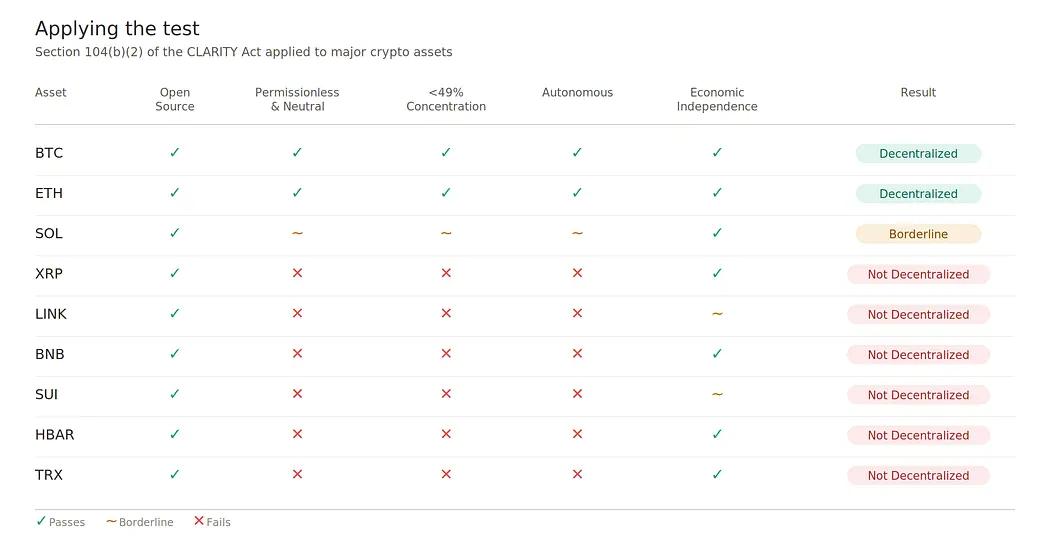
Bitcoin and Ethereum have passed all standards without controversy. Solana teeters on the edge, with its foundation's influence over upgrades, heavy allocation of early insiders, and history of coordinating network pauses all contradicting its standards of autonomy and trust neutrality.
All other major smart contract platforms failed to pass due to structural reasons that are difficult to correct. This list includes XRP, BNB Chain, Sui, Hedera, and Tron, and extends to most L1 competitors.
Of the assets that passed the test, only one had a properly functioning native smart contract economic system.
Shift in valuation system
Token trading is based on two fundamentally different valuation frameworks.
The first type is the commodity/currency premium system, whose value stems from scarcity, network effects, value storage attributes, and reflexive demand, and has no valuation ceiling based on fundamentals.
The second type is the cash flow/equity system, whose value is derived from income capitalized through the standard multiplier and is subject to a strict cap imposed by actual income projections.
Most non-Bitcoin tokens have long existed in a strategic gray area between these two systems, marketing themselves using whichever framework yields the highest valuation. The CLARITY Act ended this ambiguity through three mechanisms.
First, the disclosure requirements impose a cognitive framework. Section 4B(d) requires semi-annual disclosure, including audited financial statements (for amounts exceeding $25 million), a statement of going concern from the Chief Financial Officer (CFO), a summary of related party transactions, and forward-looking development costs.
Once a token has an SEC filing, similar to a Form 10-Q, institutional analysts will evaluate it in the same way they would evaluate an entity that has filed a Form 10-Q. The filing format determines the valuation framework.
Secondly, the legal definition itself is qualitative. Ancillary assets are defined as tokens whose value depends on the entrepreneurial or managerial efforts of the ancillary asset's originator. This definition is conceptually incompatible with currency premiums, which require that their value be independent of any issuer's efforts.
It is impossible for a token to both meet the legal definition of an attached asset and convincingly claim pricing power with a currency premium.
Third, clearly visible scarcity is fragile scarcity. Currency premiums are reflexive, and reflexivity requires a reliable scarcity narrative that the market can collectively believe in.
When a token discloses vault information, a named insider unlocking schedule, and quarterly reports on related-party transactions to the SEC, its scarcity story becomes clear; once clear, reflexivity disappears. Investors can see precisely how much supply insiders hold and when those tokens will be sold. This visibility stifles buying.
The result is a two-tiered market. Tier 1 assets trade based on currency premiums and have no valuation ceiling based on fundamentals. Tier 2 assets trade based on income multipliers and have a reasonable valuation ceiling.
Tokens currently priced according to Tier 1 logic but classified as Tier 2 will face structural re-ratings. For tokens with weak fundamentals but whose valuations are mainly driven by narratives, with LINK and SUI being the most typical examples, this re-rating could be very drastic.
The end of two major bearish arguments for ETH
Over the past five years, the reasons for being bearish on ETH have been based on two main pillars.
The first line of reasoning argues that ETH ultimately cannot be classified as a commodity, but rather as a security. Pre-mining, the foundation's continued influence, Vitalik's public role, and the merged validator economics all provide the SEC with ample justification to intervene if necessary.
Every reason for being bullish on ETH must be discounted to account for the tail risk of potentially limited access to institutional funds.
The second line of reasoning is that ETH will be replaced by faster and cheaper smart contract platforms. Every cycle gives rise to new "Ethereum killers," such as Solana, Sui, Aptos, Avalanche, Sei, and BNB Chain, each touting a better user experience and lower fees.
This argument holds that ETH's technological limitations will force economic activity to shift, thereby diluting its value capture capabilities.
The Clarity Act not only weakened these bearish arguments, but also completely overturned them structurally.
The first argument fails because ETH cleanly and decisively passed all five criteria in Section 104. There is no coordinated control, ownership concentration is far below 49%, there is no unilateral upgrade power after the merger, it is completely open source, and the value capture mechanism functions normally.
The regulatory tail risks that had long justified the discount on ETH have vanished.
The way the second logic breaks down is even more interesting. "Ethereum killers" can only compete with ETH if they adopt the same valuation system.
If SOL is certified as a decentralized asset, the competition will continue. If it fails the test (which all other major smart contract competitors currently fail as well), they will be forced into the Tier 2 valuation system, while ETH will remain in Tier 1.
This has changed the competitive landscape. Tier 2 assets can no longer compete with Tier 1 assets in terms of currency premiums, because the core advantage of Tier 1 assets lies in their exemption from fundamental-based valuation caps.
Faster and cheaper public chains can still outperform in specific verticals in terms of transaction throughput and developer attention. However, they cannot win in the asset valuation framework that is most critical to determining L1 market capitalization.
The only admission ticket
Of the assets that passed the Section 104 test, Ethereum is the only one with a fully functional native smart contract economy. Bitcoin passed the test, but its underlying implementation does not support programmable finance.
Each smart contract platform with a substantial TVL had one or more substantial failures in the tests. These include Solana, BNB Chain, Sui, Tron, Avalanche, Near, Aptos, and Cardano.
Therefore, the bill creates a new regulatory category: decentralized digital goods with a native smart contract economy, which currently has only one member.
Every traditional financial institution exploring tokenization, settlement, custody, or on-chain finance needs two things: programmability and regulatory clarity.
Before CLARITY, these properties were strictly separate. Bitcoin had clear property rights but was not programmable. Smart contract platforms were programmable but legally ambiguous. After CLARITY, Ethereum became the only asset to offer both of these properties simultaneously within a single fiat class.
Once this framework takes effect, anyone building tokenized government bonds, tokenized funds, on-chain settlement infrastructure, or institutional-grade DeFi gateways will have a clear preferred underlying platform.
This preference is not aesthetic or technical; it is driven by compliance. Asset management companies, custodians, and bank-affiliated funds operate within a legal framework that favors commodity-like assets and rejects similar securities.
Institutional funds flow according to asset classification, which has now been narrowed down to a single type of programmable asset.
The question of sound money
Once BTC and ETH share the Tier 1 classification, it becomes necessary to carefully examine their comparison in terms of monetary attributes, because traditional views actually reverse the cause and effect.
The allure of Bitcoin has always been built on its nominally fixed supply of 21 million coins and its predictable halving every four years. This scarcity narrative is indeed very valuable, and the simplicity of this story is one of the reasons why BTC has been able to command a premium over other currencies.
However, BTC's supply model also carries three structural burdens that are rarely mentioned when discussing scarcity.
First, cryptocurrency mining generates continuous structural selling pressure. Cybersecurity relies on miners bearing the real-world operating costs: electricity, hardware, hosting, and financing.
These costs are denominated in fiat currency, which means that miners must continuously sell a large portion of newly issued BTC into the market, regardless of the price.
This sell-off is permanent, price-insensitive, and ingrained in the consensus mechanism itself. This is the price of maintaining the proof-of-work security model.
Secondly, BTC does not offer native yields. Holders who want to earn yields must either lend their BTC to counterparties (introducing credit risk) or transfer it to non-BTC platforms (introducing custody and cross-chain bridging risks).
The opportunity cost of holding non-yielding BTC accumulates with compound interest over time compared to assets that generate intrinsic returns. This is a real and persistent drag on institutional holders who measure performance against benchmarks that include returns.
Third, the precipitous drop in mining subsidies poses a long-tail risk to decentralization, which is precisely what makes BTC eligible to be classified as Tier 1.
Block rewards are halved every four years and will approach zero by 2140, but the actual pressure will come much earlier. By the 2030s, subsidy revenue will be only a fraction of what it is today, and the network will have to rely on transaction fee revenue to make up the difference and maintain security.
If the fee market fails to develop sufficiently, the lowest-cost mining companies will consolidate, mining concentration will increase, and the credible neutrality of decentralization emphasized in Section 104 will begin to erode. This is not an imminent risk, but a structural risk that the BTC model has not yet addressed.
Ethereum reversed every single one of those properties.
ETH has a variable supply and no fixed cap, which is a core argument used by sound money purists against it. This argument is superficial.
For holders, what really matters is the rate of change in their share of the total supply, rather than whether the supply plan has a fixed final value.
Under Ethereum's merged design, all issued tokens are distributed as staking rewards to validators. Validator yields have historically exceeded the inflation rate, meaning anyone participating in staking can maintain or increase their share of the total supply over time.
The argument of "unlimited supply" sounds impressive rhetorically to anyone participating in validator nodes or holding liquidity-staking tokens, but it is mathematically untenable.
The structural selling pressure that burdens BTC does not exist on the same scale on ETH. Validator operating costs are negligible relative to their returns. Independent staking requires a one-time purchase of hardware and a small amount of ongoing electricity. Liquidity staking and pooled staking even abstract away these costs.
The newly issued tokens are accumulated among the validator community and largely held in place, rather than being sold on the market to cover costs. It is this same security model of distributing rewards to holders that also avoids the price-insensitive sell-offs required by proof-of-work.
The issue of a subsidy cliff also does not exist. Ethereum's security budget expands with the value of staked ETH and is funded through continuous issuance and transaction fee revenue. There is no predetermined date when security funds will suddenly run out.
This model is self-sustaining, while the BTC model increasingly relies on the development of the fee market, the latter of which remains to be seen.
The above is not an argument that ETH will replace BTC. They play different roles in institutional portfolios.
BTC is a simpler, clearer, and more politically sound scarce asset. ETH, on the other hand, is a productive monetary collateral that realizes value by paying holders who participate in its security.
The key point is that the traditional notion that BTC has the attributes of a "harder currency" than ETH because of its fixed supply limit is refuted upon closer examination.
ETH’s variable supply, combined with native yields, provides holders with better real economic attributes than BTC’s fixed supply with zero yields, and it does so without structural selling pressure or long-term safe-haven risk.
This is crucial for institutional allocators building Tier 1 cryptocurrency exposure. The reason for juxtaposing ETH with BTC is not only "that programmable asset," but also "that pays you to hold it without forcing you to engage in structured selling to maintain its security."
The vault company told the same story.
The structural differences between BTC and ETH are not abstract. They are concretely reflected in the balance sheets of the two largest corporate treasury entities built around these two assets.
Strategy (formerly MicroStrategy) holds the world's largest corporate Bitcoin position. BitMine Immersion Technologies (BMNR) holds the world's largest corporate Ethereum position.
By observing their capital operation methods and behavioral patterns, we can reveal the underlying supply-side dynamics that unfold in real corporate finance.
As of May 2026, Strategy held approximately 780,000 to 818,000 BTC, depending on the reporting period.
It financed these purchases by combining $8.2 billion in convertible notes (maturing between 2027 and 2032) and approximately $10.3 billion in preferred stock (covering the STRF, STRK, STRD, and STRC series).
Convertible notes must be converted into equity upon maturity (which dilutes the equity of existing shareholders) or refinanced (which requires access to the market to raise funds on acceptable terms).
Preferred stock comes with a continuous dividend obligation, which STRC alone needs to pay approximately $80 million to $90 million per quarter.
Strategy's core software business is negligible compared to its vault holdings, and its cash flow is minimal compared to its debt obligations. Due to the decline in Bitcoin prices, the company has reported losses for three consecutive quarters, including a net loss of $12.5 billion in the first quarter of 2026.
On May 5, 2026, during the first quarter earnings call, Executive Chairman Michael Saylor broke his five-year-old creed of "never selling Bitcoin" and told analysts at Strategy that he might sell some Bitcoin to pay dividends.
Within days, he revised his wording to "never be a net seller" and "buy 10 to 20 for every Bitcoin sold," but the directional shift was real.
On Polymarket, the probability that Strategy will sell any Bitcoin by the end of the year jumped from 13% before the conference call to 87% afterward.
The structural reality is simple. Strategy's ability to continue accumulating Bitcoin depends on its ability to issue new debt or preferred stock on repayable terms.
During the Q1 2026 earnings call, Saylor clearly outlined the break-even point for the model: Bitcoin would need to appreciate by approximately 2.3% annually for Strategy’s existing holdings to cover STRC’s dividend obligations indefinitely without selling common stock.
This figure has been widely reported and reflects the calculations published by Saylor himself, but it is one of three conditions that must be met simultaneously.
The mNAV (market capitalization to net asset value) premium must remain above 1.22 times to justify continued issuance, market demand for STRC preferred stock must remain strong, and Bitcoin must cross the 2.3% threshold.
Individually, these are not catastrophic risks, and the 2.3% rate is well below Bitcoin's historical average. However, this rate is also a moving target. STRC's effective dividend yield has climbed from 9% at issuance to 11.5% after seven monthly increases, pushing up the break-even point over time.
The underlying assets do not provide an organic income stream to fund operations. Strategy must successfully refinance, reissue, or convert to maintain its position.
BitMine Immersion Technologies operates in a fundamentally different manner. According to the latest disclosure, BMNR holds approximately 3.6 million to 5.2 million ETH (depending on the reporting period) and has virtually no debt. The company also holds between $400 million and $1 billion in unsecured cash.
Approximately 69% of its ETH holdings are actively staked, generating an estimated $400 million in staking revenue annually through its dedicated MAVAN (Made in the USA Validator Network) infrastructure.
The structural difference here is that BMNR generates native returns from its underlying asset. Regardless of the spot price of ETH, staking rewards generate compound interest.
The company does not need to roll over debt, refinance preferred stock, or maintain a mNAV premium to fund its operations. It can be a passive holder generating cash flow indefinitely or actively deploy capital.
The $200 million investment in MrBeast's Beast Industries in January 2026, and the planned "MrBeast Financial" DeFi platform built on Ethereum, represent the latter. BMNR is leveraging its vault position to participate in and accelerate Ethereum's economic ecosystem, rather than simply holding the asset.
This distinction is significant for long-term development trajectories. Chairman Tom Lee's recent comments at the Consensus Miami conference in 2026 suggest that BMNR may slow its ETH accumulation pace because "there are other things to do in the crypto space right now," indicating that the company sees expansion paths beyond simple accumulation.
Bitcoin vault companies lack such a path. There are no native yields for compounding, no protocol-level ecosystem to participate in, and no equivalent to the validator infrastructure or DeFi integration implemented by ETH.
Neither company was spared from this cycle's downturn. BMNR has fallen by approximately 80% from its peak in July 2025. MSTR has reported losses for three consecutive quarters. Both companies have seen their net asset value premiums compressed as digital asset vaults generally face pressure.
The analysis here is not about one company winning while another is losing. Rather, it's about how structural mechanisms create differences in a way that directly maps to the attributes of the underlying assets they hold.
Strategy's flexibility stems from its ability to continuously access capital markets. BMNR's flexibility stems from its continuous pledging yields.
Strategy must roll over its debt to maintain its positions. BMNR must keep its validators online. Strategy's operational needs contain embedded structured selling pressure. BMNR faces structured buying pressure from staking rewards back into its holdings.
These are not narrative preferences. They are mechanical consequences of the supply-side properties of the underlying assets.
Where the industry narrative will go from here will likely depend on how it evolves over the next 12 to 24 months.
If Bitcoin appreciates significantly, Strategy's model will continue to perform exceptionally well, and the leveraged BTC logic will remain the narrative of mainstream institutional cryptocurrencies.
If Bitcoin trades sideways or falls, Strategy's rollover debt requirements will become increasingly burdensome, and the lack of native yield will become an increasingly apparent structural disadvantage.
The Ethereum vault model has a wider range of conditions for maintaining its viability because staking rewards provide a lower bound that is lacking in a pure BTC hoarding model.
For an industry about to gain its first comprehensive regulatory framework under the CLARITY Act, and for an institutional audience about to begin making capital allocation decisions based on that framework over the next decade, the treasury company comparison offers a useful forward-looking perspective on how abstract supply-side arguments translate into real corporate behavior.
Vault companies are leading indicators of the direction of underlying assets.
The Boundaries Between Internet Philosophy and Legal Classification
A subtle but important point needs to be addressed directly. Even if Solana ultimately obtains decentralized certification under Section 104, this legal classification alone cannot elevate SOL to the same valuation level as ETH.
Legal classification is a necessary but not sufficient condition for Tier 1 currency premium treatment. A deeper question is what each network truly aims to optimize, and what value their founders and ecosystem participants believe it should be given.
On these issues, ETH and SOL made conscious divergent choices.
From the outset, Ethereum prioritized trust neutrality, reliability, and durability over raw performance. The network has achieved 100% uptime for ten years and has not experienced any major outages since its launch.
Following the Pectra upgrade in May 2025, the number of active validators exceeded one million, distributed globally, with the largest concentration in the United States and Europe, but also present on multiple continents. The average uptime of validators is approximately 99.2%.
The consensus mechanism prioritizes finality and security over speed, using carefully designed constraints to ensure that no single entity (including the Ethereum Foundation) can unilaterally alter the protocol.
Solana prioritizes throughput and transaction speed. Its architecture is optimized to process as many transactions per second as possible at the lowest possible cost. These are true engineering achievements that enable use cases that the Ethereum base layer cannot fulfill. But they come at a price, a fact that the Solana ecosystem itself increasingly acknowledges.
Since 2021, the network has experienced at least seven major outages, including several hours of downtime in January, May, and June 2022; September 2022 (18 hours); February 2023 (more than 18 hours); and February 2024 (5 hours). Each outage required coordinating validators to restart the network.
The Solana Foundation reported that it had gone 16 months without an outage by mid-2025, which is real progress, but compared to Ethereum's record of never having an outage, it reflects a fundamental difference in design priorities rather than a temporary gap in engineering capabilities.
The validator metric tells a similar story. Solana's number of active validators dropped from approximately 2,560 at the beginning of 2023 to approximately 795 at the beginning of 2026, a decrease of 68%.
The Satoshi Nakamoto coefficient, which measures the minimum number of entities required to control a critical share of the network, has dropped from 31 to 20. The Solana Foundation characterizes this as a healthy pruning of subsidized witch nodes that have never made meaningful contributions to decentralization, a plausible explanation.
Another explanation is that the economic model of running Solana validators has become uneconomical for small operators whose voting fees alone exceed $49,000 per year, which is also supported by data.
Both explanations have some merit, but neither produces the kind of geographically and operator-diverse network that Ethereum maintains.
Client diversity is the clearest point of comparison and the most worthy of study because it is directly related to the structural resilience required for monetary collateral.
On Ethereum, the consensus layer exhibits healthy diversity. Lighthouse accounts for approximately 43% of validators, Prysm 31%, Teku 14%, and Nimbus, Grandine, and Lodestar share the remainder. No single client holds an absolute majority.
While the execution layer is relatively centralized, it is constantly improving: Geth accounts for about 50% (down from 85% historically), Nethermind accounts for 25%, Besu accounts for 10%, Reth accounts for 8%, and Erigon accounts for 7%.
This diversity is not merely theoretical. In September 2025, a critical vulnerability in the Reth client caused 5.4% of Ethereum nodes to become unusable, but the network did not break down because other clients independently implemented the protocol.
Ethereum's design philosophy explicitly anticipates the possibility of failure for any single implementation, and the continued operation of the network does not depend on any single team's code being bug-free.
Historically, there has been virtually no client diversity on Solana. For most of its mainnet, each validator has been running a variant of the original Agave codebase.
The outage in February 2024 crippled the entire network because there was no independent implementation that could keep the network running while the bug was fixed.
Currently, Jito-Solana, the Agave fork optimized for MEV, holds approximately 72% to 88% of the stake. The original Agave holds the remaining 9%. Both share the same code ancestor, meaning that vulnerabilities in the core Agave logic could potentially affect approximately 80% of the network simultaneously.
Firedancer, developed by Jump Crypto, is the first truly standalone client implementation of Solana and will launch on the mainnet in December 2025, holding approximately 7% to 8% of the stake.
Frankendancer, a hybrid that combines Firedancer's networking capabilities with Agave's execution capabilities, accounts for another 20% to 26% of the market share.
The Solana ecosystem aims to achieve a 50% Firedancer share in the second or third quarter of 2026, which would be a significant step toward true client diversity. However, before crossing this threshold, the network remains structurally vulnerable to the failure of a single implementation.
These differences are not accidental occurrences of engineering capabilities. They reflect well-considered philosophical choices.
Ethereum consistently chooses a slower, more conservative path, prioritizing the ability for the network to function properly regardless of the code of any single team or the intentions of any single participant.
Solana always chooses the faster, more performance-oriented path, accepting higher coupling and operational dependencies in exchange for speed.
Both are effective engineering methods. They produce assets with different properties.
The impact on assets follows. The Solana ecosystem itself, including major analyst frameworks such as VanEck and 21Shares, is increasingly inclined to value SOL as a capital asset on a cash flow basis.
SOL holders are rewarded with network revenue, token burning, and staking proceeds, and the asset is priced based on its ability to generate these cash flows.
This aligns internally with Solana's positioning as financial infrastructure for high-throughput applications. It also fits into a Tier 2 valuation framework.
Co-founder Anatoly Yakovenko has publicly defined Solana as a "global financial atomic state machine," emphasizing value capture at the execution layer rather than currency premiums. This framework has been largely accepted by the Solana community.
In contrast, Ethereum has consistently positioned ETH as productive monetary collateral. Staking rewards, ultrasonic monetary discourse, deflationary mechanisms, and validator distribution all serve the Tier 1 framework, in which ETH is held as a monetary asset and rewards holders who participate in network security.
Although this framework is more controversial within the ETH community than within the SOL community, the underlying network design provides support for it.
In practice, this means that even if Solana obtains certification for decentralized digital goods under the CLARITY Act, its own ecosystem will still classify it as a Tier 2 asset.
This certification will unlock institutional access and eliminate regulatory tail risks, both of which are favorable for prices, but it does not make SOL a benchmark for driving currency premium pricing. The market will not assign a currency premium to a capital asset that even its own creators and the ecosystem consider to generate cash flow.
This is the deeper reason why ETH's unique position in its class is more enduring than what is implied by the legal framework alone.
Legal classifications, network design philosophy, ecosystem positioning, and apparent market preferences all point in the same direction. If a competitor wants to convincingly challenge ETH's Tier 1 status, it needs to pass legal tests, maintain an equivalent level of reliability and decentralization, and position the asset within its own ecosystem as a monetary premium rather than a cash flow asset.
In the existing network, no candidate meets all three conditions, and the philosophical commitment required to meet them cannot be remedied in the short term.
The true meaning of DeFi dominance
Ethereum's enduring dominance in DeFi has long been viewed as a legacy effect. The conventional wisdom holds that Ethereum won DeFi early on due to its first-mover advantage, but this dominance will be eroded as faster-moving public chains compete for developer attention and user activity.
Every migration of TVL to Solana, every DeFi summer on competing chains, and every article claiming that "the market is rotating away from ETH" reinforces this view.
The actual outcome does not match this narrative.
Despite years of well-funded competitors and a technologically superior execution layer, and despite facing L2 fragmentation and the high-fee era of L1, Ethereum and its Rollup ecosystem still dominate stablecoin settlement, DeFi TVL, RWA tokenization, and institutional on-chain activity.
BlackRock's BUIDL fund is launched on Ethereum. Franklin Templeton's tokenized money market fund launched on Ethereum. The supply of stablecoins on the Ethereum mainnet plus major L2 servers dwarfs all competing chains combined. The vast majority of tokenization of real-world assets occurs on Ethereum.
This enduring ability to maintain an advantage in the face of technologically superior alternatives is not merely a legacy effect. The market has been pricing in something that is not yet clearly defined at the legal level: builders and institutions value credibility, neutrality, and regulatory justification far more than performance.
The outcome of their bets is exactly what the current Clarity Act has formally established.
The very qualities that cause Ethereum to run slowly (including strict decentralization, the lack of unilateral upgrade authority, conservative consensus change mechanisms, and well-thought-out decentralized validator plans) are precisely the qualities that Section 104 is currently praising.
Every article in the past three years asserting that "ETH is losing to faster public chains" has misjudged the variables. The truly crucial variable has always been trustworthiness and neutrality, and once the regulatory direction becomes clear, trustworthiness and neutrality will inevitably become the qualifying attribute for standing out.
The market's choice preference is correct. It simply lacked a self-justifying legal framework, and the bill currently under consideration in the Senate is precisely the framework that will codify this consensus into the legal code.
Shift of reference frame
Historically, ETH has naturally been compared to other smart contract platforms such as SOL, BNB, SUI, and AVAX. Within that framework, ETH was the "slow and expensive one," facing ongoing narrative pressure as competitors continued to roll out faster execution layers.
Valuation multipliers are anchored to revenue, TVL share, and developer activity, all of which have a natural valuation ceiling.
Following the Clarity Act, this frame of reference was broken. Tier 2 public chains compete with each other on cash flow multipliers and value capture. ETH's relevant frame of reference became Tier 1 monetary base assets with a utility premium: primarily BTC, conceptually including gold, and in extreme cases, sovereign reserve assets.
None of these frameworks generate market capitalization based on income. They all generate market capitalization anchored to the role of currency in the larger economic system.
This is a revaluation worth trillions of dollars. In the past cycle, competitive pressure dragged ETH down to Tier 2 valuation logic. The CLARITY Act, by establishing that its competitors are no longer part of the framework's reference system, is pulling ETH up to Tier 1 valuation logic.
This also resolves a contradiction that has plagued ETH for years. Because the value capture that L2 Rollup feeds back to L1 ETH is considered to remain theoretical and controversial, the value of the base layer L1 has been consistently underestimated relative to the active L2 ecosystem.
Under the new framework, this issue becomes less important. ETH's value is not pegged to the capture of L2 fees. It is pegged to its role as a currency for uniquely programmable digital goods.
The L2 ecosystem has expanded ETH's economic reach without diluting its currency premium, because the currency premium stems from regulatory categories rather than transaction fee revenue.
Calculate the size of the currency premium pool
The phrase "a revaluation worth trillions of dollars" deserves in-depth analysis because the difference between Tier 1 and Tier 2 valuation systems lies not in the size of the multiplier, but in the potential market size that the asset is competing for.
Cash flow valuation is anchored to the network's transaction fee revenue, which is currently in the billions of dollars annually for ETH. With any reasonable multiplier applied, the implied market capitalization would fall into the tens of billions of dollars range.
The valuation of currency premiums is anchored on a completely different and much larger dimension.
Gold is the clearest benchmark. The total global supply of gold on land is approximately 244,000 tons, with a market value of about US$32.8 trillion at current prices. Industrial demand for gold accounts for only a small portion of this.
The overwhelming portion is purely due to the monetary premium: its value exists because gold has maintained its purchasing power over centuries, something fiat currencies, sovereign bonds, and most other financial instruments cannot do.
Gold doesn't pay returns. It doesn't generate cash flow. But that doesn't stop it from supporting a $32 trillion valuation, because the market assigns a currency premium to assets that convincingly preserve wealth, regardless of their function.
Gold's monetary premium is accompanied by often underestimated operational friction costs. Physical gold requires authentication on every transaction. Gold bars require analytical testing to confirm purity and weight. Gold coins require verification. The existence of the LBMA Good Delivery Standard is precisely because, without institutional-grade infrastructure, counterparty trust in gold quality cannot be assumed.
Retail gold transactions typically premium by 2% to 5% over spot prices to offset authentication and distribution costs. Cross-border transfers require customs declarations, security, and transport insurance.
Paper gold (ETFs, futures, allocated and unallocated accounts) solves the authentication problem, but reintroduces counterparty risk and undermines the bearer asset attribute that initially motivated people to hold gold. The gap between paper gold and physical holding is precisely the gap between trusted and untrusted institutions, a point that becomes crucial in the next section.
Real estate is where the more interesting analysis begins. As of early 2026, global real estate was valued at approximately $393 trillion, making it the world's largest asset class. Residential properties accounted for $287 trillion, agricultural land for another $48 trillion, and the remainder was commercial real estate.
Real estate has three distinct layers of value that must be distinguished. Use value is what you pay for housing or productive land. Cash flow value is what you pay for rental income or agricultural output. The monetary premium is what you pay on top of that, because the asset preserves wealth and is not diluted by inflation.
The monetary premium in real estate is precisely why prime properties in Manhattan, London, Hong Kong, and Tokyo are traded at capitalization rates of 2% to 3%. Rental income alone cannot support these prices. The implicit function of wealth storage is the real logic behind their value.
A reasonable estimate is that 30% to 50% of global real estate value (approximately between $120 trillion and $200 trillion) represents a currency premium because there is no other option but to absorb it into real estate by default, rather than because real estate itself is the most suitable vehicle.
This absorption occurs because there are no large-scale alternatives. Wealth must have a place to be stored, and for most of modern history, the only options for absorbing global liquidity have been gold, stocks, sovereign bonds, and real estate.
Stocks are cash flow assets. Bonds carry sovereign credit risk. The gold market is too small to absorb all the excess funds. Real estate absorbed the remainder as a last resort.
The asymmetry in holding costs makes this capital accumulation increasingly vulnerable. In the United States, property taxes typically account for 1% to 2% annually, and even higher in some jurisdictions. Maintenance costs also increase by an average of 1% to 2% annually. Insurance costs rise sharply as climate-related repricing accelerates.
Before factoring in vacancy, maintenance impacts, or administrative costs, total cost of ownership is roughly in the range of 2% to 4% per annum.
Transaction frictions further exacerbate the issue of holding costs. Transactions of residential properties in the United States typically incur 7% to 10% in two-way friction costs once real estate agent commissions, transfer taxes, title insurance, and settlement fees are taken into account.
International friction is often higher, with stamp duty on high-value or second homes in the UK reaching 12% to 17%, while Singapore imposes an additional buyer's stamp duty of up to 60% on foreign buyers.
In favorable market conditions, the time to liquidation is 30 to 90 days, while in unfavorable markets it is much longer. Price discovery is opaque. The volume is large and indivisible.
For decades, the monetary premium function of real estate has been subsidized by enduring these operational frictions. This didn't matter when no alternatives existed. But once alternatives appeared, everything changed.
The ongoing wealth migration
The pool of currency premium funds is not static. In response to two related dynamics that have become apparent over the past decade, wealth is actively shifting between different pools: declining trust in institutions and escalating geopolitical tensions.
Trust in institutions has been declining across multiple dimensions. The Edelman Trust Barometer consistently shows that institutional trust in most developed economies is at or near historical lows.
Geopolitical tensions have accelerated this trend. The 2022 freeze on Russian central bank reserves was a watershed moment for sovereign asset managers. The recognition that dollar-denominated reserves held in Western financial infrastructure are dependent on shifts in political stance has altered the risk appetite of central banks in every non-aligned country.
This response is measurable across three different asset classes.
Central banks' increased gold holdings are the most obvious response. In 2025, global central banks' net gold purchases exceeded 700 tons, marking the highest annual increase since 1967.
As of the end of 2025, the People's Bank of China had been a net buyer for 14 consecutive months, and its foreign exchange reserves reportedly reached 2,308 tons. India also increased its holdings in the same period.
In addition to increasing their holdings, central banks in several countries have also taken action to repatriate physical gold stored in overseas vaults. Germany, for example, repatriated half of its gold reserves from New York and Paris between 2013 and 2020. Poland, Hungary, the Netherlands, and Austria have also taken similar steps.
This model suggests that the way to deal with declining institutional trust is not simply to hold more gold, but to explicitly store gold outside the control of potentially bankrupt or weaponized institutions.
The movements in the bond market are larger in scale, yet less frequently discussed. For nearly 80 years, U.S. Treasury bonds have effectively acted as a currency premium asset.
The positioning of the "risk-free interest rate" in the global financial system essentially declares US Treasury bonds as the ultimate store of value for dollar wealth. Governments, large corporations, and high-net-worth individuals invest trillions of dollars in the Treasury bond market not because of their yields, but because Treasury bonds represent the world's deepest, most liquid, and most trusted store of value.
The outstanding amount of U.S. Treasury bonds is approximately $39 trillion, of which overseas holdings range from $8.5 to $9.5 trillion, depending on the statistical method used.
Within this overseas capital pool, a trend of asset rotation has already emerged. China's holdings of US Treasury bonds peaked at $1.32 trillion in November 2013, but by early 2026, this figure had fallen to approximately $760 billion, a decrease of 42%.
The actions of the People's Bank of China and major state-owned banks were interpreted as an "orderly liquidation" of their U.S. Treasury positions, and this process was further accelerated in early 2026 through explicit policy guidance. The same situation occurred with other major sovereign holders, although the policy direction was less explicit.
The People's Bank of China's shift from reducing its holdings of US Treasury bonds to increasing its holdings of physical gold is a clear example of cross-asset rotation: reducing its US Treasury bond position while purchasing gold for 15 consecutive months.
The share of the US dollar in global foreign exchange reserves tells a similar story at the macro level. By the third quarter of 2025, the US dollar's share of disclosed global foreign exchange reserves had fallen to 56.92%, a decline from its peak of 72% in 2001.
This decline, though gradual, is continuous. A 2025 analysis report released by the Federal Reserve pointed out that the market share lost by the US dollar was mainly absorbed by smaller currencies (such as the Australian dollar, Canadian dollar, and renminbi), rather than flowing to gold (with the exceptions of China, Russia, and Turkey).
This is an important revelation: the trend of de-dollarization is real, but its impact is often exaggerated. The current trend is more about diversification than completely abandoning the dollar, which still holds absolute dominance.
However, data from the past 20 years shows a consistent trend, and the underlying drivers (such as fiscal deficits, the risk of monetary weaponization, and the expansion of structural deficits) have not improved.
The third strategy is the gradual rise of premium digital currency assets, which have become the fourth major reservoir of wealth. Bitcoin has already absorbed this excess capital.
Since 2017, the core logic supporting Bitcoin has been that BTC provides an alternative to gold for the monetary premium function in the digital age, and the market is gradually realizing this expectation. Currently, Bitcoin's market capitalization has reached approximately $2 trillion, an achievement made from scratch in just fifteen years.
The rise of Bitcoin vault companies, the inflow of funds into spot ETFs, and recent reports of corporate adoption all reflect the same underlying logic: the currency premium is looking for a digital-age home, a home that can simultaneously address the high holding costs of real estate, the cumbersome and frictional process of gold authentication, and the heavy reliance of traditional financial instruments on institutions.
Therefore, this asset migration is far from being a theoretical discussion. It is an ongoing, large-scale reallocation of assets that will span decades. This trend has already been evident in data on central bank gold flows, changes in government bond holdings, and the composition of foreign exchange reserves.
The core issue we need to focus on now is no longer whether the funds are being transferred, but where the next available destination will be.
ETH's positioning and potential market size estimation
Until now, Ethereum has been excluded from this category due to regulatory uncertainty and pressure from the competitive narrative. The implementation of the CLARITY Act removed these regulatory hurdles.
As mentioned earlier, once regulatory classification reduces the number of competitors, the competition-based narrative falls apart. The remaining core question is: what unique advantages does ETH offer compared to traditional premium assets?
The answer lies in the fact that ETH is the first candidate currency premium asset in history to combine negative net holding costs (generating returns simply by holding) with institutional independence.
Holding gold has a positive cost, generates no profit, and involves friction during the authentication process, which can only be partially resolved even through institutionalized product packaging.
While real estate can generate rental income, the high holding costs offset this income. At the same time, depending on the region, there are transaction friction costs ranging from 7% to 17%, and the property rights are entirely subject to the local government's property protection policies.
Government bonds can provide positive returns, but as the 2022 freeze on reserves demonstrated, they are highly dependent on specific issuers.
In contrast, ETH has near-zero custody costs while offering approximately 3% to 4% annualized staking yield, which outpaces the protocol's inflation rate. Its transaction costs are calculated in basis points, it has global instant liquidity, and its cryptographic authentication mechanism is completely independent of any institutional infrastructure and is not subject to any property rights system under government jurisdiction.
Holding ETH and participating in the consensus maintenance of its network allows you to obtain positive net returns before the asset appreciates. More importantly, this asset's properties ensure its safety even in the event of a crisis in an individual institution or country.
This combination of advantages is unprecedented. Any previous currency premium asset has made compromises while solving certain problems.
Gold is independent of financial institutions, but comes with cumbersome authentication processes and no returns. Real estate can provide returns, but is subject to jurisdictional constraints and high transaction friction. Government bonds offer excellent liquidity and yield performance, but are highly dependent on the credit of the issuing institution.
ETH is the first asset to successfully overcome all of these limitations at the same time, and the CLARITY Act was enacted precisely to gain the recognition of these attributes by the institutional system that holds the power of capital allocation.
The potential market size derived from this is not a prediction, but an estimate of the market size.
Assuming ETH captures 10% of the current market capitalization of gold, that would translate to approximately $3 trillion in market value, equivalent to 7 to 10 times its current size. If ETH conservatively captures 2% of the real estate currency premium, that would be around $2.4 trillion. And if, under a more optimistic scenario, it captures 5%, that would represent a $10 trillion market.
If ETH can receive only 1% of foreign government bond holdings as asset rotation deepens, it will bring it an additional $85 billion in funds.
None of these scenarios require ETH to completely replace gold, real estate, or government bonds. They simply require a small portion of the already rotating global currency premium pool to flow from those somewhat cumbersome traditional investment vehicles to a more advantageous new destination over the next decade.
A valuation framework based on cash flow cannot derive figures of this magnitude. If conventional logic is followed, Ethereum's annual transaction fee revenue would need to experience a leapfrog growth. Even so, based on stock market valuation multipliers, its calculated market capitalization ceiling is far lower than the range derived from a currency premium framework.
This is precisely the fundamental difference between Tier 1 and Tier 2 valuations. The underlying valuation scales are fundamentally different. These two valuation frameworks do not overlap or transform into each other. For any asset, the valuation logic is either one or the other.
There are two potential risks that need to be specifically pointed out.
First, currency premiums are a reflexive phenomenon. The market assigns a currency premium to an asset because it believes it will be continuously recognized; however, this recognition can also disappear at any time. ETH's current currency premium status is not a permanent guarantee; to maintain this status, it is necessary to continuously ensure the stable operation of the network, adhere to the principle of decentralization, and remain trustworthy and neutral.
Secondly, the migration of funds is a lengthy process. Even if a significant portion of the existing pool of currency premiums eventually flows to digital alternatives, this evolution will take decades, not quarters. This profound impact on valuations is undeniable, but the path to this goal is by no means a straight line.
This analysis has revealed the enormous size of the target fund pool and indicated the predetermined direction of fund flows.
In the previous market cycle, the pricing benchmark for ETH was its transaction fee revenue and total value locked (TVL), and these two metrics often put a constraint of several hundred billion dollars on its market capitalization.
However, the CLARITY Act will free Ethereum from this constraint, increasing the size of its benchmark liquidity pool by a full two orders of magnitude. This pool is currently undergoing a massive reallocation that has lasted for decades, and prior to this, gold, Bitcoin (BTC), and to some extent, certain global reserve currencies have been the main beneficiaries of this reallocation.
This is the core significance of this valuation system reshaping.
Risk factors
There are three scenarios that could weaken or even overturn the above framework.
The bill may not pass. Polymarket estimates the probability of its passage in 2026 at around 75%, with deliberations scheduled for Thursday, though political obstacles remain surrounding the missing ethical constraints.
Since mid-2025, the decentralized framework has maintained broad consistency across different versions in the House and Senate. The 49% threshold may be adjusted, but the fundamental structure of the five elements is highly unlikely to undergo substantial changes.
If the bill is ultimately rejected outright, the structural arguments of this paper will be severely weakened. However, the framework remains valid as long as the bill passes in any identifiable form.
Solana may gain certification. If the Solana Foundation takes radical reforms during the four-year transition period, including foundation restructuring, decentralized validator deployment, and redistribution of funds, then ETH could lose its absolute dominance in the "decentralized programmable platform" space.
However, as discussed above, simply obtaining certification is not enough to elevate Solana to the ranks of those with Tier 1 valuations, because the Solana ecosystem itself is positioned based on cash flow considerations, and the network's design philosophy is more inclined to improve throughput than the high reliability upon which currency premiums depend.
Nevertheless, successful certification would still significantly narrow the gap between it and ETH, especially in the competition for institutional investment access and ETF inflows. Solana's governance decisions over the next 24 months are crucial to its chances of approval and any shifts in the ecosystem's stance on its asset valuation framework.
Even if a certain category allows for a currency premium, the market may not blindly follow suit. Regulations merely provide space for valuation frameworks; they do not force the market to accept them.
If institutional analysts continue to adhere to traditional valuation models, then even if ETH perfectly passes all standard tests, it may still only be able to trade based on cash flow logic.
While the success stories of gold, Bitcoin, and certain reserve currencies have demonstrated the widespread acceptance of currency premiums, and institutional infrastructure such as ETFs, custody services, and prime brokers are ready to offer Tier 1 treatment to eligible assets, this is not an automatic transition.
ETH itself still faces structural challenges. These include the problem of L2 fragmentation, the staking economics that some believe underestimates the value of L1 ETH, the conservative development path that frustrates developers, and the deflationary mechanism that is below expectations.
These problems cannot be solved by the Clariity Act. The Act removes two of the biggest structural obstacles and eliminates the influence of competitors that are dragging down ETH's valuation framework. It does not make Ethereum perfect.
What's next?
Its direct impact is limited. No tokens will automatically delist, there will be no overnight reshuffling, and no forced transfer of funds. The SEC has 360 days to finalize the rules defining "joint control" in practice. The four-year transition period gives projects ample time to adjust their architecture.
The first wave of certifications and rejections will not officially begin until 2027.
The framework may shift much faster than the regulatory mechanisms are implemented. Within months, asset managers, ETF issuers, custody service providers, and bank-affiliated funds will begin adjusting their internal asset classification and allocation frameworks.
It is expected that major sell-side institutions will release their first research reports declaring "ETH is the only programmable digital commodity" in the coming weeks. This narrative does not depend on the complete completion of the regulatory process. It only requires a convincing regulatory indicator.
Historically, the cryptocurrency market has often reacted before regulatory details become clear. A BTC ETF was traded for two years before its approval, and the news of an ETH ETF approval was priced into the spot price months in advance. Significant regulatory positives are often priced in beforehand.
For those who hold or trade these assets, the core issue isn't whether the bill officially takes effect on July 4th or in 2027. Rather, it's whether the market will rush to anticipate and prepare for the profound impact of the finalization of this regulation.
The underlying logic supporting ETH's valuation is undergoing a quiet but significant transformation: from being positioned as a "smart contract platform burdened with regulatory compliance risks" to becoming a "unique programmable digital commodity with the potential for currency premium."
This significant shift has not yet been fully reflected in prices.
Over the past five years, holding ETH has meant enduring a double burden of structural pressures: regulatory uncertainty and the risk of competitors catching up.
The bill's review, which is set to begin on Thursday, is expected to dispel both of these shadows. More importantly, it will also wipe out ETH's direct competitors.
The market will realize all this sooner or later. The only question now is when.