Table of Contents
ToggleOne of the most regrettable things in the cryptocurrency world is acquiring Bitcoin early on but losing the private key for various reasons—it's even more painful than being liquidated while trading futures. However, late last night, X user @cprkrn posted an article describing how he recovered 5 BTC that had been dormant for 11 years from his old college computer.
Based on the exchange rate at the time of publication, this amount of money is worth approximately $400,000.
Old address starting with "14" that has been dormant for 11 years
The on-chain records are clear. According to the address he provided, 14VJySbsKraEJbtwk9ivnr1fXs6QuofuE6 , he first bought 0.25462585 BTC in December 2014, and then bought another 5 BTC in April 2015. At that time, Bitcoin was worth about $250 USD, and his entry cost was about $1,250.
The address remained quiet for over 11 years afterward, with no further transactions.
@cprkrn recounted: "Because he changed his password after getting high," but for some reason, the seed phrase he had recorded at the time could not be used to open the wallet, so it was locked inside for more than 11 years.
8 weeks, 3.5 trillion times, then Claude
Before using Claude, @cprkrn followed the standard password rescue route, which took a full eight weeks.
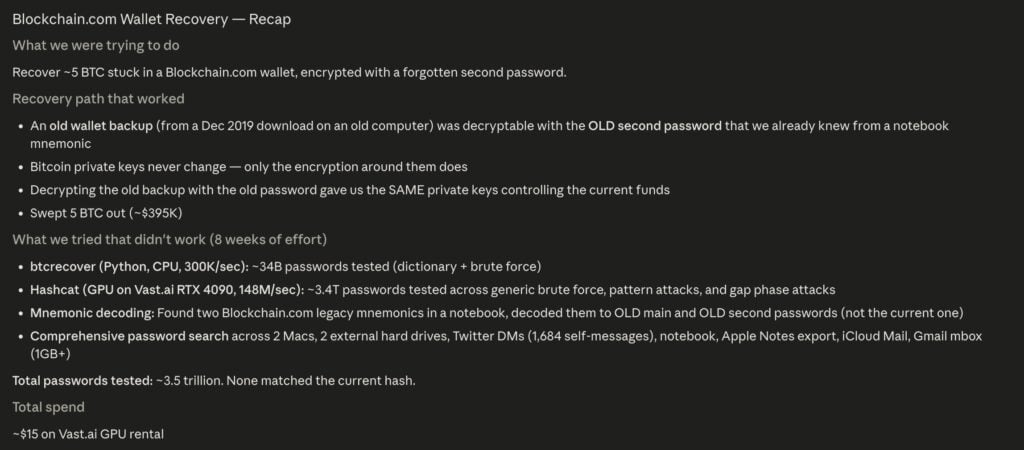
The first phase used btcrecover: an open-source Python tool that uses the CPU to run dictionary attacks and rule transformations, achieving a speed of approximately 300,000 passwords per second. It can try every conceivable password transformation (adding numbers, changing case, adding special characters). This method has tested approximately 34 billion passwords with zero hits.
The second phase involved upgrading to Hashcat and switching to GPU acceleration. He rented an RTX 4090 on the Vast.ai platform, boosting the speed to approximately 148 million passwords per second. Vast.ai is a cloud-based GPU rental platform, meaning you can rent high-end graphics cards by the hour to run brute-force attacks.
After two months, approximately 3.4 megabytes of passwords were tested, but none were successfully obtained.
The Blockchain.com wallet features a "second password" design. In addition to their login password, users can set a separate password specifically for encrypting the private key within the wallet file. This second password exists only in the user's mind; there is no copy on the Blockchain.com server. This is the very layer that @cprkrn casually changed 11 years ago when he was using marijuana.
A turning point has arrived
After eight weeks, 3.5 trillion attempts, and all failures, he dumped all the data from the old university computer into Claude.
@cprkrn Post-mortem analysis: Claude searched through 2 Macs, 2 external hard drives, 1,684 self-talk messages in Twitter DM, paper notebooks, Apple Notes export files, iCloud Mail, and a Gmail mbox export file of more than 1GB.
Claude eventually found a backup file of an older wallet he had downloaded in December 2019, which he had forgotten existed. He also found an old seed phrase in his university notebook, a string of 12 to 24 English words, which could be used to reconstruct the private key.
This seed phrase unlocked the old backup file, and the private key stored in that backup finally allowed him to regain control of his Bitcoin wallet.
It's not a technological breakthrough, but it addresses the weaknesses of human nature.
It's important to emphasize that this isn't a revolutionary technological breakthrough: the seed phrase already exists, and the old backup file has been on the hard drive for a long time. The breakthrough is when someone (or someone with the tools) can recognize "this combination is worth a try" from a pile of messy old files.
The AI here isn't playing the role of a password-cracking tool, but rather a super patient assistant who digs up old records. Congratulations to @cprkrn!
 Related reports
In the AI cryptocurrency trading competition, is Alibaba the ultimate winner?