Author: David Hoffman
Compiled by: Jia Huan, ChainCatcher
If you missed last week's news, I sold my ETH .
Making this decision is by no means easy for someone who has built a career, community, identity, and business empire around Ethereum.
The reasons for the decision to sell require a more thorough explanation than the scattered tweets on Twitter.
The argument that "ETH is money" hasn't failed... it has simply delivered. Ethereum has received the price it deserves from ETH, and I don't believe ETH as an asset will be revalued, either upwards or downwards.
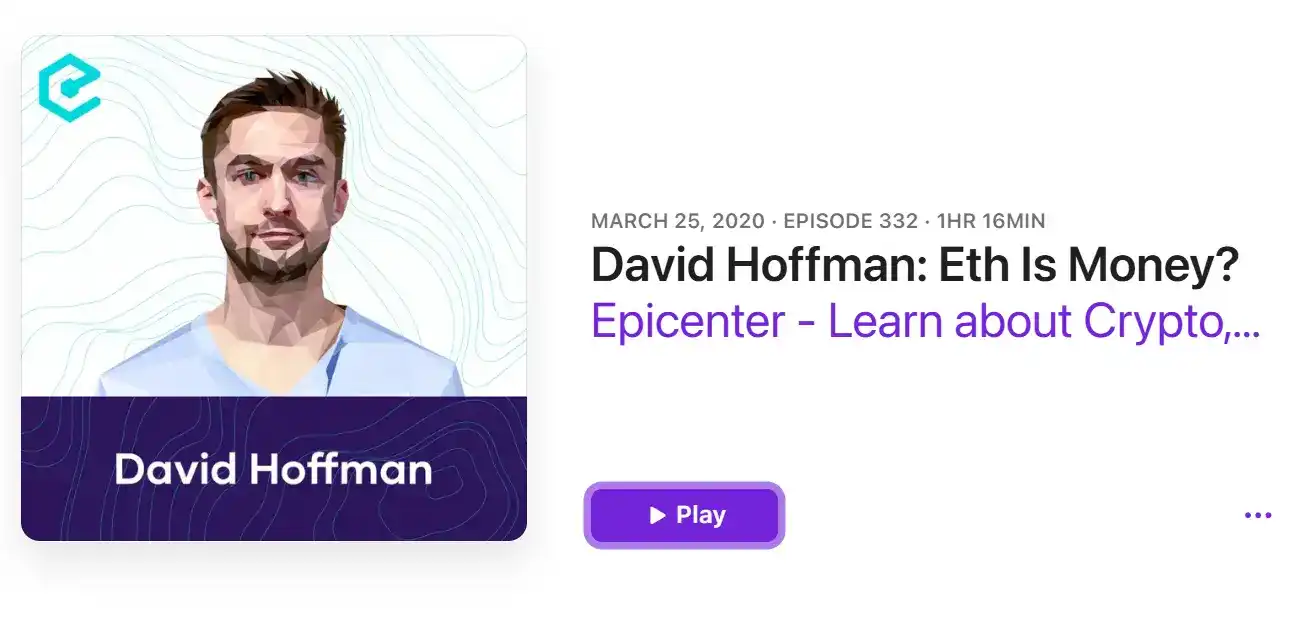
" ETH is money " is the core narrative proposed by author David Hoffman in 2019 and promoted by Bankless over a long period of time. It advocates that ETH should become a global store of value and was once one of the most mainstream bullish arguments for Ethereum.
Note: I am extremely bullish on Ethereum. I expect Ethereum as a network to perform exceptionally well from now on. However, I believe only a very small portion of this success will be reflected in ETH.
The main text of the article is as follows:
ETH is money, which has always been a luxury.
Currency is a game of coordination, and coordination is very difficult.
The Ethereum project itself is a series of coordination challenges stacked on multiple layers, and the argument that "ETH is money" requires success on all of these layers, and success that is a foregone conclusion.
Ethereum (ETH) can only become a currency if and only if every layer of its technological social stack outperforms its competitors.
Given the Ethereum project's ambitious goals, achieving its most successful version has always been a tremendous challenge. Despite its shortcomings, the Ethereum project has done an exceptionally good job and fully deserves its current market capitalization.
Nevertheless, the window of opportunity for $ETH to be "revalued" by the market seems to be closing.
To some extent, ETH is indeed a currency. But it's not the most successful version we've all been striving for.
Ethereum is a game of coordination.
A Turing-complete blockchain is such a powerful concept that Ethereum's greatest potential lies in encompassing the entire crypto world.
The only obstacle to Ethereum achieving 100% absolute dominance over everything is coordination.
Ethereum's leadership needs to be fully decentralized, and governance needs "rough consensus" to create reliable neutrality, thereby maximizing Ethereum's adoption rate at the highest level.
Ethereum's leadership needs to react quickly to market dynamics and operate like a startup facing the threat of marginalization.
Ethereum L2 needs to be able to operate independently of the base layer and make its own market choices, but at the same time, it also needs to be economically tied to and constrained by the broader Ethereum economy and brand.
Ethereum's roadmap needs to be executed in a specific order to maximize and maintain Ethereum's momentum and market dominance, thereby effectively quelling competition and maximizing people's confidence in Ethereum and ETH.
The research and engineering of key technologies need to be fast enough so that Ethereum can both prove its usefulness to the outside world and stay ahead of its competitors.
The argument that "ETH is money" is to create an extremely revolutionary and powerful financial asset that, with its unique nature as a superior global store of value, attracts individuals who would otherwise not care.
Ethereum's brand and the strength of ETH need to be so strong that traditional large funds not only feel safe, but will also actively include ETH as an important position in their retirement portfolios because of the dominance of the Ethereum project.
In order to realize that "ETH is money", everything upstream of ETH needs to function perfectly.
Ethereum is not Bitcoin; it has chosen a difficult path. Bitcoin chose to strip away everything on its blockchain to elevate BTC's status.
Ethereum has chosen to add everything to its blockchain to maximize the utility of its block space. Only by doing this optimally before its competitors can ETH achieve its status as a global currency.
We've come a long way, and Ethereum has already achieved its deserved maximum potential market capitalization share.
I'm worried that the window for playing this game has already closed.
The environment may never allow it to happen.
Looking back over the past few years, I see that Ethereum originally needed to overcome a lot of challenges from the broader environment.
1. L1 assets and income are inextricably linked.
No matter how difficult it is to evaluate smart contract chains based on fees and revenues, fees and revenues are clearly a way for smart contract L1 assets to increase their pricing power.
By 2026, we have ample data to show that all these factors are closely related: L1 activity, L1 fees, and the price appreciation of L1 native assets.
In 2021, when ETH had the highest L1 revenue market share, it held a dominant position.
In 2024, SOL achieved a dominant position when its L1 revenue market share surged across the industry.
In 2026, NEAR is undergoing a price revaluation, while its L1 revenue and NEAR destruction volume are showing fundamental growth.
You can also look at assets like BNB and TRX, which are perhaps the highest-grossing projects of all time. Their price charts look exactly what I once expected ETH to be like—provided that ETH can maintain its L1 fee dominance for longer than it did in 2022 alone.
2. The powerful version of the cryptocurrency failed to work.
@0xMakesy is right:
Ethereum represents a strong version of cryptocurrency, meaning a cryptocurrency that exists for cryptocurrencies themselves, self-sustaining and self-perpetuating. DeFi, NFTs, DAOs—we were once rebels, building a people-owned, people-enjoyed alternative financial system, connecting imagination to the money system.
There also exists a weak version: an efficient ledger infrastructure for the backend of financial institutions. The weak version will fuel the strong version, transforming the demand for internet ledgers into an inward-flowing money stream, flowing to cryptocurrencies, to Ethereum, and ultimately into ETH.
Perhaps if Ethereum had performed better, faster, and stronger, and if cryptocurrencies hadn't attracted such a large group of speculators and value extractors, the industry could have earned the influence and respect I've always believed it deserved.
However, the only period during which cryptocurrency maintained a positive brand image among the public was from the end of 2020 to the beginning of 2022. Outside of this narrow window, cryptocurrency has been known as fraud, scam, get-rich-quick scheme, and utterly useless to ordinary people.
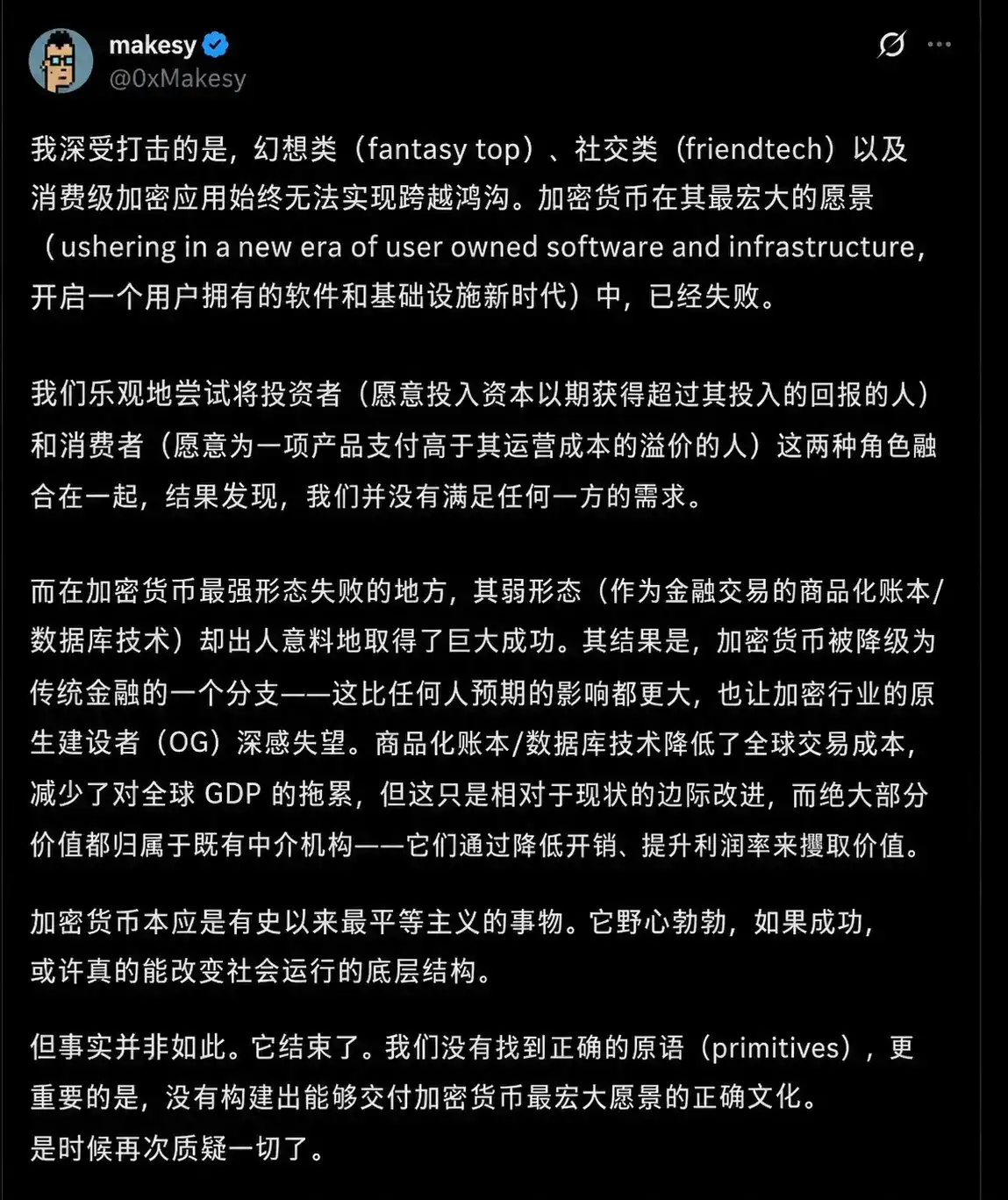
ETH is a "strong cryptocurrency" that money depends on.
At the very moment when everyone was forced to go online, ETH emerged as the internet currency. The world discovered cryptocurrency for the first time, and in that brief window of time, it was incredibly cool.
Currency is a game of coordination, and the Schelling point (consensus focus) of a currency is what binds people together by belief. In 2021, the general public believed in ETH: it was cool, disruptive, and populist. Bitcoin has the same properties and has retained them better than ETH since 2021.
This raises a disturbing possibility: a strong version of cryptocurrency may never have been a stable equilibrium. The COVID-19 pandemic has been an extremely distorted era for money, and perhaps "ETH as a currency" is only supported by this distortion.
If this is the case, ETH becoming a currency will always depend on a stronger version of the cryptocurrency performing better than it does in reality.
3. Ethereum's utility also benefits other currencies.
Is Bitcoin money? Is the US dollar money? Is gold money? It doesn't matter—whatever money is, it will be tokenized on Ethereum.
In 2020, Nic Carter proposed at Bankless that stablecoins could potentially be parasitic on ETH, the native unit of Ethereum. At that time, Ethereum had $3 billion in stablecoins. Today, that number is $163 billion, a 54-fold increase.
Ethereum's utility is helping to expand the monetary network for any asset that truly belongs to money, which is why the United States is so keen on popularizing stablecoins through cryptocurrencies. Ethereum is helping the United States maintain the dollar's hegemony, and leveraging this fact is a clear policy of the government.
Clearly, the positive spillover effects that $ETH derives as currency are far less powerful than what the US government has seen in the Ethereum stablecoin ecosystem.
Ethereum is a giver, not a taker.
In essence, Ethereum is a giver, not a taker.
It provides L2 with the world's most secure block space at cost price.
It tokenizes assets worldwide at cost price.
It secures billions of dollars in DeFi at cost price.
Ethereum does not charge any markup for anything it does.
This is the essence of open-source software, and the power of Ethereum. Ethereum provides the world with its full suite of vital value at cost.
Ethereum is noble. Ethereum is excellent.
Ethereum is the world's most successful non-profit organization.
Naturally, incredible mass adoption will occur on Ethereum. It has been, and will continue to be, the most influential open-source software project ever built by humankind, and being a "non-profit protocol" is one of its core characteristics.
This is why ETH's path to becoming a currency depends on its ability to maintain a sustained and extremely high level of market dominance.
Ultimately, as block space is commoditized, fees will drop to zero. As long as it is Ethereum, not its competitors, that commoditizes it, Ethereum can maintain its profit margins and dominance.
Ultimately, the fat protocol theory (which states that the vast majority of economic value is captured and monopolized by the underlying foundational protocol (such as Ethereum), rather than by the application layer built upon it as in the traditional internet) will give way to the fat application theory, where applications will devour the remaining profits.
As long as they are applications for Ethereum and not competitors, this is not a problem for ETH.
It's difficult to reconcile the idea that "ETH is money" with the notion that "Ethereum is a giver, not a taker." Ethereum's architecture is intentionally designed to give everything back to its ecosystem and only take the bare minimum necessary to keep the network running.
Architecturally, ETH was not prioritized in Ethereum; this is a feature, not a flaw. ETH will only become money when Ethereum wins the battle it refused to participate in architecturally.
This could have worked if Ethereum had been able to maintain its incredible market dominance.
This argument places too much emphasis on Ethereum.
"ETH is money" requires everything on Ethereum to run smoothly. The margin for error is much smaller than I initially thought. Ethereum's momentum in 2021 and 2022 made it seem like "ETH is money" was the default path.
In hindsight, Solana's rise in 2021, accompanied by a surge in anti-Ethereum sentiment, was the first major indication that the coordinated game between Ethereum and ETH was not proceeding as planned.
The Ethereum Foundation needs to decentralize and allow for the emergence of alternative power structures. But it also needs to respond to market forces with the urgency and drive of startups facing the threat of elimination.
The L2 team needs the freedom to make its own decisions, but it also needs to operate under the larger umbrella of Ethereum and ETH. The technical synchronization and integration between Ethereum and its L2 needs to be executed much faster.
Smart contract chains are valued through fees, and to break free from this model, Ethereum needs to rewrite the rules with overwhelming success.
The reason I sold
It simply didn't reach its full potential.
Ethereum has done a noble thing by choosing the most difficult, ambitious, and ideologically pure path for its future.
It achieved some incredible victories, but also failed to win some challenges.
Ethereum has earned the market capitalization it deserves.
I am very optimistic about the Ethereum network and its ecosystem—Ethereum is architecturally designed to maximize the success of its applications, L2, and ecosystem. The fat application theory means that Ethereum applications take all the fees, while the rollup-centric roadmap means that L2 takes 97% of the profits.
As for assets like ETH, I find it difficult to see them being structurally revalued, whether they are rising or falling.
Therefore, my reason for selling ETH was not because I was bearish on ETH, but because I believed the argument that "ETH is money" had been proven true, and I wanted to allocate the funds to other opportunities in the market that I was optimistic about.