Author: TechFlow TechFlow
Yesterday's Market Dynamics
SpaceX's IPO has attracted over $70 billion in retail orders.
SpaceX's IPO has attracted over $70 billion in retail orders. SpaceX will allocate at least 20% of its IPO shares to retail investors. Less than 10% of its IPO shares will be allocated to international orders.
Japan plans to include crypto assets under the same regulatory framework as stocks, potentially taking effect next year.
The Japanese parliament is pushing forward a bill to bring crypto assets under the same regulatory framework as stocks. The bill, which passed the lower house on Thursday, proposes classifying crypto assets as financial instruments, subjecting them to lower tax rates and stricter trading rules, and paving the way for new products such as crypto asset ETFs. The bill still needs to be reviewed by the upper house and is expected to take effect next year.
Xu Zhengyu: We will explore more applications of compliant stablecoins in the field of digital finance.
According to the Securities Times, Christopher Hui, Secretary for Financial Services and the Treasury of the Hong Kong Special Administrative Region Government, stated that both licensed stablecoin issuers are participating in projects related to central bank digital currencies and tokenized deposits led by the Hong Kong Monetary Authority (HKMA), with partners including local telecommunications, payment, and digital asset companies. The HKMA will continue to monitor the situation, urging institutions to implement relevant application scenarios and explore more applications of compliant stablecoins in the digital finance sector to create value for the real economy and financial activities.
In addition, the Hong Kong Monetary Authority (HKMA) has established the Ensemble Project Architecture Working Group to fully promote the construction of local unified standards, realize the interoperability of central bank digital currencies, tokenized currencies and tokenized assets, promote the seamless flow of funds and assets within the tokenized ecosystem, and clarify the development direction for the industry.
OpenAI is considering a significant reduction in token pricing to attract Anthropic users.
According to the WSJ, OpenAI is considering a significant reduction in token pricing to attract users from competitor Anthropic. Sources familiar with the matter say OpenAI is evaluating a substantial decrease in the token-based pricing of its AI products and expects Anthropic to follow suit. Discussions are ongoing, and a finalized plan has not yet been finalized.
Canton Network developer Digital Asset has raised $355 million in funding, led by a16z.
According to CoinDesk, Digital Asset, the developer of Canton Network blockchain, announced the completion of a $355 million funding round led by a16z crypto, with participation from global institutions including ABN Amro, Apollo Funds, BNP Paribas, Citadel Securities, HSBC, SBI Group, and a subsidiary of the Abu Dhabi Investment Authority. The funding amount exceeded the previous target of $300 million, valuing the company at $2 billion.
Canton Network is designed for large financial institutions, enabling the issuance and trading of tokenized real-world assets (such as bonds, loans, and funds) on a shared ledger, while also balancing privacy and compliance requirements. In addition to funding, a16z crypto will provide professional support in development, policy, and research.
Figure will acquire Kiavi for $717 million, aiming to integrate its loan assets into the blockchain-native capital market.
Blockchain capital markets company Figure Technology Solutions has signed a definitive agreement to acquire AI-driven real estate investment lending platform Kiavi for a total transaction value of $717 million. At the same time, Figure will form a joint venture with Sixth Street to acquire the loan assets on Kiavi's balance sheet.
Following the transaction, Kiavi is expected to add over $7 billion in first-lieute lending capacity annually to Figure Connect and bring over $100 million in monthly funding to the on-chain decentralized lending marketplace, Democratized Prime. Figure stated that Kiavi assets will also become the first agent-to-agent access use case for its AI product, Adaptor.
Raydium's older AMM V3 program was exploited, resulting in the transfer of approximately $1.34 million in assets.
According to official sources, Raydium stated that its old version of the AMM V3 program, which was discontinued in 2021, was exploited, resulting in the unauthorized removal of approximately 150,177 RAY, 5,603 SOL, and 893,700 USDC, involving assets worth approximately $1.34 million. The compensation will be borne by Raydium's treasury.
This incident affected five liquidity pools, including Sollet USDT - RAY, Sollet ETH - RAY, SRM - RAY, USDC - RAY, and RAY - SOL. Raydium stated that current users and the existing mainnet program are not affected, and the vulnerability was caused by insufficient verification of the LP minting address, not by key leakage or permission-related issues.
Binance Stocks will launch limit trading for SpaceX (SPCX) stock on June 12.
According to an official announcement, Binance announced that it will support whole-share limit orders for SpaceX (SPCX) stock on Binance Stocks starting at 17:05 (UTC+8) on June 12, 2026.
According to the announcement, due to the IPO price discovery process, SPCX is not expected to open at the usual 21:30 (UTC+8). Orders placed before the opening will only be queued and will not be executed. Trading on the first day will end at 04:00 (UTC+8) on June 13th and will resume on June 15th at 21:30 (UTC+8). Odd-lot orders and orders by amount will not be supported during the first day and the first 5 minutes after the opening on June 15th; pre-market, after-hours, and overnight trading will be closed on the first day.
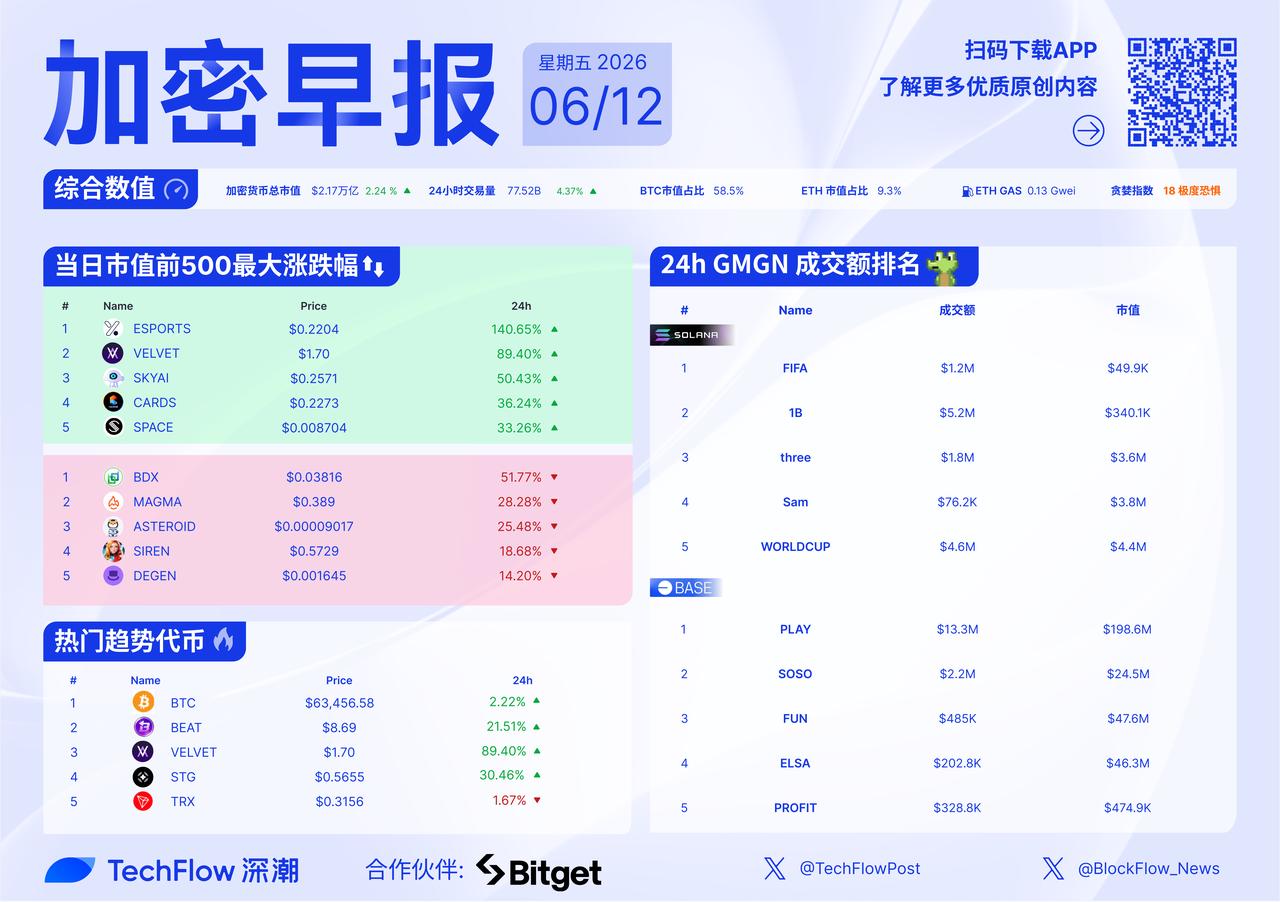
Bitcoin spot ETFs saw a net outflow of $213.84 million yesterday.
According to data from Trader T (@thepfund), Bitcoin spot ETFs saw a net outflow of $213.84 million yesterday, marking the 18th consecutive trading day of net outflows. BlackRock ($IBIT) saw a net outflow of $148.47 million; Fidelity ($FBTC) saw a net inflow of $4.04 million, WisdomTree ($BTCW) saw a net inflow of $980,000, and Grayscale Mini ($BTC) saw a net inflow of $17.52 million. Bitwise ($ARKB), Ark ($ARKB), Invesco ($EZBC), Franklin ($EZBC), Valkyrie ($HODL), and Morgan Stanley ($HODL) all had zero cash flows, while Grayscale ($GBTC) saw a net outflow of $87.91 million.
Arc introduces optional privacy enforcement solutions, aiming to support on-chain financially sensitive processes.
According to official sources, Arc Privacy, as its confidential smart contract engine, will provide private transaction and private smart contract capabilities in an optional manner, supporting enterprises and developers to handle sensitive processes such as payroll, fund management, transactions, and asset issuance on the public blockchain, while retaining controlled access permissions for authorized parties.
Arc states that the solution is compatible with audit, compliance, and governance requirements, supporting the construction of composable private applications within a familiar EVM environment. It is intended to cover on-chain financial scenarios such as payroll management, financial operations, tokenized asset management, transaction processes, and lending. The article also notes that these functionalities are still proposed designs, and the scope, features, and launch timeline may be adjusted.
Market Dynamics
Recommended reading
Interview with Instagram founder Anthropic Fable 5: The era of hand-written code is over.
https://www.techflowpost.com/article/32008
Mike Krieger, as the co-founder of Instagram, single-handedly created one of the most influential consumer applications of the past two decades. Today, he is at the forefront of AI-native product development. As the head of Anthropic Labs, he leads his team in tackling a fundamental question: when the world's most advanced AI models are handed over to real developers, where will the boundaries of technology be pushed?
Five months before Fable's official release, when he first received internal access to the model, the shock and sense of disorientation he felt remain vivid in his memory. "Well, I felt like a complete novice again," he joked to his team at the time. He suddenly realized that all the rules of thumb he had accumulated over the past few decades regarding efficiency improvement, R&D strategy, and even time management were now obsolete. The model's evolution speed had completely outpaced his original workflow.
In this episode, the host engages in an in-depth conversation with Mike Krieger, offering a glimpse into what it's like to work alongside a groundbreaking, hardcore model like Fable to co-build software. What new development BlockBeats, formidable challenges, and imaginative ultimate possibilities have emerged in this new normal of human-machine symbiosis?
Even shovel sellers have to borrow money to buy shovels: US AI stocks lost over a trillion dollars in a week, and the market is starting to price AI's "bill".
https://www.techflowpost.com/article/32004
Over the past week, the US AI sector has lost over a trillion dollars in market value. However, the market's concern is no longer whether there is demand for AI, but rather who will foot the bill for this frenzied expansion. From Alphabet raising over $84 billion, to Oracle's negative free cash flow yet plans to continue borrowing, to Broadcom partnering with private equity giants to build a financing platform for AI data centers, more and more money is being borrowed into the AI infrastructure race in increasingly complex ways. The problem is that this financing chain ultimately points to a few AI labs like OpenAI and Anthropic that have not yet achieved profitability. When even shovel sellers start borrowing money to buy shovels, and when record revenue corresponds to record capital expenditures and debt commitments, the market is beginning to recalculate the cost of the AI story. AI growth hasn't disappeared, but investors are no longer just looking at the revenue curve; they are asking: who will ultimately pay this ever-growing bill?
So much for a booming year for crypto IPOs? Only one went public in six months, and it dropped 70%.
https://www.techflowpost.com/article/32003
The anticipated year of crypto IPOs fizzled out in the first half of 2026. While SpaceX stormed to become the largest IPO in history with a $1.75 trillion valuation, the crypto listing story stalled. BitGo, the only company to complete an IPO this year, has fallen more than 69% from its offering price; Kraken's valuation has shrunk by about a third from last year's high; Consensys postponed its listing plans to the fall; and Bitpanda is also likely to miss its original timetable. Liquidity was siphoned off by the AI sector and mega-IPOs, Bitcoin fell below $60,000, and market risk appetite cooled, causing crypto companies to collectively miss the best window for entering the capital markets. With only five months left until the US midterm elections, the "crazy year of IPOs" that the crypto industry was looking forward to now seems more like a wave of listings that have been forced to postpone.
Want to chase SpaceX? Data shows that most of the 30 star US IPOs saw their share price halved in the first year.
https://www.techflowpost.com/article/31997
Want to chase SpaceX? Historical data shows that star IPOs are rarely a winning game from the opening bell. Statistics show that over the past 14 years, the median return for 30 well-known tech companies after their IPOs was -9% in both the 6-month and 12-month periods, with a median maximum drawdown of 54% in the first year – almost no company escaped this fate. Even later star performers like Meta, Palantir, Coinbase, and CoreWeave experienced drawdowns of up to 50%. Now, SpaceX has entered the capital market with a valuation of approximately $1.75 trillion, a price-to-sales ratio exceeding 90, while some institutions give it a reasonable valuation of only around $780 billion. History doesn't simply repeat itself, but for investors chasing mega IPOs, the biggest risk is often not missing out, but overestimating the market's willingness to pay in the short term.
AI Investors' Anxiety in 2026: When Models Devour Everything, What's Left for Startups' Competitive Advantage?
https://www.techflowpost.com/article/32002
While everyone is discussing how much more the model's capabilities can be improved, Silicon Valley investors are starting to think about another question: if large models can eventually complete the vast majority of standardization work, then where exactly is the startup's moat?
This article argues that true value lies not in the model itself, but in areas that cannot be measured by benchmarks—internal enterprise data, industry workflows, organizational change, user trust, regulatory approval, and long-accumulated expertise. Models will continuously consume quantifiable, trainable tasks, but the most critical decisions in industries like healthcare, law, and finance often rely on private data, real-world validation, and long-established networks of relationships—these don't disappear simply because models become smarter. For AI entrepreneurs, the future competition will no longer focus on who has the strongest model, but on who can deeply embed AI into real-world business processes, becoming an irreplaceable "translation layer" connecting models and the real world. In other words, AI will make intelligence increasingly cheaper, but trust, data, and context remain the most expensive assets.