Super Smash Bros.
Article author and source: Wall Street News · All-Weather Technology
More than a decade ago, smartphones reshaped the imaging industry with computational photography and the mobile internet, and also buried countless point-and-shoot cameras and consumer cameras.
For ordinary users, taking photos has changed from "carrying a camera with you" to "taking out your phone at will".
However, as short videos, store visits, travel vlogs, and voice-over content become new forms of daily expression, mobile phones have begun to reveal another shortcoming: they are not stable enough, they may not be suitable for one person to complete shooting for a long time, and they cannot meet the aesthetic expectations of users.
More than a decade later, as short videos and content creation have spurred new demands, those who once wanted cameras to disappear from the scene have returned to the camera market.
Thus, a demand that was once suppressed by mobile phones is making a comeback in a new form—the handheld gimbal camera.
It's not as heavy as a traditional camera, nor is it entirely equivalent to a mobile phone accessory. Instead, it attempts to carve out a middle ground between a mobile phone and a camera: it's more stable and has better image quality than a mobile phone; it's lighter and easier to use than a camera.
In 2024, DJI's Pocket 3 handheld gimbal camera sold over 5 million units, generating nearly 20 billion yuan in revenue.
The explosive success of DJI Pocket 3 has opened up possibilities for this middle ground for the first time: proving that, besides smartphones, there is still a type of independent imaging hardware that can be sold in the three to four thousand yuan price range and has the potential to become a blockbuster.
Faced with a vast market prospect, mobile phone manufacturers and others are eager to try their luck.
vivo launched its Vlog camera project at the end of 2025, directly targeting DJI's Pocket series, and has already assembled a team of nearly 100 people; OPPO has also launched a gimbal camera project, codenamed "Fuyao"; Honor plans to launch a "robot phone" equipped with a gimbal camera, which is equivalent to combining a smartphone and a Pocket camera into one.
Imaging manufacturers are not to be outdone. On June 10th of this year, InStone partnered with Leica to launch the Luna Ultra handheld gimbal camera. Prior to that, in May, Canon published a patent for a gimbal camera scheduled for 2026, and the automatic folding design shown in the patent is seen as a signal that it is entering the handheld gimbal camera field.
However, this collective entry into the market coincided with a new wave of chip price increases.
The demand for AI computing power is driving up the prices of key components such as storage and image processing chips, which is raising the hardware costs for consumer electronics manufacturers.
While manufacturers saw the market opportunity proven by the Pocket camera, they also faced more expensive supply chains and narrower profit margins.
Blitzkrieg
Before the price war even began, the patent war started first.
On the day the Inspire Luna Ultra was released, DJI filed a lawsuit in the United States, targeting its Luna series products.
In this lawsuit, DJI sets the starting point of its narrative in 2018.
That same year, DJI launched the Osmo Pocket 3, defining it as "the first truly pocket-sized, all-in-one handheld gimbal camera."
DJI believes that previously, "handheld gimbal" usually referred to a bracket with a motor, which users needed to attach their own smartphone or action camera separately.
DJI, on the other hand, has integrated a camera, a three-axis gimbal, processing electronics, control buttons, and a display screen into a device small enough to fit in a shirt pocket.
This prompted the Pocket to cease being merely an accessory for other cameras, but rather to become a complete camera in itself, a step that pioneered the entirely new category of "modern handheld gimbal camera".
Based on this, DJI believes that Inspire Luna's rotating screen appearance, gimbal mode switching, and target tracking functions all fall within the scope of its patents granted in the United States in the past, and requests the court to issue a permanent injunction against Inspire Luna.
Shadowstone seemed to have anticipated the lawsuit that followed the release of Luna.
On June 11, InStone also filed a countersuit against DJI, accusing it of infringing on five invention patents, covering gimbal stabilization algorithms, gimbal pointing control, camera smoothing and stabilization, motion data overlay and panoramic video stabilization.
According to Inspire, DJI cited Inspire's 161 and 090 patents when applying for patents for stabilization platforms, remote control methods and terminals, and stabilization and shock absorption devices and methods in the past. Based on this, DJI accused DJI of knowingly continuing to infringe on Inspire's patents despite knowing that its products would infringe on Inspire's patents, thus constituting intentional infringement.
At the same time, InStone also filed an invalidation request with the China National Intellectual Property Administration regarding related patent families.
Among them, "patent family" refers to a group of patents formed by applying for the same technology in different countries or regions.
“A patent invalidation in China will not have a direct impact on litigation in the United States, because patent law is territorial and will not automatically invalidate a patent in the United States simply because it is invalid in China. However, since it involves the same technology and the same viewpoints or statements, these can be used as evidence in U.S. cases,” a Beijing-based intellectual property lawyer explained to Wall Street Insights.
This is not the first time the two teams have faced off.
Back in March 2026, DJI sued InStone in the Shenzhen Intermediate People's Court over a patent ownership dispute involving six patents, targeting several former core DJI R&D personnel—accusing them of applying for patents within a year of leaving the company that were closely related to their work tasks during their tenure at DJI.
At that time, InSight founder Liu Jingkang and China head Yuan Yue published a long article on Weibo refuting the claims point by point. Liu Jingkang also pointed out that DJI's panoramic camera fell within the scope of many of InSight's patents, but the company "did not take the initiative to sue".
With the domestic lawsuit still pending, the North American battlefield has been ignited, further exacerbating the feud between the two imaging equipment companies amid a heating-up market for handheld gimbal cameras.
This raises a new question: With DJI and Inspire's patent war raging, will other players like vivo and OPPO, who plan to launch handheld gimbal cameras, also be drawn into similar disputes?
Thirteen years of evolution
Zooming out from the courtroom, the history of handheld gimbal cameras is the result of continuous product innovation from generation to generation.
In 2013, Feiyu Technology, which was then mainly engaged in drone flight control and aerial photography gimbals, brought the stabilization technology that was originally installed on drones to its hands and launched the Feiyu G3 handheld two-axis gimbal, which was used as an accessory for GoPro action cameras.
This product brings "stabilized shooting" from aerial photography scenarios to ordinary consumer handheld devices.
But the G3 is still essentially a camera accessory: it provides a grip, gimbal, and stabilization capabilities, but the final image is still produced by an external GoPro.
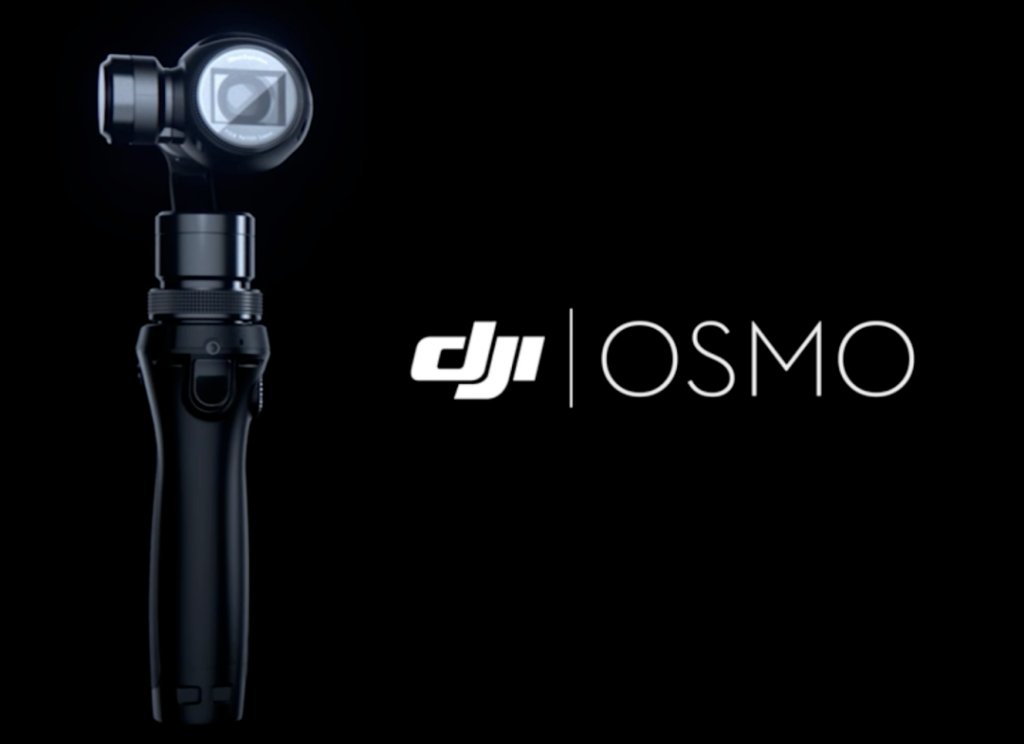
Two years later, DJI launched the Osmo, integrating a 4K camera and stabilizer into a single device. Users no longer needed to mount a separate action camera; they could switch angles, take photos, and record videos simply by holding the handle itself.
Compared to the Feiyu G3, the Osmo is closer to the prototype of today's handheld gimbal camera, but it has no screen. To frame a live view, adjust the image, and perform more operations, it still relies on a mobile phone.
Until 2017, South Korean imaging accessory manufacturer REMOVU launched the K1, which crammed a 4K camera, a three-axis gimbal, a handle, and a 1.5-inch LCD screen into the same device, claiming it to be "the first 4K camera to integrate a three-axis gimbal and a built-in LCD screen."
However, REMOVU failed to popularize this product category.
The core issue is that the product capabilities didn't keep up. The K1 weighed 340 grams, heavier than the then-popular Canon G7 X Mark II compact camera, yet its image quality, lens, and portability were inferior to the latter.
For the average user, the K1 is not as convenient as a mobile phone, does not have the image quality of a camera, and is not as durable as an action camera; it doesn't quite fit any of those categories.
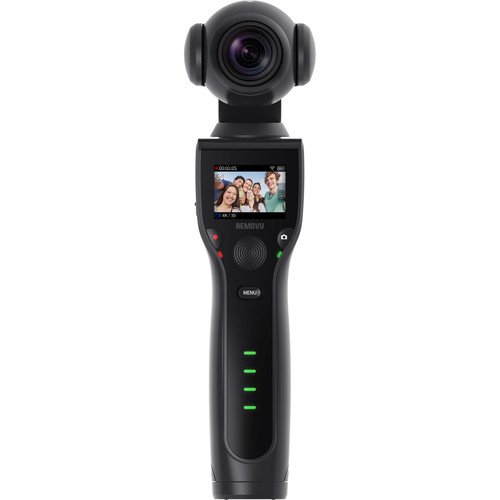 REMOVU K1
In 2018, DJI launched the first-generation Osmo Pocket. This time, the form factor was finally compressed into a size that truly embodies consumer electronics: the camera, three-axis gimbal, display screen, control buttons, and the entire shooting system were all packed into a machine that could fit in a pocket.
DJI considers this moment to be the true milestone in the formation of the "modern handheld gimbal camera".
However, for a considerable period of time, the first two generations of Pocket did not become a hit in the mass market.
In the eyes of ordinary users, they are always "a camera that needs to be carried separately". They have an extra learning curve compared to mobile phones, are not as durable as GoPro and are not suitable for extreme sports, and do not have an overwhelming advantage over cameras in terms of image quality, focal length and depth of field.
The real turning point came in 2023 with the release of the Osmo Pocket 3 by DJI.
With a 1-inch sensor, the image quality and low-light performance of the handheld gimbal camera are not only "stable", but can also capture images that are closer to the user's aesthetic expectations; the 2-inch rotatable touch screen makes framing and self-portraits more intuitive; intelligent follow shooting and focusing improve the smoothness of a person independently completing selfies, store visits, travel photography and voiceovers.
According to DJI supply chain sources, DJI itself did not expect the Pocket 3 to sell so well.
Before its release, the expected inventory of Pocket 3 was only 300,000 to 400,000 units; after its launch, the inventory was gradually increased to 1 million, and then to 5 million in 2024. By October 2025, the cumulative sales officially exceeded 10 million units.
Starting with the Pocket 3, handheld gimbal cameras have transformed from a niche imaging tool into a category within the consumer electronics market that has been repriced and imbued with new possibilities.
A struggle over the "middle ground"
The success of the Pocket 3 not only validates the commercial potential of this product category, but also represents the result of DJI's cultivation of a complete supply chain ecosystem around gimbals and handheld imaging devices over the past decade.
Behind the Pocket is a highly integrated system of components such as motors, gimbals, camera modules, wireless connectivity, heat dissipation, batteries, and screens, as well as the overall assembly.
O-Film is a core strategic supplier for DJI, and its camera modules and lenses are used in multiple product lines of DJI drones, handheld cameras, etc. The two companies have a close partnership.
According to O-Film's 2025 annual report, the company's new business areas achieved revenue of RMB 2.776 billion, a year-on-year increase of 58.73%, of which handheld intelligent imaging devices were among the new areas.
The emergence of Pocket has created an opportunity for upstream companies such as camera modules, lenses, motors, and connectors to enter a new growth cycle.
After DJI matured its supply chain, it attracted more players to enter the market. All that's left is to solve product issues.
The handheld gimbal camera is positioned as an intermediate product "between a mobile phone and a camera".
Looking up, handheld gimbal cameras shoot better than mobile phones because of their larger sensors, professional three-axis mechanical stabilization, and a set of optics and algorithms designed for video, which make up for the shortcomings of mobile phones in meeting users' aesthetic expectations.
Looking further down, it also needs to be lighter and more portable than a traditional camera, without the cumbersome process of changing lenses, adjusting parameters, and exporting data in post-production.
This means that this product category is inherently a two-pronged battle: one foot must firmly maintain the upper limit of image quality that is "better than mobile phones," while the other foot must safeguard the lower limit of user experience that is "more convenient than cameras."
If either side loses ground, the product will be forced back into the territory of mobile phones or cameras.
This product proposition determines that there are mainly two types of companies that can stand at the starting line of this track: one is professional imaging manufacturers; the other is mobile phone manufacturers with a mass user base, but who are worried that the imaging entrance will be diverted by a bypass.
Beyond hardware, each company has different resource endowments.
The advantages of mobile phone manufacturers lie in their technological accumulation and distribution channels.
In the past few years, manufacturers such as OPPO and vivo have invested heavily in mobile phone imaging.
From sensor calibration, night scene algorithms, and portrait algorithms to video stabilization, multi-camera fusion, color management, and AI image enhancement, these capabilities can obviously be reused in handheld gimbal cameras.
Another key factor for mobile phone manufacturers is their distribution channels.
OV possesses offline stores, carrier channels, e-commerce systems, and a large user base of mobile phones. Once its products are integrated with the mobile phone ecosystem, the handheld pocket gimbal camera could become an important external device for the mobile imaging ecosystem.
Shadowstone's advantage lies in its innovative gameplay.
From panoramic cameras to action cameras, InSight has been reducing users' reliance on professional shooting capabilities, allowing devices to handle more composition, camera movement, and post-processing for users.
Luna Ultra continues this approach, for example, by incorporating a detachable image transmission remote control screen into the product design, turning the screen into a remote control, which solves pain points such as having to consider the angle when taking selfies, having to repeatedly confirm the composition when taking group photos, and having difficulty seeing the image in time when shooting from a distance or from a fixed position.
Faced with the simultaneous influx of players such as Inspiron, vivo, and OPPO, DJI's next-generation product must not only maintain the user mindshare established by the Pocket 3, but also resist the attacks from newcomers in terms of telephoto, large sensor, and gameplay.
On June 15, DJI released the Pocket 4P, which for the first time adopts a dual-lens solution, featuring a one-inch variable aperture main camera and a 3x optical telephoto lens. It also supports Hasselblad color, D-Log mode, 6K 60fps video recording, and 4K 240fps slow-motion shooting.
The Pocket 4P's newly added 60mm golden mid-range telephoto lens and f/1.8 large aperture further enhance its ability to tell stories in portraits and scenes.
2026 is destined to be a year of fierce competition among handheld gimbal cameras.
A protracted war
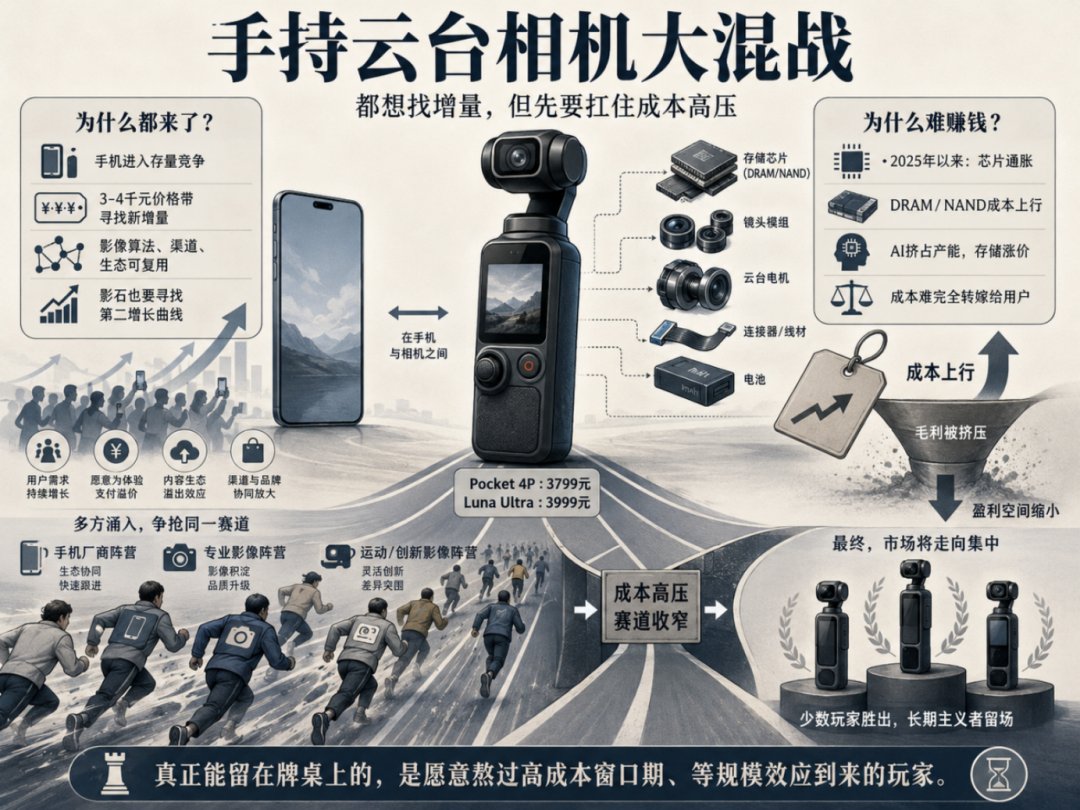
The influx of companies into handheld gimbal cameras is also a way for them to find new growth opportunities.
As users' phone replacement cycles lengthen, mobile phone manufacturers are deeply mired in competition for existing customers, and it is becoming increasingly difficult to find truly new growth opportunities in the three to four thousand yuan price range.
Handheld gimbal cameras offer a new entry point: the average order value is high enough, and they can also handle mobile phone image algorithms, sensor calibration, and distribution channels.
The same applies to InStone. Panoramic cameras and action cameras have already formed the core business, and handheld gimbal cameras are an unavoidable direction for opening up the next stage of growth.
However, the timing of these players entering the market coincided with the period when the entire imaging hardware industry was at its most expensive.
Since 2025, the global semiconductor industry has experienced a wave of memory price increases, which Morgan Stanley defines as "chipflation."
As the demand for AI computing power explodes, manufacturers such as Samsung and SK Hynix are shifting a large amount of their production capacity to produce high-profit AI-specific chips such as HBM and DDR5, directly reducing the production capacity of traditional DRAM and NAND general-purpose memory.
Storage cost pressures have even dragged GoPro, the former leader in action cameras, to the brink of being sold, and it is now seeking an opportunity to "sell itself".
As competition intensifies, it becomes increasingly difficult for all players to pass on the burden of rising costs entirely to users.
One clear indication is that the prices of DJI and Inspire's latest products are basically in the mid-range smartphone price range. The Pocket 4P and Luna Ultra standard packages are priced at 3799 yuan and 3999 yuan respectively.
Comparatively speaking, mobile phone manufacturers, due to their substantial size, do indeed have stronger bargaining power in the supply chain.
However, the challenge for mobile phone manufacturers lies in the sustainability of their resource investment.
For DJI and Inspire, handheld gimbal cameras are the core battleground of their imaging businesses; but for OPPO and Vivo, it may just be an exploration of the extension of their mobile imaging ecosystem. If sales, gross profit, and channel feedback fall short of expectations, this product line may not be able to maintain a high priority in internal resource allocation for long.
In 2026, with costs soaring, whether a company can recoup its R&D investment with its first-generation product may directly determine whether it is determined to persist in this field until the second or third generation.
This seemingly chaotic multi-party battle will likely end in a relatively peaceful manner.
Those who will truly remain at the poker table are likely those who are willing to grit their teeth and endure the high-cost window of opportunity, waiting for economies of scale to take effect.