The story of the "SpaceX liquidation " has been circulating everywhere since last week's IPO. Some argue that the overwhelming demand for SpaceX shares allowed early investors, employees, or insiders to sell at very high prices, while new buyers – especially small retail investors – were left at risk.
However, the S-1 filing, the stock unlocking schedule, and the crypto Futures Contract position suggest the opposite – at least for now.
Who might sell their SpaceX stock early?
First, it's important to understand the supply side of SpaceX's liquidation process. This offering consisted solely of newly issued SpaceX shares. The company raised approximately $75 billion by selling 555.6 million new Class A shares, and according to S-1 filings , none of the existing shareholders were permitted to sell their shares upon going public.
All proceeds go to SpaceX, primarily for the development of the company's AI capabilities. Many readers have wondered how to buy SpaceX IPO shares, assuming they would be able to purchase directly from insiders – but that's not actually the case.
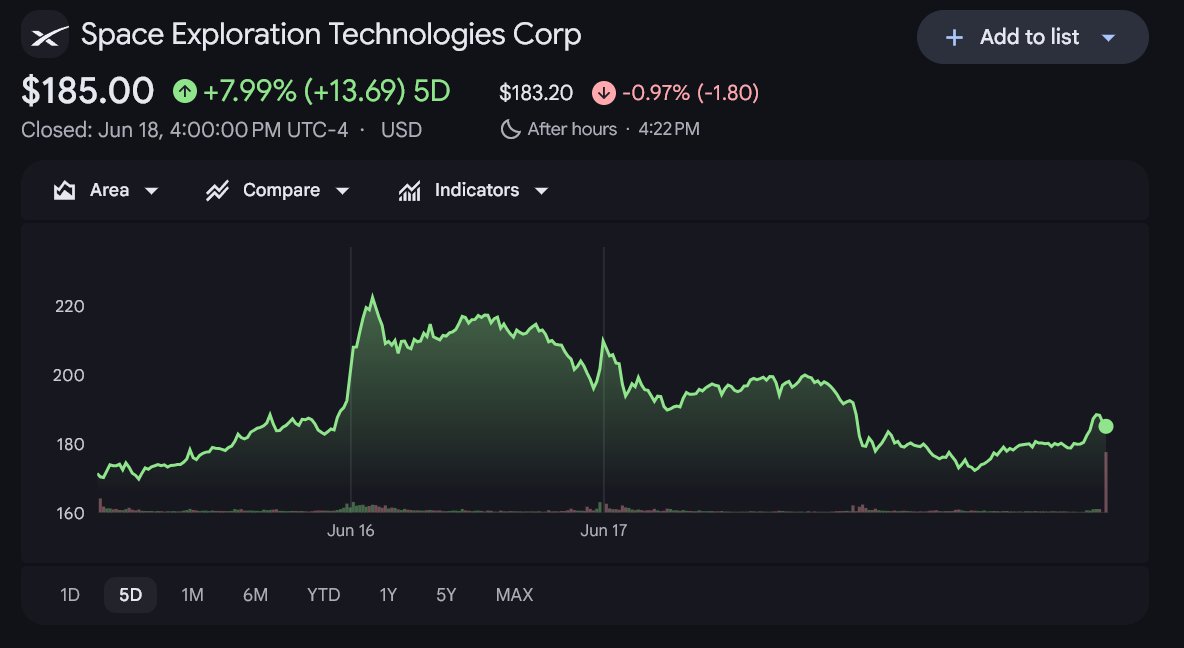 SpaceX stock price chart. Source: Google Finance
Want to read more analyses like this? Sign up for Editor Harsh Notariya's Daily Newsletter here .
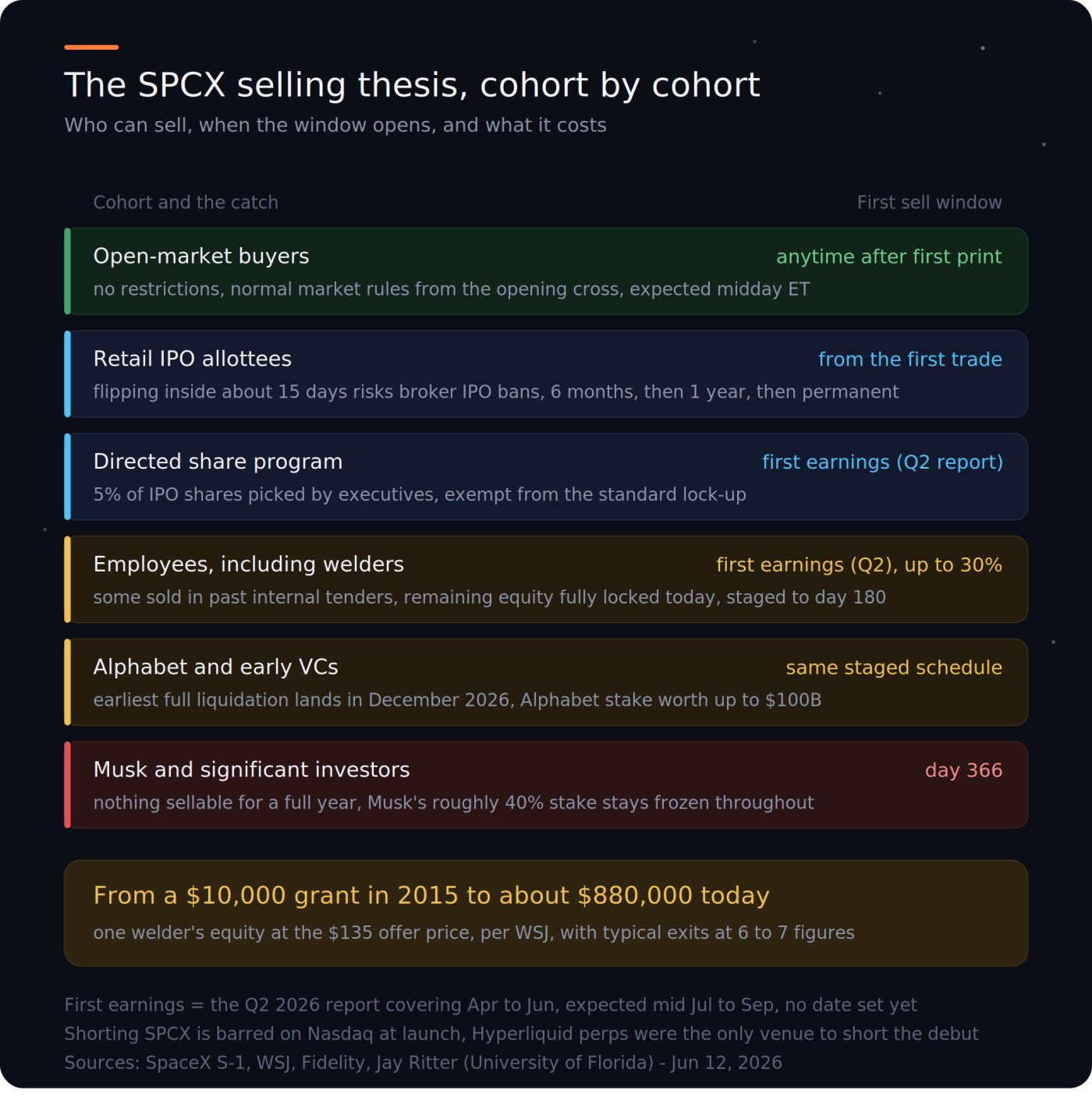
Insiders still hold approximately 95.8% of the shares . Elon Musk and several major shareholders have agreed to a 366-day lock-up agreement, meaning these individuals and employees will be restricted from trading the stock for a certain period.
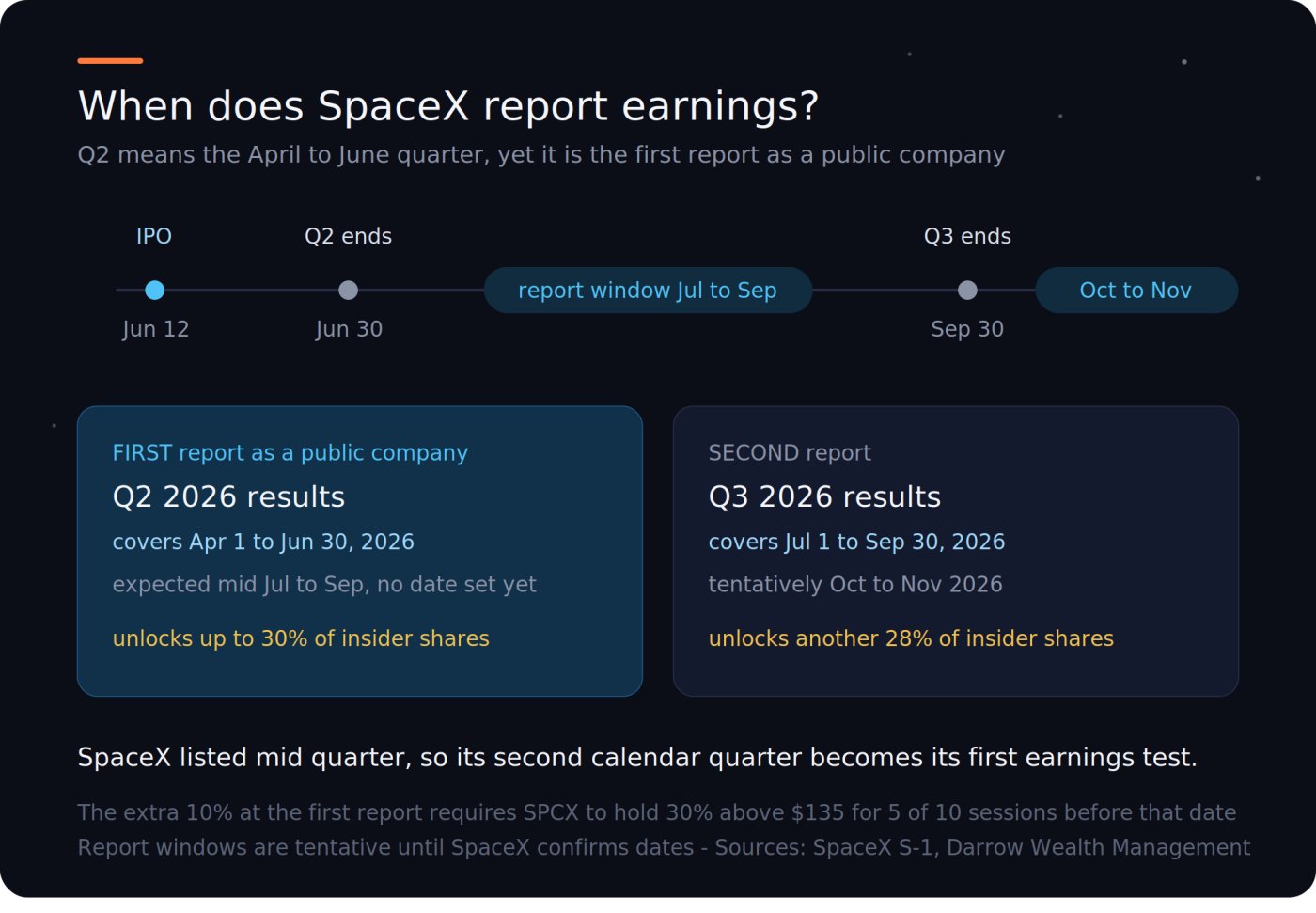
Low-level employees like welders, although officially millionaires after the IPO, had their bonus shares locked until the first "window" after the Q2 earnings announcement. Even if they wanted to sell, they couldn't Dump their SpaceX shares today.
The only exception is the special distribution program, which allocates a maximum of 5% of IPO shares to individuals designated by management. However, this group can only sell their shares after the first earnings report, and even then, they must pay the original offering price.
 SpaceX stock data when earnings report: BeInCrypto
So if no one at SpaceX is allowed to sell their stock today, who would want to sell, and when will that "door" open?
Billionaires want to Capital, but the new unlocking schedule will determine the timing.
The sellers are indeed waiting. This is also why the story about "liquidation from SpaceX IPO" isn't entirely unfounded. Google and Alphabet currently hold about 5% of SpaceX's shares after the xAI merger, which reduced their ownership stake from the previous 6.11%.
These shares could be worth up to $100 billion, nearly 100 times the Capital Alphabet invested in 2015. They clearly have an incentive to take some profits.
Early-stage Venture Capital have similar intentions.
Chad Anderson, founder of Space Capital, Chia with Fortune :
"We have been investing for almost 10 years now, and our goal is to recoup the Capital for our investors."
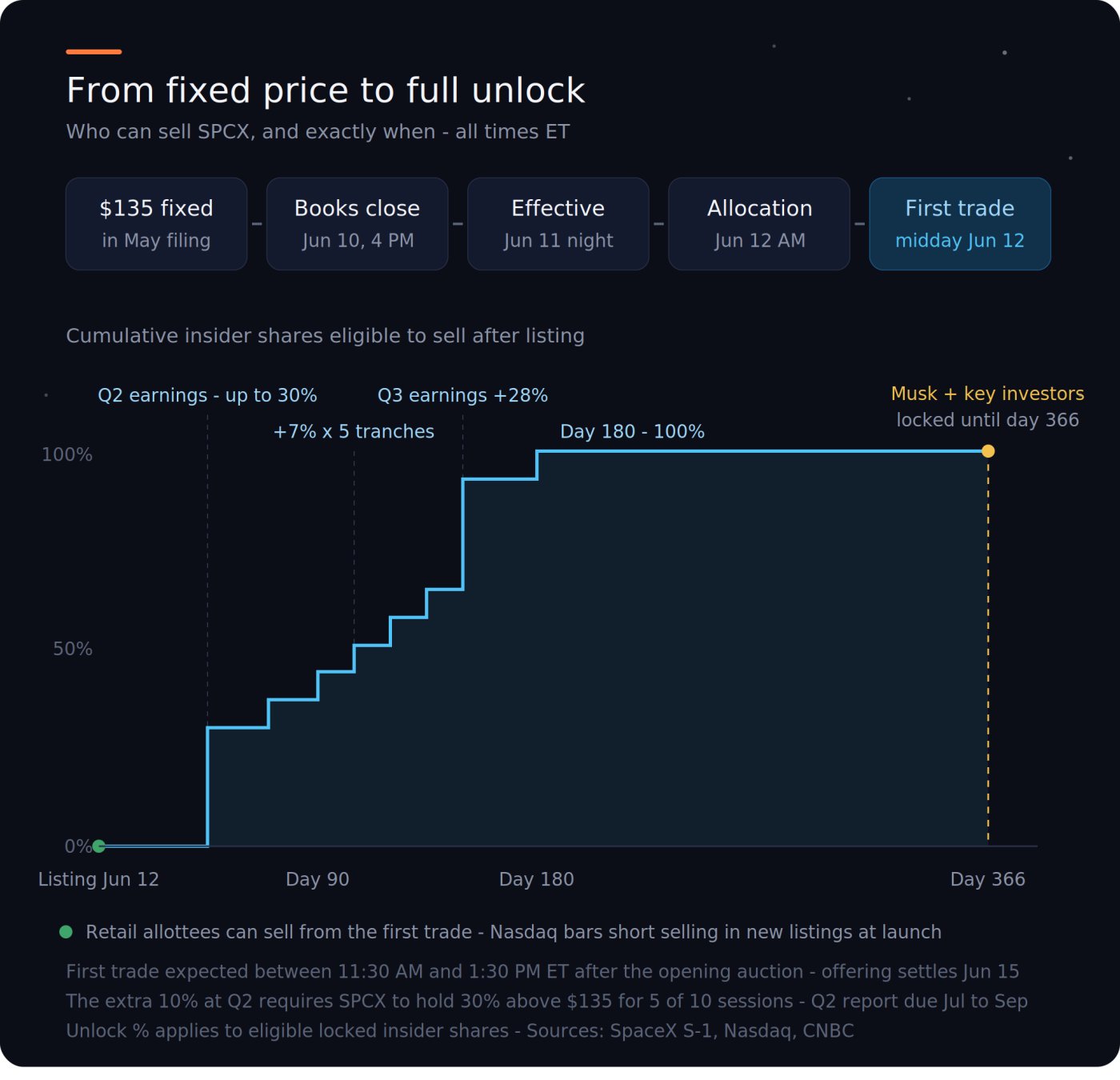
However, their Dump will be subject to a SpaceX stock unlocking schedule. A maximum of 20% of insider shares will be unlocked immediately after the Q2 earnings announcement (expected between mid-July and September 2024). An additional 10% will be unlocked if the SPCX stock price remains above 30% of the offering price for 5 out of 10 trading days. This will be followed by 7% in increments after 70, 90, 105, 120, and 135 days; a further 28% will be unlocked after the Q3 earnings announcement, and the entire remaining shares will be freely tradable 180 days after the IPO.
 Unlock schedule based on the SpaceX IPO liquidation story: BeInCrypto
This stock supply schedule also coincides with the buying schedule of investment funds. Nasdaq's fast-track listing rules and MSCI's early addition of SpaceX to its indices will incentivize a wave of index funds and retirement accounts to buy SpaceX shares within just a few weeks of trading.
This passive cash flow will always be ready to "absorb" the shares that insiders sell. The reason is that some people will want to sell quickly.
SpaceX reported revenue of $18.7 billion in 2025 but a net loss of $4.9 billion, with operating profit from Starlink reaching $4.4 billion but used to offset a $6.4 billion loss from xAI. SpaceX's current value is 94 times its cumulative revenue over the past 12 months, and Facebook, for example, saw its stock price drop 40% in 2012 after similar gradual unlocking programs.
Starlink makes a total of $4.4 Billion of PROFIT in 2025 https://t.co/hXqWv75PpU
— Ark Invest Tracker (@ArkkDaily) June 9, 2026
The selling pressure after the IPO was "scheduled," not imaginary.
SpaceX is valuing its company at $1.7 trillion based on the IPO offer price.If you consider revenue at $18bn, that means SpaceX is about 94 times sales.Context? Tesla is 15 times the sales.More context? NVIDIA is 21 times the sales.Use this information as you will.
— Kalu Aja (@FinPlanKaluAja1) June 8, 2026
Whether retail investors become the "pocket keeper" depends on who is actually allocated the shares.
Retail investors had their allocations reduced, not increased.
If insiders wanted to sell to retail investors, they would try to allocate the maximum amount to this group. But the reality was the opposite. Retail investors placed orders for SpaceX IPO shares totaling over $100 billion, far exceeding the IPO size of $75 billion, and total demand was 3.5 to 4 times the number of shares issued .
SpaceX subsequently reduced its allocation to retail investors to just over 20%, instead of the original 30%, due to large institutional orders. BlackRock alone placed a minimum order of $5 billion , while other sovereign wealth funds were each allocated over $1 billion.
The allocation mechanism further weakens the notion that retail investors are being "held captive." The allocation method is random or proportional depending on the brokerage firm, and brokerage firms only collect money for the actual number of shares that clients receive. Those who don't buy SpaceX shares still keep their money.
 The sales structure is explained in more detail as follows: BeInCrypto
The "exiting the market" narrative only holds true if the retail investor ultimately has to accept being left with the stock. This only happens in two cases: either the retail investor holds the shares but cannot sell them, or they are given shares that no one else wants.
Small investors in SpaceX avoided both of these scenarios, as they could sell their shares from day one and even receive fewer shares than they ordered.