At the 2026 AI Ascent conference, Sequoia Capital announced the arrival of the AGI era, defining it as AI agents capable of recovering from failures and persevering to complete tasks. The article points out that the AI revolution represents a qualitative leap from communication to computing, with long-duration agents achieving breakthroughs and unlocking a trillion-dollar service market. Entrepreneurs should follow the MAD strategy: build a moat centered on the customer, optimize product availability, and bridge the technology diffusion gap. This cognitive revolution will profoundly change the world like the Industrial Revolution, but human connection remains the core value.
Article author and source: Deep Thinking Circle
At the 2026 AI Ascent conference, Sequoia Capital made a groundbreaking declaration: We are now in the AGI era. When AI agents can recover from failures and persevere in completing tasks, this constitutes commercially viable artificial intelligence. This article provides an in-depth analysis of the three key characteristics of this cognitive revolution: a trillion-dollar service market, exponential growth, and the qualitative leap from a communications revolution to a computing revolution.
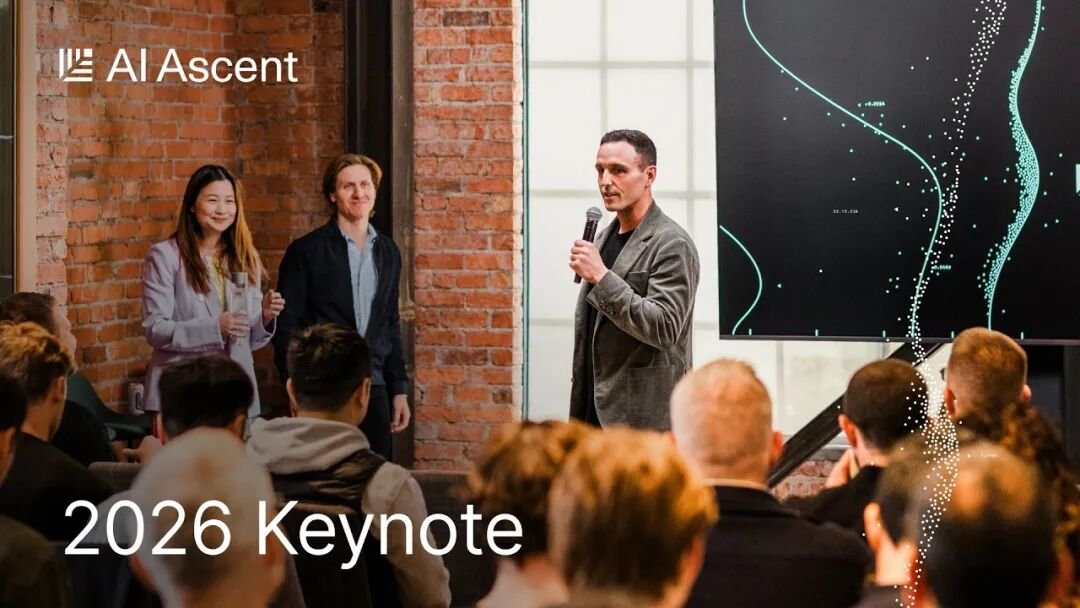
Have you ever considered that we might already be living in the AGI era? Not a scene from science fiction, not a distant future, but right now, right now. At the 2026 AI Ascent conference, three Sequoia Capital partners, Pat Grady, Sonya Huang, and Konstantine Buhler, directly declared: This is AGI. This declaration struck me deeply. Not because they used the term, but because they gave an extremely pragmatic definition: If you can send an AI agent to complete a task, and it can recover from failures and persist until the task is completed, then that is AGI. From a business perspective, a practical perspective, and a functional perspective, this is enough.
After listening to the entire speech, I felt like I'd had a sudden epiphany. For the past few years, we've been discussing how AI will change the world, but most people are probably still focused on its potential to "improve our efficiency by 10% to 40%." Sequoia's view is: the car has arrived. Not a faster horse, but a real car. This means not incremental improvements, but a fundamental shift in the way we work. Driving a car is completely different from riding a horse, and manufacturing a car is completely different from raising a horse. We are experiencing a race of a different nature.
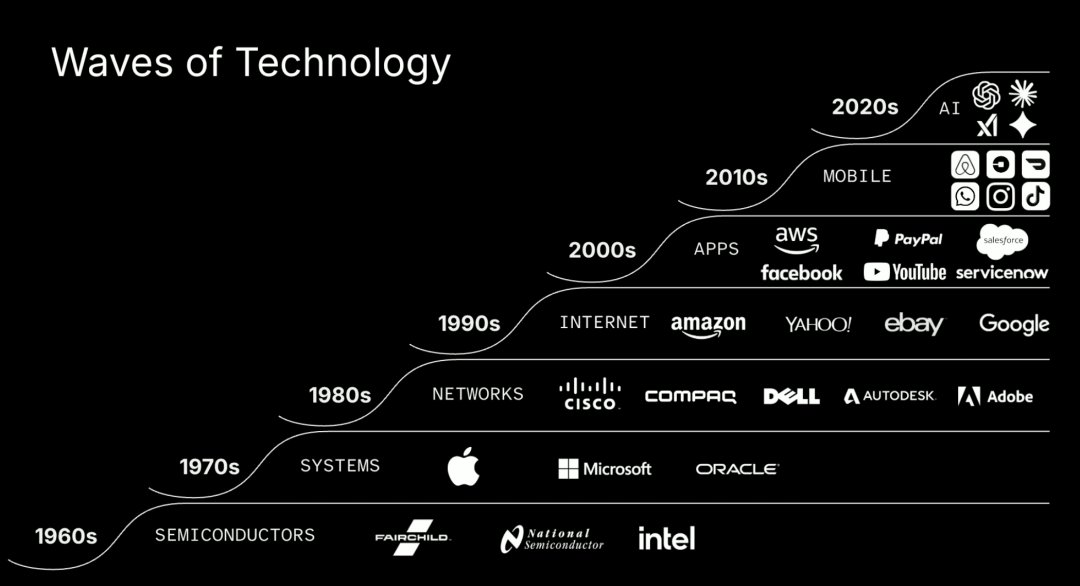
This isn't a communications revolution, it's a computing revolution. Pat Grady raised a crucial point in his speech that I believe is extremely important: the AI revolution is unlike any other technological revolution we've experienced in the past. The internet, cloud computing, mobile internet—these are all communications revolutions, about how information is distributed. But AI is a computing revolution, about how information is processed. This might sound like a semantic difference, but in reality, they are two completely different waves.
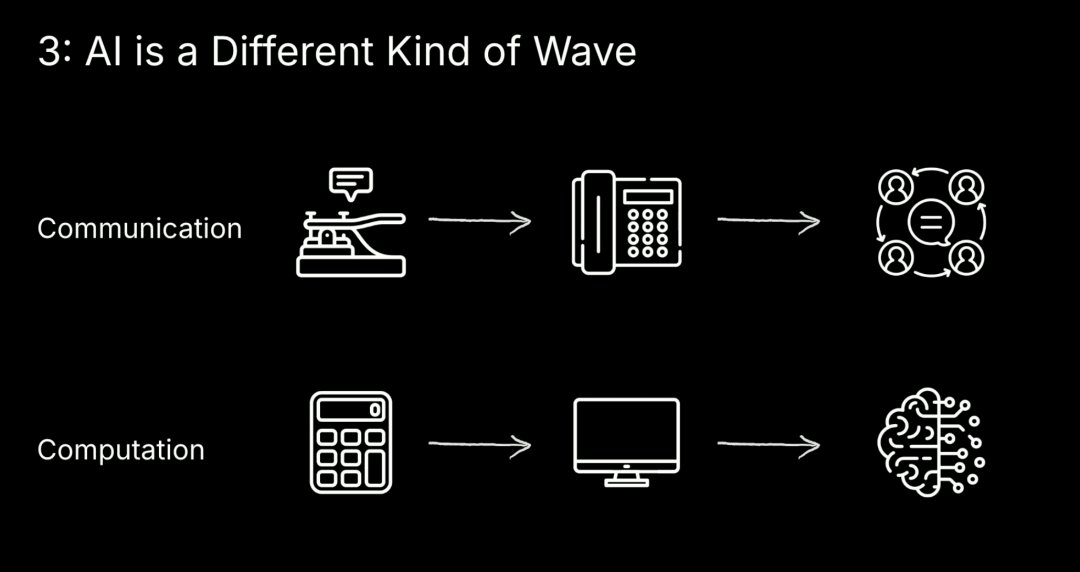
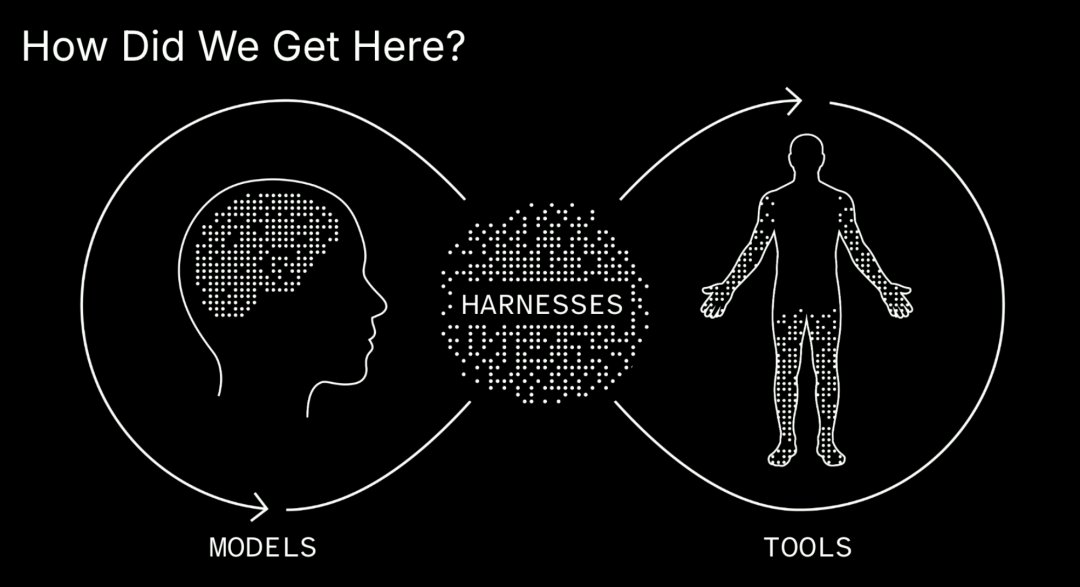
I deeply understand the implications of this difference. The communications revolution is characterized by relatively stable infrastructure; when you build applications on top of it, the underlying infrastructure doesn't change daily. But the computing revolution is different; the floor beneath your feet is constantly moving. Whenever new capabilities emerge, the technological foundation for building them changes daily. In the past few years, we've experienced three major turning points: ChatGPT in November 2022 demonstrated the power of pre-training; a few years later, the inference capabilities of the O1 model led to the emergence of the second scaling law in inference-time compute; and more recently, Claude Code, Opus 4.5, and 4.7 have shown the world the power of long-horizon agents.
I think Pat is right. There's a hard break between the second and third inflection points; it's a discontinuous change. The first two inflection points were still making AI smarter, but the third inflection point is enabling AI to actually get the job done. That's why Sequoia dares to declare, "This is AGI." Even if you don't agree that this is AGI, I think we can all see that the car is here. In the past few years, we've had many "faster horses"—applications that increase your efficiency by 10% or 40%, but don't fundamentally change the way you work. Now we're starting to see "cars"—applications that increase your efficiency by 10x or 40x and completely change the way you work, the nature of your work, and even the nature of your organization.
This shift has had a profound impact on me personally. I realized that we can no longer think about AI in the same old ways. This isn't a gradual change that can be adapted to slowly; it's a paradigm shift that requires an immediate rethinking of everything. From product design and business models to organizational structure, everything needs to be re-examined.
The real breakthrough of long-term agents
In her speech, Sonya Huang recounted the evolution of agents, a history that I found particularly illustrative. In 2022, projects like AutoGPT and Baby AGI became overnight sensations on GitHub. Their approach was to give GPT-3 some tools, wrap it in a loop, and make it run towards a goal. It sounded promising, until you watched these agents fail again and again. It was somewhat cute, somewhat endearing, but completely useless.
This example reminds us that we knew agents would arrive years ago, but the models weren't ready then. Fast forward to today, and around the beginning of the year, things really changed. Suddenly, agents are everywhere, and they seem to actually work. Claude Code was a home run for the tech community, while OpenClaw (and all its Lobster siblings) made agents accessible to anyone with a phone. Whether you're a hardcore engineer or an ordinary person, the key point is that now anyone can create agents.
Sonya provides a definition of agents that I find very accurate: an agent is a system that perceives its environment, chooses actions, and autonomously moves towards a goal. More specifically, agents have three functional components. First is the ability to reason and plan, which is a baseline level of intuition and immediate thinking. Second is the ability to take actions, including using tools, searching, writing, and compiling. Third is the ability to iterate towards a goal; this persistence allows agents to complete tasks over long periods. Agency (agency capability) combines these three points; simply put, it's the ability to get things done.
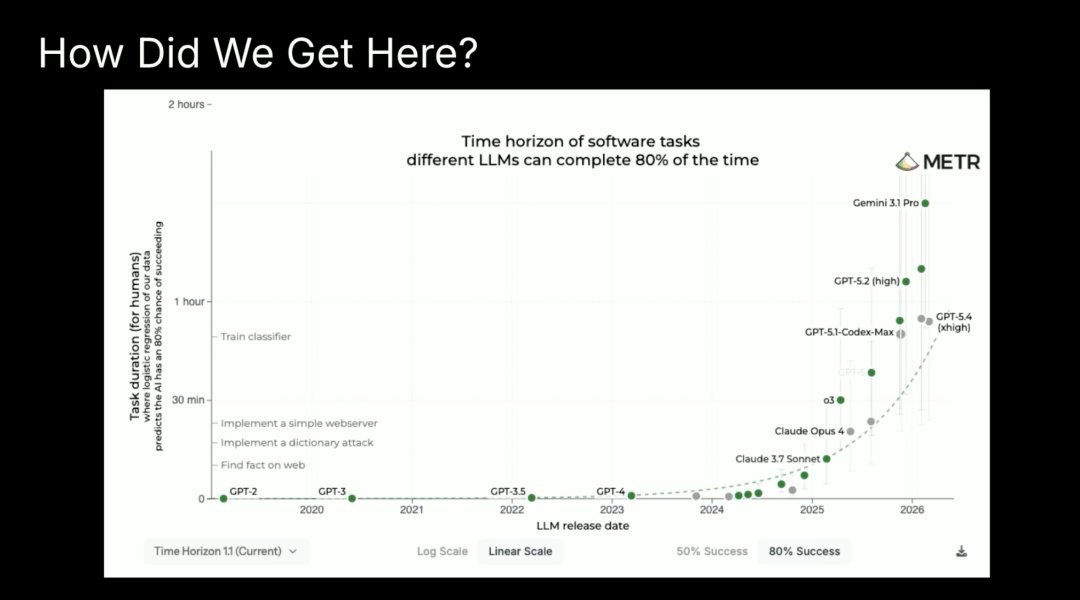
I paid particular attention to a chart Sonya presented called the "Meter chart," which measures how long a model can maintain its performance on complex tasks without going off track. A year ago, it was on the order of tens of minutes; today it's on the order of hours. This is the most important advancement. The model has finally become powerful enough to maintain its performance on long-duration tasks. This isn't a small improvement; it's a qualitative leap from "unusable" to "usable."
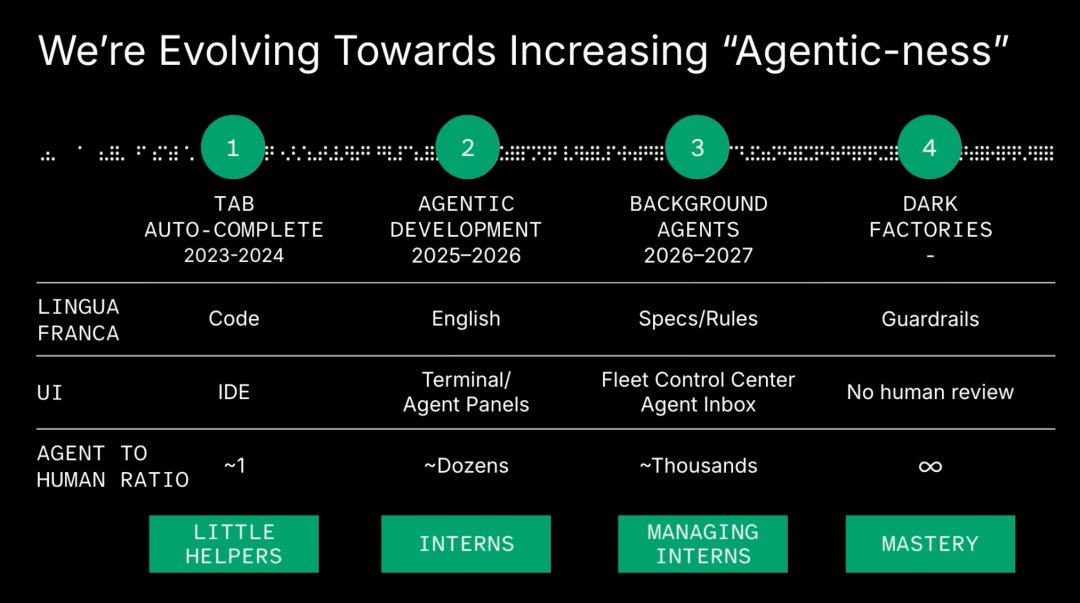
The agents we see today exist on a sliding scale of "agentness." Take programming, for example. In 2023, we had tab auto-completion, where an AI assisted a human on a single line. This was progressively useful, but not revolutionary. Now we have agency development, where a human converses with an agent, instructing it what to do, and potentially managing a team of agents. But this paradigm is being pushed further. We now see background agents, asynchronous agents, and agents generating sub-agents. Sonya believes the entire asynchronous agent paradigm may outnumber the current one in number because the leverage in the system is so great. At the forefront is what she calls "dark factories," completely removing human oversight from the system. This sounds crazy, but she says it's already being seen in production environments, including cybersecurity companies. It's possible, provided there are good enough safeguards and good enough engineering.
I'm both excited and uneasy about the concept of "dark factories." Excited because it represents the ultimate leap in productivity, uneasy because it means we're really going to have to hand over critical decisions to AI. But I also realize that this may be an inevitable trend. Agents are evolving from assistants doing small tasks to managed interns, then to self-managed interns, and finally to interns who can be trusted enough to be deployed to production environments without supervision. This evolution isn't just happening in programming, but in all agent applications.
Why is this opportunity so enormous?
In his speech, Pat emphasized three unique aspects of this AI wave, each of which I believe deserves in-depth consideration. First, this is the largest wave to date. In the 15 years before the cloud computing transformation, the total addressable market (TAM) of software grew from approximately $350 billion to $650 billion, with cloud computing accounting for about $400 billion of that. But now, the entirely new aspect is service revenue, which could be $10 trillion. Pat said they don't know the exact figure—$10 trillion, $5 trillion, or $50 trillion—but they know that legal services in the US alone represent a $400 billion market. That's just one vertical sector and one geographic location, yet it's already equivalent to the entire software market size.
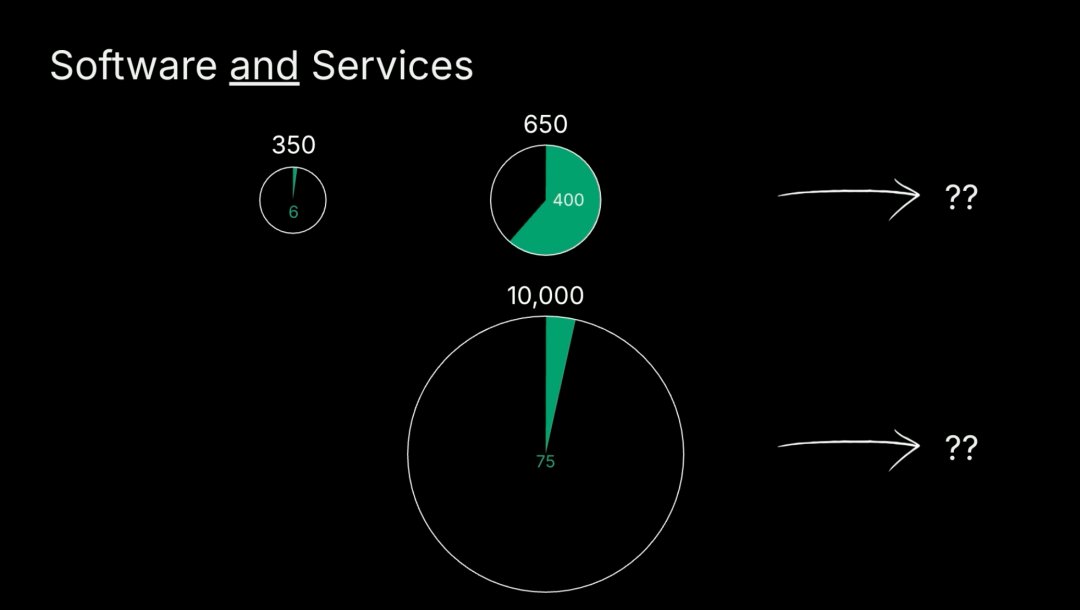
My understanding of this figure is this: in the past, we were only optimizing the software itself; now, we are replacing services. While the software market is large, the service market is far larger. When AI can truly perform the work of lawyers, doctors, analysts, and consultants, we are opening up a market of entirely different scale. This isn't software eating the world; it's AI eating the service industry. The profound significance of this shift is that we are no longer limited to software licensing and subscription business models, but can directly charge based on results, just like hiring a service provider.
This number is astounding. We've always viewed software as a huge market, but now AI is opening up a services market—an opportunity of orders of magnitude greater. Sonya emphasized this in his speech: services are the new software. This isn't just a slogan; it's a reality. In healthcare, you can hire an agent to analyze your genome, provide personalized advice, and even prescribe medications and recommend clinical trials. In law, you can hire agents to negotiate contracts, handle lawsuits, and settle disputes on your behalf. In mathematics and science, we see agents solving the Erdős problem or discovering new superconductors. In the consumer sector, personal agents can manage your inbox, calendar, finances, and even help you file taxes.
I believe the reason agents can be deployed so rapidly and on such a large scale is because the economics are so clear. Sonya's comparisons are compelling: humans are difficult to scale, while agents can scale infinitely with computation; humans are difficult to keep happy (she jokes that only she is always happy), while agents are low-maintenance; humans are expensive, you pay them wages, but you pay agents in tokens, and the cost of completing a task using tokens is usually lower than the equivalent wage cost. Humans are generally smarter today, but bitter lessons continue to be learned, and soon agents will be smarter than humans in many things.
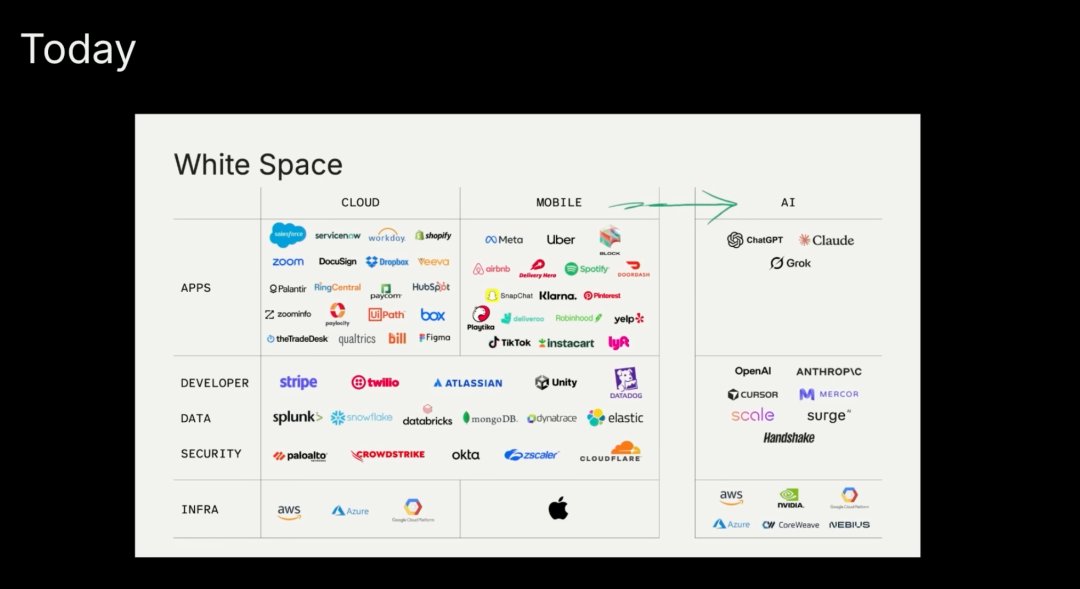
The second characteristic is that this is the fastest wave. We can all feel it. On Pat's slides, the blank space on the AI side is being filled very quickly. These logos are from companies that have achieved over $1 billion in revenue due to the transformation brought about by cloud computing, mobile internet, and now AI. At the current pace, more companies are on the horizon. This speed means we don't have much time to adapt slowly; we must act quickly. But Pat also reminds us of an important fact: no lead is safe. He uses a racing analogy: "You can't overtake 15 cars in the sun, but you can overtake 15 cars in the rain." Now, foundation models are rolling out new capabilities like a torrential downpour, which means no lead is safe, but it also means anyone can win.
My understanding of this viewpoint is this: In a stable technological environment (sunny days), first-mover advantage is crucial, and latecomers find it difficult to catch up. However, in a rapidly changing technological environment (rainy days), everything becomes uncertain, and new opportunities constantly emerge. Today's leaders may be tomorrow's laggards because new capabilities change the game. This presents both challenges and opportunities for entrepreneurs. The challenge lies in the need for continuous adaptation and evolution, while the opportunity lies in the fact that you always have the chance to surpass your competitors, as long as you can better leverage new capabilities.
The third characteristic, which I mentioned earlier, is that this is a computing revolution, not a communications revolution. Pat particularly emphasized the importance of this point. Past revolutions like the internet, cloud computing, and mobile internet were revolutions in how information is distributed—they were communications revolutions. These revolutions were characterized by relatively stable infrastructure; you could build applications on a relatively stable platform. But AI is different. AI is a revolution in how information is processed—it's a computing revolution. This means that the floor beneath your feet is constantly moving, and the technological foundation upon which it's built is changing daily.
Pat says that in his generation's careers, they've only experienced the communications revolution. This is the first true computing revolution. The implications of this difference are profound. In the communications revolution, you could create a five-year plan and execute it. But in the computing revolution, five-year plans are meaningless because the underlying capabilities can be fundamentally changing every month. This demands a completely different strategic mindset—one that is more agile and adaptable.
MAD Strategy Framework for Entrepreneurs
Pat offers a framework of advice for entrepreneurs building applications on top of models, which he calls MAD. He jokes that it's free advice, so it's worth every penny you pay. But I think this framework is invaluable because it directly addresses how to build a sustainable competitive advantage in this rapidly changing world. MAD stands for Modes, Affordance, and Diffusion.
Before discussing MAD (Marketing as a Demand), Pat first introduced the concept of a merchandising cycle, which represents the various stages in the value chain from idea to customer satisfaction. His core point was: if you take a tech-out perspective, you'll handle each stage of the value chain in a certain way. But if you take a customer-back perspective, you'll handle each stage in a completely different way.
Here's a counterintuitive point that struck me. In the computing revolution—the revolution of information processing—you might want to look down at all the cool new things that keep popping up. But to build a moat, you should actually look up, because your customers change far faster than your capabilities. The product you build might be irrelevant tomorrow, but the depth you build around your customers will last much longer.
Regarding Modes, Pat emphasized that this doesn't mean products and technology aren't important—they are extremely important, and usually the best products win. However, in a world where products and capabilities change so rapidly, when thinking about moats, he encouraged us to be as customer-centric as possible, considering all the ways we can build around the customer. I understand this to mean deeply understanding the customer's workflows, pain points, and decision-making processes, building trust, and becoming an integral part of their business. As technology changes, this customer relationship allows you to continue serving them, even with different technologies.
Pat borrowed the concept of affordance from the design world, and I think it's a particularly good choice. A hammer is an object with affordance. If he gives his two-year-old son a hammer, the son will know what to do—grab it and start hitting things. That's why they don't give their sons hammers. An object with affordance doesn't need explanation; people know how to use it.
Pat provides a good example. Claude Code is incredibly powerful, but for the average Fortune 500 employee, opening a terminal and seeing how far they can go is a different story. While powerful, it doesn't offer that much affordability. This isn't a criticism of Anthropic, but rather an opportunity for anyone wanting to build on it. Your job is to create the path of least resistance for your specific clients and their specific problems, allowing them to easily find the results their business needs.
My understanding of affordance is that there's a significant gap between technical capabilities and the actual ability of users to use them. Even the most powerful tool is worthless if users don't know how to use it or if it's too complex to use. The opportunity for application layer companies is to bridge this gap, transforming powerful but complex technology into a simple and intuitive user experience. This requires a deep understanding of users' mental models, their skill levels, and their work environments. You're not educating users on how to use complex technology; you're adapting technology to users' existing work habits.
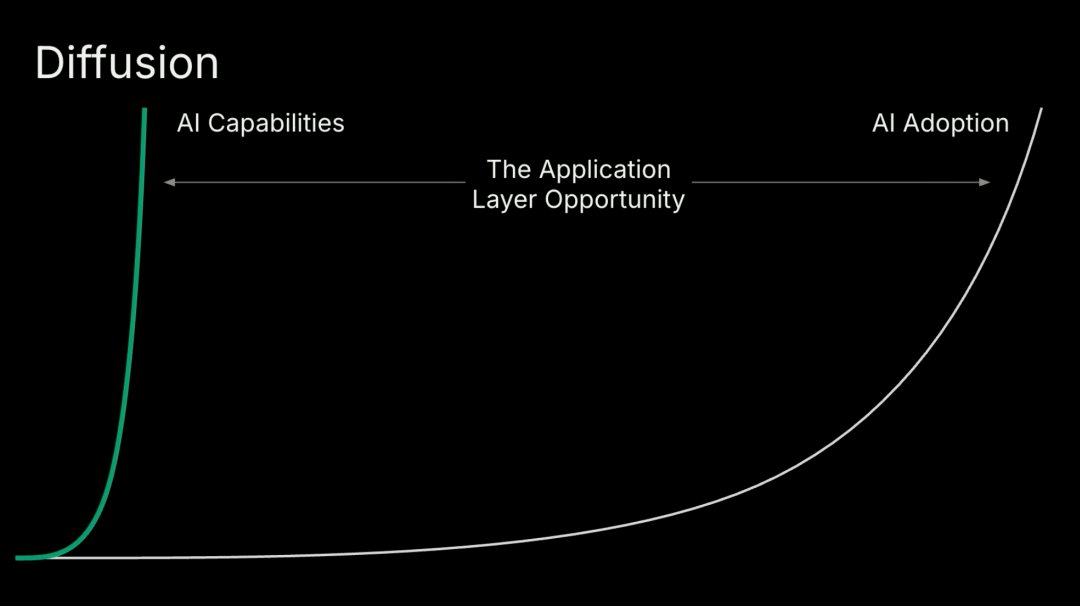
The diffusion gap is the third dimension of opportunity for application-layer companies. Pat points out that the speed at which capabilities diffuse into the market lags far behind the speed at which those capabilities are created. This gap widens whenever foundation models advance faster than the average Fortune 500 company, and the opportunity grows accordingly.

My understanding of this viewpoint is that innovation always originates in labs and cutting-edge companies, but it takes time for most businesses to adopt these innovations. They need to evaluate, test, integrate, and train. This gap is particularly large in the AI era because technology is advancing so rapidly. New models and capabilities are released every day, but most businesses are still trying to figure out how to use technologies from six months ago. This gap presents an opportunity for application-layer companies—to help businesses bridge this chasm and enable them to actually use the latest capabilities.
Pat summarizes: For moats, think as much as possible from the customer's perspective; for affordability, think as much as possible about creating the path of least resistance for your customers; that diffusion gap represents your opportunity. These three dimensions combined form a complete framework for building a sustainable competitive advantage in the AI era.
But Pat didn't stop there. He also specifically reminded us that while the slide showing the blank spaces being filled might be discouraging for some, making them feel there was no chance left, it's important to remember: no lead is safe. Foundation models are now rolling out new capabilities at a breakneck pace, meaning that companies that seem to have already secured a market share could have their leading positions overturned overnight. At the same time, it also means that anyone can win, as long as you can better leverage new capabilities and adapt to change more quickly.
I wholeheartedly agree with this viewpoint. In a stable technological environment, first-mover advantage is crucial; network effects and economies of scale can create formidable barriers. However, in a rapidly changing technological environment, these barriers can become insignificant overnight. New capabilities can render old product architectures obsolete, and new interaction methods can alter user habits. This is why Pat said, "It's wonderful to be alive in this era"—opportunities abound for those who dare to innovate and act quickly.
Agents are everywhere
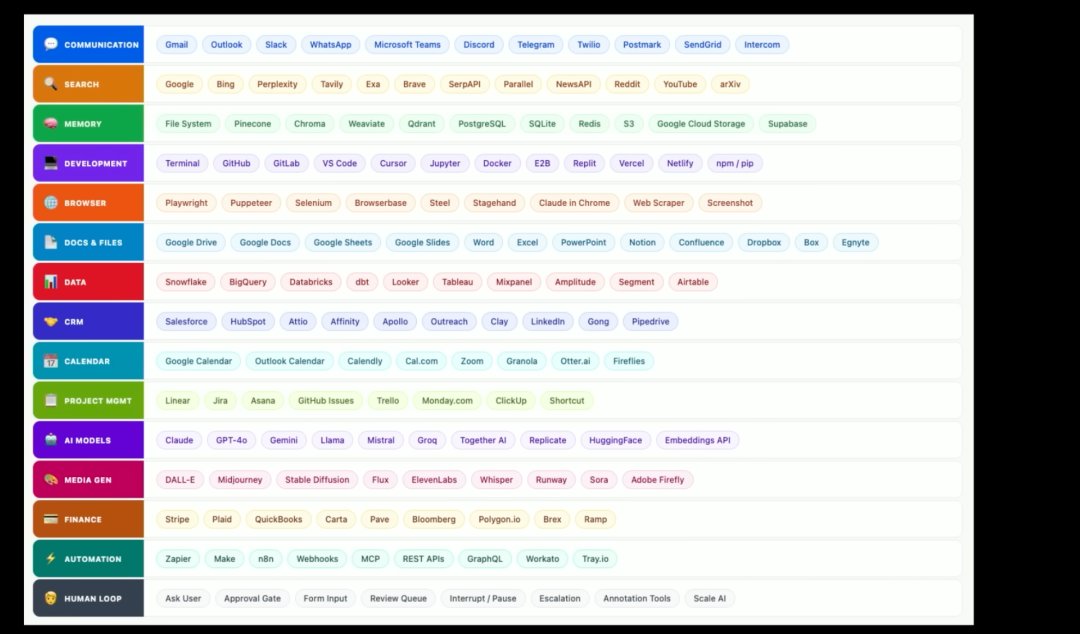
In her presentation, Sonya painted a picture of a world where agents are everywhere, a vision I found both exciting and thought-provoking. She said people are building agents for everything. Some are silly, like an OpenClaw agent reporting your neighbor's tax evasion to the tax authorities (she said, "Please don't do that, or maybe do it"). Some are entrepreneurial, with agents running generative media campaigns to sell construction services. And then there's the professional level, she said, with a huge competition within Sequoia to see who can build the best agents to get the job done better.
The speed and scale of agent deployment will be unprecedented because the economic benefits are so obvious, and agents are inherently scalable. This doesn't mean we humans will lose our jobs; Sonya believes that adaptability is a unique human trait. But we do expect the deployment of agents at the application layer to be extremely rapid and large-scale.
When you add all of these up, the number of agents is expanding in some kind of exponential, perhaps even super-exponential, way. Sonya believes we're nearing a point where things are getting really strange. What happens when business happens between agents? Can they pay each other? What happens when agents can actually negotiate terms with each other? Will we have a huge swarm of agents monitoring us to prevent cybersecurity issues or massive disruptions? All we know is that the world is getting weird at an incredibly fast pace.
I'm both excited and somewhat worried about this future. Excited because it represents a huge leap forward in human productivity. We can finally delegate repetitive, tedious tasks to AI and focus on more creative and strategic work. But worried because this shift will bring many unknown social and ethical issues. How do we regulate agents when they can trade autonomously? Who is responsible when agents make wrong decisions? These are questions we need to seriously consider.
Sonya concluded by quoting Eliezer Yudkowsky (an AI security researcher): "Long-duration agents have arrived, and their growth curve is very clear. For entrepreneurs, everyone has examples of how AI has enabled them to complete insanely difficult timelines. Zed's Nathan single-handedly completed a three-year moon landing project using Claude Code during his vacation. Brett Taylor rebuilt the Sierra in a single weekend. The Notion team rewrote 8 million lines of code in just six weeks."
Everyone has examples of these compressed timelines, but Sonya believes few people outside of AGI Labs see what happens when you overlay these compressed timelines. This is what's possible now. So whatever you can imagine building in the next 100 years, can now be achieved in 100 days, thanks to agents. This idea deeply resonates with me. We're not talking about incremental improvements, but about compression in the time dimension. This means the speed of innovation will increase exponentially.
Cognitive Revolution: The Next Industrial Revolution
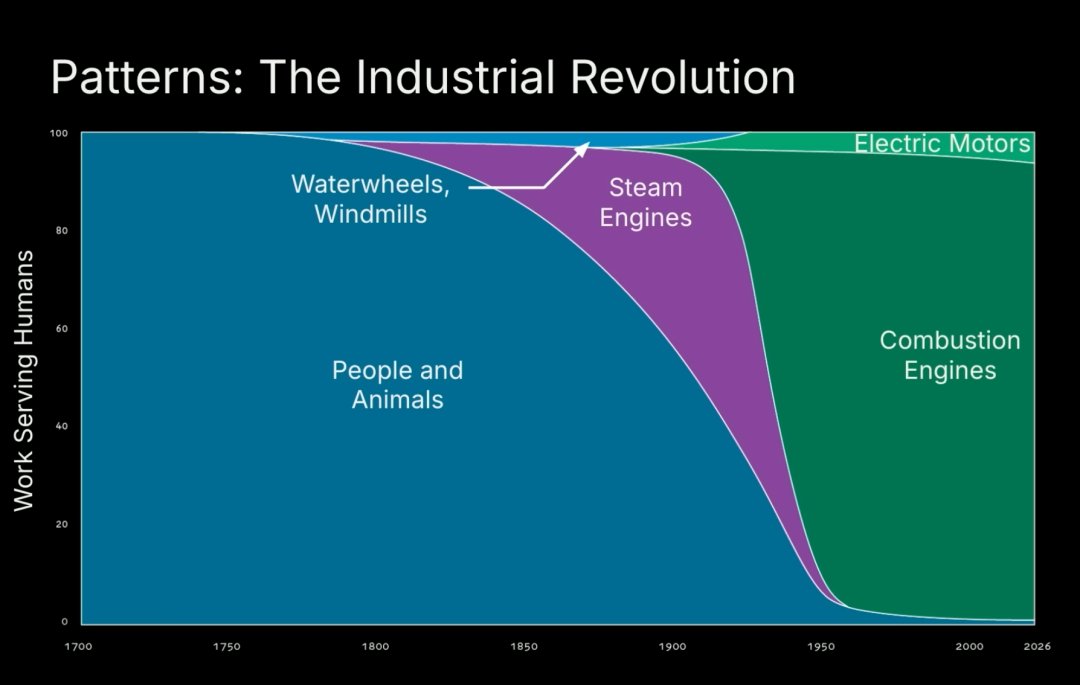
Konstantine Buhler's presentation was perhaps the most philosophically profound of the entire event. He divided work into two types: physical work and cognitive work. Physical work is like packages on the Pony Express, satellites on Falcon 9—work equals force multiplied by distance, it's physical motion. Cognitive work is like Pythagoras proposing theorems, DeepMind solving the protein folding problem—it's conscious thinking. These are two very different types of work, but Konstantine believes they will follow very similar revolutionary patterns.
He spoke of the physical work revolution, the Industrial Revolution. For most of human history, almost all work serving humans was done by some kind of muscle, by humans or animals. Humans moved things or animals pulled people. This started around 1700, but can be traced back thousands of years. Then things started to change. Water and wind power, the steam engine, and then things accelerated. The steam engine, the internal combustion engine, the electric motor. By 2026 today, you can estimate that over 99% of all physical work done for humans on Earth is done by machines. The airplane that brought you here, the manufacture of all the goods in this room, all the transportation set up for the pinnacle of human experience you are currently experiencing.
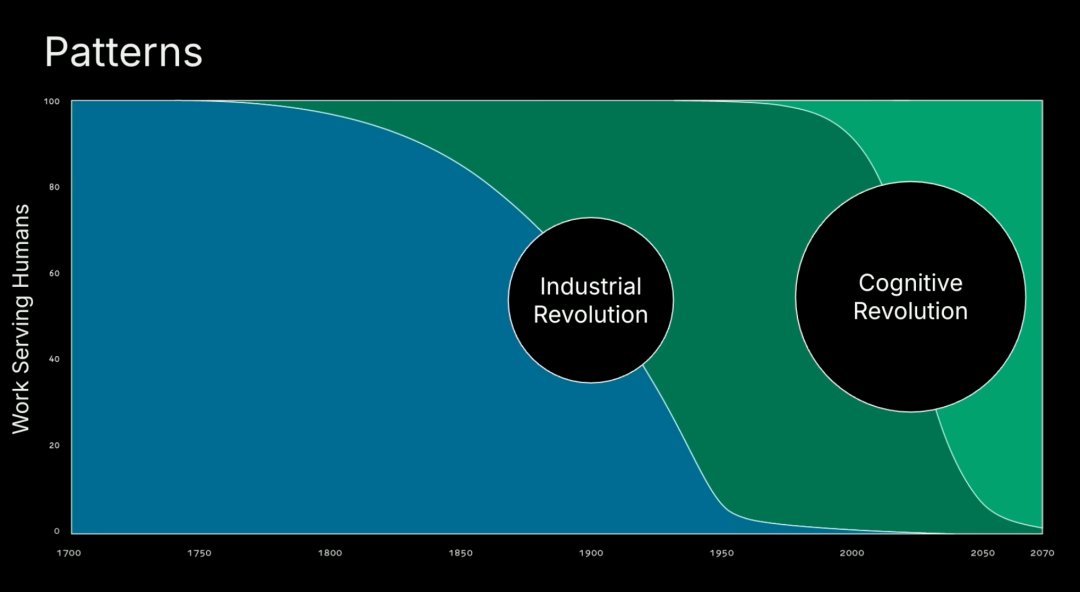
Konstantine believes a similar pattern will emerge in the realm of cognition, only we are in a much earlier stage. For most of human history, all thinking on Earth for humankind has been primarily done by humans, perhaps with a small contribution from animals like sheepdogs herding sheep. A small fraction of work has been mechanical, such as astrolabes or clocks. In the last few centuries, until the advent of electronic computing, progress was minimal. In the last hundred years, consider the trillions of calculations happening at any given moment to serve you as a human being. All this ongoing cognitive work, those trillions of calculations serving us at any given moment.
Konstantine believes that neural networks are the next big wave, and that in the near future, 99.9% of cognition on Earth will be done by machines. The parallel is quite clear. The good news is that we've experienced such a revolution before. The cognitive revolution will be very similar to the Industrial Revolution, only much larger and faster.
This idea gave me pause for thought. What would it mean if cognitive work were truly taken over by machines, just like physical work? What would our role as humans be? Konstantine offers his answer through four short stories.
Four stories about the future
Konstantine's four stories deeply moved me, each revealing an important truth about the AI era. The first story is about aluminum. In the mid-19th century, the United States wanted to build a magnificent monument to its first president and greatest war hero, George Washington. They designed what was then the tallest building in the world, the Washington National Monument. They wanted to top it with the world's most precious metal—100 ounces of the most precious metal. This metal was so precious that they displayed it at Tiffany's in Manhattan. That metal was aluminum.
Within decades of the completion of the Washington National Monument, a young inventor devised the electrolysis process to separate aluminum from the soil. Within decades, aluminum was used to wrap candy and sandwiches, then thrown in the trash. Aluminum is intelligence, and electrolysis is artificial intelligence. We are about to enter a world where some of the most precious skills, doctoral-level skills, that take decades to acquire, can be so instantly available that after use, you can crumple them up and toss them in the trash.
This analogy is incredibly apt. We're used to viewing certain cognitive abilities as precious and scarce, but AI is making them cheap and abundant. This isn't about belittling human intelligence, but rather illustrating how technological progress is redefining value. When expertise becomes as commonplace as aluminum, what will truly be valuable?
The second story is about alien design. The world we see today is designed for humans. It's optimized in a way that makes sense to our brains because we do almost all the cognitive work in the world. It's a little different when machines do cognitive work. In 2006, NASA was optimizing an antenna for a large space mission. Traditionally, their antennas look like beautiful geometrically symmetrical patterns, with optimized surface area under certain power constraints. This time, they said they'd hand it over to computers, letting evolutionary algorithms (much like reinforcement learning) process it. The result was an antenna that was significantly more productive, but not intuitive for human thought.
In this AI era, when we entrust our cognition to machines, we will obtain results that are not intuitive for us. When AI designs chips, cars, and buildings, they may look very different. We must remain open-minded about the world we are entering, because AI doesn't think like we do. It might have alien designs.
This story reminds me not to judge AI's output based on human intuition. AI may find solutions we could never have imagined, solutions that may seem strange or inelegant, but are more effective. We need to learn to appreciate this "alien aesthetic."
The third story is about emerging sciences. In the early days of the Industrial Revolution, great engineers like Newcomen and Watt perfected the internal combustion engine. Basically, you put petrochemicals into a piston, ignite it, and millions, billions, of particles explode, driving the piston. For nearly a century, all of this was about tweaking and patching. Engineers would say, "Ah, this works a little better." Maybe you'd see things like scaling laws, but it was all engineers playing with the product, seeing how to improve it a little.
Over 120 years later, Sadi Carnot appeared and formalized all of this in a new science: thermodynamics. He said, "Wait a minute, there are millions or billions of particles, and we can actually formalize what all of these look like." In that case, there are billions of neurons, trillions of tokens. Right now, we're in the patchwork stage of AI. Even if we think it's a science that's understood, it isn't. In the future, in the coming decades, we will introduce a science as fundamental as thermodynamics. Someone in this room might propose this science. This science will be taught in high school, and it will be so fundamental. It will help us master AI, and even help us master consciousness.
This realization made me understand that our understanding of AI is still very superficial. Much of what we do now is empirical, like the early steam engine engineers. But one day, someone will propose a complete theoretical framework to explain how AI works, and that will be a revolutionary moment.
The fourth story is about the art of unreason. For most of human history, for tens of thousands of years, art has been progressing towards realism. From 25,000-year-old cave paintings, Egyptian hieroglyphs, Greek pottery, Renaissance painting, to the grand transformation towards realistic art. Look at the difference. After tens of thousands of years, humanity triumphed. Then engineering came, Daguerreotype photography, early photography, and suddenly, the skill of spending decades perfecting every stroke of a painting vanished.
How did the world react? People thought painting was over. Oh, that's it, machines can do it better than any human, art is over. So what happened? How did humanity respond? Humanity responded by saying, was the purpose of this art to capture the moment the eye sees, or the moment the heart and soul sees? Impressionism, Expressionism, Cubism, Neo-Expressionism. All these new art forms were humanity's response to this enormous change in science.
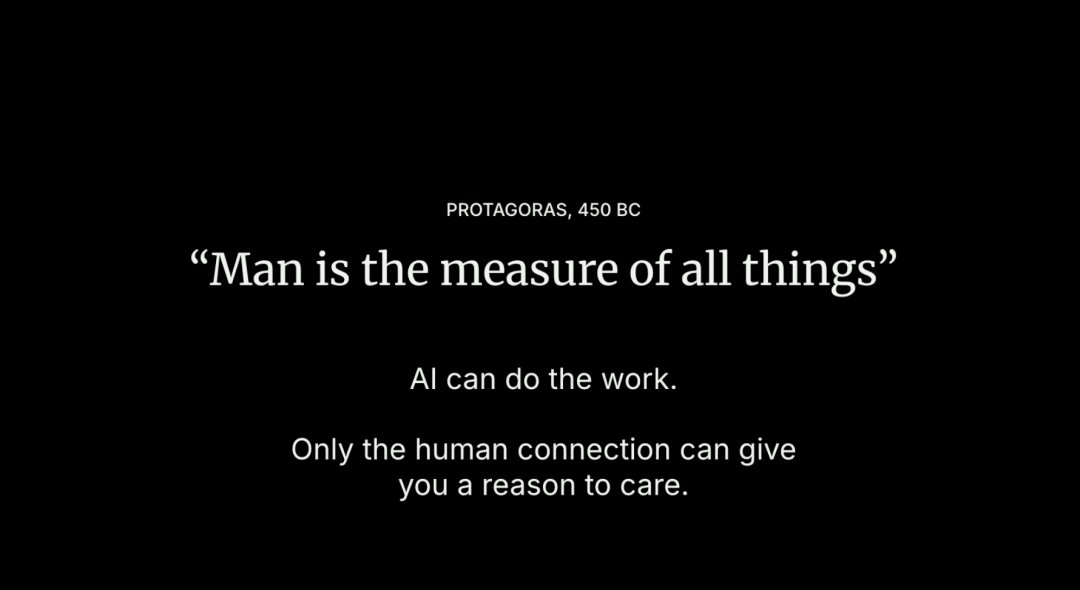
2,500 years ago, the Greek philosopher Protagoras wrote, "Man is the measure of all things." He meant that nothing in a vacuum has value for humanity. Not aluminum, not art, not intelligence. It only has value because of experience. AI can do work, AI will do work. But only human connection gives you a reason to care. That's why we're all in this room today. Ten years from now, work will be very different, things will have changed a lot. But one thing will remain constant: the relationships you build with the people around you today will endure. This is what you'll look back on; this is what has value today.
This ending deeply moved me. After all the discussions about AI capabilities, efficiency, and productivity, Konstantine reminds us of what truly matters: human connection. AI can do the work, but it cannot give meaning to it. Only humans can do that.
My deep reflections on this revolution
After listening to the entire speech, I had several profound insights.
First, we are indeed at a historic turning point. Sequoia's declaration, "This is AGI," is not hype, but a pragmatic judgment based on actual capabilities. From a business perspective, it's enough when agents can recover from failures and persevere to complete tasks. We don't need to wait for superintelligence like in science fiction movies; we already possess game-changing tools.
Second, speed is the most striking feature of this revolution. It's not an exaggeration to say that 100 years of work can be completed in 100 days. I see more and more examples around me of people using AI to accomplish tasks that previously required a team of months. This time compression will have a compounding effect, leading to an exponential increase in the speed of innovation. This means we must act quickly because the window of opportunity is extremely short.
Third, customer-centricity is more important than ever. In an era of rapid technological change, the only anchor is customer needs. Technological capabilities change daily, but the problems customers want to solve remain relatively constant. Companies that can deeply understand their customers and build solutions around them will create a true moat.
Fourth, we need to prepare for a world where agents are ubiquitous. This isn't science fiction; it's an impending reality. As the number of agents grows exponentially, society, the economy, and the law will all need to adapt. We need to establish new frameworks to manage interactions between agents and ensure their behavior aligns with human values.
Fifth, and most importantly, human connection remains central to all technological changes. AI can make us more efficient, but it cannot replace relationships and emotional connections between people. In a world where machines take over cognitive work, what will truly be valuable are those unique human qualities: creativity, empathy, curiosity, and adaptability.
I believe we are witnessing history. The cognitive revolution will profoundly change the world like the Industrial Revolution, only on a larger scale and at a faster pace. This is both exciting and awe-inspiring. We have a responsibility to ensure that this revolution benefits all of humanity, not just a select few. This requires the collective effort of all of us, the participation of technology experts, policymakers, entrepreneurs, and ordinary citizens.
Sequoia's speech was very inspiring, but it also raised many questions. Are we ready for this future? Can our education system, legal framework, and social structure keep up with the pace of change? How can we ensure that we don't lose our humanity while pursuing efficiency? These are all questions we need to seriously consider and discuss.
Whatever the answer, one thing is clear: the car has arrived, but it's not a faster horse. We need to learn how to drive this car, how to build a better car, and most importantly, how to ensure this car leads us to a better future.