Original title: "A new NFT launch strategy: The wave mint"
Original source: Scott Duke Kominers &1337 Skulls Sers, a16z crypto
Original compilation: Odaily Planet Daily
In NFT projects, the mint (the process of initially distributing tokens) largely determines the tone of your community, and how the community and the wider market perceives the development of the project. That means having a mechanism to get the people you want to participate and do it in an easy, safe, and engaging way.
In this article, we will review a new mint strategy "wave mint" recently launched by 1337 Skulls, in which members of different NFT communities are invited to participate in mint in a series of waves (waves are opportunities to participate in mint). Start and gradually expand outward. wave mint uses people's on-chain data and reputation to select holders who are a good match with the project's culture and goals, while diverting attention and energy to the project. It also avoids the common problems of "free mint", such as Gas War and robot (bot) interference.
What follows is an introduction to how the wave mint mechanism works, its strengths and challenges, and some of our experience running wave mint in practice. As the NFT community experiments with different mint and engagement strategies, we hope this will be a way for artists, builders, and other project creators to mint.
How the Wave Mint Mechanism Works
In theory, giving away NFTs for free is a great way to attract more users to the project. But in practice, "free mint" makes community management more difficult, because "free mint" may be occupied by a network of robots (bots) and/or users who just plan to "Bottom Fishing NFT" , rather than sticking to the community for a long time.
How can the project find people who align with the project's values and goals? The answer is to find those who already have the relevant NFT in their crypto wallets and invite them to join.
In wave mint, different groups of people are invited to mint sequentially, with each open "mint wave" ranging from a few minutes to a few days. As long as the number of people participating in each "wave" is low relative to the total token supply, mint can be free (or free if it is lower than the market-clearing price) without causing Gas War.
Groups invited to mint in different "waves" should recruit holders who are likely to seriously engage with the new project and support its goals and vision. Perhaps the easiest way to do this is to leverage an established community with a "common interest": 1337 Skulls provided a "mint wave" for similar cc 0 projects like Nouns and Blitmap. Meanwhile, an on-chain game might offer holders of projects like DigiDaigaku and Pirate Nation a "wave" to participate in mint.
The most critical point is that each wallet should only allow mint once, even if it is eligible to participate in multiple "wave mint". Participation in many NFT communities does overlap, so limiting each wallet to a single mint helps ensure non-overlapping and broad distribution of holders . Even with the "single mint" limit, users who hold NFTs from multiple invited communities still have a better chance than the average person. If they missed out on the first wave of qualifications, having NFTs from multiple invited communities will earn them more qualifications to participate.
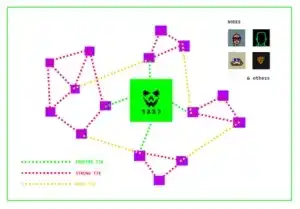
The community itself should be carefully planned to first develop a strong community of core holders and then build from the inside out. This strategy entails building tight ties of core communities and social identities, and then using “networks” to expand outward, connecting to distant but like-minded networks .
Early "waves": "trusted relationships" - early "waves" should focus on "trusted" communities. In these communities, creators have strong personal relationships and an established "presence" and reputation. Working with a close and credible community early on can help build trust in a new project. Especially since in wave mint people usually mint other NFTs from their wallets, possibly even high value NFTs. Building early mint with reliable connections helps build "social proof" that people feel trust in the mint process.
Next "wave": "Strengthening Relationships" - Once a core of trustworthy communities has been established, the next step is likely to target "Tie-strengthening" communities, i.e. Communities with significant overlap in population. The growth of community users through "referrals" also helps to attract those who specifically want to be part of the project.
Late "wave": Once a project builds a core community and attracts the attention of other related communities, it has the potential to open many new windows to larger, less connected communities, attracting people who are not necessarily directly connected, but were People in the wave who are interested in the project.
Testing the Wave Mint Mechanism
We tested the mechanism of wave mint during the launch of 1337 Skulls, an NFT project that aims to build bridges between NFT communities that open up their intellectual property under a "cc0 copyright-free license" for expansion and Remix. The wave mint is a way to attract holders who are themselves passionate about cc 0, on-chain art, and the broader internet hybrid culture.
We started with our own close community, and then opened the "wave" for holders of many other projects in the cc0 NFT ecosystem. As we progressed further through the mint process, we gradually introduced engagement "waves" for larger groups but for shorter durations. Ultimately, our goal is to provide holders of various NFT projects with special ephemeral "waves" that share commonalities with projects selected in earlier "waves" (e.g. similar aesthetics, release dates, and style of community management) . In this way, we screen members who are particularly interested in joining us, but who were not previously "closed" to the community.
Evaluate Wave Mint Strategies
By design, the wave mint approach selects those who pre-identify with the project's goals and values. Additionally, each “wave” brings in a group of holders from an established community over the same period, which creates an immediate network effect that helps “break the ice.”
From a go-to-market perspective, this presents a significant opportunity for compound audience growth - "attracting the next holder through the original holder". Information about each mint wave spreads rapidly within and between communities through word of mouth. From a community building perspective, the wave mint approach helps ensure that most token holders have at least a few strong ties in the community from the start.
We also found that, at least in our case, the wave mint process itself drew attention to the project. Mint within hours and days enables the 1337 Skulls community to be exposed with the issuance of NFTs, and it is easier for new community members to join in real time.
From a mechanism design perspective, the wave mint mechanism means that people's wallets effectively act as a kind of "proof of personality". Many people keep most of their NFTs (especially high value NFTs) in one or at most a few wallets (not a recommended security practice), limiting mint to one NFT per wallet helps reduce duplication count. For example, in the late mint of the 11337 Skulls project, which has more than 50% independent holders (measured by different wallets), the concentration of supply is much lower than that of many whitelisted mints.
Also, spontaneously opening mint windows for short periods of time can make the whole mint process more difficult. Doing so also makes it easier to monitor mint in real time and spot anomalies, for example if someone distributes snapshotted assets to multiple wallets for multiple "free mint". The wave mint mechanism allows teams to easily pause mint in such situations. Since each individual "wave" is small relative to the total supply, it is possible to synchronize supply with demand, thereby avoiding Gas Wars.
Wave Mint vs normal whitelist
The wave mint strategy has several advantages over the more common strategy of running multiple allow-lists. In this strategy, members of a particular community have an opportunity to pre-register and possibly get on the mint list.
While whitelist mechanisms allow enough time for people to discover projects and register, they often fail to centralize engagement. Many people, including ourselves, sign up for the whitelist, but forget to participate in the associated mint when they do. The wave mint strategy tightens the feedback loop - from initially learning about the project through the existing NFT community, to taking action mint, to subsequently joining and participating in the community.
With the whitelist in the early stage, it is impossible to determine how many people will participate in mint. This often results in teams over-allocating supply, resulting in massive Gas Wars. In contrast, wave mint allows the project to expand or shrink the number of available positions in real time, adjusting supply to meet demand. You can choose to make a "wave" last longer, or open multiple "waves" with a specific amount of mint for a specific community.
At the same time, multiple whitelist mechanisms make it harder for users to be restricted by mint, as they provide users with ample opportunities to relocate assets for multiple allowed whitelist spots. The wave mint mechanism directly addresses this vulnerability, although doing so relies heavily on taking "snapshots" in advance.
Finally, wave mint has one more advantage. Whitelists managed by application or lottery are not always guaranteed to be successful. In contrast, wave mint is more likely to bring about a positive framework of open opportunities. Even if people do miss out on waves they are eligible for, there are other opportunities to participate.
Challenges: Operations and Security
From an operational standpoint, wave mint is complex to execute. It runs for a long time and requires careful synchronization between the front-end and back-end teams throughout the process. The front-end and social media teams will be constantly tweeting, engaging users in Discord, and bringing fun and attention to the project (and speculation on the next community wave that might open), while the back-end team will switch wallet lists, Turn mint wave on and off and make sure everything runs smoothly.
At the same time, on the user side, there are some key questions about security. Essentially, this mechanism entices people to mint with the wallets they use to hold other digital assets, usually ones that may be particularly valuable, such as tokens from major communities. And bad actors may try to create fake wave mints to access these wallets that hold users' high-value NFTs .
For wave mint, it is more important for people to carefully check every mint invitation, and it is the responsibility of the team to provide clear information and documents. With waves opening and closing rapidly, smart contracts and other critical information must be checked in advance, clearly explained and documented. (While it is important for teams to implement maximum security measures around Discord, social media, and other communication channels, wave mints in particular need to avoid malicious actors stealing legitimate wave mints midway.)
In the long run, it would be nice to have delegation solutions optimized specifically for wave mint, allowing people to delegate access so they don't have to mint directly from a treasury wallet . Finally, in terms of incentives, if "wave mint" becomes popular, people may start storing their digital assets in many different wallets in hopes of maximizing their chances of participating in the mint. This will require more creative criteria for deciding who should be allowed to participate in each wave.
The way an NFT project forms its initial community is critical to determining its path forward. Getting tokens into the right hands is critical to building a community-native culture. wave mint is a powerful solution to this problem. By inviting members of different communities to join in batches, it is possible to build a network of holders in a way that is long-term healthy and stable, gradually expanding the scale of the community from the core members of the trusted community.