Celer Network has been on the cusp of blockchain hotspots, but its original intention has never changed.
Interview: Claudia
Editors: Claudia, Zolo
"Binance's third Launchpad project", "cBridge Cross-chain bridge without security incidents so far", "pioneer in the field of blockchain interoperability"...
If you have been in the blockchain industry for several years, you must have heard the name of Celer Network.
From Bitcoin, Ethereum, DeFi, new public chains, Cross-chain bridges, Layer2, to ZK, the encrypted world has never lacked new narratives. Celer Network is also constantly adapting to the demand and actively laying out its own Multichain ecology.
In the past five years, Celer has gone through many monuments. Looking back at Celer's development history, we can also get a glimpse of how the industry pioneers adapt to the changes of the times and keep their original intentions unchanged.
From the expansion of the L2 state channel in 2018, to the cBridge Cross-chain bridge, and then to the latest Brevis, Celer Network has been on the cusp of blockchain hotspots. Is it a kite chasing the wind? Or keep up with the forefront of the times?
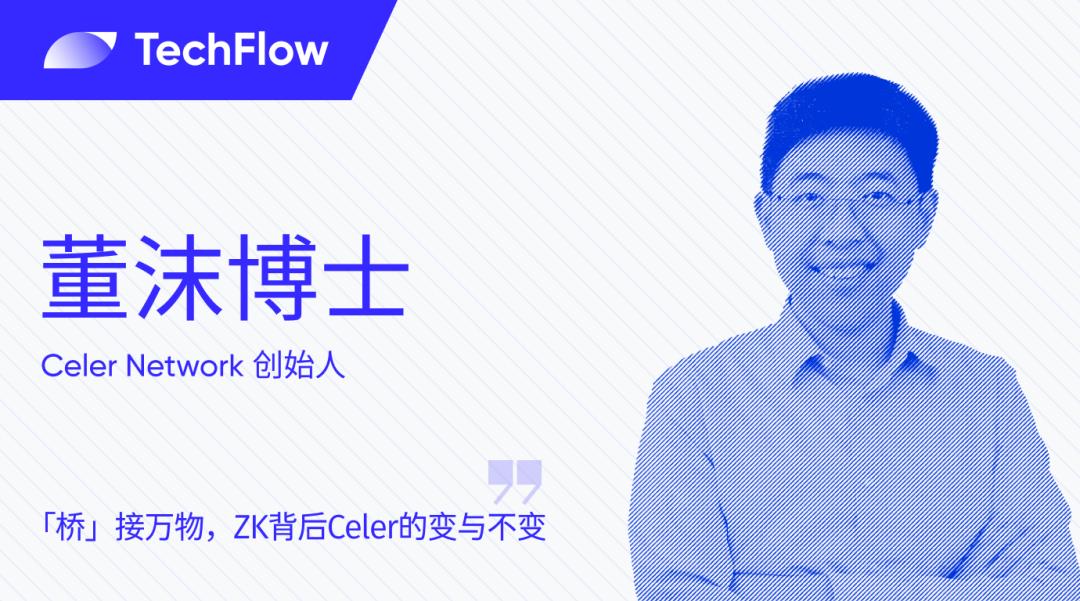
At the time of the upsurge in Hong Kong, Deep Tide TechFlow conducted an exclusive interview with Dr. Dong Mo, the founder of Celer Network, who came from the United States. Regarding blockchain technology and policy trends, talk to Dr. Dong Mo with Deep Tide TechFlow, and get a glimpse of the turbulent development of Celer Network behind ZK, a cryptographic science.
From the state channel to the ZK full chain data calculation and verification platform, only to meet the real needs of users
Shenchao TechFlow: Welcome Dr. Dong Mo to introduce himself.
Dr. Dong Mo: Let me briefly introduce that before I worked on Celer, I was a PhD student at UIUC, and my main direction was distributed systems and networks. During my studies, I started a company with my tutor, mainly doing network formal verification, which is a part of network security. The customers are some big banks, enterprises, etc., which were later acquired by VMware. At the same time, I am also doing research on distributed systems and network systems.
My research work has always been adhering to the spirit of open source, and the research results have also been adopted by companies such as Google and YouTube. If you use Google's Chrome browser now, part of the code that communicates with Google is part of our research and development at that time, and it is completely is open source.
After graduation, I started a business with my good friends in Silicon Valley, which are the other three co-founders of Celer.
From 2018 to the present, after going through bulls and bears, we have seen many people in other teams walk away, separate and join forces, but our team has always been very stable, thanks to our very consistent views on many things.
At that time, the most important problem of the blockchain was expansion, and there were two major ideological trends:
- One route is to expand capacity by establishing a faster public chain or side chain;
- Another route is to still protect the security of the bottom layer of Ethereum, and do it through the second layer expansion.
Celer's first step is to go in the direction of second-tier expansion, because we believe in decentralization very much, and we also believe that we should inherit the underlying security of Ethereum. This is the state channel we made at the beginning, the so-called state channel.
The state channel is actually a very generalized Lighting network, that is, the Lightning Network, but it can only handle some payments, and the state channel means that any program logic can run in this channel, not necessarily only payment in it.
But after doing it for a while, we found that the developer threshold of the state channel is too high. Developers need to rewrite the smart contract that has been written according to the structure of the state channel, and at the same time run many traditional back-end services. To serve high-speed program execution, the best application scenarios may still be low-cost streaming payment and conditional payment use cases (pay as you go or machine-to-machine payment based on task conditions), but the payment field itself is in the 20 From 2021 to 2021, there were many changes and restrictions in the traditional payment field, which led to the fact that the entire blockchain payment was finally stuck on the "last mile" user access.
This makes us feel that the expansion technology of the state channel needs some traditional finance and payment to help users enter and exit the blockchain world freely and at low cost. In the historical period of blockchain development, it may be too early, but We are still full of confidence in the future application of state channels.
At the same time, we found that some developers in the community began to use some things in the state channel technology stack for Multichain interaction. Among the state channel technologies, there is a technology stack called State Guardian Network (SGN), the so-called state guardian network, whose function is to safely relay some off-chain information to the on-chain. In fact, one of the things it can do naturally is to help Cross-chain message transmission. With the rise of Cross-chain demand, Celer has naturally entered the field of Multichain interaction and Cross-chain.
As for the Cross-chain field, we have done well in the past few years. Celer is running a variety of applications on the ecology. Celer cBridge now has a Cross-chain traffic of $13.7 billion. At the highest time, it had a TVL of $900 million. With a TVL of $240million, many users use cBridge every day.
Celer is now used by many leading applications and protocols: the latest version of MetaMask, the world's largest encrypted wallet, has an additional "bridge" function, which integrates Celer's Cross-chain bridge function.
In addition to the more than 40 public chains supported by Celer, the famous Japanese public chain Astar, Oasys supported by Japan's largest game companies such as SEGA and SquareEnix, and the Metaverse World side chain of the Korean game company Netmarble have all chosen Celer as the official Cross-chain At the same time, Celer's ecological developers have used Celer to develop nearly a hundred Cross-chain applications in various fields such as Metaverse, NFT, DeFi, and Governance.
Shenchao TechFlow: In March, Celer Network launched Brevis, a ZK full-chain data computing and verification platform, but I found that this concept is a bit abstract to understand. Can you explain what Brevis is with more common language and cases?
Dr. Dong Mo: In the simplest terms, it is to allow smart contracts to have the ability to acquire, calculate and use data from Dune, Defilamma, Nasen and other full-chain data.
You may not believe it, although smart contracts are born and grown on the blockchain, they are actually "blind".
People in the flesh can use tools like Dune and Nansen to use all the historical data in various blockchains and find value from them, such as the trading volume of Uniswap in the past 7 days, the price of ETH and USDC, and the price of a certain person. Trading volume, you can see whether someone is a professional game player, you can also see how the ownership of a certain NFT is transferred, you can see social and financial relationships, and so on.
But the smart contract is like a blind man. He has "three things he can't see":
- Can't see the data on other chains;
- I can't see the past data of my own chain;
- Private data in other contracts cannot be seen.
This actually greatly limits the potential of blockchain applications, because this kind of data acquisition restriction is basically the same as that of the Web2 era. In Web2, every data is bound to the application itself and is private. For domain data, you have no way to share data, no way to transfer data, and no way to use existing data to generate some new application scenarios. But in the web3 scenario, it is obvious that all data is publicly visible, but the heart of blockchain applications - smart contracts, cannot see and use these data, and end up in the same end as Web2 applications, which is incredible of.
This is the problem Brevis is going to solve: to enable smart contracts on the chain to obtain, calculate, and use all data on all chains without trusting any third party.
For example, a Defi DEX wants to dynamically and reasonably adjust its own pool, which is a very common scenario. Sushi and Pancake are usually adjusted according to the daily trading volume and LP and active trader numbers in the past. It is realized through offchain governance, that is, manual parameter adjustment. This is a very slow process, which may be adjusted once every few months. .
But in fact, the model of manual parameter tuning data is deterministic. If you have an on-chain method that can directly trust-freely obtain the data without trusting any other third party, and allow the smart contract to view the data, then Smart contract can adjust this thing by itself.
Another very common application is ZK's DID, which implements functions such as old user incentives and user life cycle management, such as rewards for continuously active users in games, retention rewards for big R players, and professional Liquidity in DeFi applications. Provider incentives and more. At the same time, it also implements the abstraction of recoverable accounts based on social and financial relationships, etc.
Someone asked, I can see the data you mentioned in Nansen and Dune. Wouldn’t it solve the problem to directly send the information of these platforms to the contract? But no, because if you do this directly, you are trusting a centralized third party again.
Shenchao TechFlow: But in fact, the amount of data on the chain is very large. Can the existing conditions realize your above vision?
Dr. Dong Mo: That's a good question. Assuming Brevis is not used, what is the most naive way to get these data? Each blockchain has its own block header, and there is something called state root in the block header. You can think of this state root as recording the state of the entire world.
For example, I want to know the past state of Uniswap, including how many active users it has in a certain day. In theory, it can be calculated directly on the blockchain with these state roots. You expand these state roots one by one, Expand to the leaf node at the bottom, look at the transactions one by one in it, verify whether it is interacting with the contract you care about, and finally get the result. But this theoretically feasible method is impossible from an economic point of view, because this method of directly dismantling the state root on the blockchain and analyzing it a little bit will consume a lot of gas, and the performance is not allowed. made.
This is only the case for one chain. If you want to read the information of other chains on one chain, it will be more complicated.
First, you need to know the blockheader of another blockchain without trust. For example, if I want to verify the status of the BNB chain on Ethereum, I must first verify that the block header of a certain BNB chain is valid. How to verify it works? It is to verify many validator signatures. If it is done directly on the chain, each validator will draw more than 1 million gas, which is unrealistic.
This is why Brevis uses ZK: ZK is to solve the problem of performance or computing cost, move the computing from the chain where the unit cost is very expensive to the chain where the unit cost is extremely low, and generate a zero-knowledge Concise proof, based on the mathematical guarantee of strong cryptography, only needs to prove that the calculation result is authentic and credible on the blockchain.
Shenchao TechFlow: From the earliest state channel expansion to the Cross-chain bridge, we found that the core narrative of Celer Network has been changing, and the evaluation of this is also quite polarized. People think this is chasing the trend, what is hot and what do you really think, why do you suddenly start to shift the focus of development to the ZK field?
Dr. Dong Mo: The ZK track is actually very natural. The reason why we came to this track is because we discovered many application requirements in the process of evolving the entire Celer Cross-chain system.
Celer's Cross-chain system currently has only one security model, which relays information to other chains through a relay chain. Can we further reduce the trust level of the middle chain? This is because we see that many use cases do not require a particularly low delay, so how to reduce the level of trust at this time? So we made the Celer ZK bridge, which is why we started to do some exploration in the ZK field.
Because we do Cross-chain, we have a good understanding of the Cross-chain ecology, and we are constantly listening to the needs of different chains and Dapp . We have never been chasing the wind, or in other words, we are chasing "real needs".
If you look at the entire blockchain as a CPU, then Brevis may be more like a DPU (data prosessing engine), helping the application to better process and use data, including on-chain data and even off-chain data . For example, if you have some Web2 Logins, and you want to prove the ownership of a Twitter account or some limited off-chain data, you can also do such verification through Brevis.
Shenchao TechFlow: Generally speaking, Zero-knowledge Proof plays a key role in two very important directions in the Crypto field, one is Scalability (expansion) and the other is Privacy (privacy). Then ZKP technology is How is it used?
Dr. Dong Mo: We do not solve the privacy problem. Our project mainly uses the nature of ZKP calculation migration. The essence of ZKP is also computing migration for ZK- Rollup .
Because ZK- Rollup also migrates the on-chain data to the off-chain, we calculate it, and the ZK core is doing calculation migration.
From the first principle, a glimpse of the judgment logic behind ZK
Shenchao TechFlow: Today, ZK has become a popular science of encryption, especially in the depressed primary market. ZK is one of the few popular narratives that support high valuations. It will give people a sense of sight of TO VC, so as a senior practitioner in this field, how do you evaluate a ZK project?
Dr. Dong Mo: I think the value methodology is relatively simple, because we need to clarify what kind of problems ZK is solving: If we go back to the so-called first driving force, the emergence of ZK is either to solve the privacy problem or to solve the privacy problem. Otherwise, it is to solve the problem of computing analog migration.
If we see that a ZK project uses ZK, but does not say to enable privacy or reduce computing costs, it is not a good ZK use case. For example, the ZK Texas game, this thing is a very good example, which requires privacy. But for example, for games like Axie Infinity, there is no need to keep any secrets during the game. If you insist on ZKing it, it is not a good application.
Shenchao TechFlow: Now ZK’s projects are very complicated, and there is also extensive competition within ZK. For example, the title of the world’s first fully functional open source zkEVM network has attracted zkSync, Polygon zkEVM, and Scroll. There are currently many ZKEVM solutions, what do you think is the key to the winner's final victory?
Dr. Dong Mo: First of all, it must be clear that ZK is a tool. We need to see what kind of scenarios this hammer is used for. The scenes you roll are different from the track, and the most exciting one now is ZK EVM. But ZK itself can actually be used in many fields, whether it is used in Data attestation like Brevis, reflection or Cross-chain(Cross-chain is actually an application scenario of Data attestation), or used in privacy, different applications Each scene must have its own degree of volume.
In fact, some new projects have emerged on the track of Data attestation, but they are far from the level of melee combat. We are not the same thing with ZK EVM volume, our relationship with Scroll, Concensys zkEVM and zkSync is actually very, very good.
I think that although various ZK EVMs are layer 2, they are still working on a blockchain ecology. For a blockchain, it has two layers of value:
- The first layer is utility value, which may be related to technology and developer friendliness;
- The other layer is consensus value. This is more about how a chain grows from a centralized developer to a community project. This is not a scientific problem, but a personal problem.
Shenchao TechFlow: In the ZK system, there is a special existence, StarkWare, because other L2 projects, including zkSync, Aztec, Loopring, Scroll, etc., all adopt the SNARKs technology route, and only he is ZK- STARK, what do you think of the technical route of ZK-STARK?
Dr. Dong Mo: The advantage of ZK-STARK is that its computation can be calculated faster, and the proof can be taken out more efficiently, but the last step still needs to go through a process to press it to the extent that the on-chain can be verified. It does There is some compression, and people choose it mainly because they think it is faster to prove.
So what are the benefits of ZK Snark? The developer ecology is relatively complete. Including the Ethereum Privacy and Skating Engineering Group (PSE) has been promoting, although its development kit can not be said to be completely perfect, but it is better than ZK-STARK, and it is also more friendly to some computing tasks. Generally speaking, I think these two technical routes are very active directions.
I very much agree with some ideas of 0xParc, that is, the future proving architecture is likely to be a composable Zero-knowledge Proof architecture. It may be difficult to implement an overall ZK application directly on the EVM, but through Brevis, different query engines can be inserted. Some of these query engines can be implemented with STARK or SNARK, as long as everyone can recurse to one that can be completed together. Validate the form on it.
On the one hand, Brevis allows developers to query data on the chain. On the other hand, the query itself has an engine. We will also provide APIs to allow developers to implement some query engines that can be used by other developers.
Shenchao TechFlow: Recently, the zk- Rollup expansion project has begun to concentrate efforts, and the Polygon zkEVM and zkSync Mainnet have been launched one after another. However, at the same time, Optimistic Rollup projects (Arbitrum, etc.) have begun to establish their own ecology.
At the beginning of February, Steven Goldfeder, the co-founder of Offchain Labs, tweeted to pour cold water on ZK Rollup and zkEVM. He disagreed with the saying that "ZK Rollup can better replace Optimistic Rollup", and it is far from being used in the production environment. Implement zkEVM, and at this stage zk- Rollup is more expensive and less compatible than OP- Rollup .
At present, ZKR and OR have more advantages and disadvantages, so what do you think of the expansion war between ZKR (zk- Rollup) and OR (Optimistic Rollup)? Who do you prefer?
Dr. Dong Mo: We feel very good. This is a battle of worldviews, one is an optimistic worldview (OP) and the other is a pessimistic worldview (ZK). The pessimistic world view means that I think the world is pessimistic, and there is a high probability of accidents, so I must use this function of ZK prove to ensure that the data in the on chain cannot be tampered with by the Sequencer. The OP ’s point of view is that we think there will be no problems in most cases, so the cost is lower because it does not need to generate proofs. In fact, at least in the short term, I think who will win the two Rollup The cost is lower, which one has better performance and can carry more applications. In the medium term, I think they are likely to merge together at the technical level. We say that OP Rollup and ZK Rollup are actually different teams. Will Arbitrum introduce a ZK- Rollup solution in the future? I think it's entirely possible. In the longer term, it depends on the consensus value, which is also the part of the blockchain community and people we mentioned before.
From today's point of view, OP Rollup has certain advantages. The advantage lies in the lower cost of on boarding and the first launch itself. However, ZK cannot be said to have no advantages. ZK has high security, and its advantages in assets and information There is no need for a 7-day waiting period when entering and exiting, and the response is faster. The OP 's 7-day waiting period is sometimes a headache, but who makes up for the OP 's shortcomings in most cases? It is made up by various bridges, because bridges can help users get in and out faster, but the cost is still very expensive.
So it is very difficult to see the high and low at a glance, because the OP cost is low, and there is no need to produce the process of prove. The exchange is that it is not easy to get out after you enter, and the ZK cost is higher, but you are free to come and go. Different application scenarios are suitable for different things. This is my point of view.
The tide of encryption is surging, but Celer's original intention remains unchanged
Shenchao TechFlow: Recently, the narrative in Hong Kong is hot. One of the reasons may be that the encryption policy of the United States is becoming more and more unfriendly, and Hong Kong is opening its arms to welcome entrepreneurs. As an entrepreneur who has been in Silicon Valley for a long time, how do you feel in the United States?
Dr. Dong Mo: Yes, it is understandable that the U.S.’s crypto encryption policy has been tightened, because there are some so-called “golden boys” who originally thought that there was a problem with someone who had no problem. This is a knee-jerk reflex. This feeling of being betrayed is the worst feeling, so it is understandable that the US regulatory policy has been strengthened recently.
Of course, on the other hand, the main problem of U.S. regulation lies in the struggle of multiple regulatory regimes. Like the SEC and CFTC, everyone has their own opinions, and there is no very good verification process. The core, I think, is that the United States does not think that the blockchain itself is a high-priority matter, so it allows different regulatory entities to come and go. I don’t agree with you, you don’t agree with me, this is the main thing. one reason.
In terms of industry enthusiasm, the previous ETH Denver was also very lively. Hong Kong definitely reflects that everyone hopes that there will be such a blockchain space in Asia. Because there is no real hub in Asia at present, and there are few developers in Singapore, but Hong Kong has a very good advantage of developer resources in Asia, with many very good schools and innovative talents.
The United States itself is already an innovation center, Hong Kong is likely to become an innovation center in Asia, we will wait and see. But we don't know much about it, so this time we also want to see what the situation is like.
Shenchao TechFlow: How do you feel after watching it?
Dr. Dong Mo: After reading it, I feel that I am still in a state of not knowing what is going on.
Shenchao TechFlow: There will also be some complaints. This conference talks about non-technical things, which are not orthodox.
Dr. Dong Mo: That’s right. First of all, a lot of sharing must be the Trade Show. Everyone is talking about the project. If you go up and talk about ZK, no one can understand it, so we shortened the slide. It turns out that the ZK part is very long. It's only a page or two now. Whether it becomes an innovation center can be seen mainly from the participants of the event. If the Hackathon can be held, the place has a certain degree of innovation. There were a lot of tourists this time. Obviously we are tourists, but many of our old friends are also tourists. We all got lost in the steel forest of Hong Kong together.
But I think Hong Kong is a signal, at least for attracting Asian developers and communities, I think it is very meaningful. We are a team of Chinese founders. Although there are many non-Chinese members in our team, we know that the development of the Chinese blockchain technology community is not easy, and the Chinese should support each other. It is what we have been looking forward to if we can see such an Asian innovation center appear in the world, although we don't know whether Web3 can really happen in Hong Kong.
Shenchao TechFlow: The last question goes back to Celer. I find it difficult to describe Celer Network in one sentence. What will the final form of Celer Network be like?
Dr. Dong Mo: Going back to Celer's original intention, everything we do is because we believe in blockchain technology and hope that more people can use blockchain. Our main line has always been based on the original basis, discovering new needs, and then maintaining the perspective of how to make more people use blockchain technology or data more conveniently, so that the various parts of the blockchain can have a better combination.
Celer's most important slogan today is Bring Mass Adoption to Blockchain. In fact, watching the development of Celer is watching the development of blockchain.
Looking back, in 2018, the cooperation between all project parties only said that we "will" cooperate. If you ask them how to cooperate, the answer is to cooperate in their minds.
But you can see that the situation will change a lot after 2020 and 2021. A large number of so-called Product Market Fits have appeared in the entire blockchain field, which is the first wave of PMF. Although the core users may only be 50,000 to 100,000 people, these people have stayed and have a complete Defi infrastructure will continue to grow in the future.
In this rapidly evolving technological trend, we ultimately hope that more people can enter the blockchain in any way or technology. Whether it is me personally or the entire team, this is what we have always believed in, and it is also the driving force that supports us through bulls and bears.
Shen Chao TechFlow: There is an extension problem. In fact, Brevis is a new technology that you have slowly evolved from the beginning to the present. During this evolution process, you can continue to do new things. If a third party also finds out about this, will there be some barriers to competition between you? Will there be competition or cooperation in the future?
Dr. Dong Mo: Blockchain is very open. In fact, everyone builds on the same plane. Our advantage may be that we have been in this circle for a long time. For example, which protocol has a security incident in each chain, we may be the first One family was contacted and said to us, "Can you help us find this agreement, do you know each other?". And most likely we all know each other. Through such a wide range of links, we may go to the market faster at the beginning, but from our own perspective, I have always said that there are mountains beyond mountains, and there are people beyond people. We have always maintained a very humble attitude to do it Things, we don't think we are good, we still have to cooperate with everyone to build a community.
Mass Adoption is a long way to go, Celer will become an important component
Shenchao TechFlow: Going back to the 50,000 users I talked about before, I understand that there are daily active users on the chain, and there may be more centralized exchanges. When is the Mass Adoption you expect to be realized? And how many user conversions do you hope to bring to this industry from the perspective of Celer?
Dr. Dong Mo: Let’s talk a little more about user transformation. User transformation cannot be achieved overnight. Let me cite a few very heroic attempts that we have seen. The first threshold for user conversion is the user's small deposit. To enter this blockchain space, the first step is to have assets. If you say that the first step for a user is to swipe his face, submit his certificate, and do all kinds of things, this thing is unrealistic, the bar is too high, we have done research, how to let users Adding a small amount of 10 yuan or 20 yuan to the blockchain application is something that is missing in the entire industry now.
Everyone may feel frustrated when we talk here, but I don’t think it’s a problem. This is a long process, and the process may take a long time. Every practitioner must be mentally prepared that this time is five years, the next five years or even ten years. it happens.
How did Mass Adoption occur or appear?
We are actually very optimistic about light applications such as games. Defi is actually relatively difficult because it is a very complicated thing. If a person without a technical background can learn this set of things, the speed of on boarding is very slow. Such relatively lightweight applications, games, etc., may be a breakthrough, which is why we believe in side chain applications such as Arbitrum or OP stack.
In fact, everyone has seen this problem, that is to say, I have an application, you can run in the application chain, because you are an application that looks harmless to humans and animals, you can bypass many thresholds like Defi deposits or find ways to It goes around.
If you ask what stage we are in Mass adoption? We may have just won a few battles, but recently we have entered the process of a long march, and we have made a detour to the "enemy rear". We should be in such a process now.
Shenchao TechFlow: In fact, I think that Gamefi is a perfection of the application layer, which is equivalent to a place to go around. Small deposits are very important infrastructure, including wallets. In your opinion, what important components need to be improved? of? In addition, what will be the position and role of Celer in the map of the entire component in the future?
Dr. Dong Mo: There are two major points, one is small deposits, and the other is that account abstraction is also very important. After letting a user come in, he should not feel that he is using the blockchain. This thing is very important now. hard.
In the game, you only need to sign some messages and verify some messages. After losing your account, you can use ZK to retrieve your account and wallet. I think it is very important. It is actually very difficult to implement a complete game database on the chain, but if you want to make a lightweight solution, it is also possible. For example, all user transactions are left in the past history. The blockchain is already a database, but it is not structured. Brevis can recombine these originally scattered data, which can be used in games, social networking, and Defi. We provide components for data acquisition, because you need a lot of data to drive if you want to operate and attract traffic Your decision-making process, this is what we expect to be able to provide developers with the tools and capabilities.
Shenchao TechFlow: This description is very similar to an upgrade of the bridge definition, and it seems that it is not only about "Cross-chain" itself.
Dr. Dong Mo: Yes. A bridge is a message to another message, or "sending". Brevis is a full-chain data verification and usage platform with a wider scope.